

Swiss Cheese Model: How to Use It in an Accident Investigation
The Swiss cheese model is James Reason's model of accident causation. It treats every defence in a system (design, procedures, training, supervision, the worker's own checks) as a slice of cheese with holes. An accident happens when holes in several slices line up at the same moment, letting a hazard pass through every layer. The holes come from front-line errors and from latent conditions built in upstream.
Most safety professionals have seen the picture: a row of yellow slices, an arrow passing through the holes. Fewer can say what a slice or a hole should be on a real incident, and that is where investigations go wrong. The model gets drawn on the first page of the report, and then the findings still say "operator failed to follow procedure."
This guide explains what Reason actually wrote, the difference between active failures and latent conditions, how to use the model step by step in a workplace investigation, a fictional incident traced slice by slice, how to turn each hole into a corrective action, how the model relates to bow-tie, HFACS and root cause analysis, and what its critics say.
Two Reports on the Same Injury
This is a fictional example built for this guide. At a packaging plant, an operator clears a jam on a carton conveyor. He presses the local stop button, reaches into the transfer point and pulls the carton out. At that moment a colleague at the control panel, who cannot see the transfer point, restarts the line. The operator's fingers are caught between the belt and a roller. He loses the tip of one finger.
Report A says: "Root cause: operator did not apply lockout before reaching into the conveyor. Corrective action: retrain operator on LOTO. Disciplinary warning issued."
Report B asks a different question for each defence that should have stopped the injury. Why was there no guard at the transfer point? Why did the jam-clearing procedure say "press stop" and not "isolate"? Who taught the operator to clear jams this way? Why could the line be restarted from a panel with no view of the transfer point? Why are jams cleared in seconds instead of minutes?
Report A finds one hole. Report B finds five, and four of them will still be there for the next operator. That difference is what the Swiss cheese model is for.
What Is the Swiss Cheese Model?
The Swiss cheese model is a systems model of accident causation that explains serious incidents as the combined result of weaknesses in several layers of defence, rather than as one person's error. It was developed by James Reason, a psychologist at the University of Manchester, and is also called Reason's model or the Reason model of accident causation.
In his 2000 paper in the BMJ, Reason wrote that defences "are more like slices of Swiss cheese, having many holes", that the holes are "continually opening, shutting, and shifting their location", and that harm happens when "the holes in many layers momentarily line up to permit a trajectory of accident opportunity" (Reason, BMJ 2000).
| Year | Publication | What it added |
|---|---|---|
| 1990 | "The contribution of latent human failures to the breakdown of complex systems", Philosophical Transactions of the Royal Society B 327 | Latent failures in organizations as the main contributors to accidents in well-defended systems; the "resident pathogen" idea |
| 1990 | Human Error (Cambridge University Press) | The error types and the organizational accident framework |
| 1997 | Managing the Risks of Organizational Accidents (Ashgate) | Organizational accidents explained for practitioners |
| 2000 | "Human error: models and management", BMJ 320 | The short, widely cited Swiss cheese description; person approach vs system approach |
| 2006 | "Revisiting the Swiss Cheese model of accidents" (Reason, Hollnagel and Paries, EUROCONTROL) | A review of the model's strengths and limits |
Larouzée and Le Coze, who traced the model's history in Safety Science, note that about ten years passed between Reason's first organizational accident model and the Swiss cheese version (Larouzée and Le Coze, 2020). The picture people know today is the end of that development, not the start.
Person approach vs system approach
Reason framed the model as a choice between two views of human error. The person approach "focuses on the unsafe acts—errors and procedural violations—of people at the sharp end" and blames individuals for forgetfulness, inattention or moral weakness. The system approach starts from the premise that "humans are fallible and errors are to be expected, even in the best organisations", and concentrates on the conditions under which people work. The Swiss cheese model belongs to the second view. Report A above is the person approach; Report B is the system approach.
Active Failures vs Latent Conditions
Every hole in the model is either an active failure or a latent condition, and Reason wrote that nearly all adverse events involve a combination of both.
| Active failures | Latent conditions | |
|---|---|---|
| Definition | "The unsafe acts committed by people who are in direct contact with the patient or system" (Reason 2000) | "The inevitable 'resident pathogens' within the system" (Reason 2000) |
| Who creates them | Operators, maintenance staff, drivers: people with hands-on control | Designers, builders, procedure writers, managers, budget holders |
| When | Immediately before the event (HSE) | Long before; they can lie dormant for months or years |
| How long the hole lasts | Usually short-lived | Long-lasting until someone finds and fixes it |
| Typical examples | Slips, lapses, mistakes, violations | Poor procedures, poor design, inadequate training, insufficient supervision, poor job design, poor working conditions (HSE) |
| How to find them | Witness interviews, records of the task | Asking "why was this possible?" about each defence |
| Fix | Depends on the error type (see below) | Change the design, the system or the decision that created it |
Reason described two ways latent conditions do harm: "they can translate into error provoking conditions within the local workplace" (time pressure, fatigue, poor equipment) and "they can create longlasting holes or weaknesses in the defences" (missing guards, unworkable procedures). Because they exist before anything goes wrong, they can be found and removed in advance. That is the proactive side of the model.
The UK Health and Safety Executive's teaching material on accident causation splits active failures into slips and lapses (errors in carrying out a correct plan), mistakes (errors in deciding what to do) and violations (deliberate breaches of a rule). It pairs each with a different remedy: design improvements for slips and lapses, training for mistakes, and finding out the motive for violations (HSE, Accident aetiology). Retraining someone who made a slip does not work, because they already knew what to do. For a fuller list of front-line acts and site conditions, see our guide to unsafe acts and unsafe conditions.
What Do the Slices and Holes Represent?
A slice is any defence that should stop the hazard or reduce the harm; a hole is a specific, observable weakness in that defence at the time of the event. The definition sounds obvious, but it is the part people disagree on most.
In a 2005 survey of 85 quality and safety professionals who said they were familiar with the model, respondents gave on average 2.7 "correct" answers out of 5 about what the holes represent, and the author concluded that interpretations "varied considerably" (Perneger, BMC Health Services Research 2005). Few respondents counted defences that reduce the consequences, not just those that prevent the event, as slices.
Use these rules to keep slices and holes concrete:
| Rule | Weak version | Strong version |
|---|---|---|
| A slice is a defence that existed or should have existed | "Safety culture" | "Interlocked guard at the transfer point" |
| A hole is an observable fact you can evidence | "Poor awareness" | "Guard removed during commissioning in March, no MOC record" |
| Say when the hole opened and whether it was still open | "Training gap" | "Operator trained by a peer in week 1; no sign-off; still open for 3 other operators" |
| Include mitigation slices | Only prevention layers | Also emergency stop reach, first aid, response time |
| Every hole has an owner | "Management" | "Maintenance manager (guards), production manager (KPI)" |
Order the slices from the organization (furthest from the event) to the sharp end (closest). That order makes the picture read like the investigation: how the system set the trap, then how the person stepped into it.
How to Use the Swiss Cheese Model in an Investigation
The model is a way to organize findings, not a method that produces them. Use it inside your normal incident investigation process: secure the scene, gather evidence, analyze, act. These six steps are the analysis part.
1. Write down the hazard and the loss
One sentence each. "Hazard: in-running nip between conveyor belt and roller. Loss: partial finger amputation." This fixes the two ends of the arrow.
2. List every defence that should have been between them
Ask what was supposed to stop this hazard reaching a person, and what was supposed to limit the harm if it did. Use the hierarchy as a prompt: design and guarding, isolation, procedures, training and competence, supervision, communication, PPE, emergency response. Include defences that should have existed but did not; a missing slice is a finding.
3. Find the hole in each slice
For each defence, record what failed, the evidence, and whether it was an active failure or a latent condition. If a defence worked, say so. Defences that worked tell you which slices to keep.
4. Ask "why was this hole there?" for each latent condition
This is where the model meets root cause analysis. A missing guard is a hole; the reason it was missing (commissioning shortcut, no management of change, no inspection) is the cause you have to fix. Use 5 Whys or a fishbone here; our root cause analysis guide covers the methods.
5. Check timing: when did each hole open?
Reason's holes open and shut. Some were open for months (the missing guard), some for a second (the restart). The long-lasting holes are the most valuable findings, because they affect every shift, not only the one that had the incident.
6. Turn every hole into an action and check other places
Each hole gets a corrective action, an owner and a date. Then ask where else the same latent condition exists: other conveyors, other sites, other procedures written by the same template. This is the step most reports skip.
Worked Example: A Hand Injury at a Conveyor Jam
Here is the fictional conveyor incident from the start of this guide, traced through five slices from the organization to the sharp end.
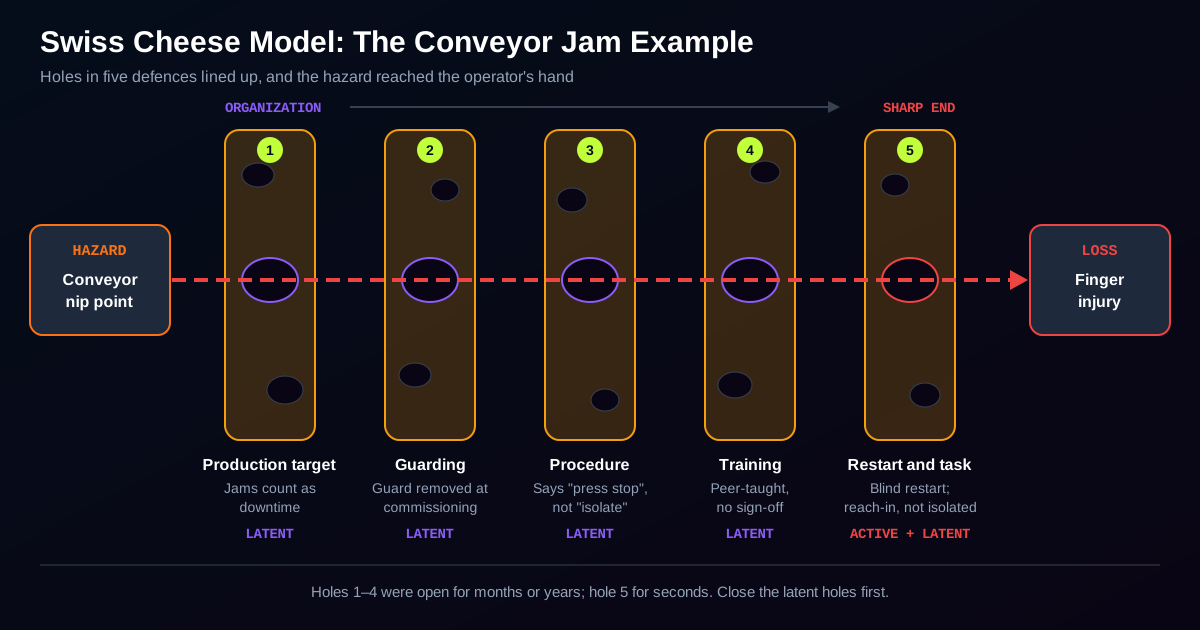
| # | Slice (defence) | Hole found | Evidence | Type | Open since |
|---|---|---|---|---|---|
| 1 | Production planning | Jam stops count as downtime against the line's hourly target; operators are expected to clear jams "within a minute" | Shift KPI board, supervisor interview | Latent (organizational) | Since the KPI was introduced, 18 months |
| 2 | Machine design and guarding | No guard at the transfer point; the original interlocked guard was removed during commissioning to make jam clearing faster | Commissioning photos, no management of change record | Latent (design) | Since commissioning, 3 years |
| 3 | Procedure | Jam-clearing instruction says "press local stop"; the LOTO procedure covers planned maintenance only | Document review | Latent (procedure) | Since the procedure was written |
| 4 | Training and supervision | Operator learned jam clearing from a colleague in week 1; no competence sign-off; supervisor had seen it done this way many times | Training records, interviews | Latent (training, supervision) | Since the operator started; same for 3 other operators |
| 5 | Restart control and the task itself | The line could be restarted from a panel with no view of the transfer point; no warning before restart; the operator reached in with the line stopped but not isolated, and the colleague restarted without checking | Panel layout, witness statements | Active (two people) plus latent (control design) | Seconds |
Two things stand out. First, only slice 5 contains active failures, and even there the restart was possible because of a design decision. Second, slices 1 to 4 had been open for months or years. On any shift, an operator clearing a jam had only the colleague at the panel between their hand and the roller. The incident was the day that last slice failed too.
A mitigation slice also belongs in the analysis. In this example the emergency stop pull-cord was within reach and first aid arrived in four minutes. Both worked. Record them, because they limited the loss.
Turning Holes Into Corrective Actions
Every hole should become an action that removes or narrows it, and the strongest actions target the latent conditions, not the person who made the last error. Ranking each action against the hierarchy of controls shows at a glance whether the plan relies on people being careful.
| Hole | Corrective action | Hierarchy level | Owner | Also check |
|---|---|---|---|---|
| No guard at transfer point | Fit a fixed or interlocked guard with a jam-clearing access door that stops and holds the drive when opened | Engineering | Maintenance manager | All conveyor transfer points on site |
| Guard removed with no MOC | Make guard removal a management of change trigger; add guards to the monthly inspection | Administrative (system) | HSE manager | Other machines commissioned by the same contractor |
| Jam-clearing instruction says "press stop" | Rewrite: jam clearing through the guard door, or isolation under lockout tagout if the guard must be opened | Administrative | Production engineer | Every "minor servicing" instruction |
| Peer-to-peer training, no sign-off | Competence check for jam clearing before working alone; retrain the 3 other operators | Administrative | Production manager | Other tasks taught on the job |
| Restart from a panel with no view | Restart permitted only from a station with a view of the area, plus an audible and visual warning before start-up | Engineering | Controls engineer | Other lines with remote restart |
| Jam stops count against hourly target | Remove jam time from the operator KPI; track jam frequency as an equipment problem | Organizational | Operations director | Other KPIs that reward speed over safe stops |
Notice what is not in the table: "retrain the injured operator" and "disciplinary warning." The injured operator did what the system had taught everyone to do. Track the actions through your corrective action (CAPA) process and check that each one actually closed its hole, for example by observing a jam being cleared after the changes.
Swiss Cheese vs Bow-Tie, HFACS and Root Cause Analysis
The Swiss cheese model is a way of thinking about defences; bow-tie, HFACS and RCA tools are methods that put that thinking into a structure. They work together rather than compete.
| Swiss cheese model | Bow-tie analysis | HFACS | RCA tools (5 Whys, fishbone, SCAT) | |
|---|---|---|---|---|
| What it is | Conceptual model of how layered defences fail | Diagram of threats, a top event, consequences and the barriers on each path | Classification of human factors into four levels built on Reason's model | Structured questioning to find causes |
| Used mainly | Explaining and organizing findings, before and after events | Before events, to plan and audit barriers | After events, to code and compare human factors across incidents | After events |
| Output | A slice-by-slice picture of holes | A barrier register per threat | Coded causal factors | Root causes and actions |
| Strength | Moves the report from blame to system | Shows which barrier belongs to which threat | Consistent categories for trend analysis | Depth on each cause |
| Weakness | Does not tell you how to find the holes | Can become a static picture | Needs trained coders | Can stop at one cause |
Bow-tie analysis is the closest relative: its barriers are the slices, and its degradation factors are the latent conditions that open holes in them. HFACS, developed by Scott Shappell and Douglas Wiegmann and described in a report for the US Federal Aviation Administration, turns Reason's layers into four levels: unsafe acts, preconditions for unsafe acts, unsafe supervision and organizational influences (Shappell and Wiegmann, FAA report DOT/FAA/AM-00/7, 2000). Those are the four levels people usually mean when they ask about "the four layers of the Swiss cheese model."
A practical combination: run the investigation with your normal RCA method, then draw the Swiss cheese picture to check that you found a hole in every defence and that most of your actions sit on the latent side.
Limits and Criticism of the Swiss Cheese Model
The Swiss cheese model is widely used and widely criticized, and both are fair. Knowing the criticism makes you use it better.
The critics. Nancy Leveson presents the model as "little more than a modified version of the domino model", which in her view shares the domino model's limits: a linear chain of events and an over-emphasis on humans as the cause of accidents (summary of Leveson's "Safety III", Patientsikkerhed 2020). She proposes her own model, STAMP, as an alternative. Sidney Dekker is the other well-known critic of Reason's work. Others point out that "hole" is vague, which Perneger's survey supports.
The defence. Reason and colleagues reviewed the model's strengths and limits themselves in a 2006 EUROCONTROL note, stating that it is not without drawbacks (Reason, Hollnagel and Paries, 2006). Andrew Hopkins examined Leveson's and Dekker's criticisms and argued that they have little merit (Hopkins, ANU, 2023). Larouzée and Le Coze concluded that the model "remains a relevant model because of its systemic foundations and its sustained use in high-risk industries."
What this means in practice:
- Use it as a frame, not a method. It tells you to look at every defence; it does not tell you how to find causes. Pair it with an RCA method.
- Do not read it as a straight line. Holes interact. In the conveyor example the KPI (slice 1) widened the training hole (slice 4), because nobody had time to train properly. Write those links down.
- Keep the latent conditions organizational. If most of your holes are about the worker, you have used the picture with person-approach thinking.
- Use it before incidents too. Reason's point about latent conditions is that they can be found before an event. Walk a task and ask, for each defence, "where is the hole today?"
Common Mistakes When Using the Swiss Cheese Model
1. Stopping at the last slice
The report draws five slices and then puts all the actions on the operator. The model has been drawn but not used. Every latent hole stays open for the next person.
2. Vague holes
"Poor safety culture" or "lack of awareness" cannot be evidenced, owned or closed. A hole must be specific enough that someone can check next month whether it is still there.
3. Treating the slices as fixed
Holes open and close: a guard is removed for one job, a supervisor is on leave, a night shift has no second person. An analysis that only looks at the written system misses the holes that exist on the day.
4. Leaving out mitigation slices
Defences that limit the harm (emergency stops, first aid, emergency response) are slices too. If they worked, record them. If they did not, the same incident could have been worse.
5. Adding slices instead of closing holes
Another procedure, another sign-off, another layer of PPE: each extra slice built on the same weak foundation has the same holes. Closing the latent condition, such as the missing guard, does more than three new administrative layers.
6. Using it only after accidents
Near misses and inspections show the same holes before anyone is hurt. A near-miss report is often the first sign that slices are already lined up.
How FindRisk Supports Swiss Cheese Investigations
FindRisk helps you collect the evidence for each slice on site. Ask the AI to build an investigation or inspection checklist for the area (for example, "conveyor jam clearing, packaging line") and walk it with the team. Photograph each defence, from the guard to the restart panel, mark the hole directly on the photo and get an AI analysis of what the image shows.
Each hole can be scored with the Fine-Kinney method, so you can show which latent conditions carry the highest risk across the site, not only on the line that had the incident. FindRisk then turns the findings into a professional report in seconds, ready to attach to the investigation file. It runs on iOS and Android.
Frequently Asked Questions
Who created the Swiss cheese model?
James Reason, a psychologist at the University of Manchester, developed the model. Its foundations are in his 1990 paper on latent human failures and his book Human Error, and it was refined in Managing the Risks of Organizational Accidents (1997). His short 2000 BMJ paper, "Human error: models and management", is the version most people cite. Reason died in 2025, and the model is still used in aviation, healthcare, engineering and process safety.
What are the 4 levels of the Swiss cheese model?
The four levels most often quoted are organizational influences, unsafe supervision, preconditions for unsafe acts and unsafe acts. They come from HFACS, which Shappell and Wiegmann built on Reason's model and described in a 2000 report for the US Federal Aviation Administration. Reason's own picture does not fix the number of slices. In a workplace investigation, use as many slices as there were real defences, from design and procedures to supervision and the worker's own checks.
What is the difference between active failures and latent conditions?
Active failures are unsafe acts by people in direct contact with the system, such as an operator reaching into a running machine; their effect is immediate and usually short-lived. Latent conditions are weaknesses built into the system by earlier decisions, such as a guard removed during commissioning or a production target that rewards speed. They can lie dormant for years, and they are the holes that must be closed to stop recurrence.
How is the Swiss cheese model different from the domino theory?
Domino-style models explain an accident as a single linear chain of events, so removing one link stops the sequence. The Swiss cheese model describes several independent defences whose weaknesses line up, and it puts most of the causes in the organization rather than in the worker. Critics such as Leveson argue that the model is still too close to a linear chain; supporters such as Hopkins disagree.
Is the Swiss cheese model still valid?
Yes, as a way of thinking about layered defences, provided you use it with care. It is criticized for being vague about holes and for implying a linear sequence, and Reason and colleagues reviewed its limits themselves in 2006. A 2020 review in Safety Science concluded it remains relevant because of its systemic foundations and its continued use in high-risk industries. Pair it with a structured investigation method.
Can you use the Swiss cheese model before an accident happens?
Yes. Reason's argument about latent conditions is that they exist before an event and can be found and fixed in advance. On an inspection or a task review, list the defences for one hazard and ask where each one is weak today. Near-miss reports are especially useful, because a near miss shows that several slices were already lined up and only the last one held.
Conclusion
The Swiss cheese model explains why serious incidents are rarely one person's fault: several defences had holes, and on one day the holes lined up. Its real value is not the picture but the questions it forces, one for each defence that should have stopped the harm. Used that way, it moves an investigation from "operator error" to the guards, procedures, training, supervision and targets that made the error possible.
Keep slices concrete, write every hole as evidence with an owner, put most of your actions on the latent conditions, and look for the same holes elsewhere before they line up again. Use it with a root cause method and a bow-tie where you need structure, and keep in mind what its critics say about linear thinking.
Download FindRisk to photograph each defence on site, mark the holes, score them with Fine-Kinney and turn your investigation into a report in seconds.
Try FindRisk
Ready to modernize your safety workflow?
Conduct AI-powered risk assessments, generate reports instantly, and keep your team safe — anywhere, anytime.