
Unsafe Acts and Unsafe Conditions: 30 Examples and Fixes
An unsafe act is something a person does, or fails to do, that raises the chance of harm, such as removing a machine guard or skipping lockout. An unsafe condition is a state of the workplace, equipment or environment that can cause harm, such as a missing guard or a blocked exit. Most incidents involve both.
The two terms appear on almost every observation card, inspection form and incident report. They are also one of the first things a new safety officer learns. Yet the split is often used badly: as a way to decide who is to blame, or as a statistic ("88% of accidents are caused by unsafe acts") that nobody can trace back to its data.
This guide gives you the clean definitions, a three-question test for classifying what you see, 30 field examples with the control that fixes each one, the hard cases that confuse even experienced inspectors, and a method for turning an observation into a finding that actually gets closed.
A Grinder, a Missing Guard and Two Different Reports
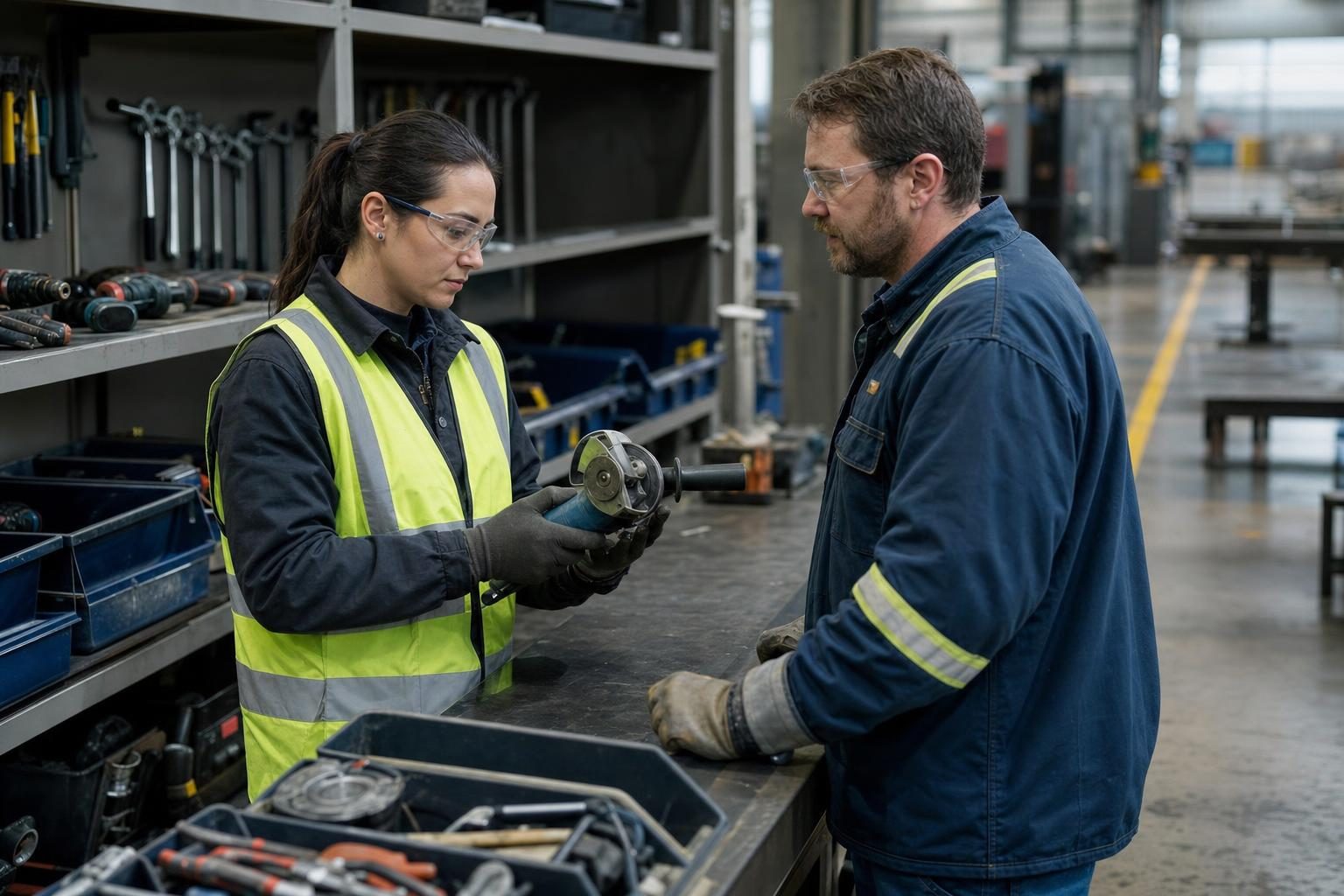
Consider a fictional example. In a fabrication shop, a maintenance technician is cutting a bracket with an angle grinder. The grinder has no guard. A spark burns through a glove, and the technician gets a minor burn.
The supervisor's report reads: "Technician used grinder without guard. Unsafe act. Retrain and issue a warning."
The safety specialist goes to the tool crib and writes a different report. Three of the five grinders have no guard, and there are no spare guards in stores. The bracket sits in a tight corner where a guarded grinder does not fit, and the job had to be finished before a shift handover. The technician had done it this way for months, and so had others.
Both reports are "true." Only one of them leads to a fix. The first removes one person from the problem until the next one picks up an unguarded grinder. The second finds an unsafe act, two unsafe conditions (unguarded tools, no spares) and the reasons behind them (no guard check in the tool crib, a task that does not suit the tool, time pressure). The rest of this guide shows you how to write the second kind of report every time.
What Are Unsafe Acts and Unsafe Conditions?
An unsafe act is a behavior, an action or an omission by a person that departs from a safe way of working and increases the likelihood of harm. An unsafe condition is a physical or environmental state of the workplace, its equipment or its materials that can cause harm if it is left uncorrected.
| Unsafe act | Unsafe condition | |
|---|---|---|
| What it is | Something a person does or fails to do | A state of the workplace, equipment, materials or environment |
| Also called | Unsafe behavior, at-risk behavior | Hazardous condition, physical hazard |
| Time frame | Happens at a moment and is often gone when you arrive | Persists until someone changes it |
| Typical evidence | Direct observation, interview, video | Photo, measurement, inspection record |
| Examples | Bypassing an interlock, not wearing issued eye protection, standing under a suspended load | A missing guardrail, a damaged cable, an unlabeled chemical container |
| Usual weak fix | Retraining, warning, poster | PPE, warning sign |
| Usual strong fix | Remove the reason for the act (design, tools, time, staffing) | Eliminate or engineer out the hazard |
The terms come from early 20th-century accident prevention, and they have a long history in safety training. Modern human factors work keeps the term "unsafe act" but treats it differently. In his widely cited paper Human error: models and management (BMJ, 2000), psychologist James Reason calls unsafe acts "active failures" committed by people "in direct contact with the patient or system." He sets them beside latent conditions: weaknesses that "arise from decisions made by designers, builders, procedure writers, and top level management." Reason notes that "nearly all adverse events involve a combination of these two sets of factors."
That is the key idea of this guide. Classifying an observation as an act or a condition is a useful first step. It is never the end of the analysis.
How to Classify an Observation: Three Questions
Use three questions, in this order, for anything you see on a walk or an inspection.
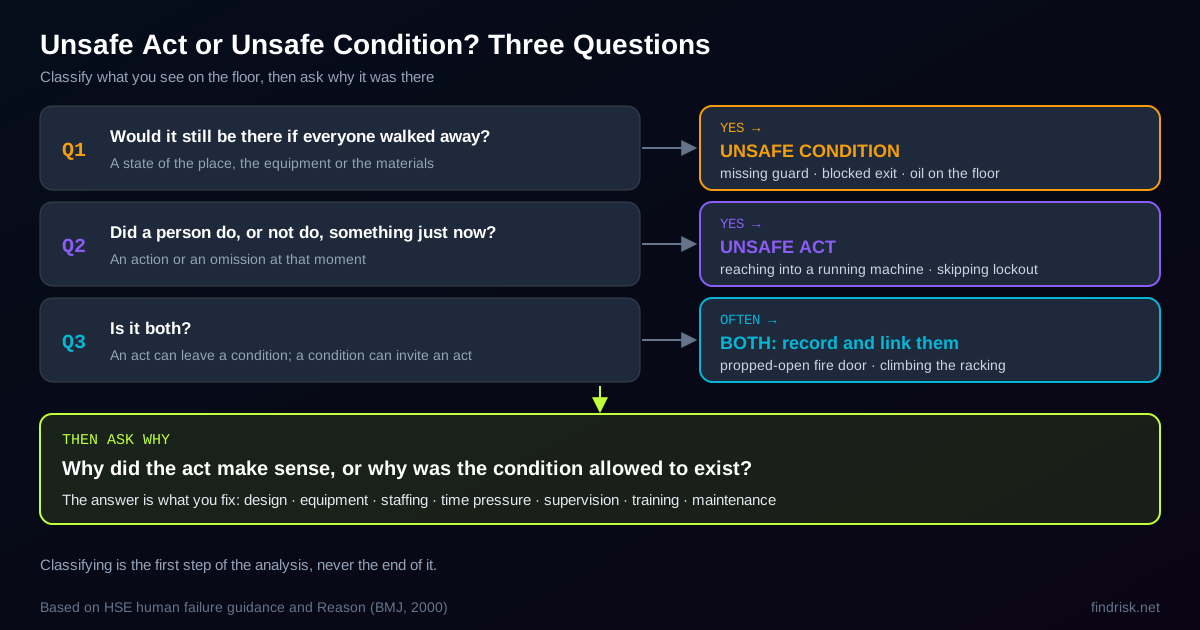
- Would it still be there if everyone walked away? If yes, it is an unsafe condition: a missing guard, a blocked exit, a frayed cable, a puddle of oil. Photograph it and record where it is.
- Did a person do something, or fail to do something they should have done, at that moment? If yes, it is an unsafe act: reaching into a running machine, walking under a load, not using the lockout lock that hangs on the panel.
- Is it both? Very often it is. An act can create a condition (someone props open a fire door), and a condition can invite an act (no ladder nearby, so people climb the racking). Record both and link them.
Then ask the question that matters most: why did this make sense to the person at the time, or why was this condition allowed to exist? The answer points to the upstream causes: design, equipment, staffing, time pressure, supervision, training, maintenance routines. Those are what you fix.
30 Examples of Unsafe Acts and Unsafe Conditions
The table below lists typical observations from field inspections, grouped by work area. For each one it gives the classification, the question to ask, and the control that removes the reason, using the hierarchy of controls. These are illustrative examples, not statistics.
Machinery and hand tools
| # | Observation | Act or condition | Question to ask | Control that fixes it |
|---|---|---|---|---|
| 1 | Operator reaches past the guard to clear a jam while the machine runs | Act | How often does it jam, and is there a safe, quick way to clear it? | Engineering: interlocked access, jam-clearing tool; fix the cause of the jams |
| 2 | Fixed guard missing from a belt drive | Condition | Who removed it, and why was it not refitted after maintenance? | Engineering: refit; guard check before maintenance sign-off |
| 3 | Angle grinder used without its guard | Act and condition | Are guards available, and does the guarded tool fit the task? | Substitution: a tool that fits the space; stock spare guards |
| 4 | Door interlock defeated with tape or a spare actuator | Act (violation) | What access or production problem does the bypass solve? | Engineering: tamper-resistant interlock; solve the access need |
| 5 | Chisel with a mushroomed head in the toolbox | Condition | Is there a routine for inspecting and replacing hand tools? | Administrative: tool inspection and quarantine routine |
Electrical
| # | Observation | Act or condition | Question to ask | Control that fixes it |
|---|---|---|---|---|
| 6 | Extension cable runs across a walkway | Condition | Why is there no socket where the work is done? | Engineering: install an outlet or a cable route |
| 7 | Electrician works on a panel without locking out "because it's only five minutes" | Act (violation) | Are locks at hand, is the procedure workable, was there time pressure? | Administrative and supply: lockout kits at the panel, supervisor backing |
| 8 | Panel door left open with live parts exposed | Condition (left by an act) | Does the door close properly, and who works in this panel? | Engineering: repair the door, lockable panel |
| 9 | Damaged extension cord still in use | Act and condition | Is there a pre-use check and a place to tag out damaged equipment? | Administrative: pre-use check, tag-out and replace |
Work at height
| # | Observation | Act or condition | Question to ask | Control that fixes it |
|---|---|---|---|---|
| 10 | Guardrail section removed from a mezzanine edge | Condition | Was it removed for a delivery, and why was it not replaced? | Engineering: a gate that closes by itself instead of a removable rail |
| 11 | Worker climbs pallet racking to reach a box | Act | Is there a suitable ladder or platform nearby? | Substitution: a mobile platform at the location |
| 12 | Harness worn but lanyard not attached | Act | Is there an anchor point at the actual work position? | Engineering: install anchors or a guardrail |
| 13 | Ladder with a cracked stile in the store | Condition | Who inspects ladders, and how are damaged ones removed? | Administrative: ladder register and removal from use |
| 14 | Floor opening without a secured cover | Condition | Who opened it, and who owns closing it? | Engineering: fixed, marked cover or guardrail |
Vehicles and warehouse
| # | Observation | Act or condition | Question to ask | Control that fixes it |
|---|---|---|---|---|
| 15 | Forklift driven fast through a pedestrian aisle | Act | Are drivers under throughput pressure? Is speed monitored? | Engineering: speed limiters, segregated routes |
| 16 | No marked pedestrian route at the loading dock | Condition | How do people actually move through the dock? | Engineering: barriers and marked crossings |
| 17 | Racking upright bent by an impact | Condition | Was it reported? Is there a damage reporting routine? | Engineering and administrative: offload, inspect, column guards |
| 18 | Pedestrian walks behind a reversing truck | Act | Are walkways clear, and do people know the reversing area? | Engineering: exclusion zone, banksman for reversing |
| 19 | Pallet stacked above its marked height | Act and condition | Is there enough floor space for the stock? | Administrative: storage limits and space planning |
Housekeeping and fire
| # | Observation | Act or condition | Question to ask | Control that fixes it |
|---|---|---|---|---|
| 20 | Fire exit blocked by stored boxes | Condition (created by an act) | Where else could the boxes go? | Administrative: marked no-storage zone, storage space |
| 21 | Oil on the floor with no barrier or absorbent | Condition | Where does the oil come from? | Engineering: repair the leak, drip tray; spill kit nearby |
| 22 | Smoking next to a flammable liquids store | Act | Is there a designated smoking area, and is it reasonable to reach? | Administrative: designated area, enforcement |
| 23 | Fire extinguisher missing from its bracket | Condition | Was it used and not replaced, or taken elsewhere? | Administrative: monthly check, replacement process |
| 24 | Poor lighting in a stairwell | Condition | Is the fault reported, and who replaces lamps? | Engineering: repair lighting, maintenance schedule |
Chemicals, health and PPE
| # | Observation | Act or condition | Question to ask | Control that fixes it |
|---|---|---|---|---|
| 25 | Safety glasses not worn at a grinding station | Act, if suitable glasses were provided | Do they fit, fog or clash with prescription lenses? | Engineering: screen at the wheel; better-fitting eyewear |
| 26 | No gloves suited to the solvent in use | Condition | Was the glove selected against the safety data sheet? | Substitution: less hazardous solvent; correct glove in stock |
| 27 | Unlabeled container of decanted chemical | Condition (created by an act) | Why decant, and are labeled containers available? | Administrative: labeled dispensers, no unlabeled decanting |
| 28 | Eating in an area where lead or chemicals are handled | Act | Is there a clean rest area within reasonable reach? | Administrative: clean rest area, hygiene rules |
| 29 | Local exhaust ventilation switched off "because it is noisy" | Act | Is the extraction too loud or badly positioned? | Engineering: quieter, better-placed extraction |
| 30 | Worker lifting a heavy drum alone | Act | Is a drum handling aid available at the point of use? | Engineering: drum trolley or lifter |
Two patterns stand out. First, six of the 30 rows are "act and condition" or "condition created by an act," and many single-label rows hide the other half (row 1 is an act, but frequent jams are a condition). A strict either/or split is misleading. Second, two thirds of the fixes are engineering, substitution or design changes, and retraining appears nowhere in the "fixes it" column, because training alone rarely removes the reason for an act.
The Hard Cases: PPE, Guards, Spills and Shortcuts
Some observations sit on the line between the two categories. Here is how to handle the six that cause most debate.
1. PPE not worn. It is an unsafe act only if suitable PPE was provided, fitted and explained. In the US, OSHA's PPE standard 29 CFR 1910.132 requires PPE to be "provided, used, and maintained" where it is necessary, requires the employer to assess hazards (paragraph (d)(1)) and train each user (paragraph (f)(1)), and, with listed exceptions, requires required PPE to be "provided by the employer at no cost to employees" (paragraph (h)(1)). If the right PPE was not available, did not fit, or was broken, the observation is an unsafe condition. Often it is both: the glasses were issued, but they fog in a hot area. For the selection side, see our PPE hazard assessment guide.
2. Guard removed. Removing the guard is an act. The machine running without it is a condition. Record both, because the condition stays after the person who removed the guard has gone home.
3. A spill. The spill is a condition. Walking past it without barriers or a report is an act. The leaking valve or the overfilled container behind it is the condition you actually need to fix.
4. A shortcut through a hazardous area. Taking the shortcut is an act. A walkway that adds five minutes to every trip is the condition that invites it. People choose the path of least effort, so design the safe path to be the easy one.
5. A tired worker. Fatigue is neither a neat act nor a neat condition. Treat it as a condition of the work organization. Reason lists "time pressure, understaffing, inadequate equipment, fatigue, and inexperience" as error-provoking conditions in the workplace. Look at shift patterns, overtime and staffing before you look at the individual.
6. Horseplay. This is clearly an unsafe act, and it should be stopped on the spot. Still ask why it happened in that place: lack of supervision, boredom on a monotonous task, or a culture where it is tolerated.
Where Does "88% of Accidents Are Caused by Unsafe Acts" Come From?
The figure comes from Herbert W. Heinrich's book Industrial Accident Prevention, first published in 1931. According to an article by Dave Rebbitt in Professional Safety, the journal of the American Society of Safety Professionals, Heinrich "used incident data collected from an insurance company" and claimed "that 88% of incidents were caused by the unsafe acts of people, 10% were caused by unsafe conditions and 2% were not preventable" (Pyramid Power, September 2014).
There are three reasons not to repeat it:
- The data is gone. Rebbitt writes that "Heinrich's original work and data are not available and no one has been able to verify or categorically refute his findings." Yet the figure "has been elevated from concept to often quoted fact" and has "even been rounded up to 90%."
- The split depends on who fills in the box. A single incident usually has both an act and a condition. Whoever writes the report decides which one goes in the "cause" field, so a percentage of acts versus conditions mostly measures the habits of the people writing reports.
- Current guidance points the other way. The UK Health and Safety Executive (HSE) says that "human failure contributes to almost all accidents" and that "human failure is normal and predictable. It can be identified and managed" (Managing human failures). If people are involved in almost every accident, "act or condition?" has the answer "both," and the useful question becomes how the work was set up.
The practical risk of the 88% figure is that it pushes organizations toward what Reason calls the person approach, whose countermeasures include "poster campaigns," "writing another procedure," "disciplinary measures," "retraining, naming, blaming, and shaming." His alternative is blunt: "though we cannot change the human condition, we can change the conditions under which humans work."
Why Unsafe Acts Happen: Errors, Violations and the Conditions Behind Them
HSE divides human failure into two types. A human error is "an action or decision which was not intended." A violation is "a deliberate deviation from a rule or procedure." Each type needs a different fix, which is why "retrain" is so often the wrong answer.
| Type | What it looks like | Example | What works |
|---|---|---|---|
| Slip | Action not as planned on a familiar task | Pressing the wrong button | Better design; HSE: "These cannot be eliminated by training" |
| Lapse | Forgetting a step | Forgetting to refit a guard after maintenance (row 2) | Better design, backed by checklists and sign-off steps |
| Mistake | Doing the wrong thing, believing it is right | Choosing the wrong glove for a solvent (row 26) | "Training based on good procedures" |
| Violation | Deliberately not following the rule, usually to get the job done | Skipping lockout (row 7), defeating an interlock (row 4) | Remove the reason ("designing violations out") and increase detection |
HSE notes that violations "usually result from an intention to get the job done as efficiently as possible," and that "mistakes resulting from poor training ... are often mistaken for violations." Before you call something a violation, confirm the person knew the rule and had what they needed to follow it.
To find the conditions behind an act, ask these five questions at the scene, in a neutral tone:
- What were you trying to get done?
- Is this how the job is usually done? By others too?
- What would the safe way have cost you: time, effort, a tool you did not have?
- Was anything different today: staffing, deadlines, equipment, weather?
- What would make the safe way the easy way?
The answers usually reveal a condition you can fix. OSHA makes the same point about incident investigation: it is "far too easy, and often misleading, to conclude that carelessness or failure to follow a procedure alone" caused an incident, and investigations should focus "on identifying and correcting root causes, not on finding fault or blame" (OSHA Incident Investigation). When an act leads to an incident, take it through a proper root cause analysis.
From Observation to Finding: Recording and Fixing Both
An observation helps nobody until it becomes a finding with an owner and a date. Use the same four-part structure for acts and conditions.
- What you saw. Location, time, a photo for conditions, a neutral description for acts. Write "lockout not applied during panel work," not "careless electrician."
- The requirement. The procedure, standard or rule that applies.
- The consequence. What could happen, and to whom. Score it with your usual risk method so it is prioritized correctly.
- The action. The control that removes the reason, at the highest practical level of the hierarchy, with an owner and a due date.
Here is the grinder example from the start, written as two linked findings:
| Finding A (condition) | Finding B (act) | |
|---|---|---|
| What | 3 of 5 angle grinders in the tool crib have no guard; no spare guards in stores | Grinder used without guard to cut bracket in corner bay; guarded grinder does not fit the space |
| Requirement | Manufacturer's instructions; site tool rules | Site tool rules; task method statement |
| Consequence | Contact with disc, disc burst, burns from sparks | Same, plus a habit that others copy |
| Action | Quarantine unguarded grinders; buy spare guards; add guard check to weekly tool-crib inspection. Owner: maintenance lead, 7 days | Review task method: smaller guarded tool or a different cutting method for corner bay. Owner: production supervisor, 14 days |
If the situation you see is about to hurt someone, stop the work first and make it safe. The paperwork comes after.
Two more practical rules. For unsafe acts seen during observation programs, keep the data free of names so people keep talking to you; an open reporting culture depends on it, and our safety culture assessment guide shows how to measure it. And treat recurring acts and conditions as signals in the same way as near misses: the same observation three times in a month is a system problem, not three individual ones.
To track each action until it is closed and verified, see our corrective action (CAPA) guide.
Common Mistakes
1. Stopping at "worker error"
The report names the act and ends. Nothing about the work changes, so the next person makes the same act. HSE's advice is that investigations "should seek to identify why individuals have failed rather than stopping at 'operator error'."
2. Quoting the 88% figure as fact
It has no surviving data behind it, and it biases every investigation toward the person. Use your own incident data, analyzed for both acts and conditions, if you need numbers.
3. Answering every act with retraining
Training fixes mistakes caused by missing knowledge. It does not fix slips and lapses, and it does not fix violations driven by time pressure or poor tools. Match the fix to the type of failure.
4. Recording only conditions
Conditions are easy to photograph and do not require an awkward conversation. An inspection that never records acts misses how the work is really done.
5. Naming people in observation data
When an observation becomes a disciplinary record, people stop doing the job in front of observers and stop reporting. You lose the information you need.
6. Using PPE or a sign as the fix for every condition
A sign next to a missing guardrail does not stop a fall. PPE and warnings are the last level of the hierarchy, for the risk that remains after the higher controls.
How FindRisk Supports Hazard Observations
FindRisk is built for the person doing the inspection. On your phone (iOS and Android), you can generate an inspection checklist with AI for the area you are walking, so both conditions and the way work is being done get looked at.
During the walk, take a photo of each observation and mark the hazard directly on the image. FindRisk's AI photo analysis suggests possible hazards you might have missed, and you can score each finding with the Fine-Kinney method, so a blocked fire exit and a loose floor tile do not get the same priority.
When you finish, FindRisk produces a professional report in seconds. You still decide how each finding is worded, so the four-part structure above, with the act, the condition and the reason behind them, carries straight into the report.
Frequently Asked Questions
Is not wearing PPE an unsafe act or an unsafe condition?
Not wearing PPE is an unsafe act when suitable, well-fitting PPE was provided and the person was trained to use it. If the PPE was not provided, did not fit, was damaged or was unsuitable for the task, the observation is an unsafe condition. In practice it is often both, for example glasses that were issued but fog up in a hot area. Record what you found and fix the reason.
Which causes more accidents, unsafe acts or unsafe conditions?
There is no reliable answer, because most accidents involve both. The often-quoted split of 88% acts, 10% conditions and 2% unpreventable comes from Heinrich's 1931 book, and his data no longer exists. HSE states that human failure contributes to almost all accidents, which means the useful question is not which category wins but which conditions made the act likely.
Is horseplay an unsafe act?
Yes. Horseplay, such as pushing, racing equipment or playing with compressed air, is a deliberate unsafe act and should be stopped immediately. It is still worth asking why it happens in that area: a lack of supervision, monotonous work, or a culture where it has been tolerated. Fixing those reduces repeat behavior more than a single warning does.
Who is responsible for correcting unsafe conditions?
The employer is responsible for providing a safe workplace and for correcting unsafe conditions, usually through the line manager who controls the area or equipment. Workers are expected to report the conditions they find and not to create new ones. Turkish Law No. 6331, Article 4(3), for example, states that workers' duties do not affect the employer's responsibilities, so a condition stays the employer's problem even when a worker created it.
What should a worker do when they see an unsafe act or condition?
If someone is about to be hurt, stop the work and make the situation safe if you can do so without danger. Then report it to the supervisor or through the site's reporting system, with the location and, for conditions, a photo. For acts, a short, respectful conversation at the time usually works better than a report alone. Reporting should never lead to blame for the person who reports.
What is the difference between an unsafe condition and a hazard?
A hazard is anything with the potential to cause harm, such as electricity, a moving machine or a chemical. An unsafe condition is a hazard that is not adequately controlled at that moment, such as an exposed live terminal or a machine running without its guard. A well-guarded machine is still a hazard, but it is not an unsafe condition.
Can an unsafe act create an unsafe condition?
Yes, and it happens all the time. Propping open a fire door, leaving a guard off after maintenance or storing boxes in front of an exit are acts that leave a condition behind. Record both: the condition so it is corrected now, and the act so you can find out why it made sense to the person and stop it from recurring.
Conclusion
Unsafe acts and unsafe conditions are a useful way to describe what you see on the floor. An act is what someone did or did not do; a condition is the state of the place, the equipment or the materials. Most real situations contain both, and the most common classification errors come from forcing a choice between them.
The value of the distinction lies in what you do next. Ask why the act made sense and why the condition was allowed to exist, write it up as a finding with a requirement, a consequence and an owner, and fix it at the highest level of control you can. Leave the 88% figure in the history books.
Download FindRisk to photograph, mark and score your next round of observations, and turn them into a report your team can act on the same day.
Try FindRisk
Ready to modernize your safety workflow?
Conduct AI-powered risk assessments, generate reports instantly, and keep your team safe — anywhere, anytime.