

Heinrich Domino Theory: 5 Dominoes, Bird's Update and Limits
Heinrich's domino theory is an accident causation model, set out by H. W. Heinrich in his 1931 book Industrial Accident Prevention, that describes an injury as the last of five factors falling in sequence: ancestry and social environment, fault of person, unsafe act or mechanical hazard, the accident, and the injury. Remove one domino and the injury does not happen.
The model is almost a century old and still appears in safety courses, exam syllabuses and investigation forms. Its picture is simple and memorable. Its weak points are just as real: the figures usually quoted with it cannot be checked, and a domino chain pushed to its conclusion tends to end with the worker. This guide sets out what Heinrich actually proposed, how Frank Bird updated it, where the evidence fails, and what is still worth keeping, using one incident read through each model.
One Loading Dock, Three Explanations
The following case is fictional, built to show how each model shapes an investigation.
At a distribution warehouse, the shortest way from the stock office to the loading dock crosses the area where forklifts turn and reverse. There is no marked walkway. A stock checker with four months in the job walks across while reading a handheld scanner. A counterbalance forklift reverses out from behind a rack end, its blue warning light broken for three weeks; the defect was ticked twice on the daily pre-use check, but no repair was ordered. The rear wheel runs over the checker's foot and fractures it. Two trucks were waiting at the dock and the shift was behind schedule.
Three investigators look at the same facts:
- The first uses Heinrich's dominoes and finds an inattentive worker who walked behind a reversing forklift.
- The second uses Bird's loss causation sequence and finds missing management controls: no traffic plan for the dock and a defect report that went nowhere.
- The third uses a systems view and asks why crossing there made sense, finding a layout that sends people through the turning area, a task that makes them look down while walking, and a schedule that rewards speed.
All three are describing the same event. The actions they recommend are very different, and that difference is the reason the choice of model matters.
What Is Heinrich's Domino Theory?
The domino theory is a sequential, or chain-of-events, model: it treats an accident as a linear sequence in which each factor triggers the next. Heinrich's first axiom states it directly: "The occurrence of an injury invariably results from a completed sequence of factors – one factor being the accident itself" (quoted in Safety+Health, 2011).
| Domino | Heinrich's label | How a modern review reads it |
|---|---|---|
| 1 | Ancestry and social environment | Conditions outside the person's control that limit how they can perform, such as poor access to education |
| 2 | Fault of person | Characteristics of the person that contributed, such as forgetfulness |
| 3 | Unsafe act or mechanical or physical hazard | The unsafe act or unsafe condition |
| 4 | The accident | The event itself |
| 5 | The injury | The effect of the accident |
The right-hand column follows the 2025 review cited below.
The prevention logic follows from the picture. As a 2025 review in the Journal of Applied Clinical Medical Physics puts it, "taking away any of the dominos, is the key to accident prevention" (Wong and Pawlicki, 2025). The same review notes that "except for the first domino, the other four dominos in this model primarily target the person as the cause of accidents."
In practice, the third domino gets most of the attention because it is the only one a supervisor can see and act on during a shift. That is also where the model's trouble starts, as later sections show.
Where the Theory Came From: Heinrich, Travelers and the 1931 Book
Herbert W. Heinrich worked for the Travelers Insurance Company in Hartford, Connecticut. His book Industrial Accident Prevention: A Scientific Approach was first published in 1931. Later editions followed, including a 1980 edition with Dan Petersen and Nestor Roos among its authors.
Three ideas from the book are still quoted:
- The domino sequence described above.
- The 88-10-2 ratio. Heinrich attributed 88% of accidents to "unsafe acts of persons," 10% to unsafe mechanical or physical conditions and 2% to unavoidable causes (Safety+Health, 2011).
- The accident triangle. "In a group of 330 accidents, 300 will result in no injuries, 29 will result in minor injuries and one will result in a major injury" (same source).
According to Safety+Health, Heinrich reviewed 75,000 cases, 12,000 from insurance records and 63,000 from plant managers. Dave Rebbitt, writing in Professional Safety, the journal of the American Society of Safety Professionals, adds that "Heinrich's original work and data are not available and no one has been able to verify or categorically refute his findings" (Rebbitt, 2014).
The model also reflects its time. Wong and Pawlicki connect its heavy focus on the person to the culture of the second industrial revolution, with its mass production and standardization.
Bird and Loftus: The Updated Domino Sequence
Frank E. Bird Jr. kept the chain but moved its starting point from the worker to management. Bird, who founded the International Loss Control Institute in 1974, set out the updated sequence with Robert Loftus in Loss Control Management (1976). In this loss causation model, the first domino is lack of management control. A tribute to Bird published in Professional Safety summarizes it: "The loss causation model showed how lack of control led to accident losses" (Germain and Clark, 2007, via DNV).
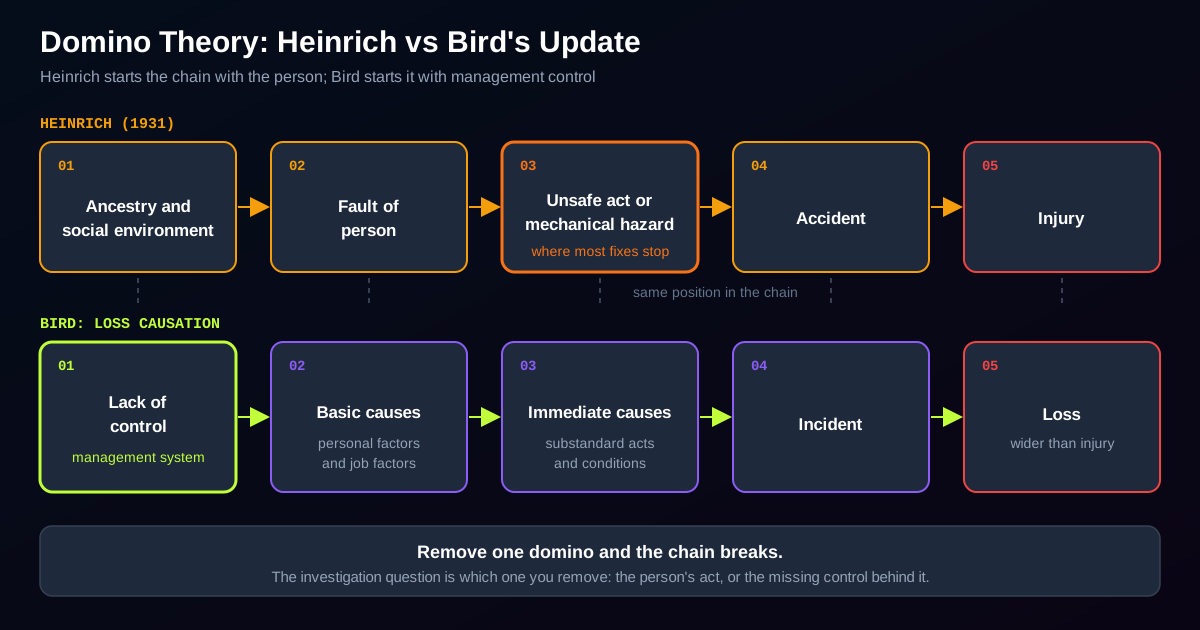
| Heinrich (1931) | Bird's loss causation sequence | What changed |
|---|---|---|
| Ancestry and social environment | Lack of control (management) | Start of the chain moves from the person's background to the management system |
| Fault of person | Basic causes: personal factors and job factors | Job factors, such as design and procedures, sit next to personal ones |
| Unsafe act or mechanical hazard | Immediate causes: substandard acts and conditions | Same domino, less loaded wording |
| The accident | Incident | Same event |
| The injury | Loss | Wider than injury alone |
Bird is also known for a 1:10:30:600 ratio. The same tribute says it came from a study at the Insurance Company of North America that analyzed 1,753,498 accidents reported by 297 companies. Like Heinrich's triangle, it describes frequencies, not causes, so it should not be read as proof that cutting minor events will cut fatal ones.
The update matters because it changes the questions an investigator asks. "Who made the mistake?" becomes "which control was missing, weak or not followed, and why?"
Reading the Loading Dock Incident Through Each Model
Here is the fictional loading dock case worked through each model, then the actions each reading produces.
Reading 1: Heinrich's dominoes
- Ancestry and social environment: nothing useful to record. A modern investigation does not examine a worker's family background, which shows how dated this domino is.
- Fault of person: "inattentive; looking at the scanner instead of the traffic."
- Unsafe act / mechanical hazard: walked behind a reversing forklift; the warning light was broken.
- Accident: foot run over by the rear wheel.
- Injury: fractured foot.
Remove domino 3 and the injury is prevented, so the actions target the act: retrain, warn, remind everyone at a toolbox talk, and repair the light.
Reading 2: Bird's loss causation sequence
- Lack of control: no traffic plan for the dock and no marked pedestrian route; defects found on pre-use checks had no route to a repair order; induction did not cover dock traffic rules.
- Basic causes: personal (four months in the job, never shown the dock rules); job (the only direct route crosses the turning area, a rack end blocks the driver's view, the scanning task is done on the move, trucks waiting at the dock).
- Immediate causes: the same act and condition as Reading 1.
- Incident: pedestrian struck by a reversing forklift.
- Loss: injury, lost time and a delayed dispatch.
Reading 3: a systems view
James Reason separates the person approach, which "focuses on the unsafe acts—errors and procedural violations—of people at the sharp end," from the system approach, which starts from the fact that "humans are fallible and errors are to be expected" (Reason, BMJ 2000). Read that way, the crossing was normal work, not an exception: everyone used that route because it was the only short one. The defenses (layout, segregation, the warning light, the defect loop, supervision) had been weak for weeks or longer, and the waiting trucks made speed feel like the right choice for both driver and checker. Those are latent conditions: present long before the injury, and fixable before the next one.
The actions each reading produces
| Action | Heinrich | Bird | Systems | Hierarchy of controls level |
|---|---|---|---|---|
| Retrain the checker, written warning | Yes | — | — | Administrative |
| Toolbox talk: never walk behind a forklift | Yes | Yes | — | Administrative |
| Repair the warning light | Yes | Yes | Yes | Engineering |
| Defects found on pre-use checks take the truck out of use until repaired | — | Yes | Yes | Administrative |
| Mark a walkway and a crossing point; add dock rules to induction | — | Yes | Yes | Administrative |
| Fit a mirror at the blind rack end | — | Yes | Yes | Engineering |
| Fixed barrier between the walkway and the turning area | — | — | Yes | Engineering |
| Move the office door or the route so pedestrians no longer cross the turning area | — | — | Yes | Elimination |
| Scan at fixed points, not while walking through traffic | — | — | Yes | Administrative |
| Track defect repair times and route breaches as leading indicators; review dock scheduling | — | — | Yes | Organizational |
The Heinrich reading is not wrong about the facts. It simply stops early, and every action except one sits at the weakest level of control. For the checks that keep a dock under control day to day, see the warehouse and logistics safety checklist.
What Heinrich Got Right
Heinrich deserves credit for several ideas that are now taken for granted:
- Injuries have causes before the event. Treating accidents as a sequence, rather than bad luck, made prevention a management task.
- Management carries the responsibility. His eighth axiom reads: "Management has the best opportunity and ability to prevent accident occurrence," and it should therefore assume the responsibility. Critics of his ratios often skip this part.
- Events without injury carry information. The triangle's lasting value is the attention it gives to precursors, which is the case for near miss reporting.
- Both acts and conditions belong in the picture. The third domino names both, even if the 88% claim pushed attention toward one of them.
Where the Domino Theory Fails
The data cannot be checked
The 88-10-2 and 300-29-1 figures rest on files that no longer exist. Safety+Health reports Fred Manuele's point in Heinrich Revisited (2002) that the original files Heinrich used do not exist, so nobody can review the work. Judith Erickson adds that Heinrich "used accident reports completed by supervisors," which means the cause attributed in each case was the supervisor's opinion. Rebbitt notes that the 88% figure "has been elevated from concept to often quoted fact" and has even been "rounded up to 90%."
It points prevention at the worker
Manuele's objection to 88-10-2 is that "the preventive efforts are directed at the worker rather than on the operating system in which the work is done." In his 2011 Professional Safety article, "Reviewing Heinrich: Dislodging Two Myths From the Practice of Safety," he names two premises to drop: that unsafe acts of workers are the principal causes of occupational accidents, and that reducing accident frequency will equivalently reduce severe injuries.
Minor-injury counts say little about serious ones
Manuele's second premise is the one with the biggest practical effect. If serious events and minor ones have different causes, a falling count of minor injuries says little about fatality risk. The loading dock case shows the trap: a site could cut minor cuts and bruises for years while people keep crossing the forklift turning area.
Real accidents are not a single line
The domino picture has one chain and one cause per step. Most incidents have several contributing conditions that line up at the same time. OSHwiki's guide on accident investigation techniques notes that sequential and epidemiological models "are not suitable for clarifying the complexities and dynamics of modern sociotechnical systems" (OSHwiki, FIOH, updated 2024).
"Fault of person" invites blame
HSE describes human failure as "normal and predictable" and says investigations "should seek to identify why individuals have failed rather than stopping at 'operator error'" (HSE, Managing human failures). A model with a domino called "fault of person" makes it easy to stop there. For a fuller look at the act/condition split and the 88% claim, see unsafe acts and unsafe conditions.
Domino Theory vs Swiss Cheese Model vs Systems Models
All three families are still in use. They differ in where they look for causes.
| Heinrich's domino (1931) | Bird's loss causation | Reason's Swiss cheese | Systemic models (STAMP, FRAM, AcciMap) | |
|---|---|---|---|---|
| Type | Sequential | Sequential | Layered defenses (often grouped with chain-of-event models) | Systemic |
| Starting point | Person's background and faults | Lack of management control | Latent conditions and active failures | Interactions and control across the system |
| View of the worker | Main source of cause | One of several basic causes | Works inside defenses that may already be weak | One part of an adaptive system |
| Typical output | Fix the act | Fix the missing control | Close holes in several defenses | Change constraints, feedback and design |
| Best fit | Teaching the idea of a causal chain | Routine incidents in a managed system | Most workplace incidents | Complex, high-hazard operations |
Critics also link the first two families. Nancy Leveson has described the Swiss cheese model as "little more than a modified version of the domino model," sharing its linear chain of events (Patientsikkerhed summary of Leveson, 2020). Wong and Pawlicki group the domino and Swiss cheese models together as "well-known chain-of-event models" and contrast them with systemic models, which "emphasize the nonlinear, socio-technical nature of accidents." For the investigation methods that sit on top of these models, see root cause analysis.
What to Keep in a Modern Investigation
You do not need to choose between Heinrich and modern models. Keep the parts that still hold and drop the rest.
| Keep | Drop |
|---|---|
| Accidents have causes before the event, so they can be prevented | Ancestry and character as causes |
| Management owns prevention (axiom 8) | 88-10-2 quoted as a statistic |
| Study near misses and minor events for precursors | 300-29-1 as a guide to preventing serious injuries |
| Record both the act and the condition | A single straight chain with one cause per step |
| Act as early in the chain as you can | Stopping the investigation at the unsafe act |
A practical rule for each finding: when an investigation reaches an unsafe act, ask two more questions before writing an action. Why did that act make sense to the person at the time? Which control should have made it unnecessary or impossible? The incident investigation guide sets out a full process that builds these questions in.
Common Mistakes
1. Quoting 88% as a measured fact
The figure cannot be traced to data anyone can check. Quoting it in training or a policy tells people that worker behavior is the main problem before any investigation has been done.
2. Stopping at the third domino
"Worker walked behind a reversing forklift" describes what happened, not why. An investigation that stops there produces retraining and warnings, and the missing walkway, the blind rack end and the broken defect loop stay in place.
3. Reading Bird's "lack of control" as "someone in management failed"
The first domino in Bird's sequence is about missing or weak controls, not about finding a new person to blame. Treat it as a gap in the system to close.
4. Using the triangle to predict fatalities
A falling minor-injury rate does not show that serious-injury risk is falling. Track the controls on the hazards that can kill (guards, isolation, work at height, vehicles) separately.
5. Teaching the dominoes without the critique
Students and new safety officers meet the domino theory early. If they learn it without its limits, they carry the blame framing into their first investigations.
How FindRisk Supports Incident Follow-Up
FindRisk is built for the person who walks the site after an incident. On your phone (iOS and Android), you can generate an inspection checklist with AI for the area where the event happened, so routes, segregation, vehicle condition and the work method get checked, not only the person involved.
Photograph each finding and mark the hazard on the image, such as an unmarked crossing or a blind rack end. FindRisk's AI photo analysis suggests hazards you might have missed, and you can score each finding with the Fine-Kinney method so that the layout problem behind the incident is ranked against the other risks in the area.
When the walk is done, FindRisk produces a professional report in seconds. You still write the findings, so the act, the condition and the missing control from the loading dock example can go into the report side by side.
Frequently Asked Questions
What are the five dominoes in Heinrich's domino theory?
The five dominoes are ancestry and social environment, fault of person, unsafe act or mechanical or physical hazard, the accident, and the injury. Heinrich argued that an injury always results from this completed sequence, so removing any one factor breaks the chain and prevents the injury. In practice, most attention goes to the third domino, the unsafe act or hazard.
What is the difference between Heinrich's and Bird's domino theory?
Bird kept the chain but changed its start. Heinrich's first two dominoes are about the person's background and faults. Bird's loss causation sequence starts with lack of management control, then basic causes (personal and job factors), immediate causes (substandard acts and conditions), the incident and the loss. The investigation question moves from who failed to which control was missing.
Is the domino theory still valid?
As a teaching picture of cause and effect, it is still useful. As an investigation model, it is too narrow: it assumes one straight chain, centers the worker and rests on data that cannot be checked. Most practitioners now use Bird's update, the Swiss cheese model or systemic methods, while keeping Heinrich's ideas of preventability and management responsibility.
What is the difference between the domino theory and the Swiss cheese model?
The domino theory shows one chain of factors leading to an injury, centered on the person's act. Reason's Swiss cheese model shows several layers of defenses, each with holes caused by latent conditions and active failures, and an accident happens when the holes line up. Critics such as Leveson argue that both remain linear models.
Is the 88% unsafe acts figure true?
Nobody can say. Heinrich's 1931 claim that 88% of accidents are caused by unsafe acts rests on supervisor reports from insurance and plant files that no longer exist, so it cannot be verified or refuted. Most incidents involve both an act and a condition, which makes any single percentage misleading.
Who created the domino theory and when?
Herbert W. Heinrich, who worked for the Travelers Insurance Company, published the domino theory in his 1931 book Industrial Accident Prevention: A Scientific Approach. The book went through later editions, including one in 1980 with Dan Petersen and Nestor Roos, and Frank Bird's loss causation model updated the sequence in the 1970s.
Conclusion
Heinrich's domino theory gave safety its first widely shared picture of how injuries happen and established that management can prevent them. Its five dominoes, read literally, lead an investigation to the worker and stop there, and its famous ratios rest on data nobody can check. Bird's update moved the chain's start to management control, and systems models go further, asking why the act made sense and which defenses had already failed.
Use the dominoes to explain cause and effect, use the 88% figure only as a piece of history, and run your investigations past the third domino. Download FindRisk to record each finding with photos, a Fine-Kinney score and a report the same day, so the controls the investigation points to get assigned and closed.
Try FindRisk
Ready to modernize your safety workflow?
Conduct AI-powered risk assessments, generate reports instantly, and keep your team safe — anywhere, anytime.