

Root Cause Analysis in Safety: 5 Methods and a Worked Example
Root cause analysis (RCA) is the detailed procedure safety professionals use to find the underlying source of an accident. It looks past the immediate trigger ("the worker slipped") to the system failures that allowed it ("no drainage, no slip-resistant surface, no procedure for wet conditions"). RCA combines evidence gathering, a timeline and a structured method such as 5 Whys, Fishbone or SCAT. The goal is corrective action that stops the incident from recurring, not finding someone to blame. ISO 45001 Clause 10.2 requires organizations to determine the causes of incidents. OSHA recommends a root cause approach for every incident investigation.
The Accident That Keeps Happening
A warehouse worker slips on a wet floor near the loading dock and sprains their wrist. The incident is recorded. The report reads: "Operator failed to observe wet floor." The corrective action: retrain the worker on housekeeping awareness. Box ticked. Case closed.
Six months later, a different worker slips in the same location and fractures their elbow.
This is the most common failure in workplace safety management: treating the symptom instead of the disease. The worker's inattention was the proximate cause — the immediate trigger. But the root cause was systemic: no drainage solution at the dock, no slip-resistant surface, no warning system for wet conditions. Those underlying factors were never identified, so they were never fixed.
Root cause analysis (RCA) is the structured process that prevents this pattern. It is what transforms a single incident report into lasting organizational change.
What Is Root Cause Analysis?
Root cause analysis is a systematic method for identifying the underlying causes of an incident or nonconformity — not just the immediate trigger — so that corrective actions address the actual source of the problem and prevent recurrence.
The distinction that matters:
| Level | What It Is | Example |
|---|---|---|
| Immediate cause | The direct trigger of the event | Worker slipped on wet floor |
| Contributing cause | Conditions that enabled the event | No warning sign was placed |
| Root cause | The systemic failure that allowed the problem to exist | No procedure for managing dock drainage after rain |
This is also the difference between a surface cause and a real cause. Surface causes are what an investigator sees at the scene: an unsafe act or an unsafe condition. Real causes are the reasons that act or condition existed. Fix only a surface cause and the same hazard returns with a different person. Addressing only the immediate cause produces compliance theater. Addressing the root cause produces actual prevention.
Why RCA Is a Legal and Regulatory Requirement
Root cause analysis is not optional in a formal OHS management system:
- ISO 45001 Clause 10.2 (Incident, nonconformity and corrective action) requires organizations to investigate incidents, determine their causes, evaluate the need for corrective action so they do not recur or occur elsewhere, and review the effectiveness of the actions taken. The same clause requires documented information as evidence of the nature of each incident, the actions taken and their results.
- OSHA PSM, 29 CFR 1910.119(m), requires an investigation to begin within 48 hours of any incident that resulted in, or could reasonably have resulted in, a catastrophic release of a highly hazardous chemical (OSHA 1910.119).
- Outside PSM, OSHA's recordkeeping rule (29 CFR 1904) requires recording injuries, not investigating them. OSHA nevertheless recommends a root cause approach for every incident, in its incident investigation guide and its fact sheet The Importance of Root Cause Analysis During Incident Investigation.
- Certification audits for ISO 45001 check Clause 10.2 evidence, so a documented RCA process is one of the clearest ways to show conformity.
Organizations seeking or maintaining ISO 45001 certification will find that a well-documented RCA process is one of the clearest demonstrations of Clause 10 compliance.
The 5 Levels of Causal Analysis
Before selecting a method, understand the depth you need to reach:
| Causal Level | Question | Example |
|---|---|---|
| Immediate cause | What happened? | Chemical splashed onto worker's face |
| Enabling cause | What allowed it to happen? | No splash guard on the container |
| Systemic cause | Why was no guard present? | Specification didn't require it |
| Management cause | Why was the specification inadequate? | No review process for equipment standards |
| Root cause | Why does that gap exist? | OHS management system lacks change-triggered review |
Most incident investigations stop at level 1 or 2. ISO 45001 requires reaching the systemic level — and documenting the path.
5 Root Cause Analysis Methods
Different incidents require different analytical tools. Here are the five methods most widely used in occupational safety.
Method 1: 5 Whys
What it is: Ask "why?" five times — each answer becomes the basis for the next question — until the root cause is reached.
Best for: Single-factor incidents; near misses; lower-severity events; quick investigations.
Real example (from our near miss reporting article):
A worker almost received a chemical splash while decanting a solvent.
- Why? → The container overflowed
- Why? → The worker couldn't see the fill level
- Why? → The container was opaque with no level indicator
- Why? → Container specification didn't require a level indicator
- Why? → The specification had not been reviewed since the solvent type changed
Root cause: No change-triggered review process for equipment specifications.
Corrective action: Update specification standard; require level-visible containers for all solvents; implement a change management procedure.
Limitation: 5 Whys follows one causal chain. When an incident has multiple independent contributing factors, it can miss important branches. For those situations, use Fishbone.
Method 2: Fishbone Diagram (Ishikawa / Cause-and-Effect Diagram)
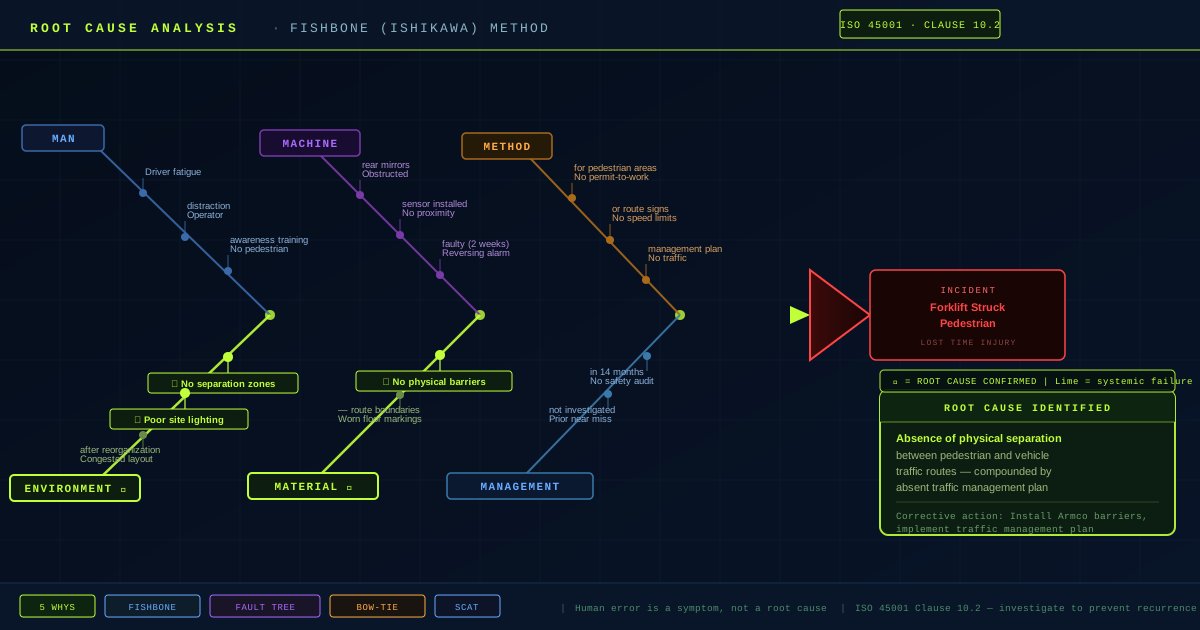
What it is: A visual diagram that maps all possible contributing causes of an incident across six categories, branching from a central "spine" pointing to the incident (the fish head).
The 6M categories:
| Category | What It Covers |
|---|---|
| Man | Human factors: training, fatigue, distraction, behavior |
| Machine | Equipment condition, maintenance, design flaws |
| Method | Work procedures, instructions, processes |
| Material | Raw materials, chemicals, consumables, PPE |
| Measurement | Inspection practices, monitoring systems, metrics |
| Mother Nature (Environment) | Physical environment, lighting, noise, weather, layout |
Real example: A forklift struck a pedestrian in a warehouse aisle.
Man: Operator was not trained on pedestrian awareness; pedestrian was using an unmarked route. Machine: Reversing alarm had been faulty for two weeks; no proximity sensor installed. Method: No documented traffic management plan; no demarcated pedestrian routes. Material: No physical barriers between pedestrian and vehicle zones. Environment: Poor lighting in the rear section; congested layout after equipment reorganization. Measurement: Last safety audit was 14 months ago; a previous near miss had been reported but not investigated.
The Fishbone reveals that this was not a "driver error" incident — it was a systemic failure across five categories simultaneously.
Best for: Complex incidents with multiple potential contributing factors; high-severity incidents; ISO 45001 Clause 10 compliance documentation.
Limitation: Identifies where to look, but doesn't automatically identify which causes are root causes versus contributing factors. Combine with 5 Whys drilling into the most critical branches.
Method 3: Fault Tree Analysis (FTA)
What it is: A top-down, deductive method that works backward from an undesired event (the "top event") through logical AND/OR gates to identify the combination of failures that could cause it.
Structure:
- Top event: The undesired outcome (e.g., "Worker receives fatal electric shock")
- Intermediate events: System-level failures leading toward the top event
- Basic events: Individual component failures or human errors at the bottom of the tree
- AND gates: All inputs must occur simultaneously for the output to occur
- OR gates: Any single input is sufficient to produce the output
Example: For an electrical fatality:
- Top event: Worker receives fatal shock
- AND: Worker contacts live conductor
- AND: Conductor is energized
- OR: Lockout/tagout procedure not followed
- OR: LOTO procedure exists but inadequate
- AND: Procedure not reviewed after equipment change
- AND: No verification step in procedure
FTA reveals which failure combinations are most critical. OR gates reveal single points of failure: any one input is enough to cause the event above it, so they deserve the closest attention. AND gates show where redundancy exists, because several failures must happen together.
Best for: Complex mechanical or electrical systems; high-consequence scenarios in energy, chemical, and heavy industry; proactive risk assessment (before an incident occurs).
Limitation: Requires specialized knowledge; time-intensive to construct; needs software tools for large systems.
Method 4: Bow-Tie Analysis
What it is: A visual risk model that places a hazard at the center (the "knot") and maps both threats (causes, on the left) and consequences (outcomes, on the right), with control barriers on each side preventing escalation.
[Threats] → |Barriers| → [HAZARD EVENT] → |Barriers| → [Consequences]
Why it is powerful for OHS:
The Bow-Tie integrates two analyses in one diagram:
- Left side (prevention): Why does an incident happen? What prevents it?
- Right side (mitigation): If it happens, what limits the harm?
The barriers correspond directly to the hierarchy of controls (elimination → substitution → engineering controls → administrative controls → PPE), making it ideal for ISO 45001 compliance documentation.
Example: Hazard = Chemical release in manufacturing
Left threats: pipe corrosion; operator overfill; valve failure; maintenance error Left barriers: inspection schedule; fill level alarms; pressure relief valves; LOTO procedures Right consequences: worker exposure; fire; environmental contamination Right barriers: PPE; emergency shutdown; spill containment; evacuation procedure
Best for: High-hazard process industries; demonstrating control adequacy to regulators and auditors; combining risk assessment and incident investigation; visualizing control gaps.
Limitation: Shows what controls exist, but not why they failed — combine with 5 Whys or Fishbone to investigate barrier failures after an incident.
Method 5: SCAT (Systematic Cause Analysis Technique)
What it is: The Systematic Cause Analysis Technique is a structured, checklist-driven method developed by the International Loss Control Institute (ILCI), aligned with Frank Bird's loss causation model. SCAT follows a standardized four-level chain:
- Contact → What was the nature of the incident? (energy transfer, hazardous substance, etc.)
- Immediate causes → Substandard acts and substandard conditions
- Basic causes → Personal factors (skill, motivation, physical/mental state) and job factors (leadership, standards, equipment)
- Lack of control → Management system gap that allowed the basic causes to exist
Why SCAT is valued in corporate OHS systems:
The SCAT chart provides a fixed set of pre-defined cause categories at each level. This makes investigations consistent and systematic, whichever investigator conducts the analysis. Large organizations and auditors can compare investigations across sites, time periods, and incident types.
The connection to Bird's Triangle (which underpins our near miss reporting framework) means SCAT data can also feed directly into leading indicator trend analysis.
Best for: Large organizations that need standardized, comparable investigation data across multiple sites; organizations with formal OHS management systems seeking audit-ready documentation.
Limitation: The checklist structure can create a checkbox mentality if investigators are not trained to think beyond the pre-defined categories.
Root Cause Analysis Example: A Machinery Incident
The example below follows one investigation from start to finish. It is illustrative, but it is typical of the injuries that reach an OHS professional's desk.
Incident: A packaging line operator suffers a crushed finger while clearing a jammed carton from a conveyor transfer point. The machine was running. Lost-time injury, three weeks off work.
Evidence gathered: Scene photos, the guard's condition (a hinged guard propped open with a cable tie), the machine's jam log, maintenance records, the operator's and two colleagues' statements taken separately, the training record, and the shift production report.
Timeline:
| Time | Event |
|---|---|
| Previous 4 weeks | Carton supplier changed; jam frequency at the transfer point rises from about 1 to about 8 per shift (jam log) |
| Week 2 | Operators start propping the guard open to clear jams faster; supervisor aware, no report made |
| 10:42 | Jam at the transfer point; line kept running to protect the hourly target |
| 10:43 | Operator reaches in through the open guard; finger drawn into the nip point |
Fishbone summary (6M):
- Man: Operator trained on LOTO but not on the jam-clearing procedure specifically.
- Machine: Hinged guard had no interlock; the nip point was reachable once the guard was open.
- Method: No written jam-clearing procedure; LOTO was seen as "for maintenance only".
- Material: New carton stock was thinner and jammed more often.
- Measurement: The jam log showed the increase, but nobody reviewed it. The target board rewarded uptime only.
- Environment: Transfer point at the back of the line, out of the supervisor's sight.
5 Whys on the key branch:
- Why was the finger crushed? The operator reached into a running nip point.
- Why was the nip point reachable? The guard was propped open and had no interlock.
- Why was it propped open? Jams had become frequent and stopping the line took too long.
- Why were jams frequent? The carton supplier changed without any check of how the new stock ran on the line.
- Why was there no check? Purchasing changes were not covered by the management of change procedure.
Root causes:
- RC1: Management of change did not cover purchasing and material changes.
- RC2: Guarding design allowed access to the nip point without an interlock.
- RC3: Production targets and supervision tolerated bypassing guards.
Corrective and preventive actions (CAPA):
| # | Action | Addresses | Type | Owner | Due | Verification |
|---|---|---|---|---|---|---|
| 1 | Fit an interlock to the hinged guard, stopping the conveyor when opened | RC2 | Engineering | Maintenance manager | 2 weeks | Function test and sign-off |
| 2 | Write and train a jam-clearing procedure, including when LOTO is required | RC2, RC3 | Administrative | Line supervisor | 3 weeks | Observation on 3 shifts |
| 3 | Extend management of change to purchasing and material substitutions | RC1 | System | OHS manager | 6 weeks | Next supplier change reviewed |
| 4 | Add jam rate and guard bypasses to the daily line review; remove uptime-only targets | RC3 | System | Plant manager | 4 weeks | Monthly review of the jam log |
| 5 | Check the other lines for guards without interlocks | RC2 | Preventive | Maintenance manager | 6 weeks | Survey report |
"Retrain the operator" does not appear on this list, and that is deliberate. The operator did what the system had made normal. Each action traces back to a root cause, has an owner and a date, and states how its effectiveness will be checked. That is what ISO 45001 Clause 10.2 expects to see, and what a corrective action (CAPA) process should track to closure. The investigation report itself can follow our incident report template.
Which Method Should You Use? Decision Guide
| Incident Type | Recommended Method | Why |
|---|---|---|
| Simple near miss or minor injury (single causal chain) | 5 Whys | Fast, practical, sufficient depth |
| Injury with multiple equipment/human factors | Fishbone (Ishikawa) | Maps all contributing categories |
| Complex mechanical or electrical system failure | Fault Tree Analysis | Logical rigor for multi-component systems |
| High-consequence or fatal incident | Bow-Tie Analysis | Visualizes all threat/consequence pathways |
| Corporate multi-site, standardized investigation | SCAT | Consistent, comparable, audit-ready |
| Any of the above + ISO 45001 Clause 10 documentation | Combine as needed | Use method + document findings formally |
For most OHS practitioners in construction, manufacturing, and logistics, Fishbone + 5 Whys drilling is the most practical combination: Fishbone maps the full causal landscape; 5 Whys drills into the highest-priority branches.
The 8-Step RCA Process
Regardless of which analytical method you choose, a rigorous investigation follows this sequence:
Step 1: Secure the scene and immediate response Preserve physical evidence before it is disturbed. Photograph the scene, equipment condition, and any environmental factors. Do not move or repair anything until documented.
Step 2: Gather evidence Collect witness statements (separately, not in groups), review CCTV footage, inspect equipment, obtain maintenance records, review training records for all involved workers.
Step 3: Build the timeline Reconstruct the sequence of events in chronological order. Include what was happening in the broader workplace before the incident — shift changes, concurrent activities, recent maintenance. Gaps in the timeline are often where the root causes hide.
Step 4: Assemble the investigation team Include the direct supervisor, a worker representative, a safety professional, and at least one person independent of the area involved. Independence matters — people who work in the area are prone to normalization bias.
Step 5: Apply the chosen RCA method Work systematically. For Fishbone: populate every category before drawing conclusions. For 5 Whys: commit to reaching level 5 before accepting a root cause. Avoid stopping when you reach "human error" — that is almost always a contributing cause, not a root cause.
Step 6: Validate the root cause Apply the validation test: "If this cause were eliminated, would this incident be prevented from recurring?" If the answer is yes, you have a root cause. If the incident could still occur through another mechanism, keep investigating.
Step 7: Define corrective and preventive actions For each root cause, define:
- Corrective action: What will fix this specific root cause?
- Preventive action: What broader systemic change prevents similar root causes elsewhere?
- Owner: Who is responsible?
- Due date: When will it be completed?
- Verification: How will closure be confirmed?
Step 8: Implement, verify, and close Assign actions to owners with clear deadlines. Verify implementation — not just that the action was completed, but that it was effective. Communicate findings and outcomes to the workforce. Close the investigation formally with documented evidence.
Why Workplace Investigations Fail to Find Root Causes
The "operator error" trap
Blaming an incident on worker carelessness or inattention is not root cause analysis — it is the stopping point that prevents root cause analysis. Human error is almost always a symptom of systemic failures: inadequate training, unclear procedures, poor equipment design, excessive workload, or organizational pressure to skip steps.
James Reason's Swiss Cheese Model reminds us: a single human error rarely causes a serious incident. It is the alignment of holes in multiple defensive layers — training, supervision, equipment, procedure, environment — that creates the pathway to harm. RCA must identify all the holes.
Stopping too early
Most investigators stop at level 2 (contributing causes). The test: ask "why?" one more time after every answer that feels like a conclusion. If a reasonable answer exists, the investigation is not finished.
Single-cause thinking
Complex incidents rarely have a single cause. The forklift example above had six simultaneous contributing factors. An investigation that identifies only one misses five ongoing hazards.
Findings without action
The most expensive RCA mistake is completing a thorough investigation, writing a detailed report, and filing it in a drawer. ISO 45001 Clause 10.2 requires that corrective actions be implemented and their effectiveness verified. Documented evidence of closure is required for certification audits.
How AI Tools Transform Incident Investigation
Traditional RCA is paper-intensive and slow. Modern AI-powered tools change what is possible:
AI-assisted photo analysis: Incident photographs are automatically analyzed for physical hazards, equipment conditions, and environmental factors — expanding the evidence set before the investigator arrives on-site.
Pattern matching across incidents: AI can identify whether the current incident resembles past incidents in other locations, surfacing previously identified root causes that may apply — reducing the risk of missing recurrent systemic issues.
Guided investigation workflows: AI can prompt investigators with the right questions based on the incident type, ensuring no causal category is overlooked — particularly useful for less experienced investigators.
Automated corrective action tracking: Every identified root cause is linked to a corrective action with an assigned owner, target date, and verification step. No manual spreadsheet management required.
Trend dashboards: Aggregating RCA findings across incidents reveals systemic patterns — the same root causes appearing across different locations or incident types — that a single-incident investigation would miss.
FindRisk covers the field side of this workflow. Capture and annotate photos of the scene, use AI hazard analysis on them, and re-score the risk with Fine-Kinney once controls are defined. You then get a professional report with recommended actions and deadlines, ready to attach to the investigation file.
For a comprehensive look at how AI is reshaping every aspect of occupational health and safety, read our article on how AI is transforming occupational health and safety.
RCA and the Near Miss Connection
The most efficient use of root cause analysis is not after a serious accident — it is after a near miss. Near misses are identical in causal structure to serious incidents: they have the same systemic failures, the same control gaps, the same underlying management system weaknesses. The only difference is that the consequences have not materialized yet.
An organization that applies rigorous RCA to near misses is systematically dismantling the base of the Heinrich/Bird Safety Pyramid before it produces serious injuries. This is the highest-leverage use of RCA capability.
For a complete guide to building a near miss reporting culture, see our article on near miss reporting in the workplace.
Frequently Asked Questions
What is RCA in safety?
RCA stands for root cause analysis. In workplace safety, it is the structured investigation that follows an incident or near miss to find why it really happened. It goes past the immediate unsafe act or condition to the management system failures behind it, and ends with corrective actions that prevent recurrence. It is the answer to the common training-quiz question "a ___ is a detailed procedure used by safety professionals to determine the source of an accident".
Which tool is most commonly used to identify the root cause of an incident?
The 5 Whys and the Fishbone (Ishikawa) diagram are the most widely used, often together. Fishbone maps all possible contributing factors across categories, and 5 Whys then drills into the most important branches. SCAT is common in large organizations that need standardized investigations. Fault Tree and Bow-Tie analysis are used for complex, high-consequence systems.
How long does a root cause analysis take?
It depends on the incident severity and the method used. A 5 Whys analysis for a minor near miss can be completed in 30–60 minutes. A Fishbone analysis for a lost-time injury with multiple factors typically requires 2–4 hours of investigation plus 24–48 hours for evidence gathering. A full Fault Tree Analysis for a serious incident in a complex system may take days to weeks. ISO 45001 does not specify a time requirement, but the standard does require that investigations be completed and corrective actions implemented in a timely manner.
Should we conduct RCA for every incident, including minor ones?
Yes — with proportionate depth. A minor near miss warrants a 5 Whys analysis documented in 10 minutes. A serious incident warrants a full multi-method investigation. The principle is consistent: every incident that is reported should have at least a basic causal analysis and a corrective action. Near misses that are systematically investigated prevent the serious incidents that follow.
What is the difference between 5 Whys and a Fishbone diagram?
5 Whys follows a single causal chain: one answer leads to the next why, in a linear sequence. It is fast and practical for simple incidents. Fishbone maps multiple causal categories simultaneously — Man, Machine, Method, Material, Measurement, Environment — allowing investigators to capture all contributing factors before identifying which are root causes. Use 5 Whys when the causal chain is straightforward; use Fishbone when you suspect multiple independent contributing factors.
Who should conduct a root cause analysis?
The investigation team should include: the area supervisor (accountability), a worker representative (frontline perspective), a safety professional (methodological guidance), and at least one person independent of the area (objective challenge to assumptions). For serious or fatal incidents, an external consultant or senior OHS professional should lead or review the investigation. Independence is critical — people who work in the area are prone to accepting "that's just how things are done" as an explanation.
How should RCA findings be documented for ISO 45001 compliance?
ISO 45001 Clause 10.2 requires documented information as evidence of the nature of the incidents or nonconformities, any subsequent actions taken, and the results of those actions, including their effectiveness. In practice, that means recording the incident description, the immediate and root causes, the corrective actions and how their effectiveness was verified. The document must be retained as evidence. Many organizations use a standardized investigation report template that captures all required fields, links to the risk assessment register, and records the corrective action completion date and verification method. Digital tools that generate audit-ready reports automatically are increasingly used to ensure compliance without administrative burden.
Conclusion
Root cause analysis is the hinge between incident response and genuine prevention. Without it, the same hazards recur, the same workers get hurt, and safety management becomes a cycle of reactions rather than a system of controls.
The five methods covered in this guide — 5 Whys, Fishbone, Fault Tree Analysis, Bow-Tie, and SCAT — are not competing approaches. They are complementary tools, each suited to different incident types and investigative contexts. The most effective OHS professionals know which tool to reach for and when to combine them.
What they all share is the same underlying discipline: keep asking why until you reach the system, not the person. Fix the system, and the person no longer needs to be perfect.
Download FindRisk to capture incident evidence in the field, analyze hazards on photos with AI, and re-assess the risk once your corrective actions are defined, all in a report you can hand over the same day.
Try FindRisk
Ready to modernize your safety workflow?
Conduct AI-powered risk assessments, generate reports instantly, and keep your team safe — anywhere, anytime.