

Near Miss Reporting: Why It Matters and How to Build a Reporting Culture
The Accident That Almost Happened
A worker steps over an unmarked cable on the factory floor — and doesn't trip. A scaffolding clip is found loose after a shift ends, not during it. A forklift reverses into a pedestrian aisle with no one in it — this time.
These are near misses. And according to the most widely cited model in occupational safety, for every fatal workplace accident, there are thousands of near misses that preceded it — most of which were never reported.
This is not a statistic to file away. It is an opportunity. Every unreported near miss is a hazard that remains in the system, waiting for circumstances to align against a worker.
What Is a Near Miss?
A near miss is an unplanned event that did not result in injury, illness, or damage — but had the potential to do so.
Near misses are sometimes called:
- Close calls
- Near hits
- Dangerous occurrences
- Unsafe conditions or acts
The defining characteristic is potential: something happened (or nearly happened) that, under slightly different circumstances, would have caused harm.
Near Miss vs Incident vs Accident
| Term | Definition | Example |
|---|---|---|
| Near miss | An event with harm potential — no actual harm occurred | Worker slips but catches themselves before falling |
| Incident | An unplanned event that caused minor harm or property damage | Worker slips and sprains an ankle |
| Accident | An unplanned event resulting in significant injury, illness, or fatality | Worker slips, falls from height, breaks leg |
| Unsafe condition | A physical hazard that could lead to an event | Wet floor with no warning sign |
| Unsafe act | A behavior that increases risk | Running in a restricted area |
All of these — near misses, unsafe conditions, and unsafe acts — are reportable events that should be investigated and corrected.
The Heinrich Triangle: Why Near Misses Predict Fatalities
In 1931, industrial safety pioneer Herbert Heinrich analyzed 75,000 workplace accidents and proposed a relationship between minor incidents and major ones:
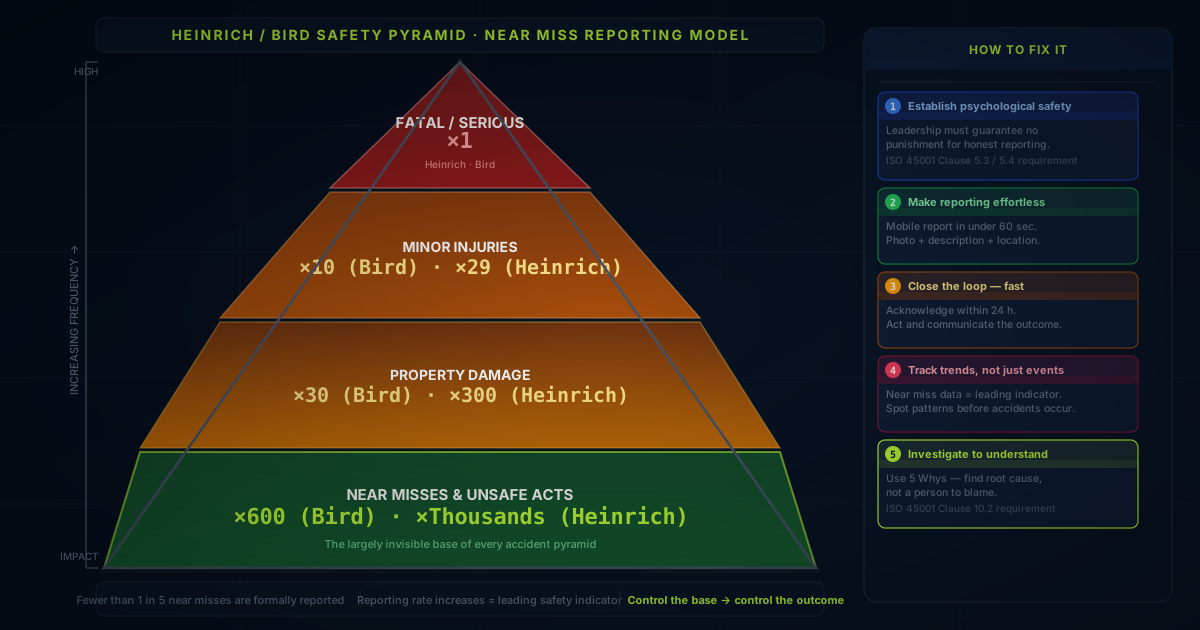
For every 1 major injury, Heinrich found there were:
- 29 minor injuries
- 300 near misses
This model — now called Heinrich's Triangle or the Safety Pyramid — was later updated by Frank Bird (1969), who analyzed 1.7 million accidents across 297 companies:
| Level | Bird's Ratio | What It Means |
|---|---|---|
| Fatality / Serious injury | 1 | The visible tip |
| Minor injury | 10 | Often reported |
| Property damage | 30 | Inconsistently reported |
| Near miss / No-injury incident | 600 | Largely unreported |
The implication is powerful: if you can systematically eliminate near misses, you eliminate the base of the pyramid — and major accidents become statistically far less likely.
Modern safety science has refined Heinrich's exact ratios (the relationship is not perfectly linear), but the underlying principle is supported by decades of research: near misses are leading indicators of future accidents. Organizations that track and act on near misses prevent the incidents that would otherwise follow.
Why Near Misses Go Unreported: 5 Real Barriers
Despite their importance, near misses are dramatically underreported in most organizations. Studies suggest that fewer than 1 in 5 near misses are formally documented. Here is why:
1. Fear of Blame and Consequences
Workers often fear that reporting a near miss will result in disciplinary action, being seen as careless, or creating paperwork problems. If the organizational culture associates reporting with punishment, reporting will not happen.
2. "Nothing Actually Happened"
Workers rationalize that if no one was hurt, there is nothing to report. This misunderstands the entire purpose of near miss reporting — which is to prevent the event where someone does get hurt.
3. Complexity of the Reporting Process
If reporting a near miss requires filling out a multi-page form, finding the right person, and waiting in a queue, workers will not bother — especially during a busy shift. Friction kills reporting culture.
4. Lack of Feedback
When workers report near misses and never hear what happened as a result, they stop reporting. Reporting feels pointless when it disappears into a black hole.
5. Normalization of Risk
When the same near miss occurs repeatedly without consequence, workers begin to see it as "just how things are." Familiarity breeds tolerance — and tolerance breeds the conditions for serious accidents.
How to Build a Near Miss Reporting Culture: 7 Steps
Step 1: Establish Psychological Safety
Workers must believe — based on demonstrated behavior, not just policy — that reporting will not lead to punishment. This requires:
- A written commitment from leadership that near miss reports will not be used for disciplinary purposes (except in cases of deliberate rule violations)
- Visible examples of senior managers reporting their own near misses
- Public recognition of workers who report near misses
This is directly supported by ISO 45001 Clause 5.3 and Clause 5.4, which require top management to actively promote OHS reporting and worker participation.
Step 2: Make Reporting Effortless
The best reporting system is the one workers will actually use. Reduce friction to the minimum:
- Mobile reporting in under 60 seconds (photo + description + location)
- Paper cards as a backup option for field workers without smartphones
- Clear, single-point ownership for receiving and processing reports
- No requirement to identify the "cause" at time of reporting — that comes later
Step 3: Communicate the Why
Every worker should understand the Heinrich Triangle principle: near misses predict accidents, and reporting near misses saves lives. This is not bureaucracy — it is active accident prevention.
Integrate near miss education into:
- New worker inductions
- Toolbox talks
- Safety briefings
- Visible posters at entry points
Step 4: Close the Loop — Fast
After a near miss is reported, the organization has an obligation to:
- Acknowledge receipt within 24 hours
- Conduct a basic investigation within 48–72 hours
- Implement a corrective action and communicate it to the reporter
- Close the finding and confirm closure
Workers who see action taken on their reports will continue reporting. Workers who see reports disappear will stop.
Step 5: Track Trends — Not Just Individual Events
A single near miss report is a data point. One hundred near miss reports are a dataset that reveals patterns:
- Which work areas generate the most near misses?
- Which task types are highest risk?
- Are the same hazards recurring?
- Is reporting frequency increasing (usually a sign of improving culture)?
Near miss data should appear in regular safety performance reviews alongside traditional lagging indicators like Lost Time Injury rates.
Step 6: Recognize and Celebrate Reporting
In a mature safety culture, reporting a near miss is an act of courage and professionalism that protects colleagues. Recognize it as such:
- Acknowledge reporters by name (with their permission) in safety meetings
- Track and celebrate the number of near miss reports submitted each month
- Share outcomes — "here is what we changed because of your report"
The goal is to make reporting feel valued, not penalized.
Step 7: Investigate to Understand — Not to Assign Blame
Near miss investigations should ask "why did this happen?" not "who made a mistake?"
The most effective investigation framework is the 5 Whys technique:
Example near miss: A worker almost received a chemical splash while decanting a solvent.
- Why? — The container was overfilled
- Why? — The worker could not see the fill level
- Why? — The container was opaque and had no level indicator
- Why? — The standard for solvent containers did not specify transparency requirements
- Why? — The container specification had not been reviewed since the solvent type changed
Root cause: Inadequate container specification review process — not "worker carelessness."
Corrective action: Update the container specification standard; require level-visible or marked containers for all solvents.
For a comprehensive guide to root cause investigation methods including Fishbone (Ishikawa) analysis, see our upcoming article on root cause analysis in workplace safety.
What a Good Near Miss Report Includes
A near miss report does not need to be long. It needs to be complete. Essential elements:
| Field | Content |
|---|---|
| Date & time | When did it occur? |
| Location | Exact work area or grid reference |
| Description | What happened? What could have happened? |
| People involved | Who was present? (may be anonymous) |
| Immediate cause | What directly led to the event? |
| Photo | A photograph of the hazard or scene |
| Suggested action | Reporter's suggestion (optional but valuable) |
| Reported by | Name or anonymous identifier |
The simpler the form, the more reports you will receive. Start with the minimum viable report and add fields only if the data is genuinely used.
How AI and Mobile Tools Transform Near Miss Reporting
Traditional near miss reporting — paper forms, email chains, shared drives — is slow and inconsistent. Modern mobile tools change the equation:
Instant field capture: Workers photograph the hazard, add a voice note or text description, and submit — in under a minute, from any location. No waiting to get back to the office.
Automatic location tagging: The report is geo-tagged to the exact work area, enabling location-based hazard mapping.
AI-assisted hazard analysis: Uploaded photos are automatically analyzed for additional hazards that the reporter may not have noticed — expanding the value of every report.
Real-time notifications: The safety manager receives the report instantly and can acknowledge it immediately, demonstrating that the system is working.
Closed-loop tracking: Every near miss moves through a workflow — reported → acknowledged → investigated → corrective action assigned → closed. Full audit trail, automatically.
Trend dashboards: Near miss data is aggregated across locations and time periods, revealing patterns that a spreadsheet would miss.
This is exactly how FindRisk supports near miss reporting — from instant photo capture in the field to AI-powered hazard analysis and one-tap report generation.
For a broader look at how AI is reshaping every aspect of OHS, read our article on how AI is transforming occupational health and safety.
Near Miss Reporting and ISO 45001
ISO 45001 places near miss reporting at the heart of the OHS management system:
- Clause 6.1 requires identifying hazards and assessing risks — near misses are a primary hazard identification source
- Clause 9.1 requires monitoring and measurement of OHS performance — near miss frequency is a leading indicator
- Clause 10.2 requires investigating incidents and nonconformities, including near misses, and taking corrective action
Organizations seeking ISO 45001 certification will find that a well-functioning near miss reporting system provides direct evidence of compliance across multiple clauses.
Frequently Asked Questions
What is the difference between a near miss and a hazard?
A hazard is a source of potential harm that exists in the workplace — a wet floor, an unguarded machine, a chemical stored improperly. A near miss is an event that already occurred — someone slipped on that wet floor but didn't fall, or nearly touched the unguarded machine. Hazards are identified through inspections; near misses are reported after an unplanned event. Both require corrective action.
Should near misses be reported anonymously?
Anonymous reporting increases report volumes, especially in organizations with a developing safety culture, because it removes the fear of blame. However, anonymous reports limit the investigation — you cannot follow up with the reporter for details. The best approach is to offer a choice: named reporting with a guaranteed non-punitive policy, or anonymous reporting as a fallback.
How many near miss reports should we expect per month?
There is no universal benchmark, but a widely cited guideline is that a healthy safety culture generates 3–5 near miss reports per employee per year in high-hazard industries. If your organization is receiving far fewer, it likely indicates a reporting culture problem — not an absence of near misses.
What is the difference between a near miss and an unsafe condition?
An unsafe condition is a static hazard (spill, broken guardrail, unlabeled chemical) identified before any event occurs — typically through an inspection. A near miss is a dynamic event: something happened or almost happened. Both should be reported and corrected. Using mobile inspection tools to report unsafe conditions is the proactive equivalent of near miss reporting.
Does reporting near misses increase our insurance risk?
This is a common fear — and a misconception. Insurers view a high near miss report rate as evidence of a mature, proactive safety culture. It is the organizations that report zero near misses that should concern insurers and regulators, because that almost certainly reflects underreporting, not an absence of risk. Many insurers now request near miss data as part of their risk assessment process.
Conclusion
Near misses are not failures — they are warnings. Every near miss that is reported, investigated, and corrected is an accident that did not happen. Every near miss that goes unreported is a hazard that remains in your workplace, waiting.
Building a near miss reporting culture is one of the highest-leverage investments an OHS professional can make. It does not require expensive technology or complex systems. It requires leadership commitment, psychological safety, a frictionless reporting process, and — critically — visible action on every report received.
The Heinrich Triangle reminds us that the tip of the iceberg is always built on a base. Control the base, and you control the outcome.
Download FindRisk to enable your team to report near misses instantly from the field — with AI-powered photo analysis, automatic location tagging, and a complete corrective action workflow built in.
Try FindRisk
Ready to modernize your safety workflow?
Conduct AI-powered risk assessments, generate reports instantly, and keep your team safe — anywhere, anytime.