

ISO 45001: The Complete Guide to Requirements, Benefits & Certification (2026)
Why ISO 45001 Matters More Than Ever
More than 85,000 organizations across 130 countries have achieved ISO 45001 certification since the standard was published in 2018 — making it the fastest-growing ISO management system standard in history.
The reason is simple: ISO 45001 works. Organizations that implement the standard report an average 25–40% reduction in workplace incidents, lower insurance premiums, and a measurable improvement in employee engagement. Beyond the internal benefits, ISO 45001 certification is increasingly required by major clients, government contracts, and procurement frameworks worldwide.
If your organization is still operating under OHSAS 18001 — or has no formal OHS management system at all — this guide covers everything you need to know to get started.
What Is ISO 45001?
ISO 45001 is the international standard for Occupational Health and Safety (OHS) management systems. Published by the International Organization for Standardization (ISO) in March 2018, it replaced the widely-used OHSAS 18001 standard and became the global benchmark for workplace safety management.
At its core, ISO 45001 provides a framework that helps organizations:
- Systematically identify and control health and safety risks
- Reduce workplace incidents, injuries, and illnesses
- Meet legal and regulatory obligations
- Continually improve OHS performance over time
The standard applies to any organization, of any size, in any sector — from a 10-person construction company to a multinational manufacturing group.
ISO 45001 follows the Annex SL high-level structure, which means it uses the same framework as ISO 9001 (quality) and ISO 14001 (environment). Organizations already certified to those standards can integrate ISO 45001 efficiently, sharing documentation, audits, and management reviews.
ISO 45001 vs OHSAS 18001: Key Differences
If your organization held OHSAS 18001 certification, the transition to ISO 45001 was required by September 2021, when OHSAS 18001 was officially withdrawn. Here is how the two standards differ:
| Aspect | OHSAS 18001 | ISO 45001 |
|---|---|---|
| Published | 1999, revised 2007 | 2018 |
| Status | Withdrawn (Sept 2021) | Active international standard |
| Structure | Standalone | Annex SL (integrates with ISO 9001, 14001) |
| Worker participation | Limited | Explicit requirement — workers must be consulted |
| Context of organization | Not required | Required (Clause 4) |
| Leadership commitment | Management representative | Direct top management accountability |
| Risk-based thinking | Basic | Central to the entire framework |
| Supply chain | Limited | Explicit contractor/outsourcing requirements |
The most significant shift is the emphasis on worker participation and top leadership accountability. ISO 45001 cannot be delegated to a safety officer alone — it requires visible commitment from the board level downward.
The 10 Clauses of ISO 45001
ISO 45001 is organized into 10 clauses. Clauses 1–3 are introductory; Clauses 4–10 contain the requirements.
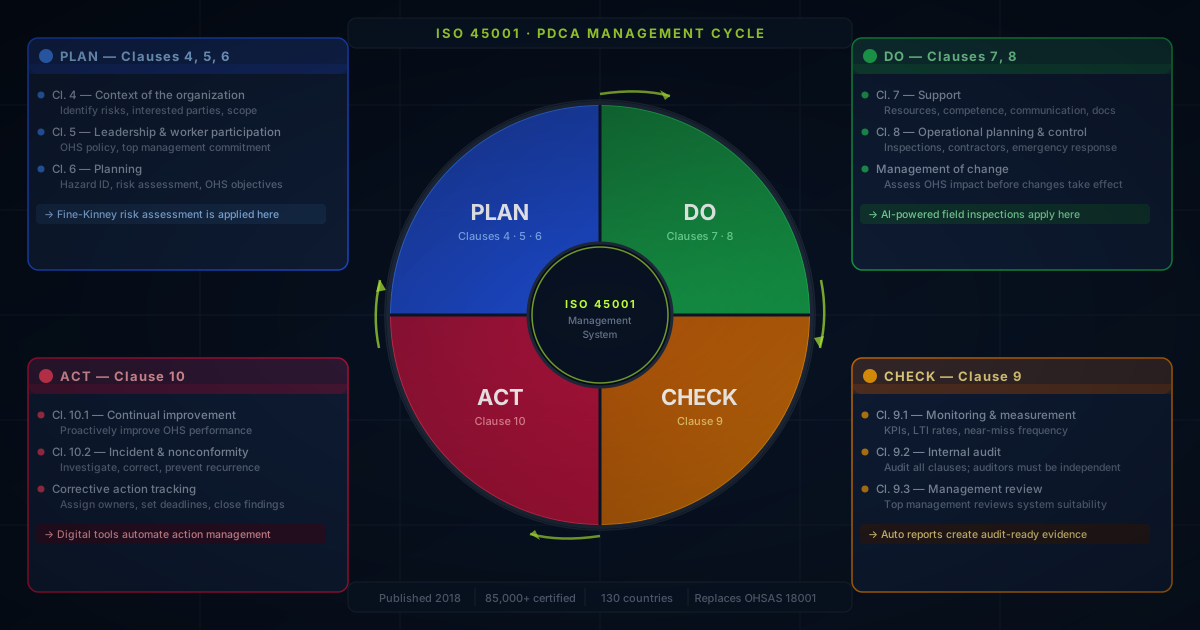
| Clause | Title | What It Requires |
|---|---|---|
| 4 | Context of the Organization | Identify internal/external issues, interested parties, and the scope of the OHS management system |
| 5 | Leadership | Top management must demonstrate visible commitment; establish OHS policy; assign roles and responsibilities |
| 6 | Planning | Identify hazards, assess risks and opportunities; set measurable OHS objectives |
| 7 | Support | Provide adequate resources, competent personnel, awareness programs, and documented information |
| 8 | Operation | Control operational risks; manage contractors and outsourced processes; emergency preparedness |
| 9 | Performance Evaluation | Monitor and measure OHS performance; conduct internal audits; management review |
| 10 | Improvement | Investigate incidents and nonconformities; implement corrective actions; pursue continual improvement |
Clause 6 in Focus: Risk Assessment
Clause 6 is the engine of ISO 45001. It requires organizations to:
- Identify all workplace hazards (physical, chemical, biological, ergonomic, psychosocial)
- Assess the risks associated with each hazard
- Determine appropriate controls using the hierarchy of controls
- Document the assessment and review it regularly
The Fine-Kinney method (R = P × F × C) is one of the most widely used quantitative approaches for meeting this requirement. Read our complete Fine-Kinney method guide to understand how to apply it in practice.
For a step-by-step walkthrough of the risk assessment process itself, see our 5-step risk assessment guide.
The ISO 45001 Certification Process: Step by Step
Achieving certification is a structured process, typically taking 6–18 months depending on organization size and starting point.
Stage 1: Gap Analysis
Before you begin implementation, conduct a gap analysis comparing your current practices against ISO 45001 requirements clause by clause. This reveals:
- Which requirements you already meet
- Where significant work is needed
- A realistic estimate of time and resources required
Stage 2: Project Planning
Define your implementation project:
- Appoint an implementation team and an OHS management representative
- Set a realistic timeline with milestones
- Allocate budget for training, consultant support (if needed), and certification body fees
Stage 3: Documentation Development
ISO 45001 requires documented information in several areas:
- OHS policy
- Scope of the management system
- Hazard identification and risk assessment records
- Legal and regulatory obligations register
- OHS objectives and plans
- Competence and training records
- Emergency response procedures
- Audit and management review records
- Incident and corrective action logs
Stage 4: Implementation
Roll out the system across your organization:
- Train employees at all levels on their roles
- Conduct hazard identification and risk assessments for all operations
- Implement control measures and verify their effectiveness
- Establish your incident reporting and investigation process
- Run internal drills and emergency response exercises
Stage 5: Internal Audit
Before the certification audit, conduct a full internal audit against all ISO 45001 requirements. This identifies remaining nonconformities before the external auditor arrives. Your internal auditors must be competent and independent of the areas they audit.
For practical guidance on conducting workplace inspections, see our construction site safety inspection guide — the principles apply across all sectors.
Stage 6: Management Review
Top management must review the OHS management system to ensure it remains suitable, adequate, and effective. The review must consider:
- Audit results
- Incident trends
- Progress on OHS objectives
- Changes in the organization or legal requirements
Stage 7: Stage 1 Certification Audit (Document Review)
The certification body conducts a desk review of your documentation to verify it meets ISO 45001 requirements. They will identify any areas needing attention before the Stage 2 audit.
Stage 8: Stage 2 Certification Audit (On-Site)
Auditors visit your site(s) to verify that your management system is implemented, operational, and effective. They will:
- Interview employees at all levels
- Review records and documentation
- Observe work in progress
- Assess whether your system is actually preventing incidents
Stage 9: Certification Issued
If the Stage 2 audit finds no major nonconformities, the certification body issues your ISO 45001 certificate. Certificates are valid for three years, subject to annual surveillance audits.
Stage 10: Surveillance & Recertification
- Year 1 & 2: Annual surveillance audits (shorter, focused on key areas)
- Year 3: Full recertification audit
The Real Benefits of ISO 45001 Certification
Incident Reduction
Organizations implementing ISO 45001 report consistent reductions in workplace incidents. A 2022 study across manufacturing firms in Europe found an average 32% reduction in Lost Time Injury (LTI) rates within 24 months of certification.
Insurance Premium Savings
Many insurers offer premium reductions of 5–20% for ISO 45001-certified organizations, recognizing the reduced risk profile.
Competitive Advantage
An increasing number of large buyers, government departments, and procurement frameworks now require ISO 45001 certification as a prerequisite for tendering. Certification opens doors that would otherwise remain closed.
Legal Compliance Confidence
ISO 45001 Clause 6.1.3 requires maintaining a register of applicable legal requirements and verifying compliance. This systematic approach to legal compliance reduces the risk of regulatory penalties and prosecution.
Employee Engagement
When workers are genuinely involved in hazard identification and risk assessment (as required by ISO 45001), they are more engaged, more likely to report hazards, and less likely to take shortcuts.
Realistic Costs and Timelines
| Organization Size | Typical Timeline | Estimated Cost (All-in) |
|---|---|---|
| Small (< 50 employees) | 3–6 months | $5,000 – $15,000 |
| Medium (50–250 employees) | 6–12 months | $15,000 – $40,000 |
| Large (250–1,000 employees) | 12–18 months | $40,000 – $100,000+ |
| Multinational (multi-site) | 18–36 months | $100,000+ |
Cost components include: external consultant fees (optional), employee training, documentation development, certification body fees (Stage 1 + Stage 2 audits + annual surveillance), and internal staff time.
Organizations with an existing ISO 9001 or ISO 14001 system can reduce implementation time and cost significantly due to the shared Annex SL structure.
How AI Tools Accelerate ISO 45001 Compliance
Meeting ISO 45001 requirements generates significant administrative work — hazard registers, risk assessment records, audit reports, corrective action logs, training records. AI-powered OHS tools reduce this burden dramatically.
Clause 6 — Hazard Identification & Risk Assessment
AI-generated checklists create comprehensive hazard identification templates for any industry in seconds. Instead of building your hazard register from scratch, safety professionals start from an AI-generated baseline and refine it — reducing preparation time from days to hours.
Clause 8 — Operational Control & Inspections
Regular workplace inspections are a core operational control. AI-powered mobile inspection apps allow teams to complete structured inspection checklists in the field, annotate hazard photos, and generate compliant inspection reports automatically. Read about how AI is transforming occupational health and safety for a deeper look at these capabilities.
Clause 9 — Performance Monitoring
Digital inspection and incident records create an automatic performance data trail — enabling trend analysis, audit readiness, and management review preparation without manual data aggregation.
Clause 10 — Corrective Actions
Digital corrective action tracking ensures every finding has an assigned owner, a target date, and a documented closure — exactly what ISO 45001 auditors look for.
FindRisk combines all of these capabilities in a single mobile app designed for OHS professionals working toward — and maintaining — ISO 45001 certification.
Frequently Asked Questions
Is ISO 45001 certification legally required?
No — ISO 45001 is a voluntary international standard. However, many industries and clients effectively make it mandatory through procurement requirements. Some national regulations also reference ISO 45001 as a recognized compliance framework, and regulators may look favorably on certified organizations during inspections.
What is the biggest difference between ISO 45001 and OHSAS 18001?
The most significant differences are: (1) ISO 45001 requires active worker participation in hazard identification and risk assessment — not just consultation; (2) top management must personally lead the OHS system, not delegate it entirely; (3) the organization's context and the needs of interested parties must be formally analyzed; and (4) ISO 45001 uses the Annex SL structure for easy integration with ISO 9001 and ISO 14001.
Can small businesses (SMEs) achieve ISO 45001 certification?
Yes. ISO 45001 is designed to be scalable to any organization size. A small business with 10–20 employees can achieve certification — the documentation and system complexity will be proportionate to the size and risk profile of the business. Many small organizations in high-risk sectors such as construction find that the benefits far outweigh the investment.
Who can certify our organization to ISO 45001?
Certification must be issued by an accredited third-party certification body (also known as a registrar or conformity assessment body). The certification body must be accredited by a national accreditation body (such as UKAS in the UK, DAkkS in Germany, or ANAB/A2LA in the USA) that is a member of the International Accreditation Forum (IAF). Internal certification is not valid.
How long does ISO 45001 certification last?
ISO 45001 certificates are issued for a three-year cycle. Annual surveillance audits are conducted in years one and two to verify the system remains effective. At the end of the three-year period, a full recertification audit is required to renew the certificate.
Conclusion
ISO 45001 is the global standard for organizations that take workplace safety seriously. Beyond the certificate itself, the real value lies in what the standard builds: a systematic, evidence-based approach to identifying hazards, controlling risks, and continuously improving safety performance.
The certification journey requires investment — in time, documentation, and training. But the returns — fewer incidents, lower costs, stronger compliance, and competitive advantage — make it one of the highest-ROI investments an organization can make in workplace safety.
Whether you are starting from scratch or transitioning from OHSAS 18001, the path to ISO 45001 is clearer than most organizations expect — especially with the right digital tools supporting your risk assessments, inspections, and corrective action management.
Download FindRisk to see how AI-powered safety tools can accelerate your ISO 45001 journey — from hazard identification and risk assessment to field inspections and audit-ready reporting.
Try FindRisk
Ready to modernize your safety workflow?
Conduct AI-powered risk assessments, generate reports instantly, and keep your team safe — anywhere, anytime.