
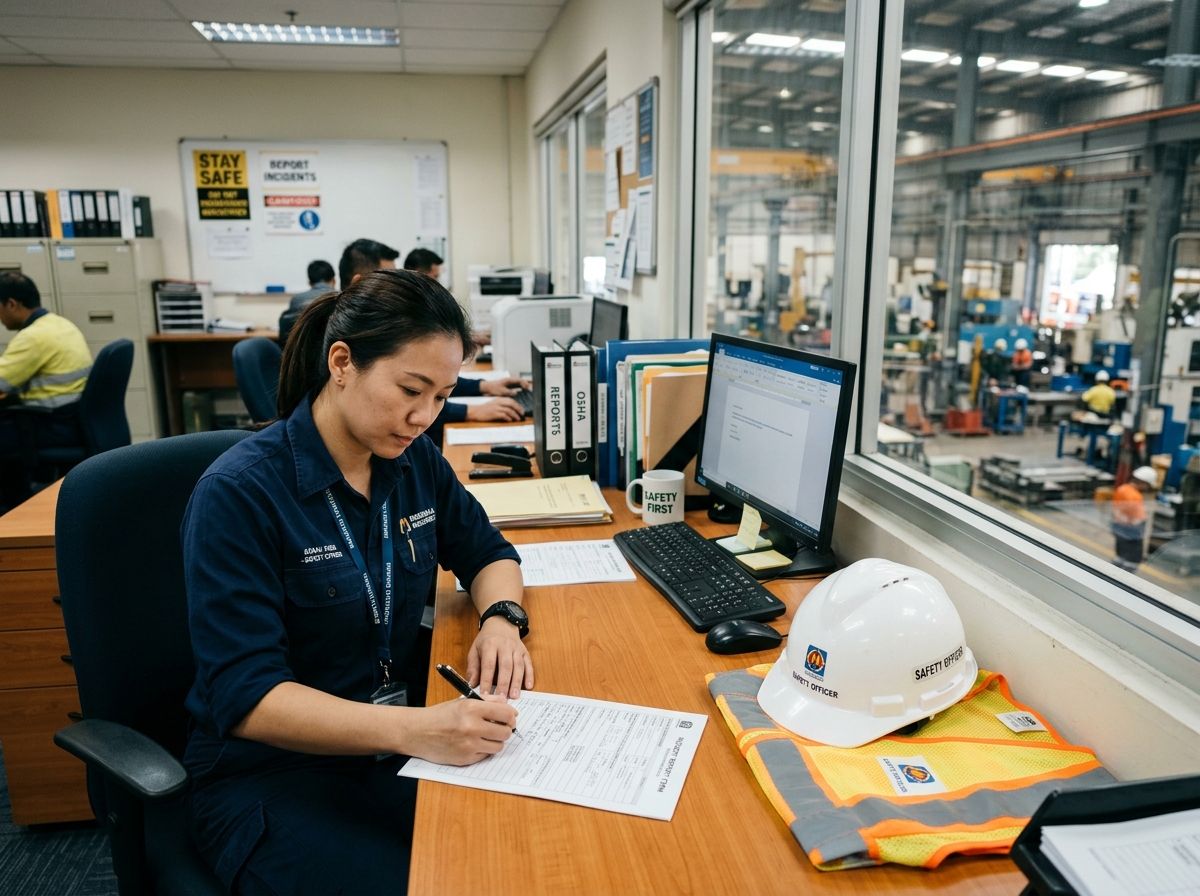
How to Write a Workplace Incident Report: Template, Examples, and Best Practices
The Report That Was Never Written
In 2017, a worker at a distribution warehouse slipped on a wet floor near a loading dock. He caught himself, felt a sharp pain in his lower back, and returned to work. He told his supervisor — informally, in passing. The supervisor acknowledged it and moved on.
Six weeks later, the worker filed a workers' compensation claim. The injury had worsened. A herniated disc. Surgery required. Four months off work.
When the insurance carrier investigated, they found no incident report. No record of the supervisor notification. No record of the wet floor being reported or cleaned up. No record of any investigation. Three subsequent workers had slipped in the same area — also unreported.
The company's insurance premium increased 40% at renewal. The legal exposure from the undocumented incident pattern was significant. And the wet floor — the actual hazard — had never been fixed.
A workplace incident report is not bureaucracy. It is the mechanism by which hazards are discovered, corrective actions are triggered, and the pattern of near-misses, minor injuries, and serious incidents is made visible before the catastrophic event arrives.
What Is a Workplace Incident Report?
A workplace incident report is a formal document that records the details of any unplanned event in the workplace that resulted in — or had the potential to result in — injury, illness, property damage, or a dangerous condition.
Incident reports are required for:
- Injuries and illnesses affecting workers (including near-misses)
- Property damage and equipment failures
- Environmental releases or spills
- Security incidents affecting workplace safety
- Any event that was investigated or that triggered corrective action
The purpose of an incident report is not to assign blame. It is to capture an accurate record of what happened, why it happened, and what is being done to prevent recurrence. The report is the starting point for root cause analysis — not the end of the process.
Types of Workplace Incidents
| Incident Type | Definition | Report Required? |
|---|---|---|
| Fatality | Death of a worker resulting from a work-related injury or illness | Always — and immediate regulatory notification required |
| Lost-time injury (LTI) | Injury resulting in at least one full day/shift away from work | Always |
| Restricted work case | Injury that limits the worker's duties but does not result in lost time | Always |
| Medical treatment case | Injury requiring medical treatment beyond first aid | Always |
| First aid case | Injury treatable with basic first aid at the workplace | Best practice to document |
| Near miss | An event that had the potential to cause harm but did not | Best practice — near miss reporting is a leading safety indicator |
| Dangerous occurrence | A structural collapse, explosion, release of dangerous substances, or similar event regardless of whether anyone was injured | Always — regulatory notification often required |
What Must an Incident Report Include?
According to OSHA and ISO 45001 Clause 10.2, a complete incident report must document sufficient information to support investigation and corrective action. The minimum required elements:
Section 1: Basic Information
| Field | Content |
|---|---|
| Report number | Unique identifier for tracking and audit |
| Date of report | When the report was completed |
| Date and time of incident | When it actually occurred — not when it was reported |
| Location | Precise location: building, floor, department, specific area |
| Incident type | Injury / near miss / property damage / dangerous occurrence |
| Reported by | Name and role of the person completing the report |
Section 2: People Involved
| Field | Content |
|---|---|
| Injured/involved person(s) | Full name, job title, department, employment type (employee/contractor/visitor) |
| Witnesses | Names and contact details of all witnesses |
| Supervisor at time of incident | Name and role |
| First responder | Name of first aid provider if applicable |
Section 3: Incident Description
| Field | Content |
|---|---|
| What was the person doing? | Specific task being performed at time of incident |
| What happened? | Factual narrative of the sequence of events — no assumptions, no conclusions, no blame |
| What was the immediate cause? | The direct event or condition that caused the incident |
| What were the contributing factors? | Environmental, equipment, procedural, or human factors |
| Hazardous energy or substance involved | Chemical, electrical, mechanical, etc. if applicable |
Section 4: Injury/Damage Details (if applicable)
| Field | Content |
|---|---|
| Nature of injury/illness | Fracture, laceration, sprain, burn, chemical exposure, etc. |
| Body part affected | Specific body part |
| Severity | First aid / medical treatment / restricted work / lost time / fatality |
| Property damage | Description and estimated value |
| Medical treatment provided | First aid given, medical referral, hospital admission |
Section 5: Immediate Actions Taken
| Field | Content |
|---|---|
| Immediate corrective actions | What was done immediately after the incident to prevent recurrence |
| Area status | Was the area made safe? Closed? |
| Evidence preserved | Was the scene photographed? Secured? |
| Notifications made | Who was notified: supervisor, HR, regulatory authority |
Section 6: Investigation Findings
| Field | Content |
|---|---|
| Root cause(s) | Underlying causes identified through investigation |
| Contributing causes | Additional factors that made the incident more likely or severe |
| Investigation method used | 5 Whys, Fishbone, FTA, etc. |
Section 7: Corrective Actions
| Field | Content |
|---|---|
| Corrective action(s) required | Specific actions to prevent recurrence |
| Responsible person | Named owner for each action |
| Target completion date | Specific date — not "ASAP" |
| Verification method | How completion will be confirmed |
Section 8: Sign-offs
| Field | Content |
|---|---|
| Reporter signature | Confirms accuracy of the information provided |
| Supervisor signature | Confirms receipt and immediate action |
| Safety officer signature | Confirms investigation and corrective action assignment |
| Management signature | Confirms review and approval of corrective actions |
Step-by-Step Guide to Writing an Incident Report
Step 1: Secure the Scene (Immediately After the Incident)
Before writing a single word, the priority is people and safety:
- Ensure injured persons receive first aid or emergency medical care
- Isolate the area if there is ongoing risk
- Preserve the scene — do not move evidence, clean up, or restart equipment until photographs and witness statements are taken
- Notify the immediate supervisor
The scene is your primary evidence source. A cleaned-up scene makes accurate root cause analysis nearly impossible.
Step 2: Gather Information Within 24 Hours
The incident report must be started within 24 hours of the event. Memory degrades rapidly. Witnesses relocate or are reassigned. Physical evidence disappears.
Information to gather:
- Speak to the injured person (if their condition permits)
- Interview all witnesses separately — before they discuss the incident with each other
- Photograph the scene from multiple angles
- Document physical measurements (height of fall, distance from hazard, etc.)
- Review any CCTV footage and preserve it before it is overwritten
- Collect relevant documents (maintenance records, training records, procedures)
Critical note on witness statements: Ask witnesses to describe what they saw — not what they think caused the incident. Separate observation from interpretation at this stage.
Step 3: Write the Incident Narrative
The incident narrative (Section 3 of the report) is the most important element. It must be:
Factual, not interpretive. Describe what happened, not why you think it happened.
- ❌ "The worker was careless and slipped on the wet floor."
- ✅ "The worker stepped from the truck ramp onto the warehouse floor at approximately 09:45. Their right foot contacted a wet surface and slipped forward. The worker fell backwards, striking their lower back on the edge of the ramp."
Sequential. Write the narrative in chronological order. Start before the incident (what was the worker doing?) and end after it (what happened immediately following?).
Specific. Include times, locations, measurements, equipment names, and job titles. "The worker" is weaker evidence than "John Smith, Warehouse Operative, Level 2."
Complete. If information is unknown at the time of writing, write "Unknown — under investigation." Do not leave fields blank or make assumptions to fill them.
Step 4: Identify Immediate and Contributing Causes
There are always multiple causes in a workplace incident. The incident report should capture:
Immediate cause: The direct event that caused the harm — "worker's foot contacted wet floor surface."
Contributing causes: The conditions and factors that made the incident possible or more severe:
- Environmental: Wet floor from a roof leak that had not been repaired
- Equipment: No drainage grate or non-slip matting at the transition from ramp to warehouse floor
- Procedural: No procedure for inspecting the floor condition at the start of each shift
- Organizational: No system for reporting and tracking maintenance requests
Most incident reports stop at the immediate cause. This is why the same incidents recur. The contributing causes — the systemic factors — are where corrective action must focus.
Step 5: Assign Corrective Actions With Named Owners and Dates
Every identified cause requires a corrective action. Every corrective action requires:
- A specific action (not "improve housekeeping" — "install non-slip grating at Dock 3 loading bay entry point")
- A named owner (not "the maintenance team" — "James O'Brien, Maintenance Supervisor")
- A specific deadline ("by 15 June 2026" — not "within two weeks" or "ASAP")
- A verification method ("inspection by safety officer on completion")
The corrective action section is where most incident reports fail. Vague actions with no owners and no deadlines produce no change.
Step 6: Complete Sign-offs and Submit
The report must be signed by the reporter, the supervisor, the safety officer, and (for serious incidents) site management. Sign-offs confirm that the information has been reviewed, the investigation is complete, and the corrective actions have been formally assigned.
Submit the completed report to your safety management system within your organization's defined timeframe — typically 24–72 hours for injuries, immediately for fatalities or dangerous occurrences.
OSHA Recording Requirements
In the United States, OSHA requires employers to maintain records of work-related injuries and illnesses using the OSHA 300 Log, OSHA 300A Summary, and OSHA 301 Incident Report forms.
OSHA 301 Incident Report is the equivalent of the organization's internal incident report for OSHA recording purposes. It must be completed within seven calendar days of receiving information that a recordable injury or illness has occurred.
Recordable incidents include:
- Any work-related fatality
- Any work-related injury or illness resulting in loss of consciousness, days away from work, restricted work, or job transfer
- Any work-related injury or illness requiring medical treatment beyond first aid
- Any work-related case involving a significant injury or illness diagnosed by a healthcare professional
Not recordable: First aid cases (defined specifically by OSHA 1904.7), injuries from personal activities at work, pre-existing conditions not aggravated by work.
Equivalent recording requirements exist in most jurisdictions. In the UK, RIDDOR (Reporting of Injuries, Diseases and Dangerous Occurrences Regulations 2013) requires notification of specified incidents to the HSE. In the EU, each member state's labor inspection authority has equivalent requirements.
Common Incident Report Mistakes
| Mistake | Why It Matters | How to Fix |
|---|---|---|
| Report completed days after the incident | Memory has faded; scene has changed; witnesses have compared notes | Start within 24 hours; establish a hard deadline |
| Blame placed in the narrative | Creates legal liability; inhibits honest reporting; focuses on person, not system | Train reporters to describe facts only |
| Immediate cause only — no contributing causes | Corrective actions address symptoms, not root causes; incident recurs | Use 5 Whys or Fishbone to look beneath the immediate cause |
| Corrective actions with no owner or deadline | Nothing gets done | Require a named person and a specific date for every action |
| Report filed and forgotten | Corrective actions are never verified; hazard remains | Build a follow-up tracking system; close every action with evidence |
| Near misses not reported | The warning signals before the serious incident are invisible | Create a low-barrier reporting culture; report near misses alongside injuries |
| Report not shared with the team | Lessons learned stay with the safety officer; rest of the workforce is unprotected | Share anonymized findings in toolbox talks and safety briefings |
How FindRisk Transforms Incident Reporting
Paper incident forms and generic email templates create a reporting process that is slow, inconsistent, and difficult to act on. The most significant problems with manual incident reporting:
- Inconsistent information capture across reporters and incidents
- No structured investigation workflow — just a form
- Corrective actions tracked in spreadsheets that no one updates
- No real-time visibility for management
- No trend analysis to identify recurring hazard patterns
FindRisk addresses these gaps directly:
Guided mobile reporting: Workers complete incident reports on-site via a structured mobile form. Every required field is prompted. Photos are captured and attached automatically. GPS location is recorded.
AI-assisted narrative: The AI helps the reporter structure a clear, factual incident description — prompting for the specific information needed for root cause analysis.
Automatic corrective action workflow: Each finding generates a corrective action item assigned to a named owner with a deadline. Owners receive notifications and track completion in the app.
Instant professional report: A complete incident report — including photos, findings, investigation summary, and corrective action plan — is generated automatically and is ready for regulatory submission or insurance purposes.
Trend analysis: All incidents are aggregated and searchable by location, incident type, body part, department, and time period — enabling pattern identification before the next serious incident.
Frequently Asked Questions
Who is responsible for completing the incident report?
In most organizations, the immediate supervisor of the injured worker completes the incident report, with input from the safety officer. In some organizations, the safety officer leads the investigation and completes the report. What matters is that the person completing the report has direct knowledge of the circumstances — not that they hold a specific title. Workers should always be given the opportunity to review and comment on reports about incidents involving them.
Does a near miss need to be reported as an incident?
Yes — near misses should be reported and investigated using the same process as injury incidents. According to the Heinrich Triangle, for every fatality there are approximately 300 near-miss events involving the same hazard. Near-miss reports are the leading indicators that allow organizations to identify and correct hazardous conditions before they cause harm.
How long must incident reports be retained?
OSHA requires that OSHA 300 Logs and 301 Incident Reports be retained for five years. Internal incident reports should be retained for at least the same period — and longer if litigation is anticipated. For incidents involving occupational disease with long latency periods (asbestos exposure, noise-induced hearing loss, etc.), records should be retained for the duration of the worker's employment plus 30 years.
Should workers be afraid of being blamed if they report an incident?
No — and if workers fear blame, incident reporting will be suppressed. Research consistently shows that organizations with punitive responses to incident reporting have lower reporting rates but not lower incident rates — meaning hazards go undetected until they cause serious harm. Incident reports should be framed explicitly as systemic investigations, not individual fault-finding. The goal is to fix the hazard, not punish the person who reported it.
Can an incident report be used against the worker in disciplinary proceedings?
This depends on jurisdiction and organizational policy. In most well-run safety management systems, incident reports are kept separate from personnel files and are not used as the basis for disciplinary action unless the investigation specifically identifies deliberate violation of safety rules as a root cause — and even then, the systemic factors (Why was it possible to violate the rule? Was the rule enforceable?) must also be addressed.
Conclusion
A workplace incident report is only as valuable as what happens after it is submitted. The form itself — filled in, signed, and filed — does nothing to prevent the next incident. What prevents the next incident is the corrective action that the report triggers.
The organizations that manage incident reporting most effectively treat every report — from the near-miss to the serious injury — as information about how their system is failing. They investigate deeply enough to find the contributing causes. They assign corrective actions that fix systems, not just behaviors. They verify that corrective actions are implemented. And they share findings across the organization so that one site's lesson becomes every site's improvement.
The incident that was never reported, never investigated, and never corrected is the incident that happens again.
Download FindRisk to conduct structured incident investigations on mobile, generate professional reports automatically, and track corrective actions to closure — anywhere, anytime.
Try FindRisk
Ready to modernize your safety workflow?
Conduct AI-powered risk assessments, generate reports instantly, and keep your team safe — anywhere, anytime.