

Construction Site Safety Inspection: Complete 50-Point Checklist & Guide (2026)
Why Construction Site Inspections Are Non-Negotiable
The construction industry is one of the most dangerous sectors in the world. According to the International Labour Organization (ILO), construction accounts for approximately 17% of all fatal workplace accidents globally — despite employing only around 7% of the workforce.
In the United States, OSHA's "Fatal Four" — falls, struck-by incidents, electrocution, and caught-in/between hazards — account for nearly 60% of all construction worker deaths each year. In the European Union, construction workers are three times more likely to be fatally injured compared to workers in other industries.
A regular, structured safety inspection is the single most effective tool for identifying these hazards before they cause irreversible harm.
What Is a Construction Site Safety Inspection?
A construction site safety inspection is a systematic, documented examination of a work site to identify hazards, verify compliance with applicable safety standards, and assess the effectiveness of existing control measures.
Unlike an informal walkthrough, a formal inspection:
- Follows a structured checklist aligned with recognized standards (OSHA, ISO 45001, EU Directive 92/57/EEC)
- Results in a written report with findings, risk scores, and corrective actions
- Is conducted at regular intervals and after any significant change in site conditions
- Covers both physical hazards and observed unsafe behaviors
Who Should Conduct the Inspection?
| Responsible Party | Role |
|---|---|
| OHS Professional / Site Safety Manager | Primary inspector — qualified and authorized |
| Project Manager | Periodic walkthroughs and report sign-off |
| Subcontractor Supervisors | Daily pre-task checks for their own crews |
| Workers | Hazard reporting and pre-use equipment checks |
| External Safety Auditor | Independent periodic audits |
Legal requirements by jurisdiction:
- USA (OSHA): The General Duty Clause requires a workplace "free from recognized hazards." Construction-specific requirements are covered under 29 CFR 1926.
- European Union: Directive 92/57/EEC mandates a Coordinator for Safety and Health during both design and execution phases.
- ISO 45001: Requires a documented, planned inspection program as part of the OHS management system.
- UK CDM Regulations 2015: Requires a Principal Designer and Principal Contractor with explicit safety responsibilities.
How Often Should You Inspect?
| Inspection Type | Frequency | Who Conducts It |
|---|---|---|
| General site walkthrough | Daily | Site supervisor |
| Full structured inspection | Weekly | OHS professional |
| Comprehensive safety audit | Monthly | Safety manager |
| Formal compliance audit | Quarterly or annually | External auditor |
| Post-incident inspection | Immediately after any incident | OHS professional |
| Post-change inspection | After scope or design changes | Safety manager |
Step-by-Step Inspection Process
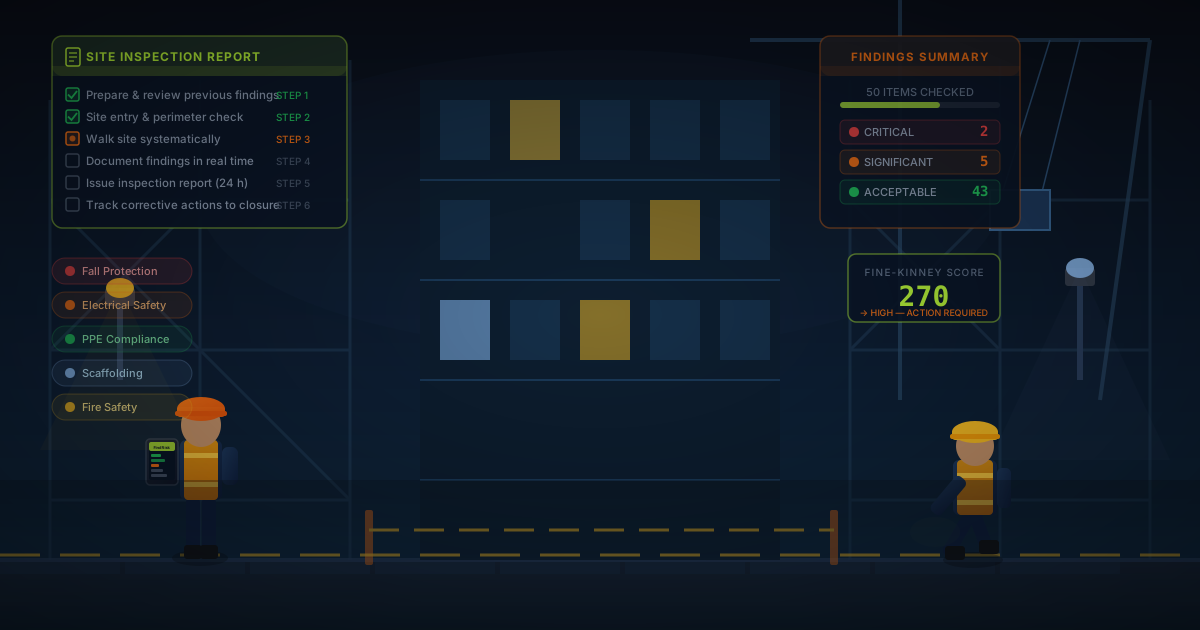
Step 1: Prepare Before You Arrive
Effective inspections start at the desk.
- Review previous inspection reports and check which corrective actions remain open
- Confirm current work permits, method statements, and site drawings
- Identify which trades and activities are in progress today
- Prepare your checklist or load it on your mobile inspection app
- Ensure you have the required PPE for site entry
Step 2: Conduct the Site Entry Check
- Signage and hazard warnings are visible and current
- Visitor registration and induction process is active
- PPE requirements are posted at the site entrance
- Perimeter fencing and unauthorized access controls are intact
Step 3: Walk the Site Systematically
Avoid random wandering — follow a defined route:
- Start from the perimeter and work inward, covering all active work zones
- Observe workers naturally before announcing your presence — behavior often reveals more than physical conditions
- Photograph every finding, both hazards and positive safe practices
- Record exact locations using grid references, zone names, or GPS coordinates
Step 4: Document Findings in Real Time
Paper forms create delays and can be lost. A mobile inspection app captures:
- Location, date, and time automatically
- Annotated photographs taken directly in the field
- Risk scores calculated automatically using the Fine-Kinney method (R = P × F × C)
- Responsible person and target date for each corrective action
Step 5: Issue the Inspection Report
Within 24 hours, issue a written report containing:
- Executive summary with total findings by risk level
- Full observation register with photos, risk scores, and corrective action assignments
- Positive observations to reinforce good practices
- Sign-off from site management
Step 6: Track Corrective Actions to Closure
An inspection without follow-up is a wasted effort. Use these closure timelines:
| Risk Score | Category | Closure Target |
|---|---|---|
| > 200 | High / Very High | Within 24 hours — stop work if necessary |
| 70–200 | Significant | Within 7 days |
| 20–70 | Possible | By next scheduled inspection |
| < 20 | Acceptable | No immediate action required |
To understand how these scores are calculated, read our complete guide to the Fine-Kinney method.
The 50-Point Construction Site Safety Inspection Checklist
Category 1 — General Site Conditions (7 items)
| # | Check Item |
|---|---|
| 1 | Site access routes are clear and well-maintained |
| 2 | Adequate lighting in all active work areas |
| 3 | Housekeeping maintained — no debris, material, or waste accumulation |
| 4 | Waste is segregated, labeled, and disposed of correctly |
| 5 | Pedestrian walkways and traffic routes are clearly marked |
| 6 | Traffic management plan is in place and being followed |
| 7 | Emergency access routes are clear and unobstructed at all times |
Category 2 — Fall Protection (7 items)
| # | Check Item |
|---|---|
| 8 | Edge protection (guardrails, toe boards) installed at all open edges ≥ 2 m / 6 ft |
| 9 | Safety nets or soft-landing systems in place where required |
| 10 | Personal fall arrest systems (harnesses) are inspected, in date, and worn correctly |
| 11 | Floor openings are covered, covers are secured and marked "Do Not Remove" |
| 12 | Rooftop work has a dedicated fall protection plan in place |
| 13 | Harness anchor points are load-tested and have current certification |
| 14 | Workers are trained in fall protection use and rescue procedures |
Category 3 — Scaffolding & Ladders (7 items)
| # | Check Item |
|---|---|
| 15 | Scaffolding was erected by a competent person and has a current inspection tag |
| 16 | Scaffold boards are fully planked with no gaps greater than 25 mm |
| 17 | Toe boards and guardrails are installed on all working platforms |
| 18 | Scaffold load capacity is not exceeded; materials not stockpiled on platforms |
| 19 | Ladders extend at least 1 m above the landing point |
| 20 | Ladders are secured at the top and/or base — no unsecured free-standing use |
| 21 | Ladders are inspected before each shift (no cracked rails or missing rungs) |
Category 4 — Electrical Safety (7 items)
| # | Check Item |
|---|---|
| 22 | Temporary electrical installations are protected by RCD / GFCI devices |
| 23 | Electrical cables are protected from physical damage (armored or elevated) |
| 24 | No unauthorized electrical connections, modifications, or bypass arrangements |
| 25 | Electrical distribution panels are locked and accessible only to authorized personnel |
| 26 | Overhead powerline exclusion zones are established and clearly marked |
| 27 | Portable tools are tested and tagged with a current inspection certificate |
| 28 | Lockout/Tagout (LOTO) procedures are in place for all energy-isolation work |
Category 5 — Plant, Equipment & Machinery (7 items)
| # | Check Item |
|---|---|
| 29 | All plant and equipment has a valid, current inspection certificate |
| 30 | Operators hold the correct licenses or certificates of competency for the equipment |
| 31 | Pre-start checks are completed and documented for each shift |
| 32 | Exclusion zones are established and enforced around operating plant |
| 33 | Reversing alarms, cameras, and spotters are in place for mobile plant |
| 34 | Machine guards are in place and have not been removed or bypassed |
| 35 | Lifting equipment (cranes, hoists, slings) has a current load test certificate |
Category 6 — Personal Protective Equipment (5 items)
| # | Check Item |
|---|---|
| 36 | All workers on site are wearing mandatory PPE (hard hat, hi-vis vest, safety boots) |
| 37 | Task-specific PPE is provided and in use (eye, hearing, respiratory protection) |
| 38 | PPE is in good condition — no cracks, tears, expiry, or damage |
| 39 | PPE storage is available, accessible, and organized |
| 40 | Workers have received training in the correct selection and use of their PPE |
Category 7 — Fire Safety & Hazardous Materials (5 items)
| # | Check Item |
|---|---|
| 41 | Fire extinguishers are positioned at designated points and inspected monthly |
| 42 | Hot work permits are issued and a fire watch is in place for all hot work |
| 43 | Flammable and combustible materials are stored away from ignition sources |
| 44 | Safety Data Sheets (SDS / MSDS) are available on site for all chemical products |
| 45 | Hazardous waste storage areas are correctly labeled, contained, and secured |
Category 8 — Emergency Preparedness (5 items)
| # | Check Item |
|---|---|
| 46 | Emergency muster point is clearly marked and communicated to all site personnel |
| 47 | First aid kit is stocked and accessible; a trained first aider is present on site |
| 48 | Emergency contact numbers are posted at the site office and main entrance |
| 49 | All workers have been briefed on the site emergency evacuation procedure |
| 50 | Incident and near-miss reporting procedure has been communicated to all workers |
Most Common Findings on Construction Sites
Based on OSHA enforcement data and international inspection trends, these are the violations safety professionals encounter most frequently:
| Finding | Risk Level | Typical Corrective Action |
|---|---|---|
| Missing or inadequate fall protection | High | Install guardrails within 24 hours; stop-work if immediate danger exists |
| Overloaded or untagged scaffolding | High | Clear scaffold, re-inspect, re-certify before returning to use |
| Unprotected or damaged electrical cables | Significant | Apply cable protection immediately; verify RCD function |
| No SDS available for chemicals on site | Significant | Obtain SDS from supplier within 24 hours |
| PPE non-compliance | Possible | Toolbox talk + re-issue of correct PPE; document repeat offenses |
| Poor housekeeping / trip hazards | Possible | Immediate site clean-up; supervisor accountability meeting |
| Hot work without a permit or fire watch | High | Stop work immediately; issue permit; deploy fire watch before resuming |
How AI Is Transforming Construction Site Inspections
Traditional paper-based inspections are slow, inconsistent, and difficult to track at scale. AI-powered mobile inspection tools change the entire workflow:
- Automated hazard detection from photos: AI analyzes inspection images and flags potential hazards, saving manual review time
- Mobile checklist completion: Complete all 50 check items on-site, in real time, directly from your smartphone
- Instant risk scoring: Fine-Kinney calculations are automated — no manual arithmetic or reference tables needed
- One-tap report generation: Professional PDF reports generated in seconds, including annotated photographs
- Corrective action tracking: Assign, monitor, and close findings digitally — full audit trail maintained automatically
Interested in how AI is reshaping the OHS profession? Read our article on how AI is transforming occupational health and safety.
FindRisk brings all of these capabilities into a single mobile app built specifically for OHS professionals.
Frequently Asked Questions
What is the purpose of a construction site safety inspection?
A construction site safety inspection identifies physical hazards and unsafe behaviors before they cause accidents or injuries. It verifies compliance with applicable regulations (OSHA, EU Directive 92/57, ISO 45001) and creates documented evidence that the duty holder has fulfilled their legal obligations.
How long does a full construction site inspection take?
A thorough weekly inspection typically takes between 1 and 3 hours, depending on site size and the number of active work activities. Using a mobile inspection app with a pre-built checklist can reduce this time by up to 50% while significantly improving documentation quality and consistency.
What qualifications are required to conduct a construction safety inspection?
Requirements vary by jurisdiction. In most countries, the primary inspector should hold a recognized OHS qualification such as the NEBOSH Construction Certificate, the OSHA 30-Hour Construction card, or an equivalent national credential. Routine daily supervisor checks can be conducted by trained site supervisors without a formal OHS qualification.
Can I use this checklist for OSHA compliance?
The 50-point checklist in this guide is based on widely accepted international standards and OSHA construction requirements (29 CFR 1926). However, your site may require additional items based on the specific scope of work. Always verify against the applicable local regulations and standards for your jurisdiction before treating any generic checklist as complete.
How does the Fine-Kinney method apply to inspection findings?
During an inspection, each identified finding is assigned a risk score using the Fine-Kinney formula: R = Probability × Frequency × Consequence. This score determines the urgency of the corrective action required. Findings scoring above 200 require urgent or immediate action, while those below 20 can be monitored. Read our complete Fine-Kinney method guide for a detailed walkthrough with scoring tables.
Conclusion
A structured construction site safety inspection — conducted systematically, documented thoroughly, and followed up consistently — is one of the most powerful risk management tools available to any OHS professional.
The 50-point checklist in this guide covers the most critical inspection categories across every major construction hazard type. Use it as your starting point, then adapt it to your site's specific activities, applicable regulations, and risk profile.
Download FindRisk to complete this checklist digitally in the field, annotate hazard photos in real time, and generate professional inspection reports in seconds — all from your mobile device.
Try FindRisk
Ready to modernize your safety workflow?
Conduct AI-powered risk assessments, generate reports instantly, and keep your team safe — anywhere, anytime.