
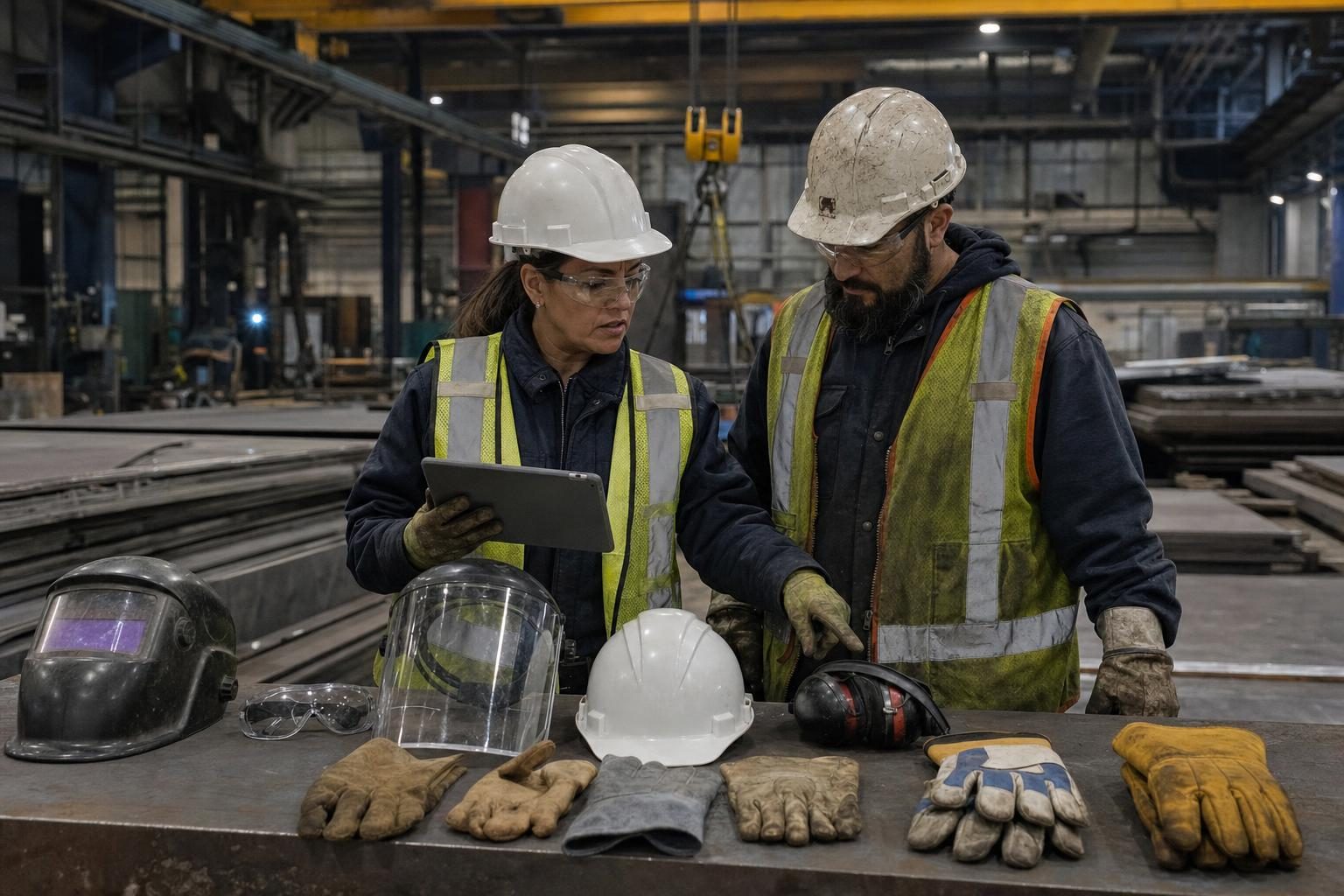
PPE Hazard Assessment: Selection Matrix and Worked Example
A PPE hazard assessment is a documented review of each work area and task that identifies hazards which require personal protective equipment, then selects PPE matched to those hazards and to the people who wear it. Under OSHA 29 CFR 1910.132(d), US employers must perform it and verify it with a written certification.
Most PPE hazard assessment forms online are blank checklists: tick "eyes", tick "hands", write "gloves". That satisfies the paperwork but not the purpose. The assessment exists to answer a more specific question: which hazard, at which task, needs which protective characteristic, and which product meets it?
This guide walks through that reasoning. You will find a hazard-to-PPE selection matrix built on OSHA's own hazard categories, a fully worked example for a fabrication bay with six tasks, a sample certification, and the points where the US, UK, EU and Turkish rules differ.
A Fabrication Bay With Six Tasks and One PPE Rule
Picture a steel fabrication bay. This is a fictional example built for this guide. Fourteen people work there on the day shift. They weld brackets with MIG, grind welds flush, cut plate with an oxy-fuel torch, wipe parts with solvent before painting, and move plate with an overhead crane.
The current PPE rule is a sign at the door: "Safety glasses, safety shoes and gloves at all times." Everyone follows it. Yet the welder's helmet is a shade that nobody chose on purpose, the person wiping parts wears the same cotton-knit gloves as the person handling plate, and the grinder operator wears foam earplugs that were never matched to a noise measurement.
None of this shows up on a blank checkbox form. A real PPE hazard assessment would catch all three, because it starts from tasks and hazards, not from a list of equipment. The rest of this guide does that assessment step by step.
What Is a PPE Hazard Assessment?
A PPE hazard assessment is a workplace evaluation that determines whether hazards are present, or likely to be present, that make personal protective equipment necessary, and that records which PPE is selected for each hazard. OSHA requires it in 29 CFR 1910.132(d). Once hazards are found, the employer must:
- select, and have each affected employee use, PPE that protects against the identified hazards;
- communicate the selection decisions to each affected employee;
- select PPE that properly fits each affected employee.
The assessment is then verified by a written certification. It is not a full workplace risk assessment. It covers the residual hazards that remain after other controls, and it focuses on protection of the body.
Other jurisdictions require the same thinking under different names:
| Jurisdiction | Rule | What the assessment must do |
|---|---|---|
| United States | OSHA 29 CFR 1910.132(d) | Assess hazards that require PPE, select PPE, communicate, ensure fit, certify in writing |
| United Kingdom | PPE at Work Regulations 1992, regulation 6 | Assess risks not avoided by other means, define the characteristics PPE needs, compare available PPE, check compatibility of PPE worn together; review when no longer valid |
| European Union | Directive 89/656/EEC | Assess PPE before choosing it; Annex I offers a risk survey table by body part |
| Türkiye | KKD Kullanılması Hakkında Yönetmelik (2013), Article 7 | Analyze risks not prevented by other methods, define required PPE characteristics, compare candidate PPE against them |
The common thread is the sequence: hazard, required characteristic, product. The US rule adds a specific written certification.
When Is a PPE Hazard Assessment Required?
A PPE hazard assessment is required in any US workplace covered by 1910.132 where hazards are present or likely to be present that require PPE. "Likely to be present" matters: a task done once a month still counts.
Two scope details trip people up. First, 1910.132(g) says the assessment and training paragraphs apply to eye and face (1910.133), head (1910.135), foot (1910.136), hand (1910.138) and fall protection (1910.140). They do not apply to respiratory protection (1910.134) or electrical protective equipment (1910.137), which have their own rules. Respirators need a written respiratory protection program, a medical evaluation before fit testing, and fit testing before first use and at least annually for tight-fitting facepieces (29 CFR 1910.134). Second, hearing protection is governed by the noise standard, 1910.95, which ties it to measured exposure.
PPE also comes last. The Turkish regulation states that the employer gives collective protection priority over personal protection, and the EU directive applies PPE only where risks cannot be avoided or sufficiently limited by collective or organizational means. Before you select PPE for a hazard, check whether it can be removed or engineered out. Our hierarchy of controls guide covers that decision.
How to Conduct a PPE Hazard Assessment in 6 Steps
OSHA's non-mandatory Appendix B to Subpart I describes a survey, organize, analyze and select process. Expanded into a field method, it becomes six steps.
1. Divide the area into tasks
List each task done in the area, including occasional ones such as maintenance and cleaning. Assess tasks, not job titles: one person may grind in the morning and handle chemicals in the afternoon. A job safety analysis already split into steps is a good starting point.
2. Walk through and identify hazard sources
Appendix B groups hazards into seven basic categories: impact, penetration, compression (roll-over), chemical, heat, harmful dust and light (optical) radiation. During the walk, look for moving machinery, high temperatures, chemical use, dust sources, welding and cutting, falling or sharp objects, rolling or pinching objects, and electrical hazards. Review injury and accident records for the area too.
3. Estimate the potential for injury
For each task and hazard, estimate how serious an injury could be and how often people are exposed. Appendix B asks you to consider exposure to several hazards at once, such as sparks and flying particles at the same grinding station.
4. Define the protective characteristic needed
Write down what the PPE must do before you choose a product: "resist impact from grinding fragments", "filter arc radiation for 160–250 A MIG", "resist the solvent in use for the length of the task". The UK and Turkish rules both require this step, including risks the PPE itself creates, such as reduced vision or heat stress.
5. Select PPE and check fit and compatibility
Compare products against the characteristic. Appendix B advises selecting PPE that gives more than the minimum protection required, and stresses fit: "PPE that fits poorly will not afford the necessary protection." Check that items worn together still work, for example goggles under a face shield.
6. Communicate, certify and set review triggers
Tell each affected employee what was selected and why, complete the written certification, train, and decide what will trigger a reassessment.
Hazard to PPE Selection Matrix
A hazard to PPE selection matrix links each hazard category to the body part at risk and to the type of PPE and selection rule that addresses it. It turns the seven Appendix B categories into a quick reference for step 5.
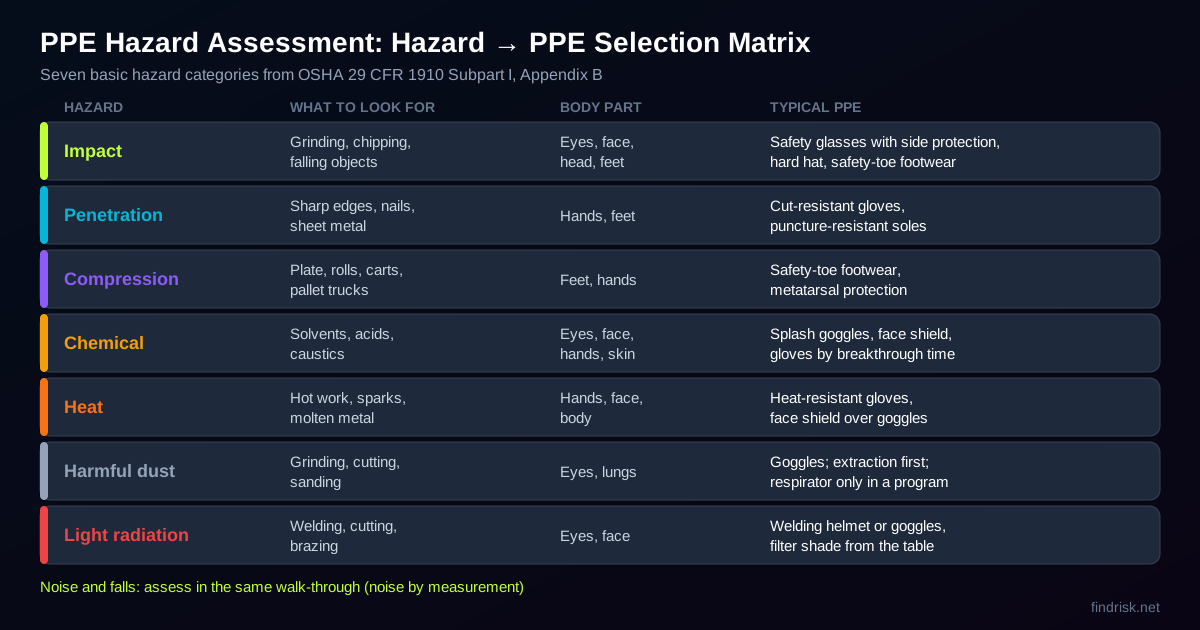
| Hazard category | Typical sources | Body part | PPE type | Selection rule |
|---|---|---|---|---|
| Impact | Grinding, chipping, falling objects | Eyes, face, head, feet | Safety spectacles with side protection or goggles; hard hat; safety-toe footwear | Side protection where flying objects (1910.133(a)(2)); helmets per ANSI Z89.1 (1910.135) |
| Penetration | Sharp edges, nails, sheet metal | Hands, feet | Cut-resistant gloves; puncture-resistant soles | Glove chosen on task, conditions and duration (1910.138(b)) |
| Compression (roll-over) | Plate, rolls, carts, pallet trucks | Feet, hands | Safety-toe footwear, metatarsal protection | ASTM F2412/F2413-2005 or ANSI Z41 (1910.136(b)) |
| Chemical | Solvents, acids, caustics | Eyes, face, hands, skin | Splash goggles, face shield for severe exposure, chemical gloves | Glove by the component with the shortest breakthrough time (Appendix B) |
| Heat | Hot work, sparks, molten metal | Hands, face, body | Heat-resistant gloves, face shield over goggles or spectacles | Thermal burns are a listed hand hazard (1910.138(a)) |
| Harmful dust | Grinding, cutting, sanding | Eyes, lungs | Goggles; respirator only within a 1910.134 program | Extraction first; respirator needs program, medical evaluation, fit test |
| Light radiation | Welding, cutting, brazing | Eyes, face | Welding helmet or goggles with filter lens | Minimum shade from the 1910.133(a)(5) table |
Noise and falls are not in the Appendix B list, but belong in the same assessment. Noise is decided by measurement under 1910.95. Fall protection is covered by 1910.140; our working at height checklist covers harness inspection.
Worked Example: PPE Hazard Assessment for a Fabrication Bay
The worked example below applies the six steps to the fictional fabrication bay. Each row shows the hazard, the characteristic the PPE needs, and the selected PPE with the rule behind it.
| # | Task | Hazards (Appendix B category) | Required characteristic | Selected PPE |
|---|---|---|---|---|
| 1 | MIG welding brackets, 180–220 A | Light radiation; heat (spatter); welding fume (dust) | Filter arc radiation at 160–250 A; resist spatter burns | Welding helmet, filter shade 10 minimum (1910.133 table for GMAW 160–250 A); heat-resistant welding gloves. Fume: local exhaust first, then exposure monitoring; respirator only if monitoring shows it is needed, under a 1910.134 program |
| 2 | Grinding welds flush | Impact (fragments); heat (sparks); noise | Impact-rated eye protection; spark shielding for the face; hearing protection matched to exposure | Safety spectacles with side protection plus a face shield over them; hearing protectors (see noise note below); gloves rated for abrasion |
| 3 | Moving plate by crane and by hand | Compression; penetration (sharp edges); impact (suspended load) | Toe protection against dropped plate; cut resistance; head protection | Safety-toe boots meeting ASTM F2413-2005; cut-resistant gloves; hard hat meeting ANSI Z89.1 |
| 4 | Wiping parts with solvent | Chemical (splash, skin absorption) | Splash protection for eyes; glove material resistant to the solvent for the task duration | Chemical splash goggles; gloves selected from the SDS by the component with the shortest breakthrough time, replaced on a set schedule |
| 5 | Oxy-fuel cutting of 12 mm plate | Light radiation; heat (sparks, hot metal) | Filter for light cutting; burn protection | Cutting goggles or shield, shade 3 minimum (oxygen cutting under 1 in); heat-resistant gloves |
| 6 | Supervisor or visitor walking through | Impact (fragments from nearby grinding); noise | Basic eye and hearing protection in marked zones | Safety spectacles with side protection; hearing protectors in the marked grinding zone; safety footwear |
The noise note
Suppose a dosimeter survey at the grinding station shows an 8-hour time-weighted average of 92 dBA (a figure assumed for this example). Under 29 CFR 1910.95, 85 dBA triggers a hearing conservation program and hearing protectors must be made available at no cost. 92 dBA is above the 90 dBA permissible exposure limit, so feasible engineering or administrative controls come first, and hearing protectors must be worn. The assessment should record the measured level, not just "earplugs".
What changed against the sign at the door
- The welder's shade is now a documented minimum tied to the current range.
- The solvent task has a glove chosen for the chemical, not a general-purpose knit glove.
- Hearing protection is tied to a measured exposure.
- The fume question is routed to the respiratory program instead of being solved with a dust mask.
- Gloves differ by task: welding, abrasion, cut and chemical.
Example Certification of Hazard Assessment
OSHA 1910.132(d)(2) requires a written certification that identifies the workplace evaluated, the person certifying that the evaluation was performed, the date(s) of the assessment, and identifies the document as a certification of hazard assessment. The example below contains those four elements.
CERTIFICATION OF HAZARD ASSESSMENT Workplace evaluated: Fabrication Bay 2, tasks 1–6 (welding, grinding, plate handling, solvent wiping, oxy-fuel cutting, walk-through) Date(s) of assessment: 14 and 15 September 2026 Certified by: J. Doe, Safety Coordinator I certify that the workplace hazard assessment for the area above was performed as required by 29 CFR 1910.132(d). The task-by-task hazards and selected PPE are attached. Signature: ______________________
The certification is one page. The working part is the attached task table, so keep the two together and date both.
Training has its own certification under 1910.132(f)(4): the name of each employee trained, the date(s) of training, and the subject of the certification. Training must cover when PPE is necessary, what PPE is necessary, how to don, doff, adjust and wear it, its limitations, and its care, maintenance, useful life and disposal. Each employee must demonstrate understanding before working with the PPE.
Training, Fit and Reassessment
Fit
Fit is part of the legal duty, not a comfort question: 1910.132(d)(1)(iii) requires PPE that properly fits each affected employee. Stock more than one size of gloves, hard hat suspensions and safety-toe boots, and check that eye protection seals where it should. The Turkish regulation also requires PPE to suit the wearer's ergonomic needs and state of health.
Payment
OSHA 1910.132(h) requires employers to provide PPE at no cost, with narrow exceptions such as non-specialty safety-toe footwear and non-specialty prescription safety eyewear that employees may wear off the job site. UK and Turkish rules also require PPE to be provided free of charge.
When to reassess
OSHA does not set a fixed interval for the PPE hazard assessment. Appendix B describes reassessment as an ongoing duty: evaluate new equipment and processes, review accident records, and re-check whether previously selected PPE is still suitable. In practice, reassess when:
- a new task, machine, chemical or process is introduced;
- an injury or near miss involves a body part the PPE should have protected;
- a PPE model, material or supplier changes (the Turkish regulation requires the assessment to be repeated if any part of the PPE changes);
- measurements change, for example a new noise survey;
- workers report that PPE does not fit, fogs, overheats or gets in the way.
Retraining under 1910.132(f)(3) follows the same triggers: workplace or PPE changes that make training obsolete, or signs that an employee lacks the required understanding or skill.
Common Mistakes in PPE Hazard Assessments
1. Writing the PPE before the hazard
The form starts with "gloves, glasses, boots" and works backward. The result is generic PPE that protects against nothing in particular. Start from the task and the hazard.
2. One glove for every task
OSHA's Appendix B notes it is unaware of any glove that protects against all hand hazards. A knit glove that is fine for handling dry parts may give little protection against a solvent. Turkey's occupational safety research institute (İSGÜM) found exactly this in its 2022 field analysis of 10 metal and construction workplaces: mechanical-protection gloves used where chemical-protection gloves were needed (ÇSGB, İSGÜM field analysis report).
3. Dust masks for vapors
The same report found dust masks in use where gas masks were needed for hazardous chemicals. A dust mask is the wrong filter type for gases and vapors. Any respirator decision belongs in a respiratory protection program, with exposure data behind it.
4. Treating the certification as the assessment
A signed one-page certification with no task table is a record that something happened, not evidence of what was assessed. Inspectors and investigators will ask to see the hazards and the reasoning.
5. Ignoring fit, compatibility and storage
Ill-fitting PPE does not protect, and items worn together can defeat each other. İSGÜM also observed PPE kept in clothes lockers or left in the work area, with no separate storage. Add storage, cleaning and inspection before use to the assessment output.
6. Never reassessing
The assessment is dated the day the shop opened, while the processes, chemicals and suppliers have changed since. Tie it to change management so that every new task or chemical triggers a review.
How FindRisk Supports PPE Hazard Assessments
FindRisk helps with the walk-through, which is where most PPE assessments go wrong. You can use the AI checklist generator to build a PPE hazard survey for a specific area, such as a welding bay or a solvent room, organized around the hazard categories in this guide, and complete it on your phone.
When you see a missing face shield at a grinder or a knit glove at a solvent station, you mark the hazard directly on a photo, and AI analysis helps flag other hazards in the same frame. Each finding can be scored with the built-in Fine-Kinney method, so you can rank which PPE gaps to close first. FindRisk then generates a professional report in seconds with photos, scores and actions, which you can attach to your PPE hazard assessment and certification. It runs on iOS and Android.
Frequently Asked Questions
Is a written PPE hazard assessment required by OSHA?
Yes. OSHA 29 CFR 1910.132(d)(2) requires employers to verify the workplace hazard assessment through a written certification that names the workplace evaluated, the person certifying it, and the date(s) of the assessment, and identifies the document as a certification of hazard assessment. OSHA does not prescribe a form, but a task-by-task hazard and PPE table attached to the certification is the practical way to show what was assessed.
How often should a PPE hazard assessment be updated?
OSHA does not set a fixed interval. Its Appendix B treats reassessment as ongoing: evaluate new equipment and processes, review accident records, and re-check whether the PPE already selected is still suitable. Update the assessment whenever a task, chemical, machine or PPE model changes, after an injury or near miss, and when new measurements such as noise surveys come in. You can also set a fixed review interval in your own procedure.
Who can perform a PPE hazard assessment?
The duty sits with the employer, and 1910.132(d) does not name a required qualification for the assessor. In practice it should be someone who knows the tasks and the hazards, typically a safety professional working with supervisors and the employees who do the work. The Turkish regulation goes further and requires the employer to consult employee representatives before deciding which PPE will be used.
Does the PPE hazard assessment cover respirators?
No. Under 1910.132(g), the hazard assessment and training requirements of 1910.132 do not apply to respiratory protection, which is governed by 1910.134. Respirators require a written respiratory protection program, a medical evaluation before fit testing, and fit testing before first use and at least annually for tight-fitting facepieces. Record airborne hazards in your PPE assessment, then route the respirator decision to that program.
Does the employer have to pay for PPE?
In the US, yes, with narrow exceptions. OSHA 1910.132(h) requires PPE to be provided at no cost, but employers need not pay for non-specialty safety-toe footwear or non-specialty prescription safety eyewear that employees may wear off the job site. Employers must not require employees to buy their own PPE. UK and Turkish rules also require PPE to be provided free of charge.
What is the difference between a JSA and a PPE hazard assessment?
A job safety analysis breaks one job into steps and identifies hazards and controls for each step, across the whole hierarchy of controls. A PPE hazard assessment focuses on the hazards that remain and require protective equipment, and selects and certifies that equipment. A good JSA feeds the PPE assessment: its hazard list per step is the starting point for selecting PPE per task.
Conclusion
A PPE hazard assessment is only useful if it links each task to a specific hazard, each hazard to a protective characteristic, and each characteristic to a product that fits the person wearing it. The fabrication bay example shows the difference: the blanket "glasses, shoes, gloves" rule became a documented weld shade, a chemical glove chosen by breakthrough time, a measured noise level and a respiratory decision handled in the right program.
Use the matrix and the worked table as a template for your own areas, keep the certification and the task table together, and reassess every time a task, chemical or PPE model changes. For chemical tasks, pair it with our chemical safety guide.
To run your next PPE walk-through on your phone, download FindRisk, generate a PPE hazard checklist for the area, mark the gaps on photos and share a scored report the same day.
Try FindRisk
Ready to modernize your safety workflow?
Conduct AI-powered risk assessments, generate reports instantly, and keep your team safe — anywhere, anytime.