
Systematic Cause Analysis Technique (SCAT): Steps and Example
SCAT (Systematic Cause Analysis Technique) is a chart-based incident analysis method that traces a loss back through five fixed levels: the loss, the incident (a contact with energy or a substance), the immediate causes, the basic causes and the lack of management control behind them. Investigators select the categories that apply at each level, so every analysis reaches the management system and results stay comparable across sites and investigators.
Most pages about SCAT are either the licence holder's product pages or scanned copies of the chart. Neither explains how an investigator works through the levels, what "basic causes" and "lack of control" mean when you are standing in a plant with a half-written report, or when SCAT is the wrong tool. This guide does that with one fictional incident taken through every block of the chart, a comparison with 5 Whys, Fishbone, Tripod Beta and bow-tie, and the legal context in which the analysis sits.
SCAT is one of the five methods in our root cause analysis guide. That post explains when to pick each method. This one goes deep on SCAT alone.
A Splash at the Dosing Station
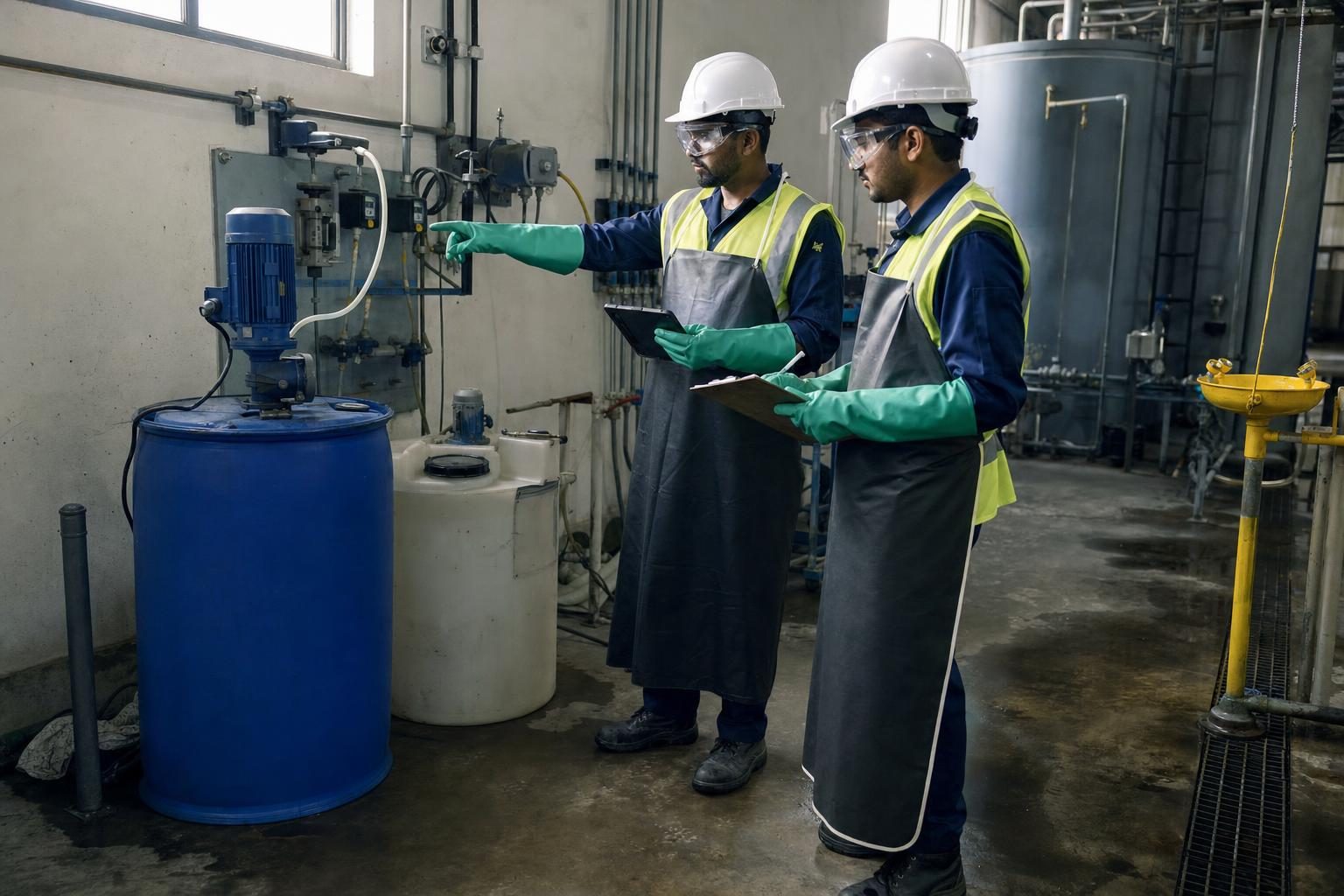
Picture the water-treatment room of a textile finishing plant. This is a fictional case built for this guide. On the evening shift an operator has to top up the 60-liter day tank that feeds sodium hypochlorite into the effluent line. The drum pump that normally does the transfer has been out of service for nine days, so, as every shift has done since it failed, the operator fills a bucket from the 200-liter drum and pours it into the tank. The bucket catches on the tank rim and the chemical splashes up into the operator's face. They are wearing safety glasses, not goggles. The eyewash station is 12 meters away behind two pallets of salt bags. A colleague helps them to it, the site nurse sends them to hospital for irrigation, and they are off work for three days.
The first report, written the same night by the shift supervisor, has one cause and one action: "Operator did not wear chemical goggles. Retrain operator." The safety manager reads it the next morning and asks for the incident to be taken through SCAT instead. The rest of this guide shows what the chart surfaced that the one-line report did not.
What Is SCAT?
SCAT is a structured way of classifying the causes of an incident against a pre-printed chart of categories arranged in cause levels. DNV, which licenses the method, describes it as "a simple but powerful tool to investigate the causation of loss events" that operational staff use "to quickly identify the corrective actions necessary" to prevent similar events (DNV, SCAT). It is sold as a poster in 30 languages, as an app with a demo mode and under an enterprise licence, so the chart itself is not reproduced here. This guide describes its structure and shows how to use it.
The method comes from the International Loss Control Institute (ILCI), the organization Frank Bird founded in 1974, and it is built on the loss causation model that Bird and George Germain set out in Practical Loss Control Leadership (1985). ILCI was bought by Det Norske Veritas in 1991, which is why SCAT is a DNV product today (Germain and Clark, tribute to Frank Bird, Professional Safety, 2007). The same lineage produced the International Safety Rating System (ISRS), so SCAT is common in companies that are audited against ISRS and in the oil, gas and marine sectors where DNV markets it.
| Term | Meaning |
|---|---|
| Loss causation model | Bird's five-stage model: lack of control → basic causes → immediate causes → incident → loss. SCAT is the chart that operationalizes it |
| Immediate (direct) causes | The substandard acts and substandard conditions present at the moment of contact. What you could have seen, heard or smelled |
| Basic (underlying) causes | The personal factors and job factors that explain why the immediate causes existed |
| Lack of control | Gaps in the management system: an inadequate program, inadequate program standards or inadequate compliance with the standards |
| Contact | The incident itself, described as an exchange of energy or substance: struck by, caught in, fall to lower level, contact with a chemical, and so on |
| Control action needs | The program elements that need work, rated for program (P), standards (S) and compliance (C) |
| BSCAT | Barrier-based SCAT: the same cause coding combined with a barrier (bow-tie style) view of what should have stopped the event (DNV) |
| MSCAT | Marine SCAT, adapted to shipboard accidents and incidents |
Two things SCAT is not. It is not an evidence-gathering method: it assumes you already have a timeline, witness accounts, photographs and records, which is the work described in our incident investigation guide. And it is not a single-cause method: the chart expects several immediate causes, several basic causes and several control gaps for one incident. An analysis with one tick per level has almost certainly stopped early.
The Loss Causation Model: Five Levels
The loss causation model reads in two directions. Read from left to right, it shows how losses happen: a weakness in management control allows basic causes to exist, basic causes produce substandard acts and conditions, those lead to a contact with energy or a substance, and the contact causes a loss. Read from right to left, it is an investigation procedure: start at the loss and ask, at each level, what made the level to its right possible. Germain and Clark describe exactly this double use: "The loss causation model showed how lack of control led to accident losses", and read backwards it "serves as a problem-solving model for incident investigation" (Germain and Clark, 2007).
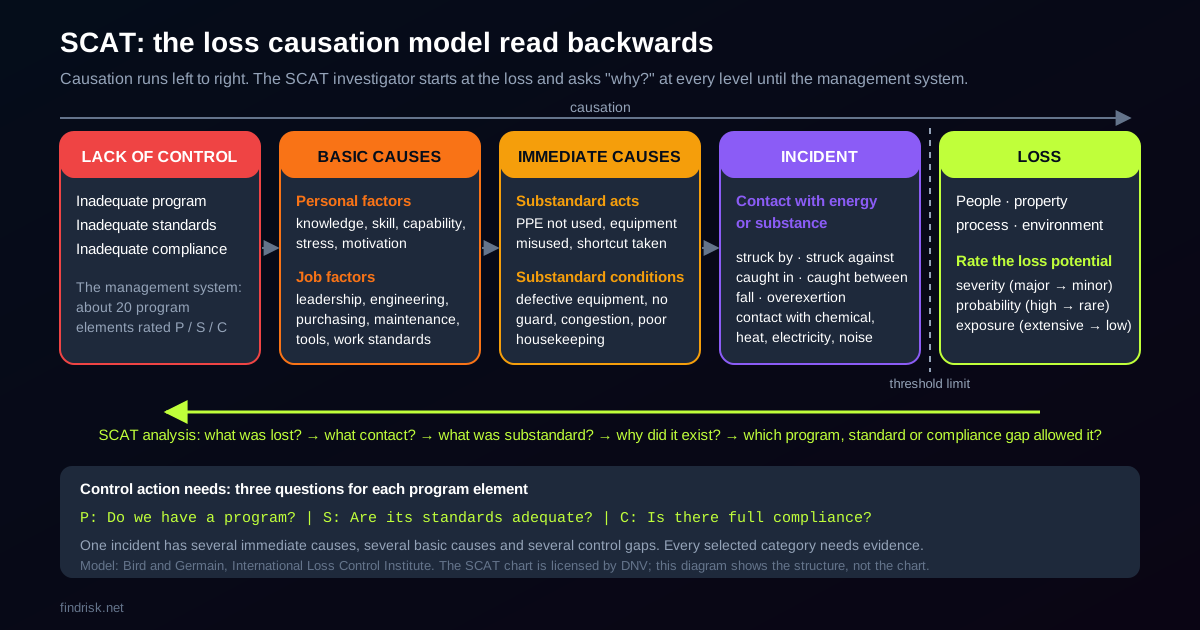
| Level | What it contains | The investigator's question | In the splash case |
|---|---|---|---|
| 1. Loss | Harm to people, property, process or environment, plus the potential loss if conditions had been slightly different | What was lost, and what could have been lost? | Eye irritation, three days off; potential: permanent eye damage |
| 2. Incident (contact) | The exchange of energy or substance that produced the loss | What type of contact happened? | Contact with a corrosive chemical (splash) |
| 3. Immediate causes | Substandard acts and substandard conditions at the moment of contact | What was different from the safe way of doing this, and what in the environment was below standard? | Open-bucket transfer; glasses instead of goggles; pump out of service; blocked eyewash; PPE not at the station |
| 4. Basic causes | Personal factors (knowledge, skill, capability, stress, motivation) and job factors (leadership, engineering, purchasing, maintenance, tools, work standards) | Why did each immediate cause exist? | No task-specific chemical training; no transfer procedure; nine-day repair with no priority; workaround accepted by supervision |
| 5. Lack of control | Inadequate program, inadequate standards, inadequate compliance with standards | Which program element should have prevented the basic causes, and did it fail for want of a program, a standard or compliance? | No standard for safety-critical equipment downtime; inspection checklist without eyewash or pump items; no temporary-change approval |
A later refinement drew a "threshold limit" line between the incident and the loss, borrowing William Haddon's idea of harm as an uncontrolled energy exchange (Germain and Clark, 2007). In practice it means the same contact can produce no loss, a near miss or a fatality depending on the energy involved, which is why SCAT asks you to rate loss potential and not only actual loss.
SCAT's levels against HSE's terms
Regulators use similar but not identical words. The UK Health and Safety Executive defines immediate causes as "the unsafe acts or conditions that initiated the undesired event(s)" and underlying causes as "the failings that allowed the unsafe acts or conditions" to arise, adding that underlying causes usually stem from "organisational or safety management systems failings" (HSE, investigation core objectives). HSE also agrees that there are no universal definitions of immediate, underlying and root causes (NEBOSH, quoting HSE). Mapped onto SCAT: HSE's immediate causes are SCAT's immediate causes; HSE's underlying causes cover both SCAT's basic causes and its lack of control; what HSG245 calls the root cause, "the failure from which all other failings grow", sits in SCAT's lack-of-control block.
Inside the SCAT Chart: What Each Block Contains
The chart is a single large page. Older copies that circulate publicly show six blocks, and the structure below follows them; DNV's current licensed chart may group or word items differently, so treat the counts as rounded.
- Description of the incident. A short factual statement of what happened, with the date, place and people involved.
- Evaluation of loss potential if not controlled. Three ratings: loss severity potential (major, serious or minor, often lettered A, B, C), probability of recurrence (high, moderate, rare) and frequency of exposure (extensive, moderate, low). This block decides how much investigation effort the event deserves. A near miss rated "major, high, extensive" gets the full treatment; a minor cut with low exposure gets a short one.
- Type of contact or near contact with energy or substance. Around ten contact types: struck against, struck by, fall to a lower level, fall on the same level, caught in, caught between, contact with (electricity, heat, cold, chemicals, noise), overexertion. One incident can have more than one contact.
- Immediate (direct) causes. Two lists: substandard acts (about twenty items in older copies, such as operating equipment without authority, using defective equipment, failing to use PPE properly, improper lifting, servicing equipment in operation) and substandard conditions (about ten, such as inadequate guards, defective tools or equipment, congestion, inadequate warning systems, poor housekeeping, hazardous environmental conditions).
- Basic (underlying) causes. Two groups: personal factors (around seven: inadequate physical or mental capability, physical or mental stress, lack of knowledge, lack of skill, improper motivation) and job factors (around eight: inadequate leadership or supervision, inadequate engineering, inadequate purchasing, inadequate maintenance, inadequate tools and equipment, inadequate work standards).
- Control action needs (lack of control). Around twenty loss-control program elements, such as leadership and administration, planned inspections, incident investigation, employee training, personal protective equipment, engineering controls, purchasing controls and maintenance programs. Each relevant element is rated with three questions: do we have a program for this activity, are its standards adequate, and is there full compliance with the standards (P, S, C).
The chart's real value is the cross-referencing. Each immediate cause points to the basic causes most often behind it, and each basic cause points to the program elements most often behind that. The chart does the remembering, so a supervisor at 02:00 is prompted to ask about purchasing and maintenance, not only about the person who got hurt.
How to Run a SCAT Analysis in 7 Steps
Step 1: Gather the evidence first
SCAT classifies; it does not discover. Before you open the chart you need the scene secured, photographs, the equipment state, the relevant records (maintenance logs, training records, risk assessment, procedures) and interviews with the people involved and with witnesses. Build a timeline from these. Our incident investigation guide covers that work in detail, including how to interview without assigning blame.
Step 2: Describe the loss and rate the loss potential
Write one factual paragraph. Then rate severity potential, probability and frequency of exposure. Be honest about potential: the question is not "how bad was it" but "how bad could this contact have been with slightly different timing or energy". This rating is also how SCAT connects to your near miss program: a near miss with major potential is investigated like an injury.
Step 3: Identify the contact
Name the energy or substance exchange. This sounds trivial, but it anchors the analysis in physics rather than behavior. "Contact with a corrosive chemical" leads to questions about containment, transfer methods and emergency washing; "operator was careless" leads nowhere.
Step 4: List every immediate cause with its evidence
Go down the substandard acts and conditions and mark each one that was present at the moment of contact, with the evidence that proves it (a photograph, a log entry, a statement). Write them as observations, not judgments: "transfer done with an open bucket" rather than "operator chose an unsafe method". Our post on unsafe acts and unsafe conditions explains how to record both halves without blame. Expect several immediate causes for a typical injury, not one.
Step 5: For each immediate cause, select the basic causes
Take the immediate causes one at a time and ask why each existed. The chart's personal and job factors are the menu of answers; the evidence decides which apply. Most immediate causes have at least one job factor behind them even when a personal factor is obvious. "Lack of knowledge" is only a finding if you can show what training was required and that it was not given.
Step 6: For each basic cause, identify the control action needs
For every basic cause, find the program element that should have prevented it and ask the three questions: is there a program, are its standards adequate, and is there compliance. This is where "retrain the operator" turns into "the maintenance program has no standard for safety-critical equipment downtime". OSHA's guidance on investigations asks the same question in plain words: "If a procedure or safety rule was not followed, why was the procedure or rule not followed?" and then why that was not identified and addressed earlier (OSHA, incident investigation).
Step 7: Write corrective actions at all three levels and verify them
Each immediate cause, basic cause and control gap needs an action with an owner and a date. Prefer actions higher in the hierarchy of controls: a closed transfer system beats a PPE reminder. Then schedule a check that the actions worked. ISO 45001 Clause 10.2 asks organizations not only to determine the causes of an incident but to consider whether similar incidents have occurred or could occur elsewhere and to review the effectiveness of the action taken; SCAT's shared categories make the "elsewhere" question answerable across sites. Our corrective action and CAPA guide covers tracking and verification.
Worked Example: The Hypochlorite Splash Through SCAT
The case is fictional. The evidence listed is what a real investigation of such an event would typically produce.
Description and loss potential
| Item | Entry |
|---|---|
| Description | Evening shift, water-treatment room. Operator transferring sodium hypochlorite from a 200-liter drum to the 60-liter day tank with an open bucket because the drum pump had been out of service for nine days. Bucket caught on the tank rim; splash to face. Safety glasses worn. Eyewash 12 m away, access blocked by two pallets. Hospital irrigation, three days' absence |
| Loss severity potential | Major (A). The product's safety data sheet warns of serious eye damage; a direct splash into the eye could have caused permanent injury |
| Probability of recurrence | High. The bucket transfer had been done at least once per shift for nine days |
| Frequency of exposure | Extensive. Every shift, every day since the pump failed |
| Decision | Full analysis with a three-person team: safety officer, maintenance lead, an operator from another shift |
Contact
Contact with a corrosive substance (chemical splash to face and eyes).
Immediate causes
| # | Immediate cause | Type | Evidence |
|---|---|---|---|
| IC1 | Transfer made with an open bucket instead of the pump | Substandard act (improper use of equipment) | CCTV; statements from three shifts confirming the practice since the pump failed |
| IC2 | Safety glasses worn instead of chemical goggles and face shield | Substandard act (PPE not used properly) | Operator's statement; glasses recovered at the scene |
| IC3 | Drum pump out of service, no replacement | Substandard condition (defective equipment) | Maintenance work order opened nine days earlier, status "awaiting parts" |
| IC4 | Eyewash station blocked by stored pallets | Substandard condition (congestion, inadequate emergency equipment access) | Photographs; the pallets had been there about two weeks per the storekeeper |
| IC5 | Goggles and face shield not available at the dosing station | Substandard condition (PPE not at point of use) | PPE kept in a locker in the main building; no PPE at the station |
Basic causes
| Immediate cause | Basic cause | Factor type | Evidence |
|---|---|---|---|
| IC1 bucket transfer | Pump repair open nine days with no priority rule for safety-critical equipment | Job factor: inadequate maintenance | Work-order system has no priority code or maximum downtime for safety-critical items |
| IC1 | No spare pump; replacement ordered on standard three-week lead time | Job factor: inadequate purchasing | Purchasing records; no critical-spares list for the treatment room |
| IC1 | Supervisor knew about the bucket method and accepted it to keep dosing going | Job factor: inadequate leadership and supervision | Supervisor's statement; no temporary risk assessment or approval |
| IC1 | Operators understood an empty day tank as a line stop and "keeping it running" as the priority | Personal factor: improper motivation (production pressure) | Statements from two shifts; shift handover notes |
| IC2 glasses | Operator trained on general PPE, never on this product's safety data sheet or the transfer task | Personal factor: lack of knowledge | Training records: general induction only; no task-specific record |
| IC2 | Risk assessment listed "chemical splash" with the control "PPE", without specifying type or a transfer method | Job factor: inadequate work standards | Risk assessment, last reviewed two years earlier; no written transfer procedure |
| IC5 PPE not at station | No rule that task PPE is stored at the point of use | Job factor: inadequate tools and equipment, inadequate work standards | Site PPE matrix lists items but not locations |
| IC4 eyewash blocked | No marked keep-clear zone; monthly store inspection checklist has no eyewash item | Job factor: inadequate work standards, inadequate supervision | Checklist; last two inspections recorded "no findings" with the pallets in place |
Lack of control (control action needs)
| Program element | P: program exists? | S: standards adequate? | C: compliance? | Finding |
|---|---|---|---|---|
| Maintenance management | Yes | No | Not applicable | No standard defines safety-critical equipment, a maximum downtime or interim controls while it is down |
| Purchasing and engineering controls | Partly | No | Not applicable | No critical-spares policy for safety-critical items; standard lead times accepted |
| Procedures and work standards | Yes | No | Not applicable | No written procedure for chemical transfer; the risk assessment names PPE without specifying it |
| Employee training | Yes | No | No | No requirement for task-specific chemical training; no record for this operator |
| Planned inspections | Yes | No | Yes | Inspections were done on time, but the checklist has no items for eyewash access or pump status, so both gaps passed twice |
| Personal protective equipment | Yes | No | No | PPE not specified per task and not stored at the point of use |
| Management of change (temporary measures) | No | Not applicable | Not applicable | No process for approving a temporary workaround with a temporary risk assessment (see our MOC guide) |
Corrective actions by level
| Level | Action | Hierarchy level | Owner, due |
|---|---|---|---|
| Immediate | Loan pump installed and the failed pump repaired; bucket transfers prohibited | Engineering | Maintenance lead, 24 hours |
| Immediate | Pallets removed; 1 m keep-clear zone marked around the eyewash; eyewash tested | Engineering, administrative | Storekeeper, 24 hours |
| Immediate | Goggles and face shields placed in a labelled box at the dosing station | PPE | Safety officer, 24 hours |
| Basic | Written closed-transfer procedure for hypochlorite; risk assessment updated to name the PPE and the method | Administrative | Safety officer with operators, 2 weeks |
| Basic | Task-specific training on the product's safety data sheet and the procedure for all treatment-room operators, recorded | Administrative | Supervisor, 4 weeks |
| Basic | Supervisor instruction: no workaround on safety-critical equipment without an approved temporary risk assessment | Administrative | Plant manager, 1 week |
| Control | Safety-critical equipment list with maximum downtime and interim controls added to the maintenance standard; critical spares stocked | Engineering, administrative | Maintenance manager, 8 weeks |
| Control | Eyewash access and pump status added to the planned inspection checklist; checklist reviewed yearly against incidents | Administrative | Safety officer, 2 weeks |
| Control | Temporary-change approval step added to the management of change procedure | Administrative | Plant manager, 8 weeks |
| Verification | Check all actions closed and effective at 30 and 90 days; review near-miss reports for other workarounds | Safety committee |
The original one-line report would have addressed one of five immediate causes and none of the seven control gaps. The bucket method, the blocked eyewash and the missing spares would have waited for the next splash.
SCAT vs 5 Whys, Fishbone, Tripod Beta and Bow-Tie
| Method | Structure | Best for | Weak point | Output |
|---|---|---|---|---|
| 5 Whys | One linear chain of "why" questions | Small incidents with a clear single thread; quick team sessions | Different analysts reach different roots; one chain misses parallel causes | A causal chain ending in one root |
| Fishbone (Ishikawa) | Brainstormed causes grouped by category (people, equipment, method, environment, management) | Generating candidate causes when the mechanism is unclear | No verification or priority; can produce long unproven lists | A map of possible causes |
| SCAT | Fixed, cross-referenced categories at three cause levels, plus loss potential and contact type | Consistency across sites and investigators; reaching the management system every time; trend analysis of coded causes | Checklist bias (ticking without evidence); generic wording; proprietary chart; no sequence or barrier view | Coded immediate and basic causes and control action needs |
| Tripod Beta | A tree of events with the barriers that failed, each traced to an immediate cause, a precondition and an underlying cause | Complex, high-consequence incidents in major hazard industries | Needs trained practitioners and time; the tree grows quickly | A barrier-failure tree with underlying causes |
| Bow-tie (reactive use) | The incident mapped as a top event with its threats, consequences and barriers | Linking the incident back to the risk assessment and showing which barriers failed | Describes barriers, not why they failed; not a cause-coding method | Barrier status against the existing bow-tie |
Tripod Beta grew out of Shell-funded research in the 1980s and 1990s; its copyright sits with the Stichting Tripod Foundation and the Energy Institute publishes the user guide. Its distinctive rule is that recommendations address barriers and underlying causes, never the immediate human act. SCAT and Tripod Beta are often used together: a 2024 study of four accidents at the South Pars gas refineries used Tripod-Beta to build the trees and SCAT to sort the causes into direct, intermediate and root categories with control measures, finding shortcomings in training resources and non-compliance with standards most often (Delarami et al., 2024). A 2022 gas-refinery study fed Fishbone results into a SCAT cause-and-effect table and traced production stoppages to gaps in training planning (Askarian et al., 2022). The pattern is the same in both: use a generative method to find candidates, then use SCAT to code them and force the management-system question. For the barrier view, read our bow-tie analysis guide; BSCAT is DNV's own combination of the two ideas.
When is SCAT the wrong tool? When you have no evidence yet (use the investigation process), when the event is a complex multi-system failure that needs a sequence (use a timeline or Tripod Beta first), and when the organization uses the chart to close reports quickly rather than to learn.
Strengths and Limits of SCAT
Strengths. The chart gives every investigator the same categories, so a slip in one plant and a slip in another are coded the same way and can be compared. It makes the management-system level unavoidable: there is a block for it, and an empty block is visible. Coded causes accumulate into trend data; a 2021 Korean study used three years of SCAT-coded incidents at one enterprise as the base for a simpler root cause method and noted that, of the more than 30 root cause analysis techniques developed in recent decades, most need specialist training that general industrial sites do not have (Kwon and Kwon, 2021). SCAT's chart lowers that bar: DNV positions it as a tool operational staff can use quickly, with the safety team reviewing the result.
Limits. The chart invites ticking. A category is a hypothesis until a piece of evidence supports it, and a SCAT form full of ticks with no evidence column is worth little. The wording is generic: "inadequate training" is a finding only when you can say which training, for whom, required by what. The chart has no timeline, so for incidents with several steps you need a sequence of events first. It does not model barriers, which is why BSCAT exists and why some teams pair SCAT with a bow-tie. And it is proprietary: the current chart and app are licensed, and your contractors may not have access.
Where SCAT Fits the Duty to Investigate
Regulators do not prescribe a method, but they describe what a good analysis must reach, and SCAT's lower two levels are built for it.
- OSHA tells employers that investigators "must look beyond the immediate causes", that concluding "carelessness or failure to follow a procedure alone" caused an incident is easy but misleading, and that root causes "nearly always involve equipment, procedural, training, and other safety and health program deficiencies". The focus should be "identifying and correcting root causes, not on finding fault or blame" (OSHA, incident investigation). Those program deficiencies are SCAT's lack-of-control block.
- OSHA's process safety management standard requires, for incidents that resulted in or could reasonably have resulted in a catastrophic release, an investigation started within 48 hours by a team including at least one person knowledgeable in the process, a report that records "the factors that contributed to the incident" and the recommendations, a system to resolve the findings, and retention of reports for five years (29 CFR 1910.119(m)). A SCAT form with an evidence column is a workable format for the "factors that contributed" section.
- HSE sets out investigation in four steps in HSG245, published in 2004 for employers, unions, safety representatives and safety professionals: gathering information, analysing it, identifying risk control measures, and the action plan and its implementation (HSE, HSG245). SCAT belongs to the second step and feeds the third.
- ISO 45001:2018 Clause 10.2 requires the organization, with worker participation, to investigate incidents, determine their causes, determine whether similar incidents have occurred or could occur, review the risk assessment, act in line with the hierarchy of controls and review the effectiveness of the action. SCAT's shared coding supports the "could occur elsewhere" question and the trend review.
Turkish readers will find the equivalent duties under Law No. 6331 in the Turkish version of this post.
Common Mistakes in SCAT Analyses
1. Ticking categories without evidence
Every tick needs a document, a photograph or a statement next to it. Without that, the chart becomes an opinion survey of the investigator. Add an evidence column to your form and leave blank what you cannot prove.
2. Stopping at the immediate causes
"Operator did not wear goggles" is where the analysis starts, not where it ends. If the control action needs block is empty, the analysis has not reached the level that prevents recurrence.
3. One cause per level
SCAT rests on the theory of multiple causes. An incident with one immediate cause, one basic cause and one program gap is almost always an incident analysed in a hurry.
4. Treating "lack of control" as a verdict on managers
The block asks about programs, standards and compliance, not about who is at fault. A missing standard is a finding about the system. Writing it as "management failed" invites defensiveness and buries the fix.
5. Skipping the loss potential rating
Teams that skip the first block give every event the same shallow treatment. The rating is what tells you to investigate a no-injury near miss with major potential as seriously as a lost-time injury.
6. Corrective actions only at the immediate level
New goggles and a reminder fix today's immediate causes. The pump priority rule, the inspection checklist item and the temporary-change approval are what stop the next, different splash.
7. Using the chart instead of a timeline
For an event with several steps, the chart alone loses the sequence. Build the timeline first, then code each step's causes.
How FindRisk Supports Cause Analysis
Several of the control gaps in the worked example are planned-inspection gaps: a checklist that never asked about eyewash access or the pump's status. FindRisk lets you generate an inspection checklist with AI for a specific area or task, so the items that an investigation surfaces (eyewash access, safety-critical equipment status, PPE at the point of use) can be added to the next inspection round instead of living only in the incident file.
During the investigation itself, the app's photo hazard marking lets you photograph a substandard condition, mark the hazard on the image and have it analyzed, which gives the immediate-causes table the evidence it needs. Findings can be scored with the Fine-Kinney method, so the "loss potential" judgment has numbers behind it, and the report is generated in seconds for the investigation record. FindRisk is available on iOS and Android.
Frequently Asked Questions
What does SCAT stand for in safety?
SCAT stands for Systematic Cause Analysis Technique. It is a chart-based method for classifying the causes of an incident at three levels, immediate causes, basic causes and lack of management control, after first recording the loss potential and the type of contact with energy or a substance. The chart was developed by the International Loss Control Institute and is licensed today by DNV.
Who developed SCAT and who owns it now?
SCAT comes from the International Loss Control Institute (ILCI), founded by Frank Bird in 1974, and is based on the loss causation model in Bird and Germain's Practical Loss Control Leadership (1985). ILCI was bought by Det Norske Veritas in 1991, so the SCAT chart, the SCAT app and the marine version MSCAT are DNV products sold under licence. There is also a barrier-based variant, BSCAT.
Is SCAT a root cause analysis method?
Yes, in the sense that its lowest level, lack of control, is where management-system root causes are recorded. It differs from 5 Whys or Fishbone in using a fixed, pre-printed set of categories rather than free analysis. That makes results consistent and comparable, but each selected category still has to be supported by evidence from the investigation.
What is the difference between immediate causes and basic causes in SCAT?
Immediate causes are the substandard acts and conditions present at the moment of contact: the open bucket, the missing goggles, the blocked eyewash. Basic causes are the personal factors and job factors that explain why those acts and conditions existed: no task-specific training, no transfer procedure, a repair left open for nine days. Lack of control, the third level, is the program, standard or compliance gap that allowed the basic causes.
What is BSCAT?
BSCAT is Barrier-based SCAT. DNV describes it as combining traditional technical and management-system root cause analysis with barrier-based risk assessment: the incident is mapped against the barriers that should have prevented or mitigated it, in the style of a bow-tie, and each failed barrier is then analysed with SCAT's cause categories.
Can SCAT be used for near misses?
Yes, and the chart is designed for it. The first block rates the loss potential of the event if it is not controlled, so a near miss with major severity potential and high recurrence probability is analysed with the same depth as an injury. Coding near misses with the same categories as injuries also lets you see which program gaps appear repeatedly before they cause harm.
Conclusion
SCAT is a disciplined way of refusing to stop early. The chart's five levels walk an investigator from the loss, through the contact and the substandard acts and conditions, to the personal and job factors behind them and finally to the program, standard or compliance gap that let everything else exist. Its fixed categories make investigations comparable across shifts, sites and years, and the loss-potential rating gives near misses the attention their potential deserves.
Its weaknesses are the mirror of its strengths. A chart can be ticked without evidence, its wording is generic until you make it specific, and it has no timeline or barrier view of its own. Used after proper evidence gathering, with an evidence column on the form and corrective actions written at all three levels, it turns a one-line "retrain the operator" into a short list of system changes that outlast the person who was hurt.
If your planned inspections are where those system changes should land, FindRisk can help you build the checklist, capture the photo evidence and score the findings. Download FindRisk for iOS or Android to try it on your next inspection.
Try FindRisk
Ready to modernize your safety workflow?
Conduct AI-powered risk assessments, generate reports instantly, and keep your team safe — anywhere, anytime.