

Process Hazard Analysis (PHA): Methods, Steps and an Example
A process hazard analysis (PHA) is a structured team review that identifies what could go wrong in a process handling hazardous chemicals, what the consequences would be, and whether the existing controls are enough. Under OSHA's Process Safety Management standard it is a required study, done with methods such as What-If, HAZOP, FMEA or fault tree analysis, and revalidated at least every five years.
Most people meet the PHA through one of its methods. Someone runs a HAZOP on a reactor, or a What-If on a change, and the word "PHA" ends up on the cover sheet. That works until an auditor asks a different question: not "did you do a HAZOP?" but "where does your PHA address facility siting, human factors and previous incidents, and what happened to the recommendations?"
This guide treats the PHA as what it is: the umbrella study that the methods serve. You will get the requirements of 29 CFR 1910.119(e) in one table, a method selection table and decision tree, a seven-step process, and a worked example in which one process unit is split into sections, each with the method that fits it.
A Resin Plant Unit With Four Different Kinds of Hazard
Picture a mid-size resin plant (a fictional example). Its solvent unit has four parts. Tank trucks unload a flammable solvent at a station next to the road. Two atmospheric storage tanks and transfer pumps hold and move it. A batch reactor runs an exothermic reaction with a cooling jacket and a temperature controller. A high-temperature shutdown stops the feed and opens full cooling if the reaction runs away.
The plant's previous PHA was a single HAZOP of the whole unit. It produced a long worksheet for the reactor and two lines for the unloading station, where most of the work is done by a driver and one operator following a procedure. Nobody asked what happens when that operator is also the person who should respond to a tank high-level alarm.
Each of those four parts carries a different kind of hazard: operator actions, standard equipment, process deviations and one high-consequence failure. A good PHA uses a fitting method for each and still ends up as one study that covers everything the standard requires, as the worked example below shows.
What Is a Process Hazard Analysis?
A process hazard analysis is an organized, systematic effort to identify and analyze the significance of potential hazards associated with the processing or handling of highly hazardous chemicals. OSHA's Appendix C to the PSM standard calls it "one of the most important elements of the process safety management program". Appendix C adds that it gives employers and employees the information they need to make decisions for improving safety and reducing the consequences of unplanned releases. In practice, the output is a set of scenarios, the safeguards against each, and recommendations where the safeguards are not enough.
The term is often confused with the methods it uses and with neighboring studies:
| Term | What it is | How it relates to the PHA |
|---|---|---|
| Process hazard analysis (PHA) | The required study of a covered process, with defined content, team, follow-up and revalidation | The umbrella |
| HAZOP, What-If, Checklist, FMEA, fault tree | Methods for finding and analyzing hazards | One or more of them are used inside a PHA |
| Risk assessment | The general duty to identify hazards and evaluate risks in any workplace | A PHA is a specialized, more detailed form for chemical processes |
| Management of change (MOC) | Review of a change before it is made | Changes are often assessed with a small PHA-style study, and revalidation checks that every change since the last PHA went through MOC |
| Pre-startup safety review (PSSR) | Check before hazardous chemicals are introduced | For a new facility, it confirms the PHA was done and its recommendations resolved |
In the US, the PHA requirement comes from 29 CFR 1910.119, which applies to processes with a listed highly hazardous chemical at or above its threshold quantity, and to processes with 10,000 pounds or more of a Category 1 flammable gas or a flammable liquid with a flash point below 100°F, with some exceptions (1910.119(a)(1)). Outside the US, Turkey's 2019 major industrial accidents regulation, prepared in line with the EU Seveso III Directive (2012/18/EU), requires a comparable study: a major accident scenario document built on the identification of internal and external hazards.
What Must a PHA Cover Under OSHA 1910.119(e)?
Paragraph (e) of the PSM standard sets seven requirements for the PHA: timing, methods, content, team, follow-up, revalidation and records. Every one of them is auditable.
| Paragraph | Requirement | What to be able to show |
|---|---|---|
| (e)(1) | An initial PHA of each covered process, "appropriate to the complexity of the process", in a documented priority order based on the extent of the hazards, number of potentially affected employees, age of the process and its operating history | The priority list and its rationale |
| (e)(2) | One or more of: What-If, Checklist, What-If/Checklist, HAZOP, FMEA, Fault Tree Analysis, or an appropriate equivalent | Why the chosen method fits each part of the process |
| (e)(3) | Content: seven elements (below) | Where each element is addressed in the study |
| (e)(4) | A team with expertise in engineering and process operations, at least one employee with experience of the specific process, and one member knowledgeable in the method being used | Names, roles and qualifications on the attendance record |
| (e)(5) | A system to promptly address findings: resolve recommendations in a timely manner, document the resolution and the actions to be taken, complete actions as soon as possible, keep a written schedule, and communicate the actions to operating, maintenance and other employees whose work is in the process | The recommendation register with status and dates |
| (e)(6) | Update and revalidate at least every five years, by a team that meets (e)(4), so the PHA is "consistent with the current process" | The revalidation report |
| (e)(7) | Keep PHAs, updates, revalidations and resolutions for the life of the process | The archive |
The seven content elements of (e)(3) deserve the closest attention. The PHA must address:
- The hazards of the process.
- Any previous incident that had a likely potential for catastrophic consequences in the workplace.
- Engineering and administrative controls applicable to the hazards and how they interrelate, including detection that gives early warning of releases (for example, process monitoring and control instrumentation with alarms, and detection hardware such as hydrocarbon sensors).
- The consequences of failure of those engineering and administrative controls.
- Facility siting.
- Human factors.
- A qualitative evaluation of a range of possible safety and health effects of control failure on employees in the workplace.
Two more parts of the standard set the stage. The employer must compile written process safety information before conducting any PHA (1910.119(d)): chemical hazards, process technology including the consequences of deviations, and equipment data such as P&IDs, relief system design and safety systems. And employees and their representatives must be consulted on the conduct and development of PHAs and given access to them (1910.119(c)).
How to Choose a PHA Method
Choose the method by the kind of hazard in each part of the process, not one method for the whole plant. OSHA's Appendix C says the choice is influenced by many factors, including how much is already known about the process and its size and complexity, and gives its own mixed example: "a checklist PHA for a standard boiler or heat exchanger and the use of a Hazard and Operability PHA for the overall process."
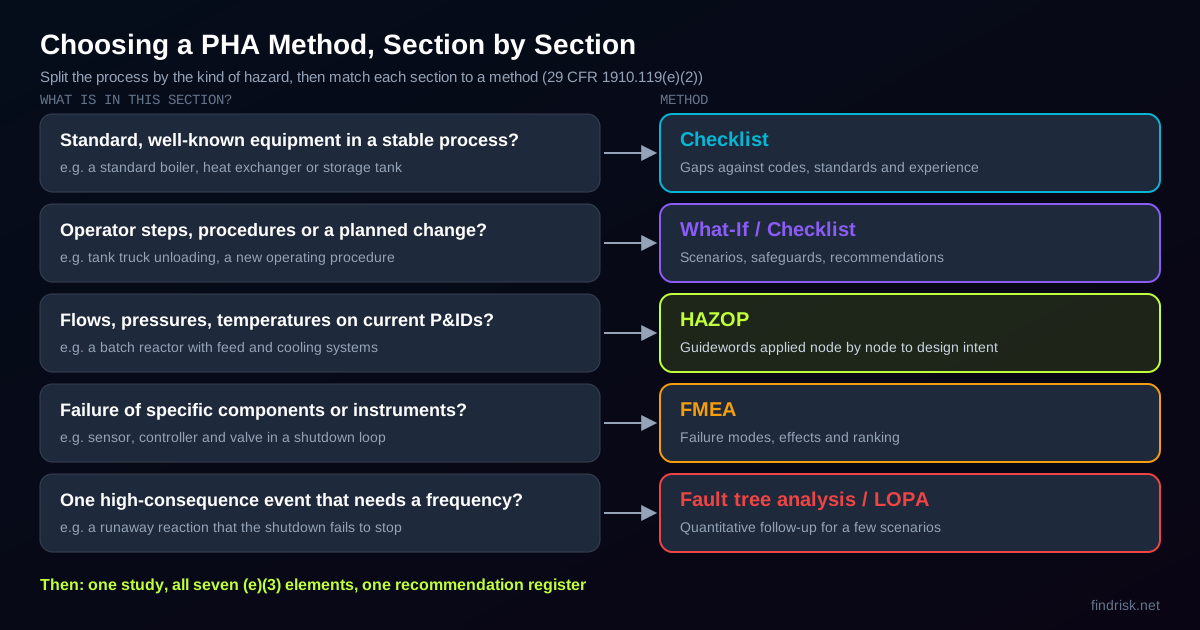
| Method | Best for | Input it needs | What it produces | Our guide |
|---|---|---|---|---|
| Checklist | Standard, well-understood equipment in a stable process | A checklist built from codes, standards and experience | Gaps against known good practice | — |
| What-If / What-If/Checklist | Procedure-driven work, operator steps, simple systems, changes | Procedures, layout, team experience | Scenarios, safeguards, recommendations | What-If analysis guide |
| HAZOP | Continuous or batch processes with defined design intent | P&IDs, operating limits, process description | Deviations node by node, causes, consequences, safeguards | HAZOP study guide |
| FMEA | Specific equipment, instruments or control components | Equipment lists, component data | Failure modes, effects, ranking | FMEA risk assessment guide |
| Fault tree analysis | One serious top event whose causes and frequency must be understood | Scenario from HAZOP or What-If, failure data | Minimal cut sets, top-event frequency | — |
| Bow-tie (communication) | Showing threats, barriers and consequences of a key scenario to the workforce | Scenarios from the PHA | One-page barrier picture | Bow-tie analysis guide |
A few rules of thumb follow from Appendix C and from how these methods work:
- Checklist only works when the process is stable. Appendix C notes that the checklist method "works well when the process is very stable and no changes are made". It will not find hazards that nobody has written down yet.
- HAZOP needs drawings. Without current P&IDs and operating limits, a HAZOP turns into a long What-If.
- Fault tree analysis and LOPA are follow-ups, not substitutes. Use them on the few scenarios where the qualitative study cannot tell whether the protection is enough. Our guide to quantitative vs qualitative risk assessment explains when numbers are worth the effort.
- Bow-tie is not in the (e)(2) list. It is a good way to communicate PHA scenarios, but on its own it would need to be justified as an "appropriate equivalent methodology".
How to Run a Process Hazard Analysis in 7 Steps
A PHA runs in seven steps, from deciding which process to study first to closing its recommendations. The steps below follow the order of paragraph (e) and Appendix C.
Step 1: Set the priority order
List the covered processes and rank them. The (e)(1) rationale considers the extent of the hazards, the number of potentially affected employees, the age of the process and its operating history. Appendix C adds that a preliminary or gross hazard analysis may help with the ranking.
Step 2: Compile the process safety information
Gather chemical hazard data, process technology (flow diagrams, chemistry, safe operating limits, consequences of deviations) and equipment data (P&IDs, materials of construction, relief system design, electrical classification, safety systems). The standard requires this before the PHA starts. Walk the unit with the drawings: a HAZOP run on out-of-date P&IDs analyzes a process that no longer exists.
Step 3: Split the process into sections and choose a method for each
Draw the boundaries. Group equipment and activities by the kind of hazard they carry, then pick a method for each section using the table above. Record why. That record answers the auditor's (e)(2) question before it is asked.
Step 4: Build the team
At minimum, (e)(4) asks for engineering and operations expertise, someone with hands-on experience of this process and someone who knows the method. Appendix C notes that a team "can vary in size from two people to a number of people", and that the leader should be fully knowledgeable in the method and "impartial in the evaluation". In practice, add maintenance, instrumentation and the safety professional, and have a separate scribe for long sessions.
Step 5: Run the sessions and cover all seven (e)(3) elements
Work section by section with the chosen method. Before closing each section, check the (e)(3) list: were previous incidents reviewed, are the controls and their interrelationships recorded, what happens if they fail, was siting discussed, were human factors considered? A coverage matrix, like the one in the worked example below, makes gaps visible.
Step 6: Evaluate and recommend
Rank the scenarios with your site's risk matrix or scoring method so the team agrees which recommendations matter most. Write each recommendation as a deficiency and an objective ("prevent tank overfill during unloading independently of the operator"), not as a single prescribed solution, so the engineers can choose the best fix.
Step 7: Resolve, schedule and communicate
Under (e)(5), every recommendation needs a documented resolution, a list of actions, a written completion schedule and communication to the people who work in the process. Track them in a register with owners and due dates, and route any physical or procedural change the PHA triggers through management of change.
Worked Example: A PHA for a Solvent and Reactor Unit
This example is fictional. It continues the resin plant unit from the opening scenario and shows how one PHA can use several methods and still cover everything paragraph (e) asks for. Assume the unit is covered by PSM; checking coverage is a separate exercise under 1910.119(a).
Sections and methods
| Section | Main kind of hazard | Method chosen | Why |
|---|---|---|---|
| A. Tank truck unloading station | Operator and driver actions, hose connections, procedure steps | What-If/Checklist | Procedure-driven; HAZOP guidewords add little to a hose and a coupling |
| B. Two storage tanks and transfer pumps | Standard equipment in stable service | Checklist, plus What-If on overfill | Well-known equipment; the overfill question links to Section A |
| C. Batch reactor, feed and cooling system | Deviations of flow, temperature, pressure and sequence | HAZOP | Defined design intent and current P&IDs; exothermic reaction |
| D. Reactor high-temperature shutdown | One scenario with catastrophic potential: runaway not stopped | FMEA of the shutdown loop components, then fault tree analysis of the top event | The team needs to know whether the shutdown is reliable enough, not just that it exists |
(e)(3) coverage matrix
| (e)(3) element | Where it was covered | Example finding |
|---|---|---|
| Hazards of the process | All sections | Flammable vapor and pool fire at unloading and tanks; runaway reaction and overpressure in the reactor; solvent vapor exposure during sampling |
| Previous incidents | Section A, B | The site's near-miss log records a hose coupling leak during unloading; the team reviewed it and similar entries before the session |
| Controls and their interrelationships | Sections B, C, D | The tank high-level alarm and the unloading operator are the same person at night: the alarm is not independent of the activity that causes the overfill |
| Consequences of control failure | Sections B, C, D | Overfill: solvent in the bund, ignition risk near the road. Cooling failure with shutdown failure: reactor overpressure, relief to the vent system |
| Facility siting | Sections A, C | The maintenance workshop is occupied all day and sits close to the unloading station; the team asked for a siting review of occupied buildings |
| Human factors | Sections A, C | Night unloading by one operator; three alarms with similar tones in the control room; the reactor charging procedure lists two steps in the wrong order |
| Qualitative evaluation of safety and health effects | All sections | Effects ranged from short-term vapor exposure of a sampler to multiple serious injuries from a fire at the unloading station; recorded in the worksheet's consequence column |
Recommendation register
| No. | Finding | Recommendation (deficiency and objective) | Owner | Due | Status |
|---|---|---|---|---|---|
| R1 | Overfill protection depends on the unloading operator | Provide tank overfill protection that works independently of the operator | Process engineering lead | 2027-03-31 | Open: design study under MOC |
| R2 | Night unloading by one operator | Review staffing and the unloading procedure for night deliveries | Operations manager | 2027-01-15 | In progress |
| R3 | Similar alarm tones in the control room | Review alarm priorities and tones so critical alarms are distinct | Instrumentation lead | 2027-02-28 | Open |
| R4 | Charging procedure step order | Correct the procedure and retrain reactor operators | Production supervisor | 2026-12-15 | Done: procedure revised, training recorded |
| R5 | Occupied workshop near the unloading station | Carry out a siting review of occupied buildings | Process safety engineer | 2027-04-30 | Open |
| R6 | Shutdown reliability unknown | Complete the fault tree for "runaway not stopped" and compare with the site's risk criteria | Process safety engineer | 2027-02-15 | In progress |
Each closed item records what was done and who was told. R4, for example, was communicated at the reactor operators' shift briefings and the training record is filed with the PHA, as (e)(5) and (e)(7) require.
How Often Must a PHA Be Revalidated?
A PHA must be updated and revalidated at least every five years after the initial PHA, by a team that meets the (e)(4) requirements (1910.119(e)(6)). The clock runs from the completion date of the previous PHA. In a 2019 interpretation letter, OSHA used the example of a PHA completed on January 1, 2020 being due for update and revalidation no later than January 1, 2025, and said the deadline is not paused while a unit is shut down: if it expires during a shutdown, the PHA must be updated and revalidated before highly hazardous chemicals are introduced again.
Revalidation does not have to be a new study from scratch. In a 1998 interpretation letter, OSHA said it does not intend the five-year requirement to mean all new and complete PHAs, and described what an update and revalidation includes:
- Evaluating the existing PHA for accuracy and completeness against the (e)(3) criteria.
- Checking that process modifications since the last PHA went through management of change.
- Confirming the process safety information is complete, current and accurate.
- Verifying that procedures specified by the PHA are adequate, up to date and in use.
- Confirming existing PHA recommendations have been documented.
- Reviewing all incident investigation reports required by 1910.119(m).
- Documenting the update and revalidation.
Five years is a maximum. A significant change goes through MOC and usually needs its own hazard review before it is made, and a serious incident is a reason to reopen the relevant part of the PHA. Records of the PHA, every revalidation and the resolution of recommendations must be kept for the life of the process (e)(7).
Common PHA Mistakes
1. One method for the whole plant
A full HAZOP of a tank farm wastes days, and a checklist on a reactor misses deviations nobody has written down. Match the method to the section and record why.
2. Treating facility siting and human factors as tick boxes
A single line saying "siting: OK" or "human factors: considered" will not survive an audit. Record what was discussed and what was found, as in the coverage matrix above.
3. Closing recommendations without action
Under (e)(5), a resolution must be documented and the actions completed on a written schedule. "Accepted, no action" without a documented reason, or a due date that keeps moving, is exactly what that paragraph is meant to prevent.
4. A team without the people who run the process
The standard requires at least one employee with experience of the specific process. Engineers alone tend to analyze the design, not the way the process is actually operated at 3 a.m.
5. Copy-paste revalidation
Revalidation is not changing the date on the old worksheet. Review the MOCs, incidents and procedures since the last study, as OSHA's 1998 letter describes, and document what changed.
6. Numbers without a source
Fault tree and LOPA results are only as good as the failure data behind them. Record where every frequency and probability came from, or keep the analysis qualitative.
How FindRisk Supports Process Hazard Analysis
A PHA lives on accurate information about the plant as it is today. With FindRisk, you can photograph the unloading station, tank bunds and reactor area before the sessions, mark hazards directly on the photos and let the AI analyze them, so the team works from a current picture rather than memory. That is particularly useful for the facility siting and human factors discussions, which depend on what the area really looks like.
After the study, FindRisk can generate an AI inspection checklist for the unit, so checks that came out of the PHA (bund condition, hose couplings, alarm tests) become a recorded routine between revalidations. Findings can be scored with Fine-Kinney risk assessment and turned into a professional report in seconds, on iOS and Android. FindRisk does not replace a HAZOP worksheet or PHA software; it covers the field inspection work around the study.
Frequently Asked Questions
What is the difference between a PHA and a HAZOP?
A PHA is the overall study that OSHA's PSM standard requires for a covered process, with defined content, team, follow-up and revalidation. HAZOP is one of the methods you can use inside a PHA, alongside What-If, Checklist, FMEA and fault tree analysis. Many PHAs use HAZOP for the main process and simpler methods for standard equipment or procedure-driven work.
How often does a PHA need to be revalidated?
Under 29 CFR 1910.119(e)(6), at least every five years after the initial PHA, by a team that meets the same requirements as the original team. OSHA has said revalidation does not have to be a completely new PHA, but it must check the study against the current process, changes, incidents and procedures, and it must be documented.
Can one person perform a process hazard analysis?
Not under PSM. Paragraph (e)(4) requires a team with engineering and process operations expertise, at least one employee experienced in the specific process and one member who knows the method being used. OSHA's Appendix C says a PHA team can vary in size from two people upward, so two is the smallest team it describes, and simple processes are where small teams fit.
Is a process hazard analysis the same as a risk assessment?
A PHA is a specialized form of risk assessment for processes that handle hazardous chemicals. A general workplace risk assessment covers all hazards, from slips to manual handling. A PHA focuses on loss of containment, fires, explosions and toxic releases from the process, and has specific content, team and revalidation requirements under OSHA's PSM standard.
Does a PHA have to be quantitative?
No. Paragraph (e)(3)(vii) asks for a qualitative evaluation of a range of possible safety and health effects of control failure. Most PHAs are qualitative and rank scenarios with a risk matrix. Quantitative follow-ups such as fault tree analysis or LOPA are used for a few high-consequence scenarios where the team cannot judge whether the protection is enough.
What information do you need before starting a PHA?
The written process safety information required by 1910.119(d): the hazards of the chemicals, the process technology (flow diagrams, chemistry, safe operating limits and the consequences of deviations) and equipment information such as P&IDs, materials of construction, relief system design and safety systems. Previous PHAs, incident reports and recent changes are also essential inputs.
Conclusion
A process hazard analysis is more than its worksheet. It is a study with a priority order, the right method for each part of the process, a qualified team, seven required content elements, a recommendation register that actually closes, and a revalidation at least every five years. An auditor will look at those parts as closely as at the worksheet.
Start with current process safety information, split the process by the kind of hazard, use our guides to HAZOP, What-If and FMEA for the sections they fit, and use a coverage matrix to prove that siting, human factors and previous incidents were addressed.
Download FindRisk to capture the unit with photos before your next PHA session, turn its findings into inspection checklists and produce a professional report in seconds.
Try FindRisk
Ready to modernize your safety workflow?
Conduct AI-powered risk assessments, generate reports instantly, and keep your team safe — anywhere, anytime.