

New and Expectant Mothers Risk Assessment: 6 Steps and 2 Examples
A new and expectant mothers risk assessment is the individual assessment an employer carries out when a worker says she is pregnant, has given birth in the last six months or is breastfeeding. It checks her actual tasks against hazards known to affect pregnancy and breastfeeding, records what changes, and is reviewed as the pregnancy progresses and on her return to work.
Most employers already have a general risk assessment that mentions "pregnant workers" in one line. That line is not enough. The law in the UK, the EU and Türkiye expects two layers: the general assessment must already consider women of childbearing age, and a personal assessment must follow once a specific worker tells you. The second layer is where most organizations struggle, because it needs a conversation, medical input and a decision about what to do when a risk cannot simply be engineered away.
This guide covers what the law requires in four jurisdictions, which hazards to look at, a six-step method, the decision ladder for risks you cannot remove, two filled assessments for a laboratory technician and a warehouse picker, and when to review. It does not give medical advice: every health question in it belongs with the worker's doctor or midwife and your occupational health provider.
A Notification Lands on Your Desk
This is a fictional example built for this guide. On a Monday morning, the safety adviser of a mid-sized distribution company receives a short email from HR. A picker on the early shift has told her manager in writing that she is 11 weeks pregnant. The manager has already moved her off the heaviest pallets "to be safe" and asked whether anything else is needed.
The site's risk assessment says, under "persons at risk", that pregnant workers will be "assessed individually". There is no form, no named person and no list of what to check. The early shift starts at 05:00, the pick faces go up to shoulder height and above, and pickers ride powered order-picking trucks for most of the shift.
The manager's instinct was kind, but it was a guess. The questions that matter are these: which of her tasks carry a recognized risk for pregnancy, what does she say about her own health and her work, what has her midwife advised, and what will change, by when, and who will check it again in a few weeks? We will come back to this picker in the second worked example.
What Is a New and Expectant Mothers Risk Assessment?
A new and expectant mothers risk assessment is an individual risk assessment that looks at one worker's job in light of her pregnancy, recent birth or breastfeeding. It sits on top of your general workplace risk assessment; it does not replace it.
The UK Health and Safety Executive (HSE) states in its guidance for employers (updated May 2026) that it applies to workers who are pregnant, have given birth in the last six months, or are breastfeeding, and that "you must carry out an individual risk assessment for pregnant workers and new mothers."
| Term | Meaning in practice |
|---|---|
| Expectant mother | A worker who is pregnant and has told her employer |
| New mother | A worker who has given birth in the last six months (UK definition) |
| Breastfeeding worker | A worker who is breastfeeding, for as long as she does so |
| General assessment | Your workplace risk assessment, which must already consider women of childbearing age |
| Individual assessment | The personal assessment for one worker, triggered by her notification |
The general assessment matters because some hazards are most harmful very early in pregnancy, often before a worker knows or chooses to tell anyone. HSE's risk assessment page says you must, by law, assess the risks to women of childbearing age as part of your general workplace risk assessment. If your general risk assessment already flags reproductive hazards, the individual assessment becomes a quick, focused check rather than a scramble.
What the Law Requires: UK, EU, US and Türkiye
All four systems put the duty on the employer, but they differ in what triggers it and what happens if a risk cannot be removed.
| UK | EU | US | Türkiye | |
|---|---|---|---|---|
| Main source | Management of Health and Safety at Work Regulations 1999, regs 16–18 | Council Directive 92/85/EEC | Pregnant Workers Fairness Act (PWFA); FLSA as amended by the PUMP Act | Gebe veya Emziren Kadınların Çalıştırılma Şartlarıyla Emzirme Odaları ve Çocuk Bakım Yurtlarına Dair Yönetmelik (2013); Law 6331 Art. 10 |
| Trigger for individual action | Written notification (reg. 18) | Assessment of all activities likely to involve a risk; results given to the worker | A known limitation related to pregnancy, childbirth or a related condition | Worker informs the employer; for pregnancy, with a document from a health facility |
| Hazard lists | Annexes I and II of 92/85/EEC, referenced in reg. 16 | Annex I (assess) and Annex II (prohibited exposure) | No hazard list; accommodation duty | EK-I measures, EK-II biological agents table, EK-III monitoring form |
| If risk remains | Alter conditions or hours, then suspend on full pay; alternative work offered first | Adjust, transfer, or leave | Reasonable accommodation unless undue hardship | Adjust conditions or hours, then transfer; if not possible, unpaid leave on her request |
| Night work | Suspend if a doctor's or midwife's certificate says so (reg. 17) | Not obliged to work nights where a medical certificate says so | No specific rule | Not required from medical confirmation of pregnancy to birth; banned for one year after birth |
Some details worth knowing:
- UK. Regulation 16 requires the main risk assessment to include risks to new or expectant mothers and their babies. If the risk cannot be avoided, the employer must alter her working conditions or hours where reasonable, and otherwise suspend her for as long as necessary. Regulation 18 says those steps apply once she has notified the employer in writing, and the employer may ask in writing for a certificate from a doctor or registered midwife. HSE adds that, under the Employment Rights Act 1996, suitable alternative work on the same terms, including pay, should be offered where appropriate before any suspension.
- EU. Directive 92/85/EEC, adopted in 1992 as the tenth individual directive under the Framework Directive, requires employers to assess the risks of all activities these workers may do, tell them the results, and never require them to perform duties involving the agents and conditions in Annex II where the assessment shows a risk.
- US. There is no federal pregnancy risk assessment standard. The PWFA, in effect since June 27, 2023, requires employers with 15 or more employees to provide reasonable accommodations, such as more breaks, a stool, avoiding lifting or certain chemicals, or temporary reassignment, unless this causes undue hardship. The PUMP Act gives reasonable break time to express milk for up to one year after birth, in a private place that is not a bathroom.
- Türkiye. Law 6331, Article 10(1)(ç), names pregnant and breastfeeding workers among the groups the risk assessment must consider. The 2013 regulation (Resmî Gazete 16 August 2013, No. 28737) adds hard limits: a maximum of 7.5 working hours a day; for pregnant workers, noise at the workstation must not exceed 80 dB(A), and work above the limits is banned even with hearing protection; and no work where group 2, 3 or 4 biological agents pose a risk unless the worker is immune and a specific assessment allows it.
Which Hazards to Assess
Start from the published lists, then add anything specific to the job. Annex I of Directive 92/85/EEC is the reference list, and UK regulation 16 points to it directly; HSE's common risks page adds practical groupings.
| Group | Hazards named in the sources | Typical jobs where it shows up |
|---|---|---|
| Posture and movement | Standing or sitting for long periods, awkward workstations, movements and postures, travelling | Retail, assembly lines, call centers, drivers |
| Manual handling | Handling of loads with a risk of back injury, lifting or carrying heavy loads | Warehousing, care, cleaning, hospitality |
| Physical agents | Shocks, vibration or movement; noise; ionizing and non-ionizing radiation; extremes of cold or heat | Construction, manufacturing, radiology, cold stores |
| Chemical agents | Substances classified as mutagenic, carcinogenic or toxic for reproduction (including effects via lactation); mercury; antimitotic (cytotoxic) drugs; carbon monoxide; agents absorbed through the skin; lead | Laboratories, pharmacy, cleaning, battery and metal work, agriculture |
| Biological agents | Groups 2, 3 and 4 where known to endanger pregnancy; toxoplasma and rubella in Annex II | Healthcare, laboratories, childcare, veterinary and animal work |
| Working conditions | Long hours, shift and night work, fatigue, work-related stress, working at height, working alone, violence | Almost every sector |
| PPE | Equipment that no longer fits or restricts movement as the pregnancy progresses | Any job relying on harnesses, coveralls, respirators |
Annex II of the directive lists exposures that pregnant workers cannot be required to undergo where the assessment shows a risk: work in hyperbaric atmospheres such as pressurized enclosures and underwater diving, toxoplasma and rubella (unless she is proved to be protected by immunization), absorbable lead, and underground mining. Lead and underground mining are also on the list for breastfeeding workers. For chemical hazards, the safety data sheet is your starting point: look for the hazard statements for reproductive toxicity, carcinogenicity and mutagenicity, and read our guide to chemical safety at work for the exposure-control side.
Do not forget the less visible hazards. HSE notes that pregnancy can affect dexterity, agility, coordination, speed of movement and reach, which changes the risk of tasks that were fine a few months earlier, such as climbing a ladder or reaching into a tight space. Long hours and night work increase fatigue, and HSE lists work-related stress, temperature and noise among the working conditions to assess.
How to Do the Individual Assessment in 6 Steps
The individual assessment works best as a short, structured meeting followed by a written record. These six steps follow HSE's guidance and the structure of the EU and Turkish rules.
Step 1: Confirm the trigger and who is involved
Note the date of the written notification. Agree who leads the assessment (line manager with the safety adviser), and involve occupational health or the workplace doctor from the start. In the UK, HSE says to consult her safety representative or trade union if she has one.
Step 2: Pull the existing assessments for her tasks
List every task she actually does, including occasional ones such as covering for absent colleagues, stocktaking or out-of-hours call-outs. Bring the general risk assessment, the chemical inventory and any noise or vibration measurements for those tasks.
Step 3: Talk to her
Ask about any pregnancy-related conditions that affect her work and any concerns she has. HSE lists this conversation as part of the individual assessment, and the Turkish regulation requires personal psychosocial and medical factors to be considered. Keep it confidential and do not ask for more medical detail than the decision needs.
Step 4: Take account of medical advice
Record any recommendations from her doctor or midwife. If she has a certificate covering night work, it decides that question in the UK and the EU. Where the evidence on a specific exposure is unclear, the decision belongs to occupational health, not to the line manager.
Step 5: Decide the controls and record them
For each hazard, write down the finding, the control, who does it and by when. Use the decision ladder in the next section when a risk cannot be removed. Share the record with her and, in the UK, with her safety representative. The EU directive and the Turkish regulation both require the worker to be told the results and the measures.
Step 6: Set the review points
Put the next review date on the form before you close it. Pregnancy changes week by week, so a single assessment at 11 weeks will not hold at 30 weeks. The review section below gives a practical rhythm.
When a Risk Cannot Be Removed: The Decision Ladder
When the assessment finds a significant risk, the law gives the same order of steps in each system, with different end points. Work down the ladder and stop at the first step that removes the risk.
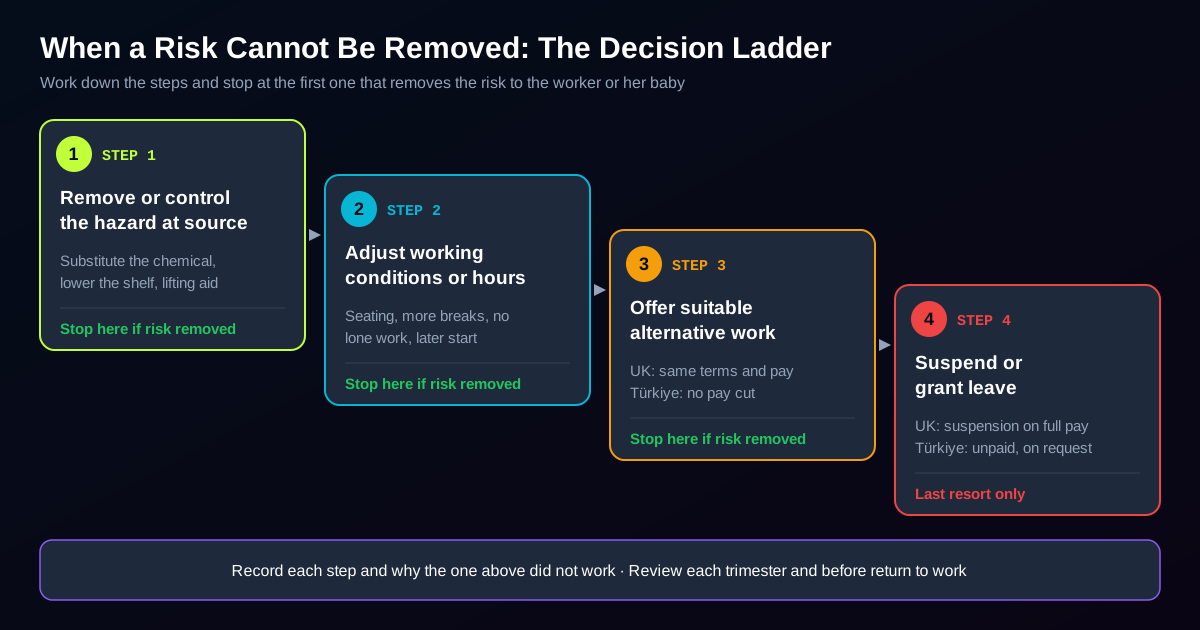
- Remove or control the hazard at source. Substitute the chemical, lower the shelf, fit a lifting aid, move the task to day shift for everyone. This follows the normal hierarchy of controls and often helps the whole team.
- Adjust her working conditions or hours. Seating, more frequent breaks, no lifting above a set weight, a later start time, no lone working.
- Offer suitable alternative work. In the UK, HSE says this should be on the same terms and conditions, including pay. In Türkiye, a pregnant worker moved to lighter work on medical advice keeps her pay.
- Suspend or grant leave. In the UK, suspension is on full pay for as long as necessary. In Türkiye, if a transfer is not possible, she is treated as on unpaid leave at her request, and that period does not count against her annual leave entitlement.
Record which step you reached and why the steps above it did not work. An assessment that jumps straight to "sent home" without showing the earlier steps is hard to defend and often unnecessary.
Worked Example 1: Laboratory Technician
This is a fictional example. A technician in a university chemistry teaching laboratory notifies her manager in writing at 9 weeks. Her tasks: preparing reagents, running solvent extractions in fume cupboards, washing glassware, moving 20-liter solvent drums and occasional evening work when practicals overrun.
| Hazard | Finding | Action | Basis | Owner / date |
|---|---|---|---|---|
| Solvents and reagents classified for reproductive toxicity | Two reagents in her prep list carry reproductive toxicity hazard statements on their safety data sheets | Remove both from her tasks; a colleague prepares them. Check every new reagent's SDS before she handles it | Annex I chemical agents; HSE harmful substances | Lab manager, this week |
| Other solvents in fume cupboards | Used under local exhaust ventilation; cupboard tests in date | Continue with fume cupboard only; no open-bench use | General assessment controls | Lab manager, ongoing |
| Manual handling of 20 L drums | Drums lifted from floor to bench | No drum handling; drums decanted by a colleague using a drum trolley and pump | Annex I loads; HSE posture and lifting | Lab manager, immediately |
| Standing for long periods | Prep sessions up to 3 hours standing | Sit-stand stool at the prep bench; break every hour | HSE posture; Annex I postures | Technician, from today |
| Evening work alone | Sometimes alone in the lab after 18:00 | No lone working in the lab; evening cover by a colleague | HSE working alone; Turkish EK-I(d) | Lab manager, from today |
| Lab coat and gloves | Current coat will not fasten later in pregnancy | Order a larger coat now; check fit at each review | HSE PPE; Turkish EK-I PPE rule | Safety adviser, 2 weeks |
| Fatigue and nausea | She reports morning nausea; solvent odors make it worse | Start time moved from 08:00 to 09:30 for now; odor-heavy tasks later in the day | HSE working conditions; occupational health advice | Manager, from Monday |
Review: at 20 weeks, at 28 weeks, after any new reagent or task, and before her return to work. The outcome stays on step 2 of the ladder: adjusted conditions, no transfer needed.
Worked Example 2: Warehouse Picker
Back to the picker from the opening scenario, now at 12 weeks. Her tasks: picking cartons up to 15 kg from floor to above-shoulder height, riding a powered order-picking truck, early shift from 05:00, occasional work in a chilled area.
| Hazard | Finding | Action | Basis | Owner / date |
|---|---|---|---|---|
| Manual handling | Picks include cartons up to 15 kg, often from floor level | Moved to a light-items zone with cartons under the weight limit agreed with occupational health; no floor-level heavy picks | Annex I loads; HSE lifting | Shift manager, today |
| Reaching above shoulder height | Top pick faces require stretching | Pick from waist to shoulder height only; top faces done by colleagues | HSE posture; reach changes with pregnancy | Shift manager, today |
| Riding the order-picking truck | Truck crosses dock plates and uneven joints; jolts at each crossing | Pick on foot with a manual trolley in the light zone; no truck use | Annex I shocks, vibration or movement | Shift manager, today |
| Early shift | 05:00 start; she reports nausea and fatigue | Day shift 08:00–16:30; daily hours reviewed with occupational health | HSE long hours and shift work; Turkish EK-I(a) | HR, next rota |
| Chilled area | Occasional 30-minute tasks at chill temperatures | Removed from chilled tasks | Annex I extremes of cold | Shift manager, today |
| Forklift traffic | Shares aisles with reach trucks in the main zone | Light-items zone is pedestrian-only | General assessment | Site manager, already in place |
| Rest and toilets | Nearest toilet 4 minutes' walk from the far zone | Light-items zone is next to the welfare block; rest room with somewhere to lie down | HSE rest facilities | Site manager, this week |
Review: at 20 weeks (the light-items zone may still involve too much walking later on), at 28 weeks, and at any change of zone or equipment. Outcome: step 2 of the ladder, with step 3 likely if walking distance becomes a problem in the third trimester.
When to Review the Assessment
HSE says to review the assessment as the pregnancy progresses and after any significant change to her activities or workplace. The law does not set fixed dates, so put them in the plan. A practical rhythm we suggest:
| Point | What to check |
|---|---|
| Written notification | Full individual assessment within days, not weeks |
| Each trimester (about 12, 20 and 28 weeks) | Reach, balance, PPE fit, fatigue, any new medical advice |
| Any change in task, shift, equipment or location | The changed task only, plus anything it affects |
| Before return to work | Whether she is breastfeeding; update for breastfeeding hazards; rest and expressing facilities |
| While breastfeeding | Lead and other agents passing via breast milk, long hours, access to a private room and storage |
| Six months after birth and no longer breastfeeding | Close the individual assessment; return to the general assessment |
Breastfeeding often gets forgotten. The UK definition of a new mother covers six months after birth, but the protection for breastfeeding workers lasts as long as she breastfeeds. Ask the question at the return-to-work meeting and record the answer.
Rest and Breastfeeding Facilities
Every system expects somewhere to rest and, for breastfeeding workers, somewhere private. HSE's rest and breastfeeding page says employers must provide a suitable area where pregnant workers and breastfeeding mothers can rest, including somewhere to lie down if necessary. It should be hygienic and private so they can express milk; toilets are not a suitable place. There should be somewhere to store milk, such as a fridge.
In the US, the PUMP Act requires a private space other than a bathroom, shielded from view and free from intrusion. In Türkiye, workplaces with 100 to 150 women employees must set up a breastfeeding room no more than 250 meters from the workplace, and those with more than 150 must provide a childcare facility.
A rest area does not have to be a dedicated room in a small workplace, but it must be available when she needs it. A first aid room that is locked or used for storage does not count in practice.
Common Mistakes in Pregnancy Risk Assessments
1. Assessing the job title, not her tasks
"Office worker, low risk" misses the stocktake ladder, the evening lock-up alone and the 05:00 start. List the tasks she actually does.
2. Making decisions without her
Managers sometimes remove tasks or change shifts without asking. That can leave real risks in place and create new problems, such as lost overtime pay. The conversation is part of the assessment.
3. Guessing on medical questions
Whether a specific chemical concentration or infection risk is acceptable is a question for occupational health. A manager's "should be fine" is not a control.
4. One assessment, never reviewed
Reach, balance and fatigue change through pregnancy. An assessment done at 10 weeks and filed is out of date by 25 weeks.
5. Forgetting the return to work
Breastfeeding hazards, expressing facilities and a new rota need a fresh look. Many forms stop at maternity leave.
6. Jumping straight to suspension
Sending someone home is the last step, not the first. Show that you tried controls, adjusted conditions and looked for alternative work.
7. Letting PPE quietly stop fitting
A harness, coverall or lab coat that no longer fits is a failed control. The Turkish regulation is explicit: if suitable PPE cannot be provided, she cannot do that work. Check fit at every review, not only when she raises it.
How FindRisk Supports Pregnancy Risk Assessments
FindRisk can build an individual assessment checklist with AI from a short description, such as "pregnant laboratory technician, solvent work, 9 weeks", which you then edit to match the job. The review points and the hazard groups from this guide fit straight into it, so the same checklist can be reused at each trimester.
You can score each hazard with Fine-Kinney if your system uses scored risks, photograph the workstation or pick face, mark the hazard on the photo and use the AI analysis to spot things you missed. When the meeting is done, FindRisk produces a professional report in seconds that you can share with the worker, her manager and occupational health. It runs on iOS and Android.
Frequently Asked Questions
When should a new and expectant mothers risk assessment be done?
The general risk assessment must already consider women of childbearing age before anyone is pregnant. The individual assessment should start as soon as the worker notifies you in writing that she is pregnant, has given birth in the last six months or is breastfeeding. In the UK, HSE says you must then complete an individual risk assessment and make any necessary changes. Aim to finish it within days, and set review dates as the pregnancy progresses.
Does a worker have to tell her employer she is pregnant?
She chooses when to tell you, but the protective measures depend on it. In the UK, regulation 18 says the employer is not required to alter conditions or suspend until she has notified in writing, and the employer may ask for a certificate from a doctor or midwife. In Türkiye, a pregnant worker is defined as one who informs her employer with a document from a health facility. Make sure workers know who to tell and that the information stays confidential.
What if the worker disagrees with the outcome of the assessment?
Go back to the evidence together. Check that the assessment reflects her real tasks, her own account and any advice from her doctor or midwife, and involve occupational health and, where there is one, her safety representative. Record the disagreement and how it was resolved. If the dispute is about legal rights such as pay, transfer or suspension, she should get advice from the relevant authority or a qualified adviser.
Can pregnant workers work night shifts?
Night work is not banned outright in the UK or the EU, but a medical certificate decides it: in the UK, if a doctor or registered midwife certifies that she should not work nights, the employer must suspend her from night work for as long as necessary, and HSE says suitable alternative work on the same pay should be offered first where appropriate. In Türkiye, a pregnant worker cannot be required to work nights from the medical confirmation of pregnancy until birth, and night work is banned for one year after birth.
How long does the breastfeeding protection last?
As long as she breastfeeds. The UK "new mother" period is six months after birth, but the separate breastfeeding category has no fixed end date. In the US, the PUMP Act gives break time to express milk for up to one year after birth. In Türkiye, a breastfeeding worker is one using her nursing break entitlement, and the daily 7.5-hour limit applies while she is pregnant or breastfeeding.
Do office workers need a pregnancy risk assessment?
Yes, but it is usually short. The individual assessment is required whatever the job; for low-risk office work it often focuses on posture, workstation set-up, long periods of sitting, travel, stress and rest facilities. Our guide to workplace ergonomics covers the workstation side. Check for occasional tasks outside the desk, such as lifting archive boxes or working alone late.
Who should carry out the assessment?
The employer is responsible. In practice, the line manager and a competent safety adviser carry it out together with the worker, with occupational health or the workplace doctor advising on medical questions. In the UK, consult her safety representative or trade union if she has one. In Türkiye, it is part of the workplace risk assessment under Law 6331, so the occupational safety specialist and the workplace doctor are the natural people to involve.
Conclusion
A new and expectant mothers risk assessment is a short, personal check with a long tail. It starts with her real tasks and her own account, uses the published hazard lists to make sure nothing obvious is missed, and turns every finding into a named action with a date. When a risk cannot be removed, work down the ladder: control, adjust, offer alternative work, and only then suspend or grant leave.
The part most employers get wrong is time. Plan the reviews at notification, follow her through each trimester, and reopen the assessment at the return-to-work meeting if she is breastfeeding. Keep the record clear enough that anyone could see what was decided and why. For related hazards, see our guides to noise risk assessment and lone working.
Download FindRisk to build an individual assessment checklist with AI, mark hazards on photos of the workstation and share the report with the worker and occupational health the same day.
Try FindRisk
Ready to modernize your safety workflow?
Conduct AI-powered risk assessments, generate reports instantly, and keep your team safe — anywhere, anytime.