
Noise Risk Assessment: Exposure Calculation and Worked Example
A noise risk assessment is a structured check of who is exposed to noise at work, how much daily noise exposure each person receives, how that compares with the legal action and limit values (80, 85 and 87 dB(A) in the UK and EU), and which controls are needed. It ends with a recorded action plan, not just a set of meter readings.
Most guides list the steps and hand you a blank form. The difficult part is turning a mix of tasks, each with its own level and duration, into one daily exposure figure, working out which task drives it, and showing that your controls actually bring it down.
This guide does that for a fabrication workshop, step by step. You will find the thresholds for the UK, Türkiye and the US side by side, the exposure formula with a worked calculation, a control plan with the exposure recomputed after each change, a hearing protector check, and the same worker assessed under OSHA's rules.
A Fabrication Workshop With a Noise Question
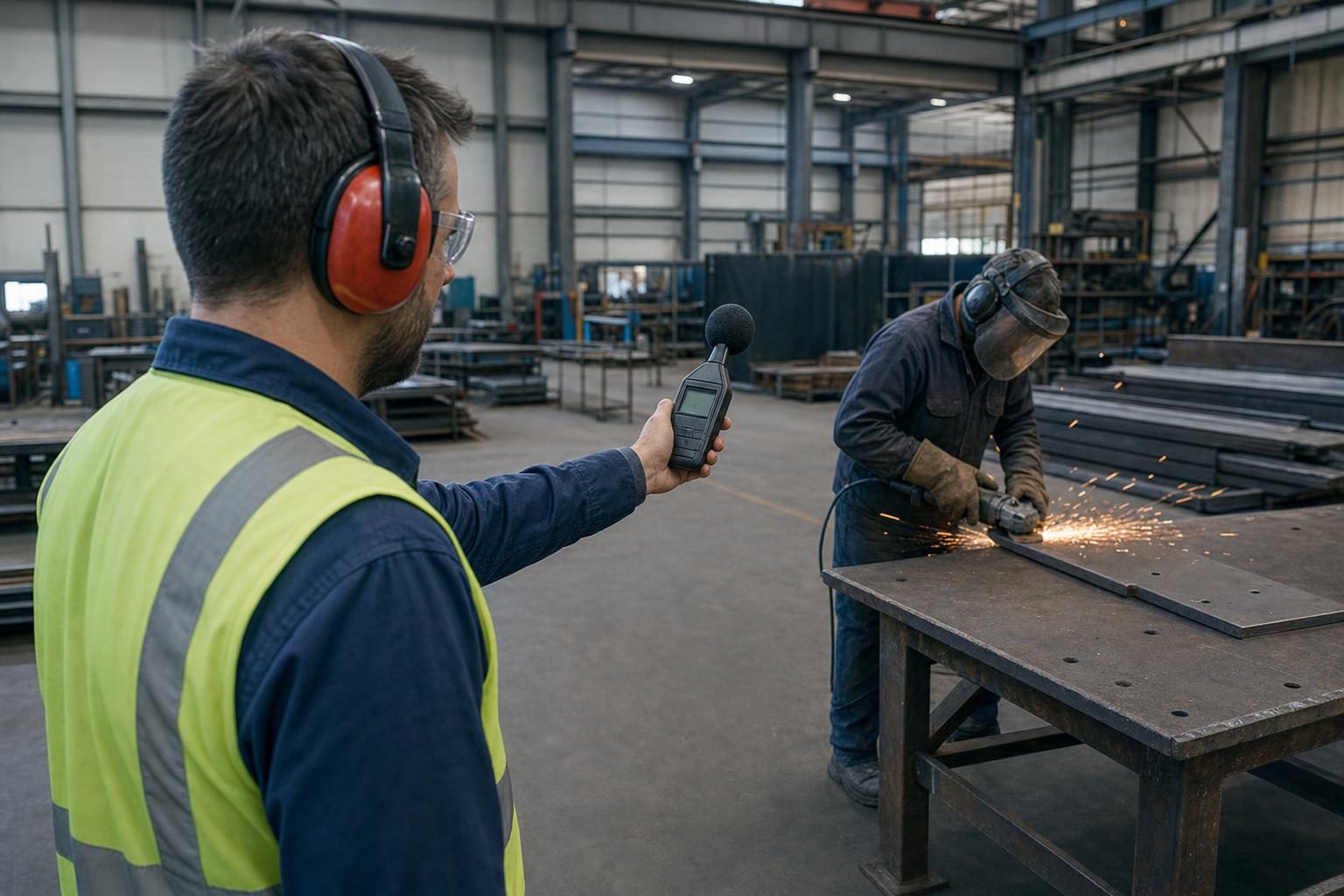
Picture a small steel fabrication shop. This is a fictional example built for this guide. A fabricator spends the day cutting and grinding plate, straightening panels with a hammer, MIG welding and doing bench work. Earmuffs hang by the door. Nobody has measured anything, and the last "noise check" was a line on a general inspection form: "hearing protection available — yes."
The supervisor asks a simple question: is this a problem? The honest answer is "it depends on the numbers." Workers have to raise their voices to talk about 2 metres apart while the grinder runs, and the grinder is in use for well over half an hour a day. HSE lists both as signs that you probably need to take action on noise.
A noise risk assessment turns that hunch into a figure, compares it with the law and ranks what to fix first. The rest of this guide works through it for this fabricator.
What Is a Noise Risk Assessment?
A noise risk assessment is a specific part of the general workplace risk assessment that deals with exposure to noise. In the UK, regulation 5 of the Control of Noise at Work Regulations 2005 requires a "suitable and sufficient assessment" wherever employees are liable to be exposed at or above the lower exposure action value. In Türkiye, the Çalışanların Gürültü ile İlgili Risklerden Korunmalarına Dair Yönetmelik (Resmî Gazete 28.07.2013, No. 28721) places the same duty on the employer in Article 7.
| Term | Meaning |
|---|---|
| Daily personal noise exposure (LEP,d or LEX,8h) | The noise dose for a working day, expressed as the level that would give the same energy over 8 hours, in dB(A) |
| Weekly exposure (LEP,w) | The average over a nominal five-day week, allowed where exposure varies markedly from day to day |
| Peak sound pressure | The highest instantaneous pressure, in dB(C), relevant for impacts and impulsive noise |
| Exposure action value | A level at which specific duties start (information, hearing protection, a control programme) |
| Exposure limit value | A level that must not be exceeded, taking hearing protection into account |
The UK regulation lists what the assessment must consider, including the level, type and duration of exposure (including peak), employees at particular risk, interaction with ototoxic substances or vibration where practicable, noise masking warning signals, manufacturers' data, quieter alternative equipment, health surveillance results and the availability of suitable hearing protectors. The Turkish Article 7 list covers the same ground.
A noise survey is not the same thing. A survey produces measurements. The assessment decides what those measurements mean for each person and what has to change. HSE notes that the assessment is "more than just taking measurements" and that measurements are sometimes unnecessary if you have reliable information.
Noise Exposure Limits and Action Values
The Turkish regulation is aligned with EU Directive 2003/10/EC, and its values match the UK's. The US uses different values and a different method.
| Threshold | UK (2005 Regulations, reg. 4) | Türkiye (Gürültü Yönetmeliği, Art. 5) | US (OSHA 29 CFR 1910.95) |
|---|---|---|---|
| Lower action value | 80 dB(A) daily/weekly; 135 dB(C) peak | 80 dB(A); 112 Pa = 135 dB(C) peak | — |
| Upper action value / action level | 85 dB(A); 137 dB(C) peak | 85 dB(A); 140 Pa = 137 dB(C) peak | 85 dBA 8-hour TWA or 50% dose |
| Limit value / PEL | 87 dB(A); 140 dB(C) peak | 87 dB(A); 200 Pa = 140 dB(C) peak | 90 dBA 8-hour TWA; impulsive noise should not exceed 140 dB peak |
| Hearing protectors counted? | Only against the limit value | Only against the limit value | Not when deciding if the action level is reached |
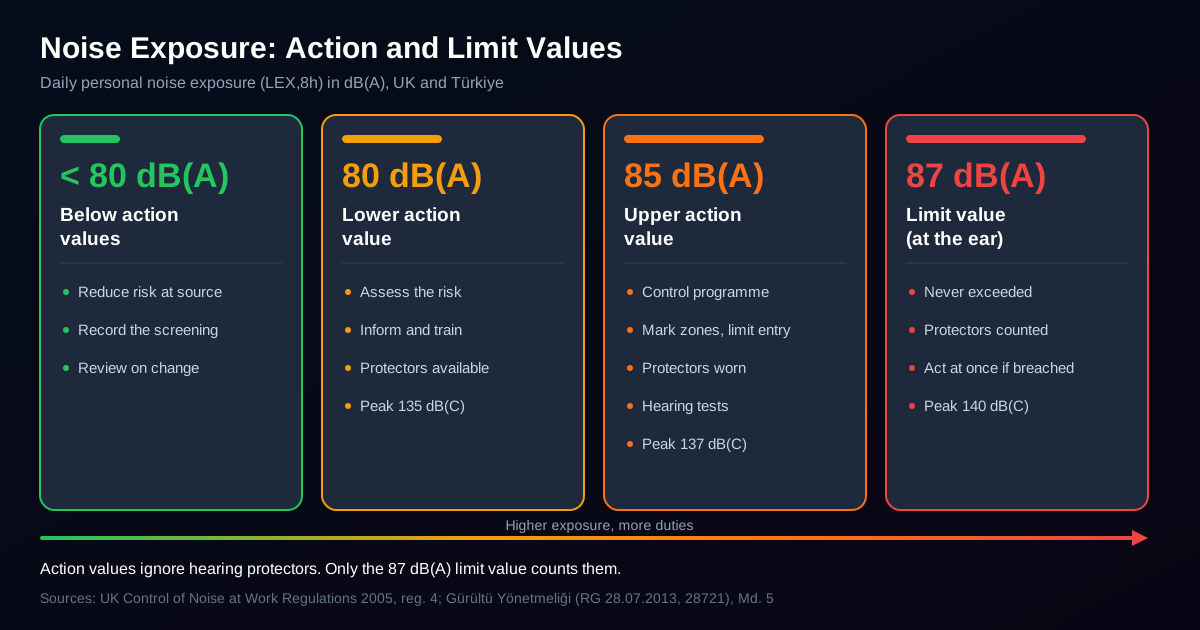
What each band means in practice under the UK and Turkish rules:
| Daily exposure | Employer duties |
|---|---|
| Below 80 dB(A) | General duty to eliminate or reduce risk at source still applies |
| 80 to below 85 dB(A) | Assess the risk; inform and train workers; make hearing protectors available on request; hearing tests where the risk assessment shows a risk |
| 85 dB(A) and above | A programme of organisational and technical measures (excluding hearing protectors); mark hearing protection zones and restrict access where practicable; protectors must be worn; hearing checks |
| Above 87 dB(A) at the ear | Not allowed. Reduce immediately, find the cause and prevent recurrence |
The sources for these duties are regulations 6, 7 and 9 of the UK 2005 Regulations and Articles 8 to 13 of the Turkish regulation. NIOSH's recommended exposure limit in the US is also 85 dBA averaged over an eight-hour workday, stricter than OSHA's 90 dBA PEL.
How to Do a Noise Risk Assessment in 6 Steps
A noise risk assessment follows six steps, and the first one often decides whether you need the rest.
Step 1: Screen for a noise problem
Walk the site during normal work. HSE's warning signs are a good screen: noise as intrusive as a busy street or vacuum cleaner, people raising their voices to talk at about 2 metres, noisy powered tools used for more than half an hour a day, impact noise or explosive sources. If none applies, record that and stop.
Step 2: Identify who is exposed and to what
List people by job, not by machine. A fabricator moves between four tasks; a maintenance fitter may visit ten areas. For each person, write down the tasks, the noise source in each and a realistic duration, including overtime and noisy rest areas.
Step 3: Get reliable noise levels for each task
Use your own measurements, data from similar workplaces or manufacturers' declared emission values. In Türkiye, workplace noise measurements must be made by a laboratory holding a competence or pre-competence certificate under the İş Hijyeni Ölçüm, Test ve Analizleri Hakkında Yönetmelik (Resmî Gazete 27.01.2023, No. 32086), Article 5(3). Note peak levels for hammering, presses and nail guns.
Step 4: Calculate daily exposure and compare
Combine the task levels and durations into LEX,8h for each person (next section), and compare with 80, 85 and 87 dB(A) and the peak values.
Step 5: Plan controls by the hierarchy
Eliminate or reduce at source first, then use the workplace layout and work organization, then hearing protection. Recalculate exposure for each planned change so the plan shows its effect.
Step 6: Record, act and review
Record the significant findings and an action plan with timetable and owners. Review when machines, processes or rosters change. HSE advises not leaving it more than about two years without checking whether a review is needed. In Türkiye, noise sits inside the general risk assessment, which must be renewed at least every 2, 4 or 6 years depending on the hazard class, and sooner after changes.
How to Calculate Daily Noise Exposure
Daily noise exposure is calculated by adding up the sound energy of each task and spreading it over a reference 8-hour day. Schedule 1 of the UK 2005 Regulations gives the formula for several periods in a day:
LEX,8h = 10 × log10 [ (1/8) × Σ ( Ti × 10^(Li/10) ) ]
Here Ti is the duration of task i in hours and Li is its equivalent continuous level in dB(A). For a single task, this reduces to LEX,8h = L + 10 × log10(T/8).
Two rules of thumb follow directly from the formula:
- Doubling the time adds 3 dB. One hour at 95 dB(A) gives the same dose as two hours at 92 dB(A). Halving the time removes 3 dB.
- The loudest task usually dominates. Because the scale is logarithmic, a short loud task can outweigh a long quiet one. That is why the first thing to check is the share of each task, not the average.
You can work out the partial exposure of each task first and then combine them:
| Task | Level dB(A) | Hours | Partial LEX,8h | Share of daily dose |
|---|---|---|---|---|
| Angle grinding | 98 | 1.5 | 90.7 | 80% |
| Hammering / panel straightening | 92 | 1.0 | 83.0 | 13% |
| MIG welding | 84 | 3.0 | 79.7 | 6% |
| Bench work, other | 75 | 2.5 | 69.9 | 1% |
| Total | 8.0 | 91.7 dB(A) |
The grinding alone, at 90.7 dB(A), already breaks the 87 dB(A) limit before the rest of the day is counted. HSE also publishes a free noise exposure calculator that does the same arithmetic.
Worked Example: Noise Risk Assessment for a Fabrication Workshop
This example continues the fictional workshop. The task levels are illustrative inputs, not measurements from a real site; the results are computed with the formula above.
Findings
| # | Finding | Who | Result |
|---|---|---|---|
| 1 | Fabricator's daily exposure 91.7 dB(A), above the 85 upper action value and, without protection, above the 87 limit value | 3 fabricators | Control programme required; protectors mandatory |
| 2 | Grinding contributes 80% of the dose | Fabricators | First target for controls |
| 3 | Hammering produces impact noise; peak level not yet measured | Fabricators, nearby welder | Measure peak against 135/137/140 dB(C) |
| 4 | No marked hearing protection zone; earmuffs at the door, wear not checked | All | Mark zone, supervise wear |
| 5 | Nobody has had a hearing test | Fabricators | Health surveillance with hearing tests |
Control plan with recalculated exposure
Every row below is a hypothetical result you would confirm by re-measuring after the change.
| Step | Change (hierarchy level) | New task levels / times | Fabricator LEX,8h |
|---|---|---|---|
| 0 | Baseline | Grinding 98 dB(A) for 1.5 h | 91.7 |
| 1 | Reduce at source: change the cutting and grinding method or tooling, support plate on a damped bench (engineering) | Grinding re-measured at 93 dB(A) | 88.3 |
| 2 | Damp the straightening bench and use a quieter straightening method (engineering) | Hammering re-measured at 87 dB(A) | 87.3 |
| 3 | Plan work so grinding is done in one block and shared, cutting each fabricator's grinding to 45 minutes (organizational) | Grinding 0.75 h | 85.5 |
| 4 | Hearing protection zone around the grinding and straightening area; protectors worn (PPE) | — | Still above 85 unprotected, so protectors stay mandatory |
The table makes two things visible. First, engineering changes on the dominant task give the biggest drop: one source change took off more than 3 dB. Second, even a good control programme can leave exposure close to 85 dB(A), so hearing protection, zones and hearing checks remain part of the plan. This order follows the hierarchy of controls and is what the UK regulation 6 and Turkish Article 8 require: technical and organizational measures first, protectors last.
If you rank findings across the whole site, a scoring method such as the Fine-Kinney method helps sort the noise actions against other risks, but the scored risk does not replace the exposure calculation. The law is written in decibels.
Choosing and Checking Hearing Protection
Hearing protection is checked by estimating the level at the ear while it is worn and comparing the resulting exposure with the 87 dB(A) limit. HSE gives three practical rules in its hearing protection guidance:
- Aim to get below 85 dB at the ear, and avoid protectors that bring it below 70 dB. Over-protection isolates people, and they take the protectors off.
- Use the SNR as a first guide: SNR 20 or less for 85–90 dB, 20–30 for 90–95 dB, 25–35 for 95–100 dB, 30 or more for 100–105 dB. This is not suitable where there is significant low-frequency noise.
- Allow for real-world use. HSE says to derate the protector by 4 dB: assume the level at the ear is 4 dB higher than the standard calculation predicts. This does not apply to peak noise.
Back to the baseline fabricator. Suppose the manufacturer's data for the chosen earmuffs predicts 74 dB(A) at the ear during grinding and 68 dB(A) during hammering. After the 4 dB derating, that is 78 and 72 dB(A). Welding and bench work stay as they are.
| Scenario | Protected LEX,8h |
|---|---|
| Earmuffs worn for all grinding and hammering | 80.7 dB(A) |
| Same, but removed for 15 minutes of grinding | 85.0 dB(A) |
Fifteen minutes without earmuffs at 98 dB(A) adds more than 4 dB to the protected daily exposure. This is why HSE stresses that removing protection for only a few minutes considerably lowers the protection, and why supervision of wear is part of the assessment, not an afterthought.
US Rules: The Same Day Under OSHA 1910.95
OSHA assesses noise with a 5 dB exchange rate instead of 3 dB, so the same workday gives a lower number in the US. 29 CFR 1910.95 Appendix A defines the dose as D = 100 × (C1/T1 + C2/T2 + …), where T = 8 / 2^((L − 90)/5) is the reference duration at level L, and TWA = 16.61 × log10(D/100) + 90.
For the baseline fabricator, treating the task levels as equivalent inputs for illustration:
| Task | Level dBA | Hours (C) | Reference duration (T) | C/T |
|---|---|---|---|---|
| Grinding | 98 | 1.5 | 2.64 h | 0.57 |
| Hammering | 92 | 1.0 | 6.06 h | 0.17 |
| Welding | 84 | 3.0 | 18.38 h | 0.16 |
| Bench work | 75 | 2.5 | below the 80 dB integration threshold | — |
| Dose | 89.7% |
A dose of 89.7% corresponds to a TWA of 89.2 dBA. Under OSHA, this worker is below the 90 dBA PEL but above the 85 dBA action level. That triggers a hearing conservation program under paragraph (c): monitoring, notifying employees, audiometric testing with a baseline within 6 months and annual audiograms, hearing protectors at no cost and annual training. Under the UK and Turkish rules, the same day is 91.7 dB(A) and breaks the limit without protection.
OSHA also requires feasible administrative or engineering controls whenever exposure exceeds the Table G-16 levels, before relying on PPE. If your organization works across regions, it is simpler to assess against the stricter values and then confirm local compliance.
Common Mistakes in Noise Risk Assessments
1. Treating a noise survey as the assessment
A report full of decibel readings is not an assessment until it says who is exposed, for how long, against which value, and what will change.
2. Averaging levels instead of energy
Taking the arithmetic mean of 98 and 84 dB(A) gives 91, which hides how much the loud task dominates. Decibels must be combined with the formula.
3. Ignoring short, loud tasks
A grinder used "only for a few minutes at a time" can add up to an hour and a half a day. Ask workers how long tasks really take, and include overtime.
4. Going straight to earmuffs
Hearing protectors do not count when deciding whether action values are exceeded, and both UK and Turkish rules require technical and organizational measures first above 85 dB(A).
5. Trusting the label SNR
Protectors give less protection in real use than in the lab, and much less if removed even briefly. Use the derating and check fit and wear.
6. Forgetting peak noise and other effects
Hammering, presses and nail guns need peak measurement. Noise can also mask alarms and reversing signals, and the UK regulation asks you to consider ototoxic substances and vibration. Our chemical safety guide covers solvent exposure on the same sites.
7. Never reviewing
New machines, a second shift or a changed job rotation all change exposure. Review when the work changes, and re-measure to confirm controls worked.
How FindRisk Supports Noise Risk Assessments
FindRisk does not measure noise; you still need a sound level meter, dosimeter or an accredited laboratory for the numbers. What it does is make the walk-through and the reporting faster. You can generate an AI checklist for a noise walk-through of a workshop, covering screening signs, sources, hearing protection zones, signage and protector condition, then mark noise sources and missing signs directly on photos.
Each finding can be scored with the built-in Fine-Kinney method so noise actions sit in the same ranked plan as the rest of the site's risks. FindRisk then generates a professional report in seconds, with photos, scores and owners, ready for the plant manager or the occupational physician. It runs on iOS and Android. For routine plant checks, combine it with our manufacturing safety inspection checklist.
Frequently Asked Questions
Who can carry out a noise risk assessment?
The employer is responsible, but the work should be done by someone competent who understands the regulations, the work and how to get reliable noise data. The UK regulation also requires you to consult employees or their representatives. In Türkiye, the assessment is part of the general risk assessment team's work, while workplace noise measurements must be made by a laboratory holding a competence or pre-competence certificate.
How often should a noise risk assessment be reviewed?
Review it whenever the work changes in a way that could affect exposure, such as new machinery, new processes or longer shifts, and after a hearing test shows a work-related change. HSE suggests not leaving it more than about two years without checking whether a review is needed. In Türkiye, the overall risk assessment must be renewed every 2, 4 or 6 years by hazard class, or sooner after changes.
Do I need to measure noise to do a noise risk assessment?
Not always. HSE says measurements are sometimes unnecessary if you have reliable information, such as data from similar workplaces or manufacturers' figures. Measurement is needed when exposure is likely to be near an action or limit value, when sources are unclear, or to confirm that controls worked. In Türkiye, any workplace noise measurement you rely on must come from an authorized laboratory.
Is 85 dB safe for 8 hours?
No level is a guarantee of safety for everyone. 85 dB(A) over 8 hours is the upper exposure action value in the UK and Türkiye, where protectors become mandatory and a control programme is required, and it is also the NIOSH recommended limit and the OSHA action level. Treat 85 dB(A) as a point where serious action is required, not a safe target.
Does hearing protection count toward the noise exposure limit?
Yes, but only for the limit value. Under both the UK regulations and the Turkish regulation, the protection given by hearing protectors is taken into account when checking the 87 dB(A) limit, but not when deciding whether the 80 and 85 dB(A) action values are reached. Under OSHA, the action level is also assessed without hearing protector attenuation.
What is a hearing protection zone?
A hearing protection zone is an area where workers are likely to be exposed at or above the upper exposure action value. Under UK regulation 7, it must be marked with the ear protection sign, access must be restricted where practicable, and anyone entering must wear hearing protectors. The Turkish regulation similarly requires marking these work areas and limiting access where technically possible.
Conclusion
A noise risk assessment answers three questions for each worker: how much noise, compared with which value, and what will change. The arithmetic is simple once you combine energy rather than averaging levels, and it shows quickly which task drives the dose. In the workshop example, one tool produced 80% of the exposure, and fixing it first did more than any amount of earmuffs.
Use the calculation table as a template for your own site, plan controls in hierarchy order and recalculate after each change, then check hearing protection with the real-world derating. Pair this guide with our general risk assessment guide so noise sits inside the same review cycle as the rest of your hazards.
To run your next noise walk-through on your phone, download FindRisk, generate a checklist for the area, mark noise sources on photos and share a scored report the same day.
Try FindRisk
Ready to modernize your safety workflow?
Conduct AI-powered risk assessments, generate reports instantly, and keep your team safe — anywhere, anytime.