
Lone Working Risk Assessment: Scored Examples and Check-In Plan
A lone working risk assessment is the part of your workplace risk assessment that looks at people who work without close or direct supervision. It asks whether the task can be done safely by one person, what makes this worker more vulnerable, how they will raise the alarm, and how quickly help will reach them. It ends with written controls and a check-in plan.
Working alone is common and often perfectly safe. Security guards, cleaners, field engineers, delivery drivers, care workers and anyone in the building after hours all do it. The hazards are usually the same ones their colleagues face. What changes is the outcome when something goes wrong: nobody sees the fall, nobody hears the shout, and a manageable injury becomes a serious one because help arrives hours later.
Most lone working guides stop at a generic list of factors and a blank form. This guide adds what they leave out: a decision test for whether a task can be done alone at all, the tasks that need a second person with their legal source, three roles scored before and after controls, and a check-in plan with a missed check-in procedure you can adapt.
A Night Shift With No One to Call
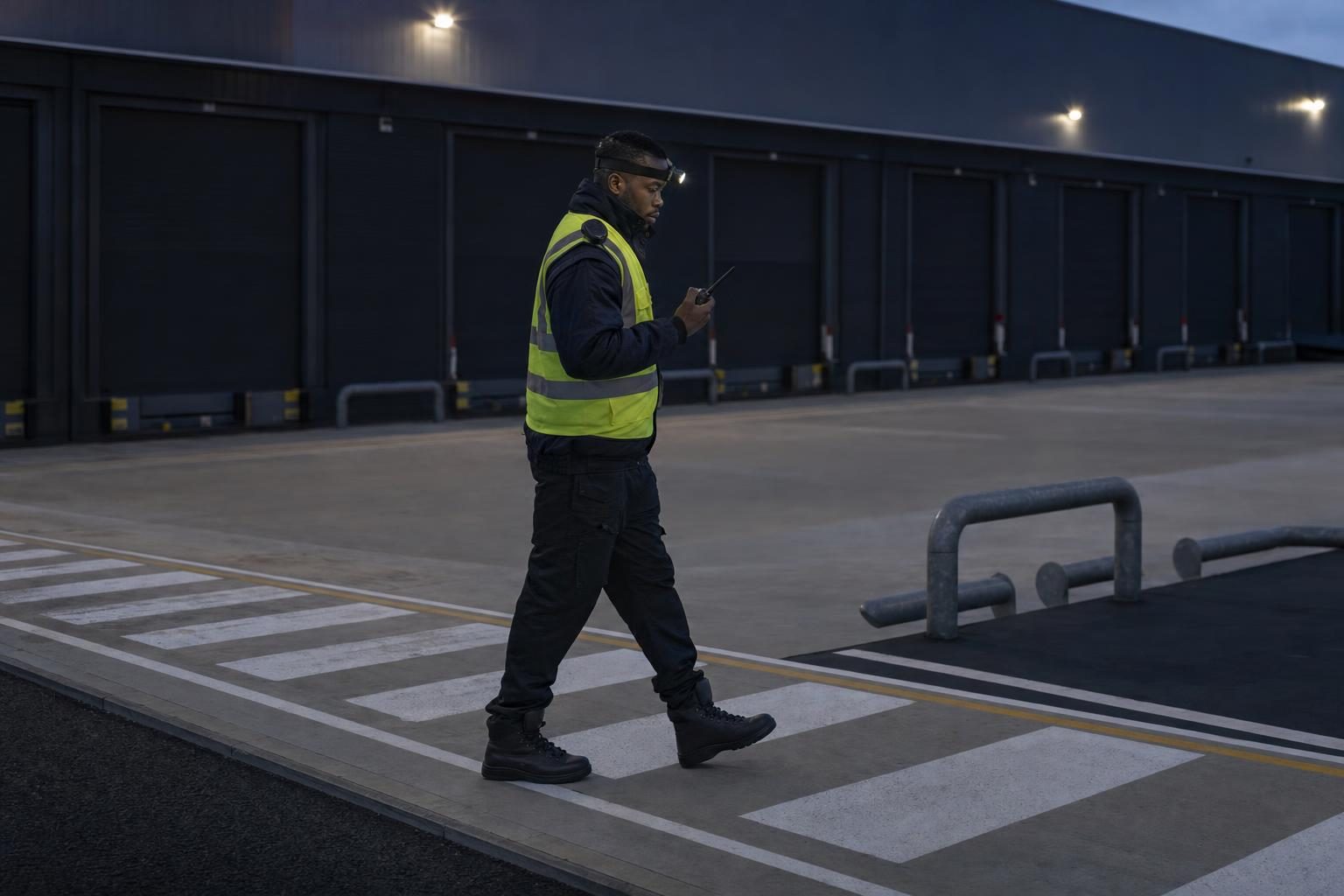
This is a fictional example built for this guide. A security guard covers a closed distribution site from 22:00 to 06:00. The guard patrols the yard every two hours, checks the loading doors and logs each round on paper. The only phone is the guard's own mobile, and the yard has a dead spot behind the far warehouse. The supervisor finds out how the night went when they read the log the next morning.
Nothing in that set-up is unusual, and nothing has gone wrong yet. Now ask three questions. If the guard slips on an unlit kerb at 02:10 and cannot get up, who knows? If a trespasser is inside the fence, what is the guard expected to do? If the guard collapses, how long until anyone checks?
The honest answer to all three is "nobody, until 06:00." A lone working risk assessment exists to change that answer before an incident does. We will come back to this guard in the worked example.
What Is Lone Working?
The UK Health and Safety Executive defines a lone worker as "someone who works by themselves without close or direct supervision" in its guide Protecting lone workers (INDG73). Being alone in the building is not the test. A cleaner on the fifth floor of a busy office can be a lone worker if nobody would notice they had stopped moving.
| Type of lone worker | Examples from HSE INDG73 |
|---|---|
| Alone at a fixed base | Shops, petrol stations, factories, warehouses, leisure centres |
| Separated from others on the same premises or outside normal hours | Security staff, cleaners, maintenance and repair staff |
| Working at home | Homeworkers |
| Mobile, away from a fixed base | Home-visiting care workers, engineers, estate agents, sales and service representatives, delivery drivers, agricultural and forestry workers |
| Volunteers working on their own | Fundraising, litter picking |
British Columbia's regulation uses a functional test that works well in practice: a person works "alone or in isolation" when assistance would not be readily available in an emergency, or if they are injured or ill (WorkSafeBC OHS Regulation, section 4.20.1). If you are unsure whether someone is a lone worker, ask: if they were hurt right now, how long until someone would know?
Is Lone Working Legal? UK, US, Canada and Türkiye
Working alone is legal in all four jurisdictions below, but none of them lets the employer skip the assessment. HSE puts it plainly: "It will often be safe to work alone. However, the law requires you to think about and deal with any health and safety risks before people are allowed to do so."
| Jurisdiction | What the law says about lone working |
|---|---|
| UK | Duties come from the Health and Safety at Work etc Act and the Management of Health and Safety at Work Regulations. HSE states there is no legal requirement for a separate lone worker risk assessment, but lone-worker risks must be in your general risk assessment. Employers with five or more workers must record the findings. |
| US | OSHA's FAQ says there is no general OSHA standard on working alone, except in specific situations such as emergency response, interior structural firefighting and permit-required confined spaces. In shipyards, 29 CFR 1915.84 requires the employer to account for anyone working alone at regular intervals during the shift and at the end of it, by sight or verbal communication. |
| Canada (British Columbia) | OHS Regulation section 4.21 requires a written procedure for checking a lone worker's well-being, including the interval between checks, what to do if the worker cannot be contacted, a designated person who records the checks, and an end-of-shift check. Section 4.23 requires a review at least once a year. |
| Türkiye | We found no regulation dedicated to lone working. The duty sits in 6331 sayılı Kanun (Article 4: carry out a risk assessment and consider whether the worker is fit for the task; Article 10: consider groups needing special protection) and the Risk Değerlendirmesi Yönetmeliği, whose Article 8 lists working methods, shift patterns and team working among the things to consider. |
The common thread: the employer owns the risk, the assessment must happen before the person works alone, and the controls must include a way to keep in touch and respond.
What to Assess: The Lone Working Risk Factors
A lone working assessment looks at four things: the person, the place, the task and the response. HSE's INDG73 lists the questions below. We grouped them into a checklist you can run for each lone-working role.
| Factor | Questions to answer |
|---|---|
| The person | How experienced are they in the role and in working alone? Have they had the relevant training? Are they more vulnerable, for example young, pregnant, disabled or a trainee? Is there a medical reason they should not work alone? (Seek medical advice if needed.) |
| The place | Is it rural or isolated? Are they entering someone else's home or premises? Is there a safe way in and out for one person outside normal hours? Is there mobile or radio coverage everywhere they go? |
| The task | Does it involve operating equipment alone or lifting objects too large for one person? Does a law or standard require a second person? Could an incident leave them unable to call for help? |
| Triggers for violence | Do they enforce rules or have authority over customers? Do they handle cash, ask for payment or remove goods? Do they work late evening or early morning? Do they meet people affected by alcohol or drugs? |
| Wellbeing | How often do they talk to their manager? Are they included in team updates, training and consultation? Lone working can raise work-related stress when support is hard to reach. |
| The response | How do they raise the alarm? Who answers? How long until help arrives? Has the emergency procedure been tested? |
The last row is where most assessments are weakest. A procedure that says "call the supervisor" is not a response if the supervisor is asleep and the phone has no signal.
How to Do a Lone Working Risk Assessment in 6 Steps
A lone working risk assessment follows the same logic as any risk assessment, with extra attention on detection and response.
Step 1: List who works alone, when and where
Go role by role and shift by shift. Include the hidden cases: the maintenance technician who stays late to finish a job, the manager who opens up at 06:00, the contractor working on a roof while the tenant is on holiday. Record the location, the hours and the tasks done alone.
Step 2: Decide whether each task can be done alone at all
Run the four gates in the next section. Some tasks fail the first gate and need a second person regardless of how good the check-in system is.
Step 3: Identify hazards and how isolation changes the outcome
List the normal hazards of the task, then the foreseeable emergencies HSE names: fire, equipment failure, illness and accidents. For each, ask what being alone changes. Usually it is the time until someone notices and the time until help arrives.
Step 4: Score the risk
Use your normal method. We use Fine-Kinney below because it separates probability, exposure and consequence, which makes it easy to see where a lone-working control acts.
Step 5: Set controls, supervision and a check-in plan
Apply the hierarchy of controls: remove the need to work alone first, then engineer out the hazard, then add procedures, training and monitoring. HSE notes that the level of supervision is a management decision based on the risk assessment: "the higher the risk, the greater the level of supervision required." New starters, trainees and people facing new situations may need to be accompanied at first.
Step 6: Record, consult, test and review
Involve the workers in the assessment. Write down the findings, test the alarm and check-in system with real drills, and review the assessment periodically and after significant changes such as new staff, processes or equipment.
Can This Task Be Done Alone?
Before scoring anything, put each lone task through four gates. If it fails a gate, fix that first or do not do the task alone.
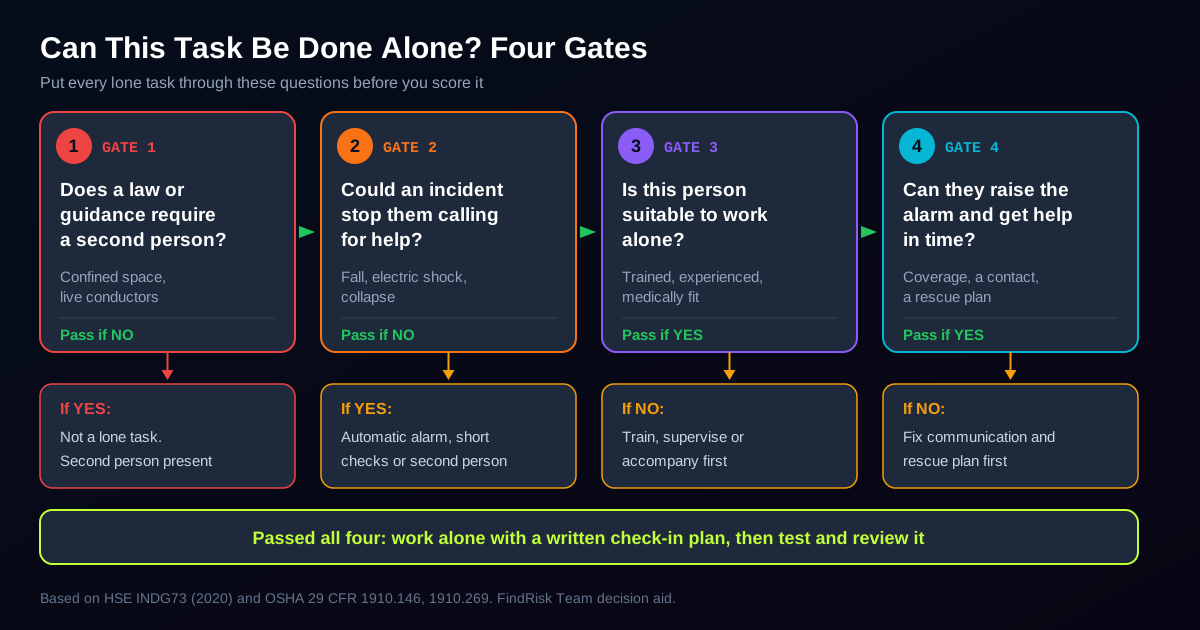
- Does a law or guidance require a second person? If yes, the task is not a lone task. See the table below.
- Could a foreseeable incident leave the worker unable to call for help? Falls from height, electric shock, being trapped, collapse. If yes, a manual phone call is not enough. You need an automatic alarm (no-motion or fall detection), a much shorter check interval or a second person.
- Is this person suitable to work alone? Trained for the task, experienced enough to recognise when to stop, and medically fit. HSE says to set limits on what can and cannot be done while working alone.
- Can they raise the alarm and get help in time? Coverage where they work, a contact who answers, a known address or location, and a rescue plan that does not depend on the lone worker.
Tasks that need at least one other person present, with the source:
| Task | Requirement | Source |
|---|---|---|
| Confined space entry | A supervisor may need to be present, plus someone dedicated to the rescue role | HSE INDG73 |
| Permit-required confined space (US) | At least one attendant outside the space for the duration of entry, who stays outside until relieved and summons rescue | 29 CFR 1910.146(d)(6), (i) |
| Work near exposed live conductors | At least one other person may need to be present | HSE INDG73 |
| Installing, removing or repairing lines energized above 600 V (US power generation, transmission and distribution) | At least two employees present, with limited exceptions | 29 CFR 1910.269(l)(2) |
| Enclosed spaces in power work (US) | An attendant with first-aid training immediately available outside | 29 CFR 1910.269(e)(7) |
| Diving operations, vehicles carrying explosives, fumigation | At least one other person may need to be present | HSE INDG73 |
| Lifting objects too large for one person | Plan a team lift or mechanical aid | HSE INDG73 |
For the entry procedure itself, see our confined space entry guide. For electrical work, isolate first with lockout/tagout so live work is not needed.
Worked Example: Three Lone Workers Scored With Fine-Kinney
The three roles and nine hazards below are fictional, written by FindRisk Team to show the scoring logic. The scales are Kinney and Wiruth's (1976): risk R = Probability × Exposure × Consequence. Classes: above 400 very high, 200–400 high, 70–200 substantial, 20–70 possible, below 20 acceptable.
Role 1: Night security guard at a closed distribution site
| Hazard | Before: P × E × C | R | Main controls | After: P × E × C | R |
|---|---|---|---|---|---|
| Confronting an intruder alone at night | 3 × 6 × 15 | 270 High | No-confrontation rule (observe, report, wait for police), CCTV checks from the gatehouse before patrols, panic button on a monitored device, personal safety training | 0.5 × 6 × 15 | 45 Possible |
| Trip or fall on the unlit yard, found only at shift change | 3 × 6 × 7 | 126 Substantial | Lighting along the patrol route, head torch, kerb marking, no-motion alarm on the device | 1 × 6 × 7 | 42 Possible |
| Sudden illness with no one to raise the alarm | 1 × 6 × 15 | 90 Substantial | Medical advice before assigning solo nights, automatic no-motion alarm, hourly check-in with a monitoring centre, first aid kit | 1 × 6 × 7 | 42 Possible |
Role 2: Field service technician visiting customer sites
| Hazard | Before: P × E × C | R | Main controls | After: P × E × C | R |
|---|---|---|---|---|---|
| Fault-finding inside a live distribution panel alone | 3 × 3 × 15 | 135 Substantial | Isolate and lock out before work; live testing only with a second competent person present | 0.5 × 3 × 15 | 22.5 Possible |
| Reaching roof plant by ladder, no edge protection, alone | 3 × 3 × 15 | 135 Substantial | Check roof access when booking; no guardrails means a two-person job with a MEWP or temporary edge protection | 0.5 × 3 × 15 | 22.5 Possible |
| Driving between sites while tired, long days | 3 × 6 × 15 | 270 High | Schedule limits on daily driving, route planning with breaks, no phone calls while driving, end-of-day check-in | 1 × 6 × 15 | 90 Substantial |
Role 3: Early-morning office cleaner, multi-storey building
| Hazard | Before: P × E × C | R | Main controls | After: P × E × C | R |
|---|---|---|---|---|---|
| Slip on a wet floor or stairs, not found for hours | 3 × 6 × 7 | 126 Substantial | Clean half the width at a time, slip-resistant footwear, check-in at start, every two hours and at finish | 1 × 6 × 7 | 42 Possible |
| Mixing chlorine bleach with an acid descaler in a small store | 1 × 6 × 7 | 42 Possible | Pre-diluted dosing system, remove incompatible products, ventilated store | 0.2 × 6 × 7 | 8.4 Acceptable |
| Carrying heavy waste bags down stairs alone | 3 × 6 × 3 | 54 Possible | Bag weight limit, wheeled bins, use the lift | 1 × 6 × 3 | 18 Acceptable |
What the numbers show
Look at the guard's "sudden illness" row. No control can lower the probability of a heart attack, so P stays at 1. What the alarm and check-ins change is the consequence: someone found within minutes has a far better outcome than someone found at 06:00. That is the core of lone working control. Monitoring cuts the time to help, which lowers consequence. Task controls lower probability. You usually need both.
Second, the driving row stays at 90 after controls. That is an honest result. HSE notes that many lone workers are exposed to work-related road risks, and a check-in system does little for them. The residual score tells management that this risk needs further work, such as fewer site visits per day or shorter routes.
Third, the technician's two highest-consequence hazards were solved by not doing them alone. Monitoring would not have helped much: a person who receives an electric shock or falls from a roof edge may not be able to press a button.
Check-In Intervals and Missed Check-In Procedure
There is no fixed legal interval for lone worker check-ins in the UK or Türkiye. British Columbia requires the interval to be written into the procedure and agreed with the worker, and OSHA's shipyard rule says intervals must be "appropriate to the job assignment." The interval should come from your risk assessment.
The table below is a FindRisk Team starting point, not a legal requirement. Adjust it to your assessment.
| Residual situation | Suggested check-in | Alarm |
|---|---|---|
| Low hazard, normal hours, people nearby (office work after hours) | Start and end of the shift | Mobile phone |
| Moderate hazard or isolated location (cleaner, site visit) | Start, every 2 hours, end | Phone app with manual alert |
| Higher hazard, night work or violence risk (security, remote sites) | Hourly, plus end of shift | Device with panic button and no-motion alarm, monitored 24/7 |
| Incapacitation would be fatal within minutes (confined space, live work, unprotected edges) | Check-ins are not a control here | Second person present |
A check-in system only works if someone acts when a check-in is missed. Write down the escalation and test it. An example:
| Time after a missed check-in | Action |
|---|---|
| 0 min | Monitor calls the worker's phone and radio |
| 10 min | Second call and text; check the device's last location |
| 15 min | Supervisor informed; calls the site or customer the worker was visiting |
| 30 min | Someone is sent to the last known location, or emergency services are called if the risk is high |
For high-risk roles, shorten every step. HSE advises that you regularly test technical solutions and all emergency procedures. A drill once a quarter, where the worker deliberately misses a check-in, shows whether the chain actually works at 03:00.
Common Mistakes in Lone Working Risk Assessments
1. Treating a mobile phone as the whole control
A phone needs signal, battery and a conscious worker who can use it. It does nothing for a fall, a collapse or a confrontation where the worker cannot reach it. Ask what happens if the worker cannot press anything.
2. No one answers the alarm
The check-in goes to a supervisor's mobile that is on silent overnight. Name the person or monitoring service, their hours and their backup.
3. Missed check-ins have no procedure
Without a written escalation, a missed call is often read as "probably busy." Set the times and actions in advance, as in the table above.
4. Assessing the role, not the person
A trainee, a young worker, a pregnant worker or someone with a medical condition may need a different arrangement for the same task. HSE and Turkish law both name these groups. Include the individual check in the assessment.
5. Letting monitoring replace task controls
A check-in every 30 minutes does not make live electrical work or confined space entry acceptable for one person. Some tasks need a second person, full stop.
6. Never reviewing after a near miss
A guard who was threatened or a cleaner who slipped and lay on the floor for 20 minutes is a near miss for the lone working arrangement. Update the assessment after such events and after changes in staff, sites or equipment.
How FindRisk Supports Lone Working Assessments
FindRisk lets you build a lone working checklist with AI from a short description of the role, such as "night security guard at a distribution site", and then edit it to match your site. You can run the four gates and the risk factor questions on your phone during a site visit.
Each hazard can be scored with the built-in Fine-Kinney risk assessment, so the before and after scores sit next to each other just like the tables above. If you walk the patrol route or the cleaner's floor plan, you can photograph problem spots such as an unlit kerb or a mobile dead spot, mark the hazard on the photo and use the AI analysis as a second pair of eyes.
When you are done, FindRisk produces a professional report in seconds that you can share with the site manager and the workers you consulted. It runs on iOS and Android.
Frequently Asked Questions
Is it legal to work alone?
Yes. Working alone is legal in the UK, the US, Canada and Türkiye, and HSE notes that it will often be safe. The condition is that the employer assesses and controls the risks before anyone works alone. Some specific tasks, such as permit-required confined space entry, legally require another person present, so the answer depends on the task, not only the job title.
Do you need a separate risk assessment for lone workers?
Not in the UK. HSE states there is no legal requirement for a specific, separate lone worker risk assessment, but you must include lone-worker risks in your general risk assessment and act on them. Many employers still write a short lone working section or form for each role, because it makes the check-in plan and the emergency response easy to find and audit.
How often should lone workers check in?
There is no single legal interval in the UK or Türkiye. The interval should come from your risk assessment: the higher the risk, the shorter the interval. British Columbia requires the interval to be written down, agreed with the worker and followed by an end-of-shift check. As a starting point, many employers use start and end checks for low-risk work and hourly checks plus an automatic alarm for high-risk night work.
What jobs should never be done alone?
HSE lists confined space work, work near exposed live electrical conductors, diving operations, vehicles carrying explosives and fumigation as examples where at least one other person may need to be present. In the US, OSHA requires an attendant outside permit-required confined spaces and at least two employees for installing, removing or repairing lines energized above 600 volts, with limited exceptions. Any task where an incident would stop the worker calling for help deserves the same scrutiny.
Can young or pregnant workers work alone?
They are not banned from working alone, but HSE and Turkish law both require the assessment to consider them specifically. HSE asks whether the worker is more vulnerable because they are young, pregnant, disabled or a trainee. 6331 sayılı Kanun Article 10 names young, older, disabled, pregnant and breastfeeding workers as groups needing special protection. The result may be closer supervision or a different task.
Do lone workers need a lone worker device?
Not always. HSE lists several ways to keep in touch: supervisor visits, regular contact by phone or radio, alarm devices that work manually or automatically, and a system to confirm the worker has returned to base. A dedicated device with a panic button and no-motion alarm makes sense when the worker could be incapacitated, works at night or faces a violence risk.
Does working from home count as lone working?
Yes. HSE includes homeworkers in its definition of lone workers and states that employers have the same responsibility for their health and safety as for any other employee. The assessment usually focuses on workstation set-up, stress and keeping in contact rather than physical emergencies, but the duty to assess still applies.
Conclusion
A lone working risk assessment is not a separate paperwork exercise. It is your normal risk assessment with one extra question asked of every task: what happens if this person is hurt and nobody knows? Answering it honestly sorts tasks into three groups: those that need a second person, those that need an automatic alarm and short check-ins, and those where a start and end check is enough.
Score each hazard before and after controls, and look at what each control actually changes. Monitoring shortens the time to help; task controls make the incident less likely. Write the check-in interval and the missed check-in procedure down, test them at the hours people really work alone, and review after every near miss.
Download FindRisk to build a lone working checklist with AI, score each hazard with Fine-Kinney and share the report with your team the same day.
Try FindRisk
Ready to modernize your safety workflow?
Conduct AI-powered risk assessments, generate reports instantly, and keep your team safe — anywhere, anytime.