
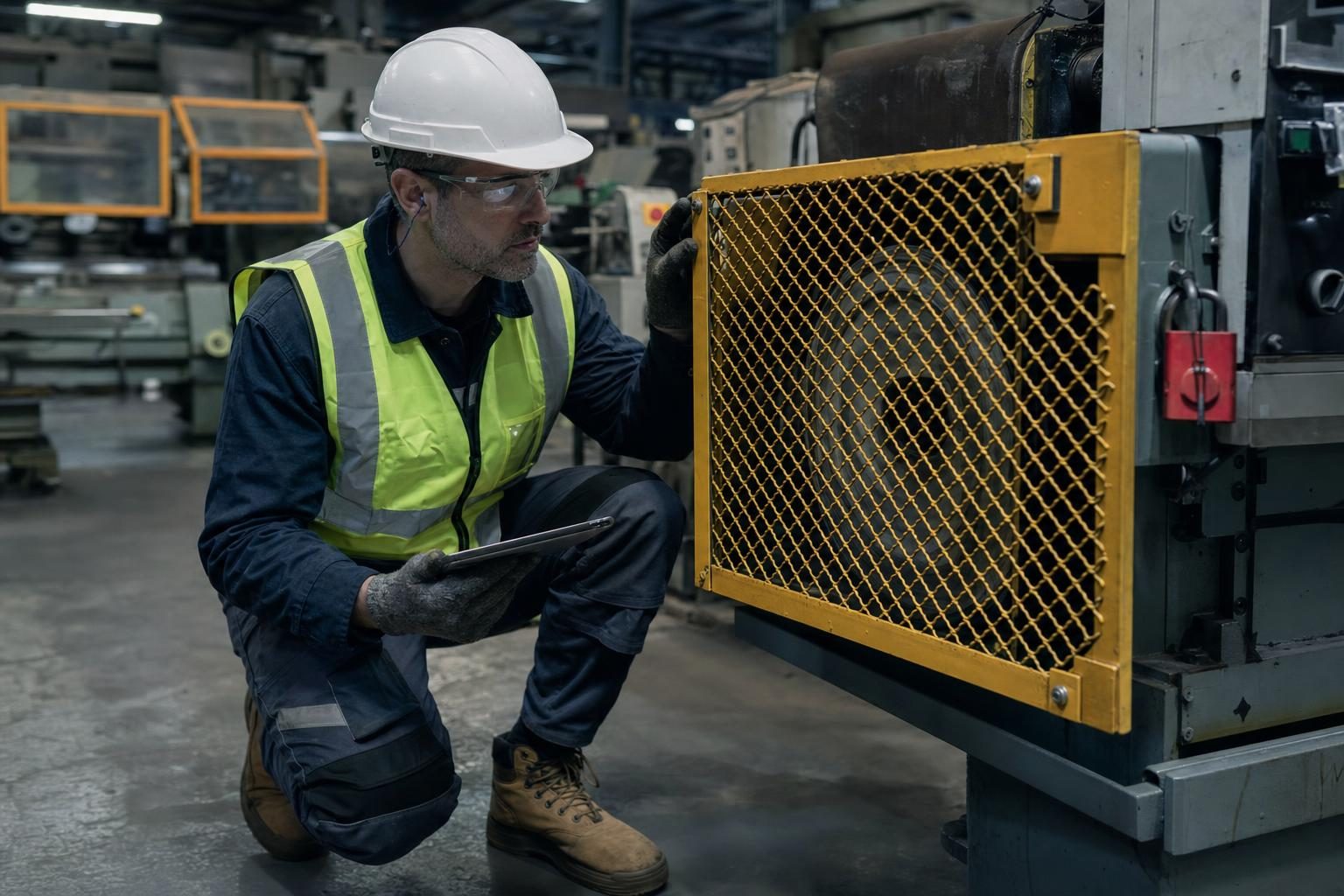
Machine Guarding Checklist: 36 Checks for Safe Machinery
A machine guarding checklist is a structured list of checks used to confirm that every dangerous moving part of a machine is either enclosed or stopped before a person can reach it. It covers the point of operation, power transmission parts, interlocks and sensing devices, controls and emergency stops, and the people and procedures around the machine, so that a missing or defeated guard is found before it causes an amputation.
Machine guarding is one of the oldest rules in occupational safety and is still cited every year. OSHA's preliminary list of the most frequently cited standards for fiscal year 2026 (October 1, 2025 to August 31, 2026) puts machine guarding, general industry (29 CFR 1910.212) at number 10, with lockout/tagout at number 3 (OSHA Top 10). OSHA describes the stakes plainly: moving machine parts can cause "crushed fingers or hands, amputations, burns, or blindness" (OSHA).
Most machine guarding checklists online copy the old OSHA question list and stop there. This one adds what an inspector needs to make a decision: which safeguard should be there, measurable checks you can do with a tape measure, how often to inspect, which findings stop the machine, and three findings scored before and after the fix.
A Machine That Passed Last Month's Inspection
Picture a hypothetical metal fabrication shop. Last month's inspection sheet for the CNC lathe, the bench drill and the belt-driven compressor is all ticks. This month, an inspector who walks the floor with a structured checklist finds three problems in fifteen minutes.
The lathe door interlock has a spare actuator taped into the switch, so the spindle runs with the door open. The compressor's belt guard was taken off to change a belt two weeks ago and is leaning against the wall. The drill's chuck guard is there, but raised all the way up because "it gets in the way."
Nothing on last month's sheet was false. Each guard existed. What the sheet did not ask was whether each guard was fitted, working and impossible to defeat easily. The scenario is illustrative, but the pattern is common: a guarding inspection fails when it checks that guards exist, not that they protect.
What Is Machine Guarding?
Machine guarding is the set of physical guards and safety devices that prevent a person from contacting dangerous moving parts of a machine, or stop those parts before contact. OSHA requires "one or more methods of machine guarding" to protect the operator and other employees "from hazards such as those created by point of operation, ingoing nip points, rotating parts, flying chips and sparks" (1910.212(a)(1)).
Dangerous parts sit in three places on almost every machine:
- Point of operation: "the area on a machine where work is actually performed upon the material being processed" (1910.212(a)(3)(i)), such as the blade, the press die or the drill bit.
- Power transmission apparatus: belts, pulleys, chains, sprockets, gears, shafts and couplings that carry energy to the working part.
- Other moving parts: feed mechanisms, reciprocating tables, rotating stock and auxiliary parts.
OSHA's Machine Guarding eTool groups the hazards into motions and actions (OSHA eTool):
| Type | What it is | Typical example |
|---|---|---|
| Rotating motion | Shafts, couplings, spindles, flywheels; "even smooth, slowly rotating shafts can grip hair and clothing" | Drill spindle, lathe chuck |
| In-running nip points | Two rotating parts, a rotating and a tangentially moving part, or a rotating and a fixed part | Belt and pulley, conveyor tail drum, rolls |
| Reciprocating motion | Back-and-forth or up-and-down movement that can strike or trap | Press ram, shaper table |
| Transversing motion | Movement in a straight, continuous line | Conveyor belt, gantry |
| Cutting, punching, shearing, bending | Actions at the point of operation | Saws, punch presses, guillotines, press brakes |
Which rules apply?
| Jurisdiction | Main requirement |
|---|---|
| US (OSHA) | 29 CFR 1910.212 general requirements; 1910.219 mechanical power transmission; 1910.217 mechanical power presses; 1910.147 lockout/tagout |
| UK | Provision and Use of Work Equipment Regulations 1998 (PUWER), regulation 11 on dangerous parts of machinery |
| Türkiye | Work equipment regulation (İş Ekipmanlarının Kullanımında Sağlık ve Güvenlik Şartları Yönetmeliği, 2013), Annex I item 2.8 on guards and protection devices |
| EU, machine makers | Machinery Directive 2006/42/EC, replaced by Regulation (EU) 2023/1230 from 20 January 2027 |
Design standards fill in the details: ISO 14120 for fixed and movable guards, ISO 13857 for safety distances that keep arms and legs out of hazard zones, and ISO 14119 for interlocking devices, including measures against defeat.
Choosing the Right Safeguard: Guards and Devices
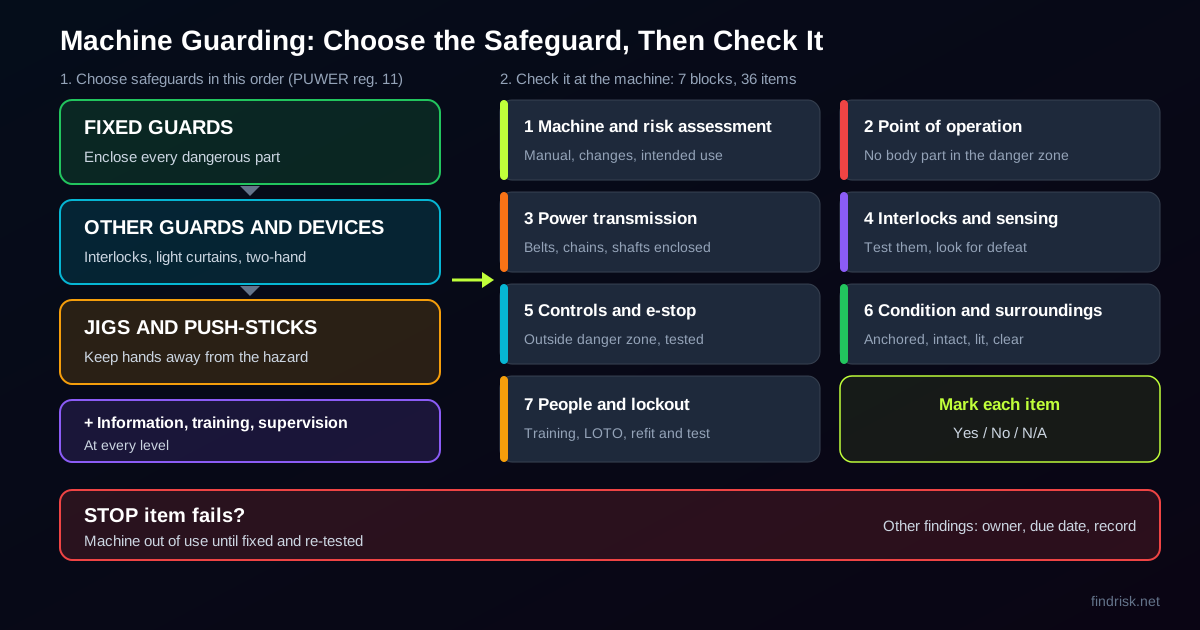
A checklist verifies safeguards; it cannot fix the wrong choice of safeguard. Before you inspect a machine, know what should be on it. PUWER regulation 11 sets a clear order:
- Fixed guards enclosing every dangerous part, where practicable.
- Where not, other guards or protection devices (interlocked guards, light curtains, two-hand controls).
- Where not, jigs, holders, push-sticks or similar protection appliances.
- At every level, the information, instruction, training and supervision needed.
This is the hierarchy of controls applied to moving parts: a guard that works without anyone's action beats a device that depends on adjustment, and both beat a push-stick that depends on behavior.
Guard types and their limits
| Guard | How it protects | Main limitation (OSHA eTool) |
|---|---|---|
| Fixed | A permanent part of the machine, not dependent on moving parts | May interfere with visibility; removal for adjustment needs other protection |
| Interlocked | Opening it shuts off or disengages power and stops moving parts | "Requires careful adjustment and maintenance"; "may be easy to disengage" |
| Adjustable | Can be set to admit different stock sizes | "Hands may enter danger area"; operator can make it ineffective |
| Self-adjusting | Opening is set by the movement of the stock | "Does not always provide maximum protection"; frequent adjustment |
Safety devices and their limits
| Device | How it protects | Main limitation (OSHA eTool) |
|---|---|---|
| Presence-sensing (light curtain, RF field, sensing bar) | Stops the cycle when the field is broken | "Limited to machines that can be stopped"; no protection against mechanical failure |
| Two-hand control | Both hands must press and hold to run the cycle | "Requires a partial cycle machine with a brake"; can be defeated by blocking; protects only the operator |
| Two-hand trip | Both buttons start the cycle, then hands are free | Operator may reach in after tripping; protects only the operator |
| Pullback / restraint | Cables pull hands out of, or keep them away from, the danger zone | Limits movement; needs close supervision and frequent inspection |
| Safety trip control (body bar, trip wire) | Stops the machine when pressed or pulled | Must be activated by the person; protects only the operator |
| Gate | Movable barrier that must close before the cycle starts | Needs regular inspection; may block the view of the work |
Two rules follow from these tables. Devices that stop the machine only work on machines that can stop quickly, so check stopping performance, not just the device. And anything that protects "only the operator" leaves helpers, cleaners and passers-by to other safeguards.
The Machine Guarding Checklist
Use this list at the machine, with the machine running where it is safe to observe and stopped and isolated when you need to touch or open anything. Mark each item Yes, No or N/A. Any "No" on an item marked [STOP] means the machine is taken out of use until it is fixed.
Block 1: Machine and risk assessment
- The machine is identified (asset number, location) and has a current risk assessment that covers its moving parts and the tasks done on it, including setting, cleaning and jam clearing.
- The manufacturer's manual is available, and the guards fitted match what the manufacturer supplied or a documented modification.
- Any change to the machine (new tooling, new feed, a removed or modified guard) went through a documented review.
- The machine is used only for the work it was designed for.
Block 2: Point of operation
- The point of operation is guarded so that no part of the body can enter the danger zone during the cycle (1910.212(a)(3)(ii)). [STOP]
- Openings in point-of-operation guards are small enough for their distance from the hazard (see the measurable checks below).
- Adjustable guards (for example, drill chuck or band saw blade guards) are set as close to the work as the task allows, not parked fully open.
- Hand tools or push-sticks are available where the operator must feed small parts, and they are used in addition to, not instead of, the guard.
- The operator can see the work through or around the guard without removing it.
- No one can reach the hazard from the side, from below or over the top of the guard.
- Guards protect against flying chips, sparks, coolant and broken tooling where these can be ejected.
Block 3: Power transmission and other moving parts
- Belts, pulleys, chains, sprockets, gears and couplings within reach are fully enclosed. Under OSHA, parts 7 feet or less above the floor or platform must be guarded, and horizontal belts with both runs 42 inches or less from the floor must be fully enclosed (1910.219). [STOP] if a nip point is exposed within reach.
- Rotating shafts, shaft ends and set screws are covered, and collars have no projecting fasteners.
- Fixed guards are held by fasteners that need a tool to remove, and all fasteners are present.
- Conveyor tail drums, return rollers and transfer points are guarded where people work or clean.
- Fan blades less than 7 feet above the floor or working level are guarded with openings no larger than half an inch (1910.212(a)(5)).
Block 4: Interlocks and sensing devices
- Every interlocked guard stops the hazardous motion when opened, and the machine cannot start while it is open. Test it. [STOP] if it fails.
- There is no sign of defeat: taped or wedged switches, spare actuators, magnets on sensors, bridged wiring, a key left in a trapped-key interlock. [STOP]
- On machines that take time to stop, the guard stays locked until motion has stopped, or the stopping time is shorter than the time needed to reach the hazard.
- Light curtains and other presence-sensing devices cover the whole access area, are mounted at the safe distance stated in their documentation, and stop the machine when tested with the test piece.
- Two-hand controls are mounted so that one hand and an elbow, or a single hand, cannot operate both buttons.
- Daily function checks of interlocks and sensing devices are recorded where your procedure requires them.
Block 5: Controls and emergency stop
- Start controls are outside the danger zone, clearly marked and protected against accidental operation.
- The operator can see that no one is in the danger zone before starting, or an automatic audible and visual warning sounds first.
- Emergency stop buttons are present where the hazard and stopping time call for them, reachable from each work position and tested. [STOP] if an e-stop does not work.
- After a stop or power failure, the machine does not restart without a deliberate action.
- Energy isolation points (main switch, pneumatic valve) are clearly visible, identified and lockable.
Block 6: Machine condition and surroundings
- Machines designed for a fixed location are securely anchored and do not walk or move (1910.212(b)).
- Guards are in good repair: no cracks, holes, missing panels or bent mesh that opens a gap.
- Hot or very cold surfaces within reach are insulated or shielded.
- The work area around the machine is clear, lit and free of slip hazards, and the operator does not wear loose clothing, gloves near rotating parts, jewelry or loose long hair.
Block 7: People, maintenance and lockout
- Operators are trained on this machine, know what each guard does and know that they must not remove or bypass it.
- Only authorized people remove guards, and only for maintenance, setting or cleaning under a written procedure.
- A lockout/tagout procedure is used whenever a guard is removed or bypassed, or a person must put any part of the body in the point of operation or danger zone (1910.147(a)(2)(ii)). [STOP] if guards are being removed on running or energized machines.
- Guards are refitted and tested before the machine returns to production after maintenance.
- Workers know how to report a missing, damaged or defeated guard, and reports are acted on.
For a full factory walk-through that covers housekeeping, electrical, chemicals and forklifts alongside machinery, use the manufacturing safety inspection checklist.
Measurable Checks: Openings, Heights and Distances
Some guarding checks need a tape measure, not judgment. These are the ones inspectors most often skip.
Guard openings. A guard with a large opening close to the hazard lets fingers through. For mechanical power presses, OSHA Table O-10 (1910.217) links the maximum opening to its distance from the point of operation:
| Distance of opening from the hazard (in) | Maximum width of opening (in) |
|---|---|
| 1/2 to 1 1/2 | 1/4 |
| 1 1/2 to 2 1/2 | 3/8 |
| 2 1/2 to 3 1/2 | 1/2 |
| 3 1/2 to 5 1/2 | 5/8 |
| 5 1/2 to 6 1/2 | 3/4 |
| 6 1/2 to 7 1/2 | 7/8 |
| 7 1/2 to 12 1/2 | 1 1/4 |
| 12 1/2 to 15 1/2 | 1 1/2 |
| 15 1/2 to 17 1/2 | 1 7/8 |
| 17 1/2 to 31 1/2 | 2 1/8 |
The table is written for presses, but the principle applies to any guard: the closer the opening is to the hazard, the smaller it must be. In the EU, the UK and Türkiye, ISO 13857 gives the equivalent safety distances for upper and lower limbs.
Heights. OSHA treats power transmission parts 7 feet or less above the floor or platform as within reach (1910.219), and fan blades below 7 feet must have a guard with openings of half an inch or less (1910.212(a)(5)). Check guards that stop short of these heights, and check for platforms, steps or stacked pallets that bring a "high" part within reach.
Gaps. Measure the gap between a guard and the machine frame, the floor or the conveyor belt. A guard that is complete on drawings but leaves a hand-sized gap at the bottom is not complete.
How Often Should Machine Guards Be Inspected?
Machine guards should be checked by the operator before each shift or each use, and by a competent person at planned intervals and after any maintenance that involved removing a guard. Fixed intervals in law are rare; most come from the manufacturer, your risk assessment and your maintenance system.
| Check | Who | When | Basis |
|---|---|---|---|
| Pre-use visual check: guards fitted, undamaged, interlocks working | Operator | Before each shift or use | Good practice; manufacturer's instructions |
| Function test of interlocks, light curtains, two-hand controls, e-stops | Operator or maintenance | Daily or per manufacturer | Manufacturer's instructions; your procedure |
| Inspection of power transmission equipment | Competent person | At intervals not exceeding 60 days | OSHA 1910.219(p)(1) |
| Detailed guarding inspection with this checklist | Supervisor or safety professional | Monthly or quarterly, by risk | Your risk assessment |
| Guards refitted and tested | Maintenance | After every repair, setting or cleaning that removed a guard | 1910.147; PUWER reg. 11 |
| Periodic inspection of listed equipment (Türkiye) | Authorized person | Per Annex III of the work equipment regulation | İş Ekipmanları Yönetmeliği Art. 7 |
Keep records. A tick on a shared sheet does not show who tested the interlock or what happened when it failed. A record with a name, a date and a photo does, and it is what the next inspector needs to check the fix. Our safety inspection checklist guide covers how to build inspection frequencies into a wider program.
Stop the Machine or Fix and Record?
Not every "No" carries the same risk. Separate the findings that take the machine out of use from the ones you fix and record, so the checklist drives decisions instead of producing a list of equal ticks.
| Take the machine out of use until fixed | Fix promptly and record |
|---|---|
| Point of operation open to hands during the cycle | Guard fastener missing where the guard is still held securely |
| Exposed belt, chain, gear or nip point within reach | Guard discolored or scratched, but intact and in place |
| Interlock or light curtain fails the test, or shows signs of defeat | Daily function check done but not recorded |
| Emergency stop does not work | Warning label faded |
| Guard removed and not refitted after maintenance | Push-stick missing but guard complete |
| Guards removed on an energized machine without lockout | Training record not on file, operator demonstrates the right method |
When a stop-the-machine finding is fixed, test the item again at the machine and record who fixed it and when. For the right-hand column, give each finding an owner and a due date, as you would any corrective action.
Scoring Machine Guarding Findings: Three Examples
A risk score turns a list of findings into a priority order. The three findings below are scored with the Fine-Kinney scales used in our Fine-Kinney risk assessment examples (Risk = Probability × Exposure × Consequence). The values are illustrative; your team should score its own machines.
| Finding | Before: P × E × C | Risk | Control applied | After: P × E × C | Risk |
|---|---|---|---|---|---|
| CNC lathe door interlock defeated with a taped spare actuator; operator opens the door to check parts many times per shift | 6 × 10 × 7 | 420 (Very high) | Spare actuators removed; coded interlock that resists defeat; daily function test | 0.5 × 10 × 7 | 35 (Possible) |
| Conveyor tail drum guard removed for weekly cleaning and not refitted | 3 × 3 × 15 | 135 (Substantial) | Guard refitted with captive fasteners; cleaning done only under lockout | 0.5 × 3 × 15 | 22.5 (Possible) |
| Compressor V-belt and pulley exposed at hip height next to a walkway used daily | 3 × 6 × 7 | 126 (Substantial) | Fixed mesh enclosure, fastened with tools | 0.5 × 6 × 7 | 21 (Possible) |
Scales used: P 6 = quite possible, 3 = unusual but possible, 0.5 = conceivable but very unlikely; E 10 = continuous, 6 = frequent (daily), 3 = occasional (weekly); C 15 = very serious, one fatality, 7 = serious injury. Entanglement in a conveyor drum can kill, which is why it carries a higher consequence than a hand injury at the lathe.
In all three cases exposure and consequence stay the same after the fix. The machine still runs and a failure would still hurt someone. Only probability falls, and it falls most when the fix is a guard that works without relying on people remembering to put it back.
Common Machine Guarding Mistakes
1. Checking that a guard exists, not that it protects
A guard leaning against the wall, parked fully open or bolted on with a gap underneath scores a tick on a careless checklist. Ask whether you can reach the hazard, not whether there is a guard.
2. Never testing interlocks
An interlock that has been bridged looks the same as one that works. Open the guard and watch the machine stop. If it keeps running, you have found the most dangerous item on the floor.
3. Ignoring the people who are not the operator
Two-hand controls and many sensing devices protect only the operator. Cleaners, setters and maintenance staff reach into machines from other sides and at other times. Check guarding from every side people approach.
4. Guarding the point of operation and forgetting the drive
Belts, chains and shafts at the back of a machine cause entanglement injuries just as serious as the blade at the front. Walk around the machine.
5. Treating cleaning and jam clearing as "not maintenance"
Jam clearing and cleaning are when guards come off on running machines. Under OSHA, removing or bypassing a guard during production brings the task under lockout/tagout unless it is a minor, routine, repetitive task done with alternative measures that give effective protection.
6. Guards that make the job harder
A guard that blocks the view or slows down every part change will be removed. If operators keep defeating a guard, redesign the guard or the task rather than writing another warning.
How FindRisk Supports Machine Guarding Inspections
FindRisk lets you run this checklist on your phone at the machine. Its AI checklist generator can build a machine guarding checklist for the machines you describe, such as a press brake line or a packaging conveyor, which you then adjust to your own procedure and stop-work rules.
During the walk-through you can photograph an exposed pulley, a taped interlock or a missing panel and mark the hazard directly on the photo, with AI analysis to help spot hazards you might have missed. Each finding can be scored with the built-in Fine-Kinney risk assessment, and the inspection becomes a professional report in seconds, ready for the maintenance team or plant manager. FindRisk runs on iOS and Android.
Frequently Asked Questions
What are the OSHA requirements for machine guarding?
Under 29 CFR 1910.212, employers must guard the point of operation, ingoing nip points, rotating parts and flying chips and sparks. Guards must be attached to the machine where possible and must not create a hazard themselves. The point-of-operation guard must keep every part of the operator's body out of the danger zone during the cycle. Specific rules cover power transmission (1910.219), mechanical power presses (1910.217) and other machine types.
What are the four types of machine guards?
OSHA describes four types: fixed guards, which are a permanent part of the machine; interlocked guards, which stop the machine when opened; adjustable guards, which can be set for different stock sizes; and self-adjusting guards, whose opening is set by the stock. Fixed guards give the most reliable protection. Devices such as light curtains and two-hand controls are safeguards too, but they are not guards.
How often should machine guards be inspected?
Operators should check guards before each shift or use, and interlocks and sensing devices should be function-tested as often as the manufacturer and your procedure require, often daily. OSHA requires power transmission equipment to be inspected at intervals of no more than 60 days. A detailed inspection by a competent person should follow a schedule set by your risk assessment and always follow maintenance that removed a guard.
Can a machine be operated with the guard removed?
No. A machine should not run in production with a required guard removed, bypassed or defeated. Guards may be removed only by authorized people for maintenance, setting or cleaning, with the machine stopped and isolated under a lockout/tagout procedure. The guard must be refitted and tested before the machine returns to production.
What is the difference between a guard and a safety device?
A guard is a physical barrier that prevents access to the danger zone, such as a fixed cover or an interlocked door. A safety device detects or controls the person instead of blocking them: a light curtain stops the machine when a hand breaks the beam, and a two-hand control keeps both hands on the buttons. Devices only work on machines that can stop quickly and often protect only the operator.
Who is responsible for machine guarding?
The employer is responsible for making sure machines in use are guarded and kept in good condition. Manufacturers must supply machines that meet design safety requirements, such as the EU machinery rules, but that does not remove the employer's duty to check the guards in use. Supervisors and operators carry out the daily checks and report defects.
Conclusion
A machine guarding checklist works when it checks that each guard protects, not just that it exists. That means knowing which safeguard should be on the machine, testing interlocks and sensing devices, measuring openings and heights, inspecting the drive as well as the blade, and separating findings that stop the machine from findings you fix and record.
Use the 36 items above as a base, mark the stop-work items for your plant, and score the findings so that defeated interlocks and exposed nip points are fixed first. Tie every guard removal to lockout and every refit to a test.
To run this checklist on your next walk-through, download FindRisk, generate a machine guarding checklist for your machines, and mark every finding directly on a photo.
Try FindRisk
Ready to modernize your safety workflow?
Conduct AI-powered risk assessments, generate reports instantly, and keep your team safe — anywhere, anytime.