
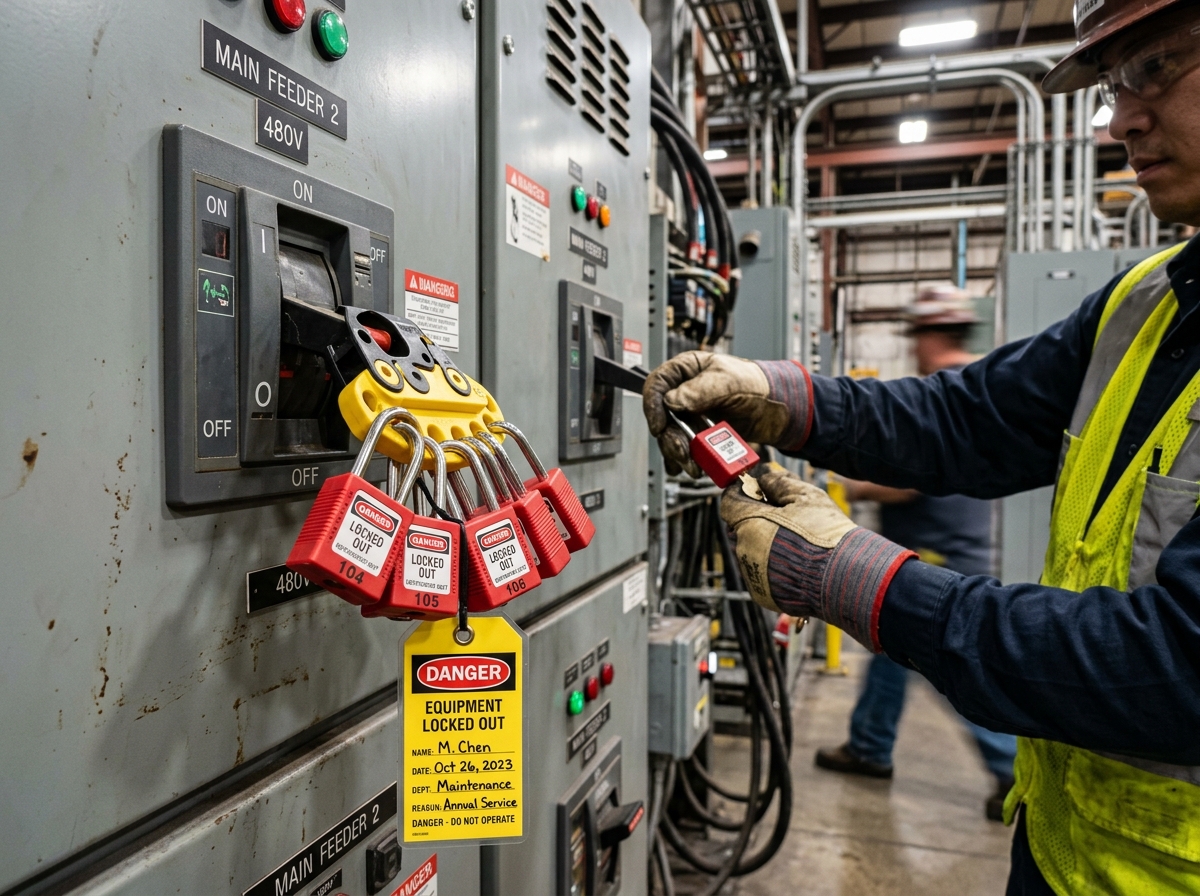
Lockout Tagout (LOTO): Complete Procedure Guide, Checklist, and OSHA Requirements
The Maintenance Worker Who Didn't Come Home
In 2018, a maintenance technician at a food processing plant in the UK was performing routine maintenance on a packaging conveyor. A colleague, unaware that work was in progress, restarted the machine remotely. The technician suffered fatal crush injuries.
The investigation found no lockout tagout procedure had been applied. The machine had an accessible isolation point. The facility had a written LOTO policy. The failure was not in the policy — it was in the absence of any system to enforce it.
According to the US Occupational Safety and Health Administration (OSHA), failure to control hazardous energy accounts for approximately 10% of serious industrial accidents. OSHA estimates that compliance with its lockout tagout standard prevents approximately 120 fatalities and 50,000 injuries each year in the United States alone.
Lockout tagout is not a complicated concept. Its requirements are specific. Its logic is simple. And yet it remains one of the most frequently cited OSHA violations — because the gap between having a procedure and following it is where workers get killed.
What Is Lockout Tagout (LOTO)?
Lockout Tagout (LOTO) is a safety procedure used to ensure that dangerous machines are properly shut off and not able to be started up again before maintenance or repair work is completed. It involves physically isolating all energy sources that power a machine — electrical, hydraulic, pneumatic, mechanical, thermal, chemical — and applying physical locks (lockout) and warning tags (tagout) to those isolation points.
The purpose of LOTO is deceptively simple: make it physically impossible for the machine to move while a person is working on or near it.
LOTO is required whenever a worker must:
- Remove or bypass a guard or safety device
- Place any part of their body in a point of operation or area where work is performed
- Place any part of their body in a danger zone during machine operation
- Service or maintain equipment where unexpected startup or release of stored energy could occur
Lockout vs Tagout: What Is the Difference?
| Method | What It Involves | When Used |
|---|---|---|
| Lockout | Physical lock applied to the energy isolating device, preventing it from being re-energized | Whenever the isolating device can accept a lock — preferred method |
| Tagout | Warning tag applied to the isolating device indicating the device must not be energized | Only when the energy isolating device cannot accept a lock; provides warning only — no physical barrier |
Critical distinction: A tagout provides warning only. It does not physically prevent re-energization. OSHA requires that tagout provides the equivalent level of protection as lockout — which typically means additional supplementary measures (removing a valve handle, blocking a machine element, etc.).
The 6 Types of Hazardous Energy
A complete LOTO program must address all forms of energy that could power a machine. Missing any one of them defeats the entire procedure.
| Energy Type | Examples | Isolation Method |
|---|---|---|
| Electrical | Motors, control circuits, heating elements, capacitors | Disconnect switch, circuit breaker, plug removal |
| Hydraulic | Hydraulic cylinders, presses, clamping mechanisms | Shut off pump, bleed lines, block actuated components |
| Pneumatic | Air cylinders, pneumatic tools, actuators | Close supply valve, bleed residual air pressure |
| Mechanical (stored) | Springs under tension, gravity-held components, counterweights | Block, restrain, or release controlled energy before work begins |
| Thermal | Steam lines, heated surfaces, ovens, process piping | Isolate valves, allow cooling, vent steam |
| Chemical | Process fluids, gases, hazardous material lines | Close and blind valves, purge and vent, verify zero pressure |
The most dangerous mistake in LOTO: Isolating the main electrical disconnect and assuming the machine is safe — without identifying and controlling hydraulic accumulators, pneumatically stored pressure, or spring-loaded components that remain energized after electrical isolation.
OSHA 1910.147: The Legal Framework
In the United States, LOTO is governed by OSHA Standard 29 CFR 1910.147 — the Control of Hazardous Energy standard. Equivalent requirements exist in most jurisdictions:
- UK: Provision and Use of Work Equipment Regulations 1998 (PUWER), Electricity at Work Regulations 1989
- EU: Machinery Directive 2006/42/EC, Framework Directive 89/391/EEC
- Australia: AS/NZS 4024.1602 (Safeguarding of Machinery)
- Canada: CSA Z460 Control of Hazardous Energy
Key OSHA 1910.147 requirements:
- A written energy control program (policy) must exist
- Machine-specific lockout/tagout procedures must be developed for each piece of equipment
- Workers performing LOTO must receive authorized employee training
- Workers in areas where LOTO is performed must receive affected employee training
- Annual inspection of energy control procedures by an authorized employee
- Each authorized employee must have their own padlock — locks cannot be shared
- LOTO devices (locks, hasps, tags) must be durable, standardized, and substantial
OSHA 1910.147 is consistently among the top 10 most frequently cited OSHA standards, with thousands of violations recorded annually.
The 8-Step LOTO Procedure
This is the sequence every authorized employee must follow before beginning work on any equipment covered by LOTO.

Step 1: Prepare for Shutdown
Before isolating energy, the authorized employee must:
- Identify the equipment to be serviced
- Review the machine-specific LOTO procedure
- Identify all energy sources (electrical, hydraulic, pneumatic, mechanical, thermal, chemical)
- Gather the required lockout/tagout devices for each identified isolation point
- Notify affected employees that the equipment is being shut down
Step 2: Notify Affected Employees
All workers in the area who operate or interact with the equipment must be informed that the machine will be locked out and the reason why. This prevents someone from attempting to use the machine during the maintenance window.
Step 3: Shut Down the Equipment
Shut down the machine using its normal stopping procedure. Do not attempt to lock out equipment that is running — shut it down first using its standard operating controls.
Step 4: Isolate All Energy Sources
Operate all energy isolating devices (disconnect switches, valves, circuit breakers) to the "off" or "closed" position. This must include every energy source identified in Step 1 — including secondary and residual sources.
Step 5: Apply Lockout/Tagout Devices
Each authorized employee working on the equipment applies their personal padlock to each energy isolating device (through a hasp if multiple locks are required). A warning tag is attached to each lock. The tag identifies the worker, the date, and the reason for the lockout.
One worker = one lock. Every time. No exceptions.
Step 6: Release or Restrain Stored Energy
After all isolating devices are locked, residual or stored energy must be controlled:
- Electrical: Test for absence of voltage using a calibrated tester
- Hydraulic/Pneumatic: Bleed pressure, vent lines, verify zero pressure with a gauge
- Mechanical: Block components that could move under gravity or spring force
- Thermal: Allow cooling; verify temperature
- Capacitors: Allow discharge time specified in the machine procedure
Step 7: Verify Zero Energy State
Before beginning work, the authorized employee must verify that the equipment is in a zero-energy state. This means:
- Attempting to operate the machine using its normal controls (it should not respond)
- Using calibrated test equipment to confirm absence of electrical voltage
- Verifying that pressure gauges read zero for hydraulic and pneumatic systems
Never assume the machine is de-energized. Always verify.
Step 8: Perform the Work
Work may now proceed safely under the lockout condition. While work is in progress:
- The lock must remain on the energy isolating device at all times
- If additional workers join the task, each must apply their own lock
- If a worker must leave the area, their lock remains — and is re-verified when they return
- If the scope of work changes (e.g., additional equipment must be accessed), a new LOTO assessment is required
Restoring Equipment to Service
When work is complete, restoration follows a defined sequence:
- Ensure all tools and materials are removed from the equipment
- Ensure all guards and safety devices are reinstalled
- Ensure all workers are clear of the equipment
- Notify affected employees that lockout is being removed
- Remove lockout/tagout devices — only the employee who applied the lock may remove it
- Restore energy sources in the reverse sequence of isolation
- Notify affected employees that the equipment is now available
Machine-Specific LOTO Procedures: What They Must Include
A generic LOTO policy is not sufficient. OSHA requires machine-specific written procedures for each piece of equipment where LOTO applies. Each procedure must document:
| Element | Required Content |
|---|---|
| Equipment identification | Machine name, location, equipment ID number |
| Steps for shutting down | Normal stopping procedure specific to this machine |
| Energy isolation points | Location and type of each isolating device (with diagram if needed) |
| Type and magnitude of energy | Voltage, pressure rating, spring force — each source quantified |
| Special hazards | Residual energy, gravity-held components, process fluid contamination |
| Required PPE | Specific PPE for working on this equipment |
| Tools required | Any specialized tools needed for isolation |
Machine-specific procedures are a common deficiency in OSHA inspections. Facilities with only a generic LOTO policy — without equipment-specific procedures — are consistently cited.
The 7 Most Common LOTO Failures
1. Incomplete Energy Identification
Workers isolate the electrical disconnect but fail to identify a hydraulic accumulator that remains pressurized. Or a pneumatic line with residual pressure. The machine cannot start — but it can still move.
2. Stored Energy Not Released
The electrical isolation is complete, but a spring-loaded component, elevated counterweight, or capacitor bank still holds sufficient energy to cause motion or injury.
3. Group Lockout Procedures Not Followed
Multiple workers share a single lock, or a "crew lock" procedure substitutes for individual locks. If one worker leaves, the remaining workers lose their physical protection.
4. Locks Removed by the Wrong Person
A supervisor removes an employee's lock because the employee is absent. This destroys the fundamental protection — a lock should only ever be removed by the person who applied it.
5. Tagout Used Where Lockout Is Possible
A facility uses tagout for equipment that has lockable isolation points. Tags provide no physical protection — they can be ignored, removed accidentally, or simply not seen.
6. LOTO Bypassed Under Time Pressure
Maintenance is classified as "just a quick adjustment" or "it'll only take a second." The pressure to restore production leads workers to bypass the procedure. This is the scenario most commonly associated with LOTO fatalities.
7. Procedures Not Updated After Equipment Changes
A machine is modified — a new control system is added, a hydraulic circuit is reconfigured — but the LOTO procedure is not updated. Workers follow the outdated procedure, leaving energy sources uncontrolled.
LOTO and the Permit to Work System
In high-hazard facilities, LOTO is typically the first stage of a broader Permit to Work authorization process. The relationship:
- The Permit to Work authorizes the specific maintenance task, verifies that all preconditions are met, and establishes the scope of work
- LOTO is the physical implementation of the energy isolation specified in the permit
- The permit cannot be signed by the authorizing authority until LOTO isolation is verified complete
In facilities operating a combined PTW and LOTO system, the isolation register on the permit lists every isolation point, and the LOTO procedure verifies each one before work begins.
How FindRisk Supports LOTO Programs
FindRisk accelerates LOTO compliance through two key capabilities:
Pre-task hazard assessment: Before maintenance begins, use FindRisk's AI-powered assessment to identify all energy sources associated with the specific equipment and task. The AI generates a task-specific checklist — including energy types that generic procedures might overlook — based on your description of the machine and the work to be performed.
LOTO inspection documentation: During periodic LOTO procedure audits or pre-startup safety reviews, use FindRisk to conduct and document the inspection — capturing photos of isolation points, lock applications, and residual energy verification — and generate an inspection report with findings and corrective actions automatically.
Frequently Asked Questions
Can a supervisor remove a worker's lock if the worker is unavailable?
In general, no — and certainly not without an extraordinary procedure. OSHA permits lock removal by someone other than the employee who applied it only under extraordinary circumstances, with a documented procedure that includes: verification that the authorized employee is not in the facility; notification to the employee before their return; and management authorization. This procedure must be defined in the written energy control program and should be used extremely rarely. Routine lock removal by supervisors is one of the most serious LOTO program failures.
What is the difference between an authorized employee and an affected employee?
An authorized employee is a person who locks or tags out machines or equipment to perform servicing or maintenance. An affected employee is someone whose job requires them to operate or use equipment on which servicing or maintenance is being performed, or who works in the area where such work is being performed. Both categories require training, but authorized employees receive more detailed training on the specific procedure.
Does LOTO apply to electrical cord- and plug-connected equipment?
For cord- and plug-connected electrical equipment, the plug may be used as the lockout/tagout device — if the plug is under the exclusive control of the employee performing the work. If the cord could be plugged in by anyone other than the authorized employee during the work, additional lockout measures are required.
How often must LOTO procedures be reviewed?
OSHA 1910.147 requires annual inspections of energy control procedures. The inspection must be conducted by an authorized employee other than the one using the procedure. The inspection should verify that the procedure is current, that workers understand and follow it, and that it correctly reflects the current configuration of the equipment.
What documentation is required for a LOTO program?
Required documentation includes: the written energy control program (policy); machine-specific LOTO procedures for each piece of covered equipment; training records for all authorized and affected employees; and records of the annual procedural inspections. Records of actual LOTO applications are not required by OSHA, but many organizations maintain them for continuous improvement and incident investigation purposes.
What happens if a worker forgets to apply their lock?
If a worker begins maintenance without applying a lock, work must stop immediately. The worker should step back from the equipment, complete the full LOTO procedure, and only then resume work. There is no circumstance in which "just a quick fix" justifies skipping a LOTO application. Management pressure to skip LOTO is itself a violation of OSHA requirements.
Conclusion
Lockout tagout is one of the most straightforward and most effective safety controls in industrial environments. The concept is simple: before you put your hands inside a machine, make it physically impossible for that machine to move.
The failures that lead to LOTO-related fatalities are almost never about procedure complexity. They are about pressure, habit, and the normalization of shortcuts. Effective LOTO programs are built on three foundations: machine-specific procedures that workers can actually follow; physical devices (locks, hasps, multi-lock devices) that are always available at the point of use; and a culture that treats lock removal by the wrong person as seriously as a live electrical contact.
According to OSHA, compliance with the lockout tagout standard prevents an estimated 120 deaths every year. Every one of those deaths is preventable. Every one begins with someone deciding that the procedure can wait just this once.
Download FindRisk to integrate AI-assisted hazard identification into your LOTO pre-task assessments, and to document LOTO audits with photo evidence and automatic corrective action tracking.
Try FindRisk
Ready to modernize your safety workflow?
Conduct AI-powered risk assessments, generate reports instantly, and keep your team safe — anywhere, anytime.