

Manufacturing Safety Inspection: Complete 60-Point Checklist and Guide (2026)
A Hazard That Nobody Saw Coming
In 2019, a worker at an automotive parts manufacturer in the US state of Ohio reached into a conveyor system to clear a jammed component. The machine had not been locked out. The conveyor restarted automatically and the worker suffered a traumatic arm amputation.
The investigation revealed that the facility had been conducting monthly safety inspections for two years. The conveyor lockout procedure had been inspected — on paper — six times in the preceding 12 months. Every inspection had passed.
No inspector had tested whether the lockout procedure was actually being followed during maintenance. No inspector had observed a maintenance worker actually interacting with the equipment. The inspection was checking documentation, not reality.
This is the fundamental challenge of manufacturing safety inspection: the gap between what the checklist says and what is actually happening on the floor.
A manufacturing safety inspection is not a paperwork exercise. It is a systematic, eyes-on assessment of real conditions, real behaviors, and real hazards — conducted by a competent person who knows what they are looking for and is not afraid to act on what they find.
This guide gives you the framework, the 60-point checklist, and the process to make your manufacturing inspections genuinely protective — not merely compliant.
What Is a Manufacturing Safety Inspection?
A manufacturing safety inspection is a structured assessment of a production facility, conducted to identify hazards, verify that controls are in place and functioning, and generate documented findings that drive corrective action.
Unlike a safety audit (which evaluates the management system) or a risk assessment (which evaluates specific tasks), a safety inspection is primarily observational. You walk the facility, you look at physical conditions, you observe behavior, you test equipment — and you record what you find.
Manufacturing inspections serve four functions:
- Hazard identification — Finding unsafe conditions before they cause harm
- Compliance verification — Confirming that legal requirements and internal standards are being met
- Corrective action — Generating findings that trigger specific improvements with defined owners and deadlines
- Evidence generation — Creating a documented record for ISO 45001 audits, regulatory inspections, and incident investigations
How Often Should Manufacturing Sites Be Inspected?
| Inspection Type | Frequency | Conducted By |
|---|---|---|
| Informal walkthrough | Daily | Supervisors / team leaders |
| Formal site inspection | Monthly | OHS officer or trained inspector |
| Comprehensive departmental audit | Quarterly | Senior OHS manager + department head |
| Management system audit | Annually (min.) | Internal or third-party auditor |
| Post-incident inspection | Within 24 hours of incident | OHS + management |
| Pre-startup safety review | Before new equipment or process | Multidisciplinary team |
Before You Begin: Inspection Preparation
An unprepared inspector conducts an unprepared inspection. Before entering the facility:
Review previous findings. Pull the last two or three inspection reports and identify any repeat findings. Persistent problems that appear on multiple consecutive inspections indicate systemic control failures — not one-time oversights.
Check corrective action status. Were the findings from the last inspection actually closed out? What was overdue?
Know what you are looking at. Manufacturing facilities vary enormously. A chemical processing plant and an automotive assembly line share a regulatory framework but have completely different hazard profiles. The inspector should understand what processes are running during the inspection, what equipment is in use, and what materials are present.
Define your scope. A 60-point checklist covering the full facility should be completed in sections — not all at once. Work area by work area, department by department.
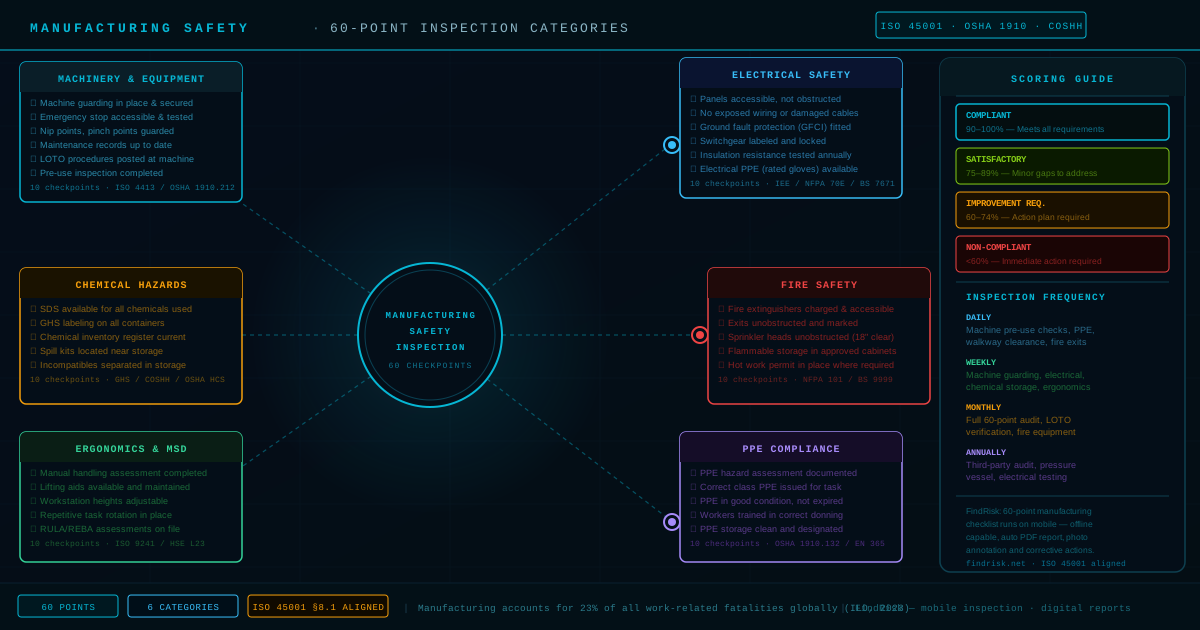
The 60-Point Manufacturing Safety Inspection Checklist
The following checklist is organized into 10 categories. Each item should be rated:
- ✅ Compliant — Hazard controlled, no action required
- ⚠️ Action Required — Hazard present but not immediately dangerous; corrective action needed
- 🔴 Critical Finding — Immediate risk; work must stop or area must be isolated until hazard is controlled
Category 1: General Housekeeping (Points 1–8)
| # | Inspection Item | Guidance |
|---|---|---|
| 1 | Work areas are free of unnecessary materials, waste, and clutter | Apply 5S principles. Check floor areas, shelving, and storage zones |
| 2 | Walkways and emergency egress routes are clear and marked | Minimum 1.2 metre clear width; yellow floor markings visible |
| 3 | Spills are cleaned up immediately; no wet surfaces without warning signs | Pay particular attention to loading areas and process zones with liquids |
| 4 | Waste containers are properly labelled and not overfilled | Check for hazardous waste mixed with general waste |
| 5 | Compressed air is not being used for personal cleaning | OSHA prohibits use of compressed air above 30 psi for cleaning clothing |
| 6 | Materials and parts are stored stably and within safe stacking heights | Unstable stacking is one of the leading causes of warehouse fatalities |
| 7 | Work surfaces and benches are free of unnecessary tools and sharp objects | Sharp edges and tools left loose on surfaces are leading causes of lacerations |
| 8 | Drainage is functional; no standing water in production areas | Standing water creates slip hazards and can indicate process leaks |
Category 2: Machine Guarding (Points 9–16)
| # | Inspection Item | Guidance |
|---|---|---|
| 9 | All rotating parts (shafts, pulleys, gears, sprockets) are guarded | Guards must prevent contact, not merely make it more difficult |
| 10 | Guards are in place and secure — not removed or propped open | Check for tools, tape, or wedges used to keep guards open |
| 11 | Point-of-operation guards are in place on all machining and stamping equipment | Point of operation is the highest-fatality zone on manufacturing equipment |
| 12 | Nip points (where two rotating parts come together) are guarded | Rollers, conveyors, and calendar presses are common nip-point hazards |
| 13 | Conveyor systems have emergency stop devices accessible from all working positions | Test emergency stops during the inspection — verify they actually work |
| 14 | Guards are maintained in good condition — no cracks, missing fasteners, or improvised repairs | Document deteriorated guards as action-required items |
| 15 | Workers are not bypassing guards (observed behaviour during inspection) | This requires observational inspection, not just equipment inspection |
| 16 | All machinery has an identifiable, accessible emergency stop control | The emergency stop must be reachable without crossing into the hazard zone |
Category 3: Lockout / Tagout (LOTO) (Points 17–22)
| # | Inspection Item | Guidance |
|---|---|---|
| 17 | Written LOTO procedures exist for all equipment requiring maintenance isolation | Verify procedures are machine-specific, not generic |
| 18 | LOTO procedures are posted at or near the equipment they cover | Check that the posted procedure matches the actual machine configuration |
| 19 | Lockout devices (padlocks, hasps, multi-lock hasps) are available at point of use | Each worker must have their own assigned padlock |
| 20 | Energy source identification is complete — all electrical, hydraulic, pneumatic, and mechanical sources are identified | Inspect isolation points against the written procedure |
| 21 | Workers performing LOTO tasks are observed to follow the procedure correctly | Shadow a maintenance interaction if possible — this is the most revealing LOTO inspection step |
| 22 | Locks are removed by the worker who applied them — no one else | A lock left in place after work is complete, or removed by a supervisor, indicates a system breakdown |
Category 4: Electrical Safety (Points 23–28)
| # | Inspection Item | Guidance |
|---|---|---|
| 23 | All electrical panels are accessible and their covers are in place | Covers must be closed; verify no exposed live parts inside panels |
| 24 | Electrical panels are not blocked by stored materials | NFPA 70E requires 0.9 metre (3 feet) clear access to electrical panels |
| 25 | Extension cords are used only temporarily; no permanent extension cord wiring | Permanent use of extension cords is a fire and shock hazard; fixed wiring required |
| 26 | All electrical equipment is grounded; no missing ground pins on plugs | Check portable tools, extension cords, and fixed equipment connections |
| 27 | Arc flash hazard labels are present on equipment rated at required voltage thresholds | Required by NFPA 70E; label must specify PPE category required |
| 28 | Damaged electrical cords are taken out of service immediately | No tape repairs on electrical insulation; damaged cords must be replaced |
Category 5: Fire Safety (Points 29–34)
| # | Inspection Item | Guidance |
|---|---|---|
| 29 | Fire extinguishers are present at required locations, mounted, and accessible | Check that extinguisher type matches the fire risk class for that area |
| 30 | Fire extinguishers have been inspected within the past 12 months (tag check) | Monthly visual inspection required; annual service by certified provider |
| 31 | Flammable liquids are stored in approved safety cabinets | Maximum quantities per area are defined by local fire codes |
| 32 | Hot work controls are in place where welding, cutting, or grinding occurs | Verify hot work permit is issued; fire watch is assigned; atmosphere is tested |
| 33 | Fire doors are functional, self-closing, and not propped open | Propped fire doors are among the most common — and most consequential — fire safety violations |
| 34 | Emergency exit signs are illuminated and exit routes are clearly marked | Test emergency lighting by simulating power failure if accessible |
Category 6: Chemical Safety and Hazardous Materials (Points 35–40)
| # | Inspection Item | Guidance |
|---|---|---|
| 35 | Safety Data Sheets (SDS) are available for all chemicals in use in the area | SDS must be in the language of the workers; electronic access must be functional without a PIN or password during emergencies |
| 36 | Chemicals are stored in labelled containers with GHS-compliant hazard labels | No unlabelled containers; no decanting into unlabelled secondary containers |
| 37 | Incompatible chemicals are segregated | Check for acids and bases stored together; oxidizers near flammables |
| 38 | Chemical storage areas are ventilated adequately | Measure or verify ventilation rate for areas with flammable or toxic storage |
| 39 | Spill containment equipment (absorbent materials, spill kits) is available in chemical use areas | Spill kit must be appropriate for the chemicals present — not a generic "clean all" kit |
| 40 | Workers handling hazardous chemicals are wearing the correct PPE for those specific chemicals | Cross-reference the SDS PPE section against what workers are actually wearing |
Category 7: Personal Protective Equipment (Points 41–46)
| # | Inspection Item | Guidance |
|---|---|---|
| 41 | PPE requirements for each work area are posted and visible | Signs stating required PPE (eye protection, gloves, foot protection, hearing protection) must be present |
| 42 | Workers are wearing required PPE in all mandatory areas | Observe behavior — not just whether PPE is available |
| 43 | PPE is in good condition — no cracked lenses, torn gloves, compromised hearing protection | Damaged PPE provides false protection — it may be worse than no protection because it encourages risk |
| 44 | High-visibility clothing is worn in all vehicle and pedestrian shared zones | Check that visibility garments meet the required rating for the hazard level |
| 45 | Respiratory protection is correctly fitted and workers are enrolled in a medical evaluation and fit-test program | Respirator programs require medical clearance and annual fit testing — not just having respirators available |
| 46 | Fall arrest equipment is inspected before each use and maintained in good condition | Check harnesses, lanyards, and anchor points for wear, corrosion, or damage |
Category 8: Ergonomics and Material Handling (Points 47–52)
| # | Inspection Item | Guidance |
|---|---|---|
| 47 | Manual handling tasks with loads above defined thresholds (typically 23–25 kg) have been risk assessed | Over-reliance on manual lifting without assessment is a leading cause of musculoskeletal injury |
| 48 | Mechanical lifting aids (hoists, pallet jacks, conveyors) are available and used for heavy loads | Verify that aids are actually in use — not just available |
| 49 | Repetitive motion tasks are assessed for frequency, force, and awkward posture | Assess tasks where workers perform the same motion more than 900 times per shift |
| 50 | Workstation heights are adjustable or set to appropriate heights for the task and worker | Both sitting and standing workstation heights should be checked |
| 51 | Vibrating tools are used within defined daily vibration exposure limits | Vibration white finger (Hand-Arm Vibration Syndrome) is preventable but irreversible |
| 52 | Load pathways are clear and floor surfaces are appropriate for the loads carried | Uneven or damaged flooring under load paths is a forklift and pedestrian hazard |
Category 9: Vehicles and Mobile Equipment (Points 53–57)
| # | Inspection Item | Guidance |
|---|---|---|
| 53 | Pedestrian and vehicle routes are clearly separated and marked | Physical separation (barriers) is preferred over painted lines alone |
| 54 | All forklift operators hold current certification for the specific vehicle type they operate | Forklift certification is machine-specific — a counterbalance certification does not cover reach trucks |
| 55 | Pre-shift vehicle inspections are completed and documented for all powered industrial trucks | Check the inspection log — blank fields or identical entries across multiple days indicate the inspection is not being done |
| 56 | Speed limits are posted and enforced in the facility | Observe vehicle speed during the inspection |
| 57 | Pedestrians are not walking in vehicle operation zones without defined crossing points | This behavioral check requires observation, not documentation |
Category 10: Emergency Preparedness (Points 58–60)
| # | Inspection Item | Guidance |
|---|---|---|
| 58 | Emergency procedures are posted at worker stations and at emergency equipment locations | Evacuation routes, assembly points, and emergency contacts must be visible without having to search |
| 59 | First aid equipment is present, stocked, accessible, and within its expiry dates | Check the contents of every first aid kit inspected — expired or depleted kits provide false security |
| 60 | All workers know the emergency evacuation assembly point and the procedure for reporting an emergency | Ask two or three workers to demonstrate — if they don't know, that is a critical finding |
How to Record and Act on Your Findings
A manufacturing safety inspection that produces findings and then files them is not a safety inspection — it is a documentation exercise. The value is entirely in what happens after the inspection.
Document every finding with:
- Location (building, floor, department, equipment tag)
- Description of the hazard
- Risk level (Critical / Action Required / Compliant)
- Photographic evidence
- Recommended corrective action
- Assigned owner
- Deadline
Classify by urgency:
- Immediately dangerous to life or health (IDLH): Halt work. Isolate the hazard. No timeline — immediate action.
- High risk: Corrective action within 24–48 hours.
- Medium risk: Corrective action within 5–10 business days.
- Low risk / observation: Corrective action within 30 days.
Follow up: The most common inspection failure is not finding hazards — it is failing to verify that corrective actions were actually implemented. Schedule a follow-up check for every open finding.
Manufacturing Safety Inspection and ISO 45001
ISO 45001 Clause 9.1 requires organizations to monitor, measure, analyze, and evaluate their OHS performance. Safety inspections are the primary method by which manufacturing organizations generate the monitoring data that this clause requires.
| ISO 45001 Clause | Requirement | How Inspection Satisfies It |
|---|---|---|
| Clause 6.1 | Identify hazards and assess risks | Inspection findings generate new hazard identification inputs |
| Clause 8.1 | Operational planning and control | Inspection verifies that operational controls (guards, LOTO, PPE) are in place |
| Clause 9.1 | Monitoring and measurement | Inspection records are the primary monitoring evidence |
| Clause 9.1.2 | Compliance evaluation | Inspection evaluates conformance with legal requirements and standards |
| Clause 10.2 | Incident and nonconformity management | Inspection findings are a source of nonconformities requiring corrective action |
For organizations pursuing ISO 45001 certification, a documented monthly inspection program with tracked corrective actions provides direct evidence for multiple critical clauses.
How AI and Mobile Tools Transform Manufacturing Inspections
The 60-point checklist in this guide works on paper. It also works dramatically better on a mobile platform with AI assistance.
The most significant limitations of paper-based manufacturing inspections are:
No photo evidence. Paper checklists rarely include photographic documentation of findings. Without photos, corrective action owners cannot see what needs to change — and the inspection has no value as legal evidence.
No consistent structure. Paper inspections are only as thorough as the inspector's memory. Fatigue, distraction, and habit lead to areas being skimmed. AI-assisted checklists prompt the inspector through every item without relying on memory.
No real-time corrective action assignment. Paper findings must be transcribed into another system to assign owners and deadlines. This transcription delay means hazards go unaddressed longer.
No trend analysis. Paper records cannot be aggregated to identify which departments, equipment types, or hazard categories are generating repeat findings.
FindRisk addresses all of these limitations:
On-site AI assistance: Describe the inspection context (equipment type, process running, materials present) and the app generates a contextually relevant checklist — including hazards specific to your scenario that a generic template would miss.
Photo annotation: Capture photos of every finding, annotate hazards directly on the image, and embed annotated photos in the automatically generated report.
Instant corrective action assignment: Assign each finding to an owner with a deadline before you leave the inspection area.
Fine-Kinney risk scoring: Score each finding using the Fine-Kinney quantitative method — probability, frequency, and consequence — to prioritize corrective actions by calculated risk level rather than subjective judgment.
Professional PDF report: A complete inspection report, with photos, findings, risk scores, and corrective actions, is generated automatically. No office time required.
Frequently Asked Questions
Who should conduct a manufacturing safety inspection?
The inspector must be a competent person — someone with sufficient training, knowledge, and experience to identify hazards in a manufacturing environment and to recognize when a condition is unsafe. This typically means a qualified OHS officer or safety manager. For specific equipment hazards (electrical panels, lifting equipment, pressure vessels), a specialist may need to be involved for the relevant sections of the inspection. The inspector should not be so familiar with the facility that they no longer "see" the hazards — familiarity blindness is a real and documented phenomenon in safety inspection.
What is the difference between a safety inspection and a safety audit?
A safety inspection is primarily observational and operational — it looks at physical conditions, behavior, and equipment to identify current hazards and verify that controls are functioning. A safety audit is primarily systemic — it evaluates whether the safety management system is designed correctly and functioning as intended. Inspections generate hazard findings; audits generate system nonconformities. Both are required by ISO 45001, and they should be conducted independently.
How long does a 60-point manufacturing inspection take?
For a mid-size manufacturing facility (5,000–15,000 m²) with three to four production departments, a thorough 60-point inspection typically takes 3–5 hours. This includes time to interview workers, test equipment (like emergency stops), and document photographic evidence. Using a mobile inspection app with AI assistance and automatic report generation reduces total time — including report writing — by approximately 40–50% compared to paper-based inspection.
What happens if a Critical Finding is identified during an inspection?
Work in the affected area must be stopped immediately, the area isolated if necessary, and the finding reported to the responsible manager. The inspector should not continue the inspection as if the critical finding can wait. If the hazard cannot be immediately corrected, the area must remain closed until it is. Document the critical finding, the stop-work decision, and the corrective action taken. Resumption of work should be authorized by a manager with the authority to make that determination.
Can AI really help with manufacturing safety inspections?
AI tools have demonstrated measurable value in two specific inspection tasks: generating contextually relevant checklists (reducing missed hazards by prompting for hazards specific to the equipment and process), and analyzing photos for specific unsafe conditions (PPE compliance, housekeeping violations, guard condition). AI does not replace the experienced inspector's judgment — particularly for behavioral observation, equipment feel and sound, and contextual interpretation of conditions. The best results come from AI as an assistant to a trained inspector, not as a replacement for one.
How should we handle repeat findings from multiple inspections?
A hazard that appears on three consecutive monthly inspection reports and has not been corrected is not a hazard — it is a failure of your corrective action system. Treat it accordingly. Escalate to senior management. Conduct a root cause analysis on why the corrective action was not completed. The inspection finding is no longer the issue — the management system failure is. Repeat findings are among the most important data points in a safety inspection program, and they should be tracked and reported separately from first-time findings.
Conclusion
Manufacturing is consistently among the highest-hazard sectors for workplace injury and fatality. Machine guarding failures, LOTO breakdowns, chemical exposure incidents, and vehicle collisions are all preventable — and systematic, rigorous inspection is the mechanism by which their prevention is verified.
A 60-point inspection conducted monthly, with findings documented, assigned, and tracked to closure, does more to protect workers than any policy document ever written.
The shift from paper to digital inspection tools — with AI assistance, photo annotation, and automatic report generation — does not change the fundamental nature of the inspection. It changes what is possible in the same amount of time, and the quality of the evidence generated.
Download FindRisk to conduct your next manufacturing safety inspection with AI-assisted checklists, on-site risk scoring, and professional reports generated before you leave the floor.
Try FindRisk
Ready to modernize your safety workflow?
Conduct AI-powered risk assessments, generate reports instantly, and keep your team safe — anywhere, anytime.