
Lithium-Ion Battery Fire Risk Assessment: Steps and Example
A lithium-ion battery fire risk assessment is the part of your fire risk assessment that covers every lithium-ion battery on site: where each one is charged, stored, used and thrown away, what condition it is in, and which controls stop a failing cell from becoming a building fire. It is not a separate legal document. It is the existing assessment, updated for a hazard that behaves differently from ordinary combustibles.
Most workplaces now hold far more lithium-ion batteries than their fire risk assessment admits. Forklifts and pallet trucks have moved to lithium-ion, cordless tools have replaced corded ones, every picker carries a scanner, and staff ride e-bikes to work and want to charge them. The assessment written five years ago lists "forklift charging" as one line and says nothing about the rest.
This guide shows how to close that gap: how thermal runaway starts and why it changes the assessment, how to build a battery inventory, a filled assessment for a distribution warehouse, charging and storage controls taken from regulator and insurer guidance, a quarantine procedure for damaged batteries, and what to tell the fire service.
A Warehouse That Charges Everywhere
This warehouse is made up for the guide.
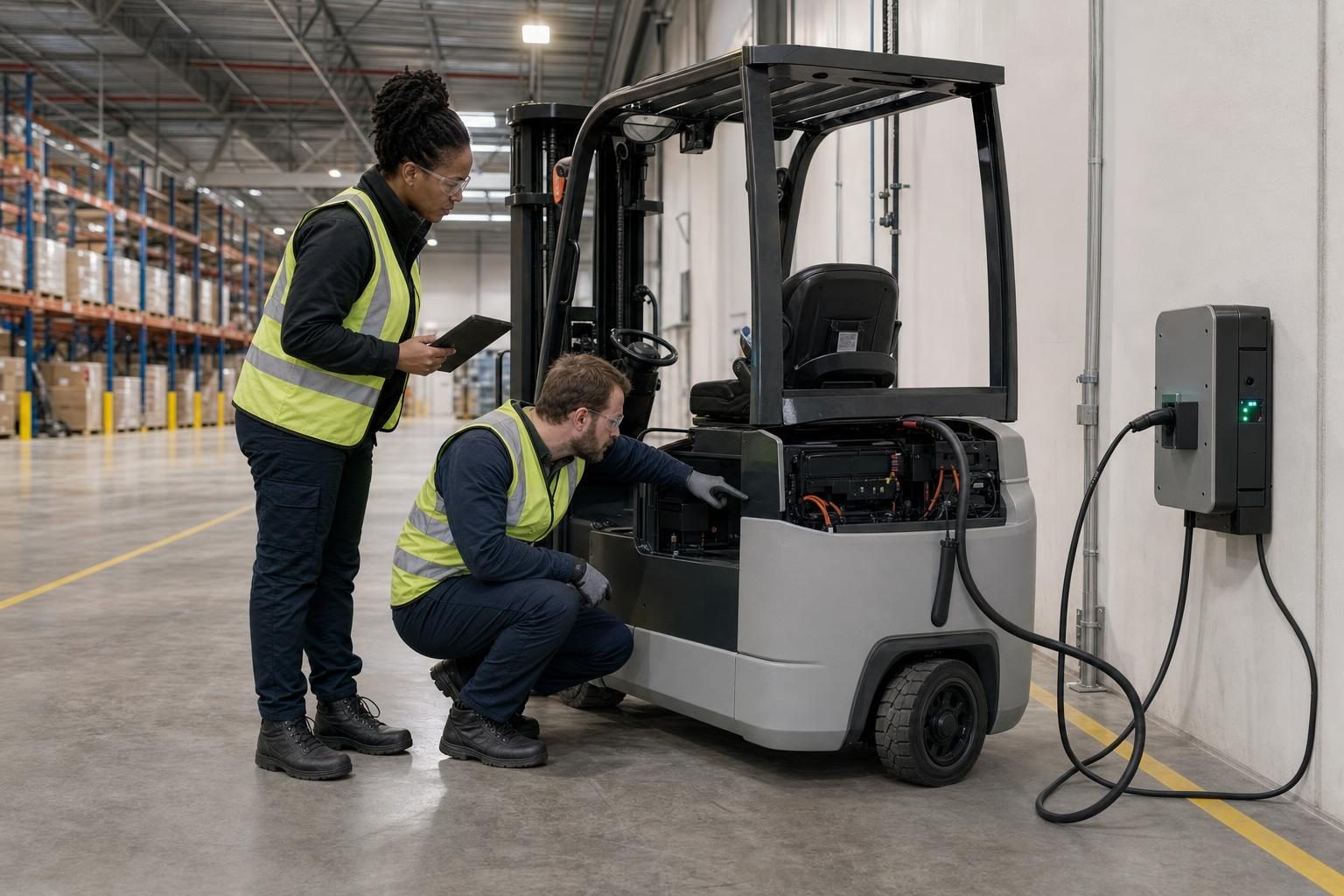
A regional distribution center with 60 people across two shifts switched its four counterbalance forklifts to lithium-ion last year. The supplier installed chargers on the back wall of the building, next to the racking. Six electric pallet trucks charge wherever there is a free socket, usually by the dock doors. Forty handheld scanners sit in cradles in the dispatch office. The maintenance workshop charges a dozen cordless tool batteries on the bench.
Five members of staff ride e-bikes or e-scooters to work. With nowhere else to put them, they charge them in the corridor by the staff entrance, which is also a fire exit. Customer returns, including power tools and laptops, wait in two cages beside the cardboard baler. And in the corner of the charging bay, a pallet truck battery that was dropped during a battery change a month ago is waiting for the supplier to collect it.
The fire risk assessment, reviewed two years ago, was written when the forklifts were lead-acid. It mentions battery charging once, under ventilation.
What Is a Lithium-Ion Battery Fire Risk Assessment?
A lithium-ion battery fire risk assessment is a structured review of the fire, explosion and toxic-gas risks from lithium-ion batteries in a workplace, and of the controls that keep those risks low. In most countries it sits inside the general fire risk assessment or the general workplace risk assessment rather than standing alone.
| Name you may see | What it usually means |
|---|---|
| Lithium-ion battery risk assessment | The battery part of the fire risk assessment, or a separate annex to it |
| Battery charging area assessment | A narrower review of one charging room or bay |
| E-bike / e-scooter charging policy | The management rules that come out of the assessment for staff-owned devices |
| Energy storage system (ESS) assessment | Large fixed battery installations, which need specialist design and are outside this guide |
The assessment answers five questions:
- Which lithium-ion batteries are on site, including ones people bring in?
- Where is each type charged, stored, used and disposed of?
- What condition are they in, and how would you know if one were damaged?
- What could a battery fire reach: people, escape routes, stock, the building?
- What happens in the first five minutes if one fails?
It follows the same five steps as any fire risk assessment. What changes is how you judge likelihood and how much weight you give to separation and early detection.
Why Thermal Runaway Changes the Assessment
Thermal runaway is the failure mode that makes lithium-ion batteries different. OSHA's lithium-ion battery hazards page describes it as a chain reaction in which heat from one failing cell damages nearby cells. Once it starts in one cell, it can spread through the pack.
OSHA lists four causes:
- internal short circuit from manufacturing defects
- mechanical damage
- excessive heat or cold
- improper charging
SafeWork NSW's lithium-ion battery guidance gives the same picture in workplace terms: overcharging, physical damage such as puncturing or crushing, manufacturing defects and high temperatures.
Three features matter for the assessment:
- The battery is its own fuel and its own ignition source. Several electrolyte solvents are flammable, according to OSHA. You cannot control the risk only by keeping ignition sources away, as you would for a pile of cardboard.
- The smoke is toxic. OSHA lists hydrogen fluoride, hydrogen chloride, hydrogen cyanide, phosphoryl fluoride and carbon monoxide among the byproducts of these fires. The electrolyte salt LiPF6 can react with water to form hydrogen fluoride.
- It can come back. SafeWork NSW warns that failing batteries can cause secondary ignitions after the flames are out. A battery that has stopped burning is not safe.
The London Fire Brigade says that when lithium-ion batteries fail they can ignite quickly and produce intense fires that spread rapidly, and that on average there is a fire from a lithium-ion battery in an e-bike or e-scooter every two days in London.
The practical result: in a lithium-ion assessment, condition and charging practice drive likelihood, and separation and detection drive consequence. A new, undamaged battery charged on the right charger in a monitored area is a low risk. The same battery after a drop, on a cheap charger, overnight, next to the stock is not.
How to Do a Lithium-Ion Battery Fire Risk Assessment
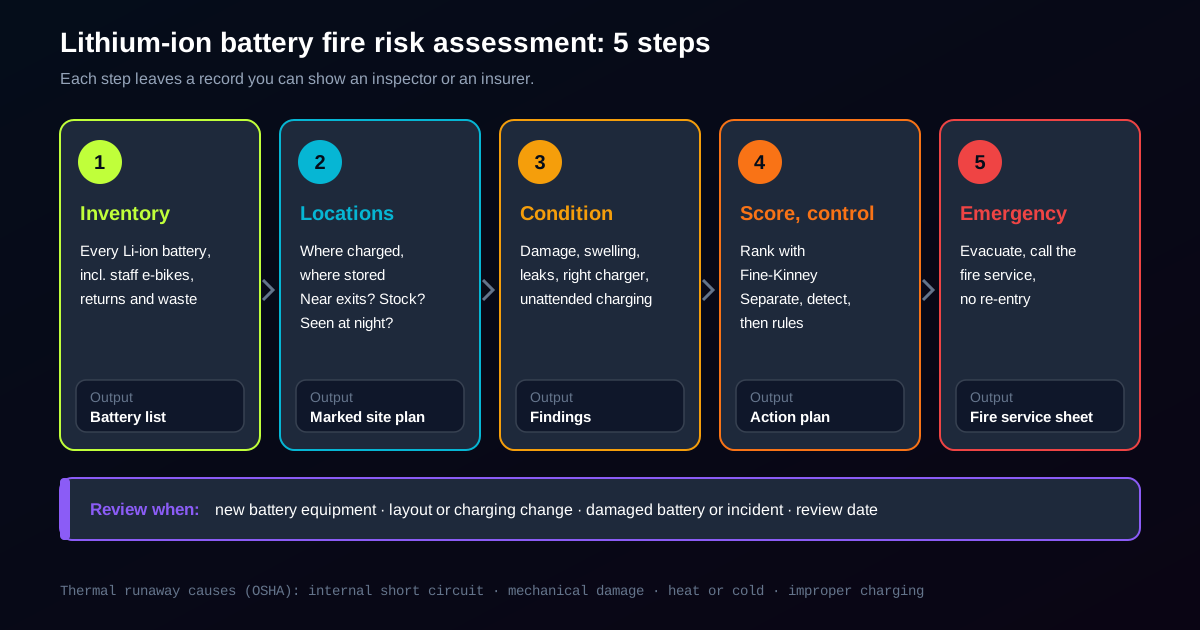
The assessment has five steps. Each one produces something you can show an inspector or an insurer.
Step 1: Build the battery inventory
Walk the whole site, not just the charging bay, and list every type of lithium-ion battery. Include what people bring in and what passes through as goods.
| Battery group | Typical examples | Questions to ask |
|---|---|---|
| Traction batteries | Forklifts, pallet trucks, floor scrubbers, AGVs | Who supplied the charger? Is charging done only in one place? |
| Tool and equipment batteries | Cordless drills, grinders, torches, gas detectors | Where are spares kept? Who checks them? |
| Personal electronics | Scanners, radios, laptops, phones, body cameras | How many charge at once, and where? |
| Staff-owned vehicles | E-bikes, e-scooters, mobility scooters | Are they brought inside? Are they charged at work? |
| Goods and returns | Products containing batteries, returned or damaged items | Are returns inspected? Where do they wait? |
| Waste | Spent and damaged batteries awaiting collection | Is there a defined place? Who arranges collection? |
Step 2: Map charging and storage locations
Mark on the site plan where each group is charged and where it is stored. Then check each location against three things: what combustibles are close by, whether it is on or next to an escape route, and whether anyone would notice a fire there, day and night.
Step 3: Check condition and charging practice
Condition is the main driver of likelihood. Look for damage, swelling and leaks, which SafeWork NSW lists as signs to stop using a battery. Check that each battery is charged on a charger designed for its type and voltage, and whether charging happens unattended or out of hours.
Step 4: Score each hazard and set controls
Score each finding with your usual method, then choose controls in the order of the hierarchy of controls. The worked example below uses Fine-Kinney.
Step 5: Plan the emergency response
Write down what staff do if a battery overheats, smokes or catches fire, and prepare the information the fire service will need when they arrive. Both are covered below.
Worked Example: A Filled Assessment for a Distribution Warehouse
This is the warehouse from the scenario. The site and the findings are made up for the guide. The scores use the Fine-Kinney scales from the 1976 report (R = Probability × Exposure × Consequence) and are our judgment, with the reasoning shown.
The inventory
| # | Battery group | Number | Where charged | Where stored | Condition found |
|---|---|---|---|---|---|
| 1 | Forklift traction batteries | 4 trucks | Supplier chargers on the back wall, beside racking | In the trucks | Good; charging at night with no one in that part of the building |
| 2 | Pallet truck batteries | 6 trucks | Any free socket, mostly by the dock doors; one extension lead | In the trucks | One truck has a cracked battery cover |
| 3 | Handheld scanners | 40 | Desk cradles in the dispatch office | Same | Good |
| 4 | Cordless tool batteries | 12 | Workbench in the maintenance workshop | Drawer under the bench | Two spares of unknown origin |
| 5 | Staff e-bikes and e-scooters | 5 | Corridor by the staff entrance (a fire exit) | Same | Unknown; privately owned |
| 6 | Customer returns with batteries | Up to 2 cages | Not charged | Beside the cardboard baler | Not inspected on receipt |
| 7 | Damaged pallet truck battery | 1 | Not charged | Corner of the forklift charging bay | Dropped a month ago; waiting for collection |
Scores before and after controls
| # | Hazard | P × E × C (before) | R | Main controls | P × E × C (after) | R |
|---|---|---|---|---|---|---|
| 1 | Damaged battery stored among the charging trucks | 6 × 10 × 15 | 900 Very high | Removed the same day to a quarantine point away from the building; container and labelling as the procedure below; supplier collection booked | 0.5 × 2 × 15 | 15 Acceptable |
| 2 | E-bikes charging in the fire exit corridor | 3 × 6 × 15 | 270 High | No charging or storage of staff vehicles inside the building; covered outdoor parking away from walls and exits; policy issued to all staff | 0.5 × 6 × 15 | 45 Possible |
| 3 | Pallet trucks charging at dock sockets on an extension lead | 3 × 10 × 7 | 210 High | Fixed charging points for pallet trucks, away from exits and stock; only the manufacturer's chargers; extension leads banned; truck with the cracked cover taken out of service | 0.5 × 10 × 7 | 35 Possible |
| 4 | Forklift charging bay beside racking, charging unattended at night, no detection in the bay | 1 × 10 × 15 | 150 Substantial | Smoke detection extended over the bay and linked to the alarm; area in front of the chargers kept clear of stock, width agreed with the insurer; charging scheduled for staffed hours where the shift pattern allows | 0.5 × 10 × 15 | 75 Substantial |
| 5 | Returns containing batteries stored beside the baler | 1 × 10 × 15 | 150 Substantial | Returns inspected on receipt; damaged items go to quarantine; return cage moved to a marked area away from cardboard and the baler; quantity limited to one cage | 0.2 × 10 × 15 | 30 Possible |
| 6 | Tool batteries of unknown origin | 1 × 6 × 7 | 42 Possible | Unknown spares removed; only batteries and chargers from the tool manufacturer; batteries added to the monthly tool check | 0.5 × 6 × 7 | 21 Possible |
How the scores were set. In row 1, probability is 6 ("quite possible") because the battery has known mechanical damage, one of OSHA's four causes of thermal runaway, and it sits among other batteries that are charging. Exposure is 10 because it is there all the time. After the fix, exposure falls to 2: a damaged battery is now present only occasionally, and never in the building. In row 2, consequence is 15 because a fire in the only corridor to the staff exit could trap people. In row 4, the forklift chargers stay at Substantial after the first controls. The residual risk is recorded with a further action: move charging into a fire-separated room at the next layout change. Not every row reaches Acceptable in one step, and the assessment should say so.
The scanners (inventory row 3) were checked and not scored as a separate hazard: few cells per device, charged on their own cradles, in an occupied office with detection. They stay in the inventory and the monthly check.
Charging and Storage Controls
The controls below come from regulator and insurer guidance. Where a source gives no number, this guide gives none either: separation distances and quantity limits depend on your building and your insurer, and you should get them from your fire engineer or insurer survey.
Charging
| Control | Source |
|---|---|
| Follow the manufacturer's instructions for charging, use, storage and maintenance | OSHA |
| Use chargers designed for the specific battery type and voltage; buy from reputable sources | SafeWork NSW |
| Do not leave batteries charging unattended or for long periods | SafeWork NSW |
| Avoid charging out of hours or when the site is unattended; check contractors do not leave equipment on charge | Allianz |
| No charging on escape routes or in communal areas | Allianz |
| Segregate charging areas from areas where batteries are handled or worked on; limit access to authorized staff | Allianz |
| Provide ventilation where charging takes place inside a building | Allianz |
| Provide smoke detection where batteries are stored or charged; consider carbon monoxide detection | Allianz |
Storage
| Control | Source |
|---|---|
| Store in a cool, dry place away from direct sunlight, heat sources and flammable materials | SafeWork NSW, OSHA |
| Limit the quantity stored, following NFPA 800 and NFPA 855 | OSHA |
| Continuously monitor flammable and toxic gases in large storage locations | OSHA |
| Check regularly for damage or swelling and stop using any battery that shows it | SafeWork NSW |
| Inspect and maintain battery-powered plant, such as forklifts and hand tools, under a documented system | SafeWork NSW |
Applying the hierarchy
Elimination and substitution come first. Keeping staff e-bikes outside the building removes the hazard from the escape route entirely. Buying tools whose batteries and chargers come from one manufacturer is a form of the "safer substitution" OSHA lists. Engineering controls come next: a fixed charging point with detection, away from stock. Rules such as "no unattended charging" are administrative controls and depend on people following them, so they should not be the only thing between a failing battery and the racking.
If the batteries are stored or handled in a way that could create an explosive atmosphere, for example in a battery room with poor ventilation, check whether the area belongs in your explosion protection document. Warehouse-wide checks such as racking and traffic routes are in the warehouse safety checklist.
Damaged Batteries: A Quarantine Procedure
A damaged lithium-ion battery is the highest-likelihood item on most sites, so it needs a written procedure, not a corner of the charging bay. The steps below follow SafeWork NSW's guidance on damaged batteries.
- Stop using it. Never use or charge a damaged battery. Take the equipment out of service and tag it.
- Isolate it. Move it away from other batteries and combustible materials, if that can be done safely. If it is hot, smoking or hissing, do not handle it: follow the emergency steps below.
- Contain it. Put it in a suitable container or a fire-resistant bag designed for batteries, as the manufacturer recommends.
- Place it. Keep the container in a cool, dry, well-ventilated area away from heat and sunlight, and away from the main building where possible.
- Label it. Mark the container so others know what it holds and why it is there.
- Get rid of it properly. Arrange collection through the supplier or a battery recycler. OSHA says batteries go to designated recycling facilities, not municipal trash or recycling bins, and battery types should not be mixed.
- Record it. Log what was damaged, how, and when it left site. A damaged battery is also a near miss: ask why it was damaged.
Train everyone who handles batteries to spot damage. OSHA's control guidance asks employers to train workers to recognize defective, damaged or failing devices and batteries.
Emergency Response and What to Tell the Fire Service
Your emergency plan needs lithium-specific steps. OSHA says the emergency action plan should include lithium-related incident response procedures, based on the manufacturer's instructions and NFPA guidance, and that response staff should be trained on hazardous decomposition products such as hydrogen fluoride.
What staff should do
SafeWork NSW's advice for a battery fire is short: do not attempt to put out the fire, evacuate the area and call emergency services. Allianz tells employers that fire extinguishers may not work effectively on lithium-ion battery fires, that putting out the flames can change the risk from fire to explosion, and that an extinguisher may at best help people escape. OSHA says to follow the manufacturer's guidance on extinguishing small battery fires.
So the plan should say, in this order:
- raise the alarm and evacuate the area
- call the fire service and say a lithium-ion battery is involved
- do not try to move a hot, smoking or burning battery
- do not re-enter because the flames have stopped; secondary ignition is possible
- use an extinguisher only if the manufacturer's guidance allows it and only to clear an escape route
The fire service information sheet
Keep a one-page sheet at the fire alarm panel or the main entrance. The fire service needs to know what is inside before they go in.
| Item | Example entry (fictional warehouse) |
|---|---|
| Battery types on site | Lithium-ion traction (forklifts, pallet trucks), tools, scanners |
| Charging locations | Forklift bay at the back wall (grid D7); pallet truck points at grid B2 |
| Approximate number of batteries | 4 forklifts, 6 pallet trucks, about 50 small batteries |
| Quarantine point | Outdoor container, northeast corner of the yard |
| Isolation | Charger isolator in the bay; main switchboard location |
| Site contact | Shift manager phone number, 24 hours |
| Plan updated | Date of the last change |
Update the sheet whenever the inventory changes, and give a copy to whoever holds your emergency plan.
What the Law Requires
In the four jurisdictions below, the duty to assess lithium-ion batteries comes from the general fire and risk assessment rules, which apply in full.
| Jurisdiction | Where the duty comes from | What it means for batteries |
|---|---|---|
| Great Britain | Regulatory Reform (Fire Safety) Order 2005, article 9 | The responsible person must make a suitable and sufficient fire risk assessment and review it when there is a significant change. Switching a fleet to lithium-ion, or starting to charge e-bikes on site, is the kind of change that should trigger a review. GOV.UK's guide for factories and warehouses already lists forklift truck charging units as an ignition source. |
| United States | OSHA's lithium-ion battery guidance; 29 CFR 1910.38 where an emergency action plan is required | OSHA's lithium-ion guidance asks for lithium-specific procedures in the emergency action plan and training on the hazards. |
| New South Wales, Australia | WHS Act and Regulation | SafeWork NSW says the WHS laws do not explicitly address lithium-ion batteries but their general principles apply: risk assessment, safe work procedures, training and emergency plans. |
| Türkiye | 6331 Occupational Health and Safety Law, Article 10; Emergency Situations Regulation (RG 18.06.2013, No. 28681), Article 8 | The risk assessment must cover the batteries, and emergencies such as fire and explosion are identified from it. The Turkish building fire regulation has no lithium-ion-specific provision. |
The Turkish version of this guide covers the Turkish rules in more detail. The general method is in our risk assessment guide.
Common Mistakes
1. Assessing only the forklift bay
The fleet charger is the most visible battery hazard, so it is often the only one assessed. Pallet trucks on extension leads, tool batteries in a drawer and e-bikes in a corridor are left out, and these are often the ones with the worst charging practice.
2. Keeping damaged batteries "until collection" next to the rest
A damaged battery waiting for the supplier is the most likely item on site to fail. Storing it in the charging bay puts it beside other batteries and the stock. It needs a quarantine point, not a shelf.
3. Letting staff charge private e-bikes on escape routes
The corridor by the staff door is warm, dry and has a socket, which is why people use it. It is also the route out. Allianz's guidance is clear that charging should not happen on escape routes or in communal areas.
4. Relying on the extinguisher
An assessment that says "CO2 extinguisher provided" as the main control for a charging area has misread the hazard. The insurer and regulator guidance above says extinguishers may not work and staff should evacuate. Separation and early detection are the controls that matter.
5. Never reviewing after a change
Lithium-ion batteries arrive quietly: a new pallet truck, a new tool range, a scanner upgrade. Each one is a change to the matters the assessment covers. If the assessment date is older than the fleet, it is out of date.
How FindRisk Supports Lithium-Ion Battery Fire Risk Assessments
FindRisk helps you run the walk-through in Step 1 and Step 2 without a clipboard. Generate an AI inspection checklist for battery charging and storage areas, then work through it on site on iOS or Android.
When you find a pallet truck on an extension lead, a swollen battery or e-bikes in a fire exit, take a photo, mark the hazard on it and let the AI analyze it. Score each finding with the Fine-Kinney method so the actions are ranked, as in the worked example above.
When the walk-through is done, FindRisk produces a professional report in seconds, with photos, scores and actions, ready to attach to your fire risk assessment or send to the insurer.
Frequently Asked Questions
Do lithium-ion batteries need to be included in a fire risk assessment?
Yes. Wherever lithium-ion batteries are used, charged or stored, they are part of the fire risk the assessment must cover. In Great Britain, article 9 of the Fire Safety Order requires a suitable and sufficient assessment and a review after significant change, and in Türkiye the 6331 risk assessment must cover them. No separate battery law is needed for the duty to apply.
Can you charge lithium-ion batteries overnight at work?
Regulator and insurer guidance advises against it. SafeWork NSW says not to leave batteries charging unattended or for long periods, and Allianz advises avoiding charging out of hours or when the site is unattended. If shift patterns make night charging unavoidable, the charging area needs automatic smoke detection linked to the alarm and separation from stock and escape routes.
What are the warning signs of a failing lithium-ion battery?
OSHA lists rising battery temperature and venting of gas, vapor or smoke as signs of thermal runaway. SafeWork NSW adds visible damage and swelling, and says to stop using any battery that shows them. Train everyone who charges or handles batteries to recognize these signs and to report them instead of carrying on.
Can a fire extinguisher put out a lithium-ion battery fire?
Do not plan on it. Allianz warns that fire extinguishers may not work effectively on lithium-ion battery fires and that putting out the flames can change the risk from fire to explosion. SafeWork NSW advises not trying to put out the fire, evacuating and calling emergency services. OSHA says to follow the manufacturer's guidance for small battery fires.
How should damaged lithium-ion batteries be stored?
Isolate them from other batteries and combustible materials, put them in a suitable container or a fire-resistant battery bag as the manufacturer recommends, and keep them in a cool, dry, well-ventilated place away from heat and sunlight. Label the container and arrange collection through a battery recycler. Never use or charge a damaged battery.
Should staff be allowed to charge e-bikes and e-scooters at work?
That is a decision for your assessment, but never on escape routes or in communal areas. The London Fire Brigade reports an e-bike or e-scooter battery fire every two days in London on average. One option, used in the worked example above, is covered outdoor parking with no charging of private vehicles inside the building. Whatever you decide, write it into a policy and tell staff.
When should the lithium-ion battery assessment be reviewed?
Review it when the battery inventory changes, for example a new fleet, a new tool range or e-bikes on site; when the layout or charging locations change; after any battery incident or damaged battery; and at your normal review interval. In Türkiye, the risk assessment regulation sets maximum renewal periods of 2, 4 or 6 years by hazard class, and earlier renewal when equipment changes.
Conclusion
A lithium-ion battery fire risk assessment is mostly a matter of seeing what is already there. Build the inventory, put every charger and every stored battery on the site plan, and look hard at condition and charging practice. The scores will show where to act first, and in most workplaces that is a damaged battery in the wrong place or a charger on an escape route.
Use separation and detection as the main controls, keep damaged batteries in quarantine, and give staff a short emergency rule: raise the alarm, get out, call the fire service. Keep the fire service sheet up to date so the people who arrive know what is inside.
Download FindRisk to run your next battery walk-through with an AI checklist, mark what you find on photos and turn it into a scored report the same day.
Try FindRisk
Ready to modernize your safety workflow?
Conduct AI-powered risk assessments, generate reports instantly, and keep your team safe — anywhere, anytime.