
Fire Risk Assessment: 5 Steps and a Worked Warehouse Example
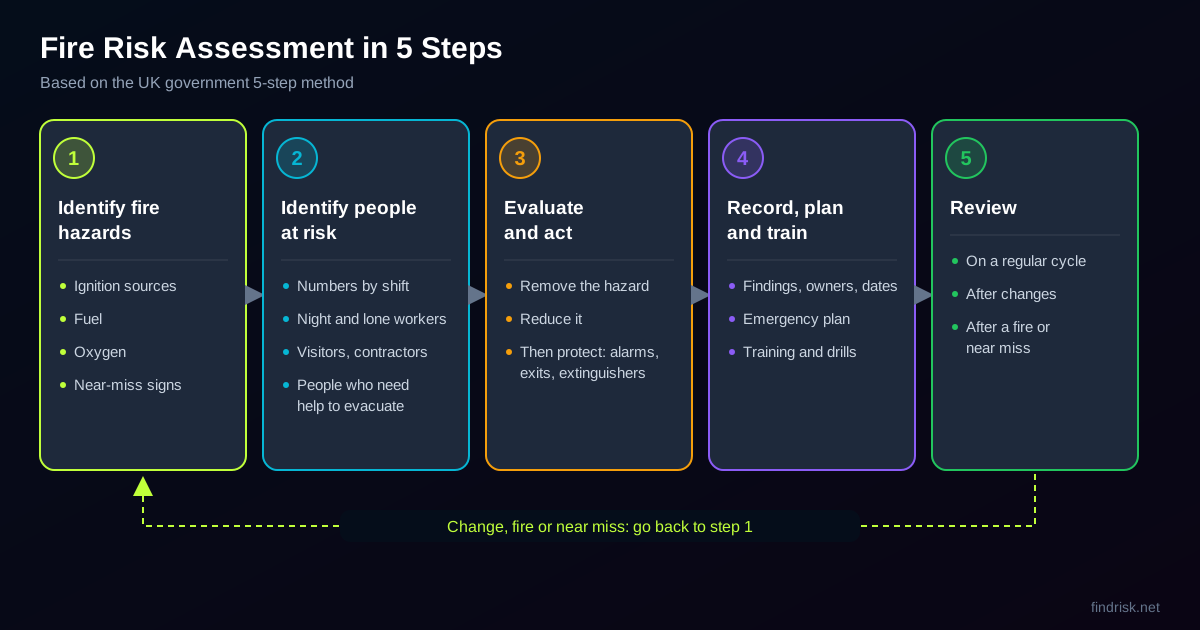
A fire risk assessment is a structured review of a workplace that identifies what could start a fire, what would burn, who would be at risk, and whether the existing precautions are enough to prevent a fire and get everyone out safely. It follows five steps: identify fire hazards, identify people at risk, evaluate and act, record and train, and review.
Most fire risk assessment guides stop at those five headings. The headings are easy. The hard part is standing in a real building and turning "identify fire hazards" into a list of specific findings, each with a rating, an owner and a deadline, and then checking whether people can actually reach an exit in time.
This guide walks through a complete fire risk assessment for a warehouse, from the first walk-through to the action plan. You will see scored findings, a travel-distance check against published UK guidance, the Turkish calculations for extinguishers and emergency teams, and the legal requirements in the UK, the US and Türkiye.
A Warehouse Walk-Through
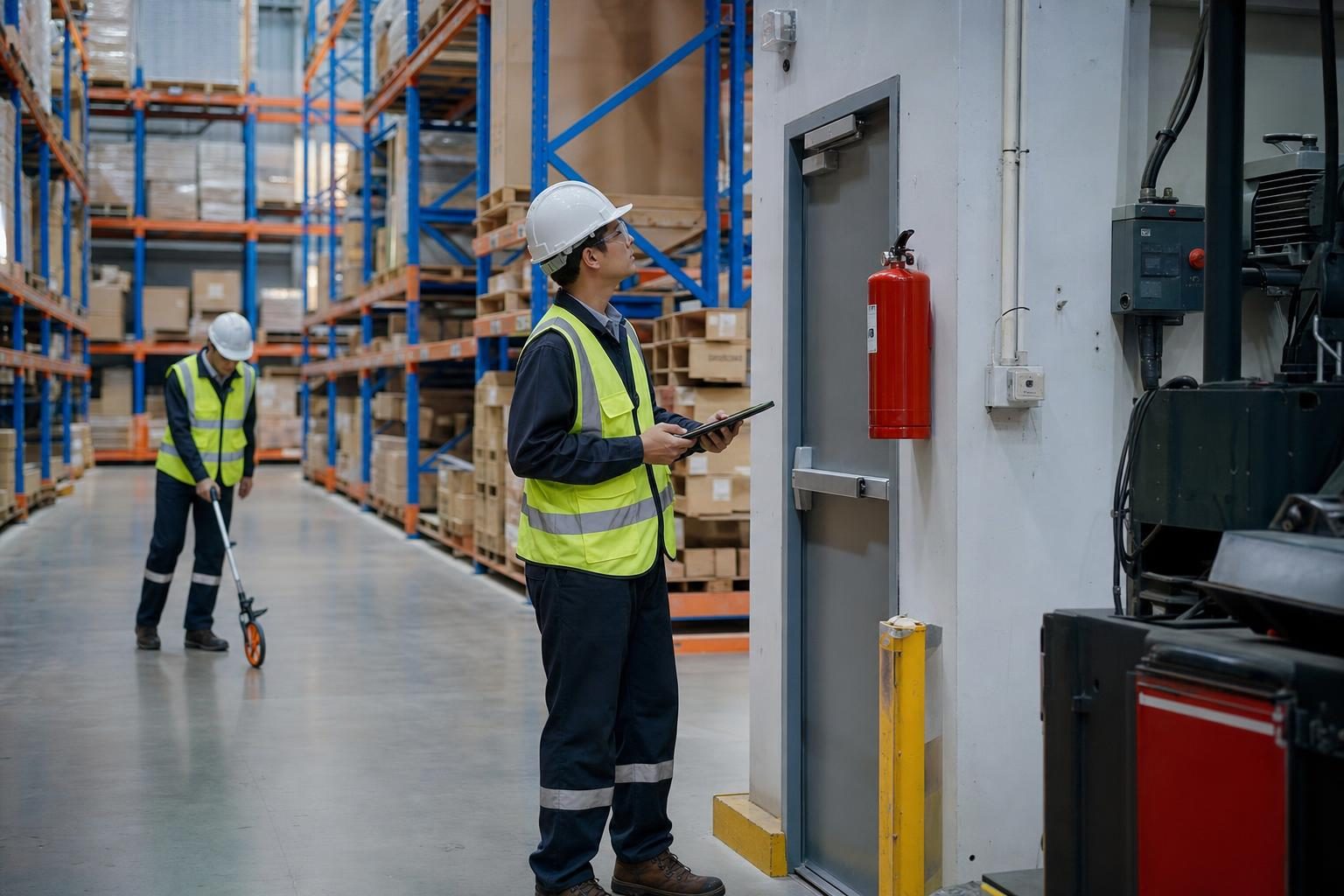
Picture a distribution warehouse of 4,000 m² (about 43,000 ft²). This is a fictional example built for this guide. Sixty people work there over two shifts: 35 on days, 25 on nights. There are pallet racks, a forklift battery charging area, a shrink-wrap station, a cardboard baler next to the loading dock, and a small dispatch office.
The site manager's existing "fire risk assessment" is a one-page form. It says "extinguishers in date, exits clear, fire drill done." All three statements are true. The walk-through still finds a charger one meter from a stack of empty pallets, a fire door wedged open with a wooden block, loose cardboard piled against the outside wall, and a rear aisle where the nearest exit is further away than the guidance allows.
None of these problems shows up on a checklist that only asks whether equipment is present. A proper fire risk assessment asks what could start a fire here, what it would burn, and who would be trapped. The rest of this guide answers those questions for this warehouse, one step at a time.
What Is a Fire Risk Assessment?
A fire risk assessment is a documented evaluation of the risk of fire in a premises and of the precautions needed to protect the people in and around it. In England and Wales it is a legal duty under the Regulatory Reform (Fire Safety) Order 2005, which requires the "responsible person" to carry out a "suitable and sufficient" assessment (article 9). GOV.UK defines the responsible person broadly: the employer, owner, landlord, occupier or anyone else with control of the premises, such as a facilities manager or managing agent (GOV.UK).
It is built on the fire triangle. The UK government's guide for factories and warehouses puts it simply: a fire needs a source of ignition, fuel and oxygen, and "if any one of these is missing, a fire cannot start" (GOV.UK, factories and warehouses guide).
| Term | What it means | Where you meet it |
|---|---|---|
| Fire risk assessment (FRA) | Assessment of fire hazards, people at risk and precautions | UK Fire Safety Order, most EU and Commonwealth practice |
| Fire prevention plan | Written plan listing major fire hazards, ignition sources and controls | OSHA 29 CFR 1910.39 (US) |
| Emergency action plan | Reporting, evacuation and accounting procedures | OSHA 29 CFR 1910.38 (US) |
| Yangın risk değerlendirmesi / acil durum planı | Fire risks inside the general risk assessment, plus a separate emergency plan | 6331 Law and its regulations (Türkiye) |
A fire risk assessment is not the same as a fire equipment inspection. An inspection checks that extinguishers, alarms and signs are present and working. The assessment asks whether those are the right precautions for the hazards and people in this building.
The 5 Steps of a Fire Risk Assessment
The five steps below follow the UK government's published method (GOV.UK 5-step checklist).
Step 1: Identify fire hazards
Walk the whole site and list items under each side of the fire triangle:
- Ignition sources: electrical installations and equipment, heaters, hot work, cooking, smoking, friction and static from conveyors, battery charging, arson.
- Fuel: packaging, pallets, high-piled or racked storage, flammable liquids and gases, waste, combustible insulation.
- Oxygen: normally the air, but also oxygen cylinders, oxidizing chemicals and ventilation that feeds a fire.
Look for near-miss evidence too. The UK guide lists scorch marks and discolored or charred plugs and sockets as signs of hazards you might otherwise miss.
Step 2: Identify people at risk
Count how many people are present at different times and where. Then note who is especially at risk: people working alone, night shifts, contractors and visitors who do not know the building, young workers, and anyone who may need help to evacuate because of a disability.
Step 3: Evaluate, remove, reduce and protect
Judge how likely a fire is and how badly it would affect people. Then act in this order: remove the hazard if you reasonably can, reduce it if you cannot, and only then rely on protection such as detection, alarms, escape routes, emergency lighting, signs and extinguishers. The UK guide says removing or reducing hazards should "as a priority" come before any other action. This is the hierarchy of controls applied to fire.
Step 4: Record, plan, inform, instruct and train
Write down the findings, the actions and who is responsible. Prepare the emergency plan, tell staff about the risks, train them and run drills.
Step 5: Review
Keep the assessment under review and revise it when something significant changes. The triggers are listed in the review section below.
Worked Example: Fire Risk Assessment for a 4,000 m² Warehouse
Here is the assessment for the fictional warehouse from the opening scenario. The rating uses a simple 3×3 scale created for this example. It is not a regulatory scale, but it is enough to rank findings:
- Likelihood of fire: 1 = unlikely, 2 = possible, 3 = likely
- Consequence to people: 1 = slight harm, 2 = serious harm to a few, 3 = serious harm to many or blocked escape
- Rating = L × C: 1–2 Low, 3–4 Medium, 6–9 High
If your organization already scores risks with Fine-Kinney or a 5×5 matrix, use that instead. What matters is that every finding gets a score, an action and an owner.
Step 1 and 2 results: hazards and people
| Area | Ignition sources | Fuel | People at risk |
|---|---|---|---|
| Battery charging area | Chargers, damaged leads | Empty pallets, shrink-wrap rolls stored nearby | Forklift drivers |
| Shrink-wrap station | Heat gun | Film, cardboard | Packers |
| Cardboard baler / dock | Arson from outside, forklift exhaust | Loose cardboard, full bales | Dock team, delivery drivers |
| Pallet racks | Electrical faults in lighting, friction | Racked goods, packaging | Pickers, night shift |
| Dispatch office | Daisy-chained extension leads, heater | Paper, furniture | Office staff, including one wheelchair user |
The night shift matters more than its size suggests. NFPA's latest analysis of US warehouse fires found that fires between midnight and 6 a.m. were 18% of warehouse fires but caused 40% of the direct property damage (2020–2024 annual averages, NFPA, 2026). The same report found that processed wood or paper, such as cardboard and pallets, was the first item ignited in 41% of warehouse fires, and that operating equipment was the leading heat source (43% of fires).
Step 3 results: scored findings and actions
| # | Finding | L | C | Rating | Action | Owner / due | Residual |
|---|---|---|---|---|---|---|---|
| 1 | Charger 1 m from stacked empty pallets and shrink-wrap rolls | 3 | 2 | 6 High | Move pallet store out of the charging area, mark a clear zone on the floor, add it to the daily check | Warehouse lead / 3 days | 1 × 2 = 2 |
| 2 | Fire door between charging area and racks wedged open | 2 | 3 | 6 High | Remove wedge; if the door must stay open for traffic, fit a hold-open device released by the fire alarm | Facilities / 7 days | 1 × 3 = 3 |
| 3 | Loose cardboard piled against the external wall by the dock | 2 | 3 | 6 High | Clear daily, move the waste container away from the building, lock the baler area out of hours | Dock supervisor / today | 1 × 3 = 3 |
| 4 | Rear aisle: 52 m to the nearest exit (see next section) | 2 | 3 | 6 High | Add an exit in the rear wall or re-plan the racking to shorten the route | Site manager / 60 days | 2 × 1 = 2 |
| 5 | Scorch mark on a socket in the dispatch office; extension leads daisy-chained | 2 | 2 | 4 Medium | Electrician to inspect and add fixed sockets; ban chained leads | Facilities / 14 days | 1 × 2 = 2 |
| 6 | Heat gun left on the cardboard bench between uses | 2 | 2 | 4 Medium | Metal stand, clearance around the bench, switch-off rule at breaks | Packing lead / 7 days | 1 × 2 = 2 |
| 7 | Alarm hard to hear in the rear aisle with the conveyor running | 1 | 3 | 3 Medium | Alarm contractor to add a sounder or visual beacon; retest with the conveyor running | Facilities / 30 days | 1 × 1 = 1 |
| 8 | No evacuation arrangement for the wheelchair user in the office | 1 | 3 | 3 Medium | Agree an individual plan with the employee: route, assistance, refuge if needed | HR + safety / 14 days | 1 × 1 = 1 |
Note what is not on the list. Extinguishers were in date, exit signs and emergency lighting were in place, and the last drill had been recorded. The old one-page form was right about all of that, and it still missed the seven problems that actually drive the risk.
Also note the order of the actions. Findings 1, 3 and 6 remove fuel or separate it from the ignition source. They do not add more extinguishers. That is Step 3 working as intended.
Checking Escape Routes: Travel Distances
Travel distance is how far a person has to walk from any point in the building to the nearest safe exit. The UK factories and warehouses guide gives suggested maximums that depend on the fire risk of the area and on whether there is more than one escape route (GOV.UK, Table 2):
| Escape routes | Higher fire risk | Normal fire risk | Lower fire risk |
|---|---|---|---|
| More than one route | 25 m | 45 m | 60 m |
| Single route only | 12 m | 25 m | 45 m |
Places of special fire hazard, such as a room used for spraying highly flammable paint, need shorter distances, for example 18 m with more than one route and 9 m with a single route. The guide warns that the lower-risk figures apply only in exceptional cases.
In the example warehouse:
- The charging area was treated as a higher-risk area with two routes out. Measured distance: 22 m. Within 25 m, so no finding.
- The main racked store was rated normal risk with two routes. The furthest point of the rear aisle was 52 m from the nearest exit, measured along the actual walking route around the racks. That is more than 45 m, so it became finding 4.
Measure along the path people really walk, around racks and machines, not in a straight line on the drawing. These distances are UK guidance, not hard limits. Where local building rules set their own figures, those apply.
What the Law Requires: UK, US and Türkiye
| UK (England and Wales) | United States | Türkiye | |
|---|---|---|---|
| Main rule | Regulatory Reform (Fire Safety) Order 2005, art. 9 | OSHA 29 CFR 1910.39 fire prevention plan and 1910.38 emergency action plan, where another OSHA standard requires them | 6331 İSG Kanunu art. 10 (risk assessment) and art. 11 (emergency plans, firefighting) |
| Who is responsible | The "responsible person" | The employer | The employer; for fire safety of the building, the owner or manager (BYKHY art. 124) |
| Written record | Required in full for all premises in England since 1 October 2023 | Written plan; employers with 10 or fewer employees may communicate it orally | Written risk assessment and emergency plan |
| Review | Regularly and after significant change | Emergency plan reviewed when developed, when duties change and when the plan changes | Risk assessment renewed at least every 2, 4 or 6 years by hazard class; emergency plan on the same cycle; drills at least yearly |
UK. From 1 October 2023, section 156 of the Building Safety Act 2022 requires responsible persons in England to record the fire risk assessment in full, including all findings, together with their fire safety arrangements. This replaced the earlier rule of recording only the significant findings, and the five-employee threshold with it (GOV.UK). You must also record who carried out the assessment. Serious breaches of the Fire Safety Order can lead to a fine, up to two years' imprisonment, or both (article 32).
US. OSHA's fire prevention plan standard applies when another OSHA standard in Part 1910 requires a plan. The plan must list the major fire hazards, their handling and storage, ignition sources and their control, the fire protection equipment, how flammable waste is controlled, and who is responsible. In practice, a fire risk assessment is the best way to produce those contents. The emergency action plan standard covers reporting, evacuation, accounting for employees and the alarm system.
Türkiye. Fire is assessed inside the general risk assessment required by the 6331 Law, and the results feed the emergency plan required by the İşyerlerinde Acil Durumlar Hakkında Yönetmelik. The Regulation on Protection of Buildings from Fire (BYKHY) sets building-level requirements. Two of its numbers turn directly into a calculation for our warehouse:
- Extinguishers (BYKHY art. 99): one 6 kg dry chemical powder extinguisher, or an equivalent gas unit, per 500 m² in low-hazard areas and per 250 m² in medium- and high-hazard areas. Warehouses must also have wheeled extinguishers, and nobody should have to walk more than 25 m to an extinguisher. For a 4,000 m² store rated medium or high hazard, that means at least 4,000 ÷ 250 = 16 portable units plus wheeled units.
- Emergency teams (Acil Durumlar Yönetmeliği art. 11): the employer appoints trained support staff for each of the firefighting, rescue and protection teams: at least one per 30 employees in very hazardous workplaces, per 40 in hazardous and per 50 in less hazardous workplaces. Shift patterns must be taken into account. With 35 people on the day shift, a "hazardous" class workplace needs one person per team on that shift, and a "very hazardous" one needs two.
The warehouse's hazard class under Turkish OHS law depends on its activity code, so check it before you calculate. The BYKHY building hazard classes (low, medium, high) are a separate classification from the OHS hazard classes.
When to Review a Fire Risk Assessment
Review a fire risk assessment whenever something changes that could make it invalid, and in any case on a regular cycle. The UK factories and warehouses guide lists these triggers:
- Changes to work activities or the introduction of new equipment
- Alterations to the building, including the internal layout
- A new hazardous substance, or more of one in storage
- Failure of a fire precaution, such as the detection or sprinkler system
- Significant changes to the type, quantity or method of storage of goods
- A significant increase in the number of people present
- The presence of people with a disability
A fire or a near miss is also a sign that the assessment may be inadequate. Investigate the cause, then revise the assessment. Our root cause analysis guide shows how.
In Türkiye, the risk assessment must be renewed at least every 2, 4 or 6 years for very hazardous, hazardous and less hazardous workplaces respectively, and earlier when conditions change. The emergency plan follows the same 2/4/6-year cycle, and drills must be held at least once a year.
For the example warehouse, peak season is a real trigger. If extra racking, temporary staff and more cardboard arrive in November, the assessment written in March no longer describes the building.
Common Mistakes in Fire Risk Assessments
1. Treating it as an equipment checklist
"Extinguishers in date, exits clear" describes precautions, not risk. A building can pass every equipment check and still have a charger next to a pallet stack. Start from the fire triangle, not from the equipment list.
2. Adding protection instead of removing fuel
It is tempting to answer every finding with another extinguisher or sign. The UK guidance puts removing and reducing hazards first. Clearing cardboard daily costs less and works better than a larger extinguisher next to it.
3. Assessing the day shift only
Assessments are usually done in office hours. Nights have fewer people, fewer trained responders, locked doors and, according to NFPA's warehouse data, a much larger share of the property damage. Walk the site on the night shift at least once.
4. Measuring travel distance on the drawing
Straight-line distances on a plan are always shorter than the real route around racks. Walk it with a measuring wheel or a laser.
5. Ignoring contractors and hot work
Welding, cutting and grinding by contractors are classic ignition sources. Control them through a permit to work with a fire watch, and include them in the assessment.
6. Never updating after changes
A new mezzanine, a layout change or a switch to lithium-ion forklifts changes the fire risk. If the assessment date is older than the layout, it is out of date.
How FindRisk Supports Fire Risk Assessments
FindRisk is built for the walk-through part of the job. You can use the AI checklist generator to create a fire safety inspection list for a specific area, such as a charging room or a loading dock, and work through it on your phone. When you find a wedged fire door or a charger next to pallets, you mark the hazard directly on a photo, and AI analysis helps point out hazards you might have missed in the same frame.
Each finding can be scored with the built-in Fine-Kinney method, so the action plan is ranked by risk rather than by the order you walked the site. When you are done, FindRisk generates a professional report in seconds, with photos, scores and actions, ready for the site manager or an auditor. It runs on iOS and Android.
Frequently Asked Questions
Who can carry out a fire risk assessment?
The responsible person, usually the employer or whoever controls the premises, must make sure it is done, but they can appoint someone else to carry it out. In England, the identity of whoever carries out the assessment must be recorded, and GOV.UK guidance says assessors should have sufficient training and experience or knowledge; a legal competence requirement is due to come into force later. Simple, low-risk premises can often be assessed in-house; complex or high-risk sites usually need a specialist.
How often should a fire risk assessment be reviewed?
The UK Fire Safety Order requires the assessment to be reviewed regularly and whenever there has been a significant change, such as building alterations or a reorganization of work. It does not fix an interval, so set one in your own procedure and stick to it. In Türkiye, the risk assessment must be renewed at least every 2, 4 or 6 years depending on the hazard class, and sooner after changes.
Do I need a written fire risk assessment if I have fewer than five employees?
In England, yes. Since 1 October 2023, every responsible person must record the full fire risk assessment and their fire safety arrangements, whatever the size of the business. The old rule that only businesses with five or more employees had to write down their significant findings no longer applies in England. In the US, OSHA allows employers with 10 or fewer employees to communicate fire prevention and emergency plans orally.
Is a fire risk assessment required in the US?
US federal rules do not use the term "fire risk assessment." Instead, OSHA 29 CFR 1910.39 requires a written fire prevention plan whenever another OSHA standard calls for one, and 1910.38 sets out the emergency action plan. Both require you to identify fire hazards, ignition sources and controls, so a fire risk assessment is the practical way to produce them. State and local fire codes may add further requirements.
What is the difference between a fire risk assessment and a fire safety inspection?
A fire safety inspection checks whether precautions are present and working: extinguishers serviced, exits clear, alarms tested. A fire risk assessment asks whether those precautions are right for the hazards and people in the building, and what should change. Inspections are frequent and routine. The assessment is less frequent and decides what the inspections should look for. Our safety inspection checklist guide covers the routine side.
Is the fire risk assessment separate from the general workplace risk assessment?
It can be either. In the UK, the fire risk assessment is a separate duty under the Fire Safety Order, although it can be done alongside the general risk assessment. In Türkiye, fire risks are normally assessed inside the general risk assessment, and the results feed the emergency plan. What matters is that fire hazards, people at risk and escape arrangements are covered in detail.
Conclusion
A fire risk assessment is five steps on paper and a careful walk on site. Identify what could ignite and what would burn, work out who would be at risk and when, remove or reduce the hazards before adding protection, write it all down, and review it when the building or the work changes. The warehouse example shows why each step matters: the equipment was fine, and the real risks were a charger, a wedged door, a cardboard pile and a long aisle.
Use the worked example as a template for your own site, check travel distances by walking them, and apply the local rules for records, extinguishers and emergency teams. For storage sites, pair it with our warehouse and logistics safety checklist, and for sites that store solvents or gases, with our chemical safety guide.
To run your next fire walk-through on your phone, download FindRisk, generate a fire safety checklist for the area, mark hazards on photos and share a scored report the same day.
Try FindRisk
Ready to modernize your safety workflow?
Conduct AI-powered risk assessments, generate reports instantly, and keep your team safe — anywhere, anytime.