
Explosion Protection Document: DSEAR/ATEX Guide With Example
An explosion protection document is the written record of how an employer has assessed explosion risks from flammable gases, vapors, mists or combustible dusts: which places are classified into zones, which equipment is suitable for each zone, and which measures prevent ignition and limit the effects. EU Directive 1999/92/EC requires it before work starts.
Most of what you find online is a blank form. The hard part is applying the zone definitions to a real layout, checking each piece of equipment against its zone, and keeping the document true when the site changes.
This guide sets out the required contents under EU, Turkish and British law side by side, then builds a filled document for a shop with both solvent vapor and wood dust.
A Finishing Shop With Solvents and Sanding Dust
Picture a furniture maker's finishing department (a fictional example). Panels are sanded on a line whose extraction runs to a bag filter in the yard. Thinner arrives in 200-liter drums and is decanted into small cans in a store room. Lacquer is sprayed in a booth with its own exhaust fan.
The site has a fire risk assessment that says "flammables stored in a cabinet." There is no zone drawing. Last month someone installed a battery charger for the pallet truck next to the store door, because there was a free socket. Maintenance now wants to weld a new branch onto the extraction ductwork.
Which places are hazardous, and how hazardous? Is the charger allowed where it is? Who confirms the shop is safe to run after the duct change? An explosion protection document answers all three in writing.
What Is an Explosion Protection Document?
An explosion protection document is a written record that demonstrates an employer has identified and assessed explosion risks and put adequate measures in place. It comes from Article 8 of the ATEX workplace directive 1999/92/EC, which requires it to be drawn up before work starts and kept up to date. Each jurisdiction names and scopes it a little differently:
| Jurisdiction | Legal source | What it is called | Who must have it |
|---|---|---|---|
| EU | Directive 1999/92/EC, Article 8 | Explosion protection document | Employers where explosive atmospheres may occur |
| Great Britain | DSEAR 2002, regulation 5(4) | Record of the significant findings of the DSEAR risk assessment | Employers with five or more employees; zoning, equipment, verification and coordination must be included where an explosive atmosphere may occur |
| Türkiye | Çalışanların Patlayıcı Ortamların Tehlikelerinden Korunması Hakkında Yönetmelik (Resmî Gazete 30.04.2013, No. 28633), Article 10 | Patlamadan korunma dokümanı | Every employer in scope; the article sets no headcount threshold |
ATEX and DSEAR are not the same thing. ATEX is shorthand for two EU directives: the workplace directive 1999/92/EC for employers and the equipment directive 2014/34/EU for equipment manufacturers. In Great Britain, DSEAR implements the workplace directive and the Equipment and Protective Systems Regulations 2016 implement the equipment directive. Türkiye has the same split: the 2013 regulation parallels 1999/92/EC, and a separate 2016 regulation transposes 2014/34/EU.
The explosion protection document is not a separate exercise from the risk assessment. It is the part of the risk assessment that deals with explosive atmospheres, written down in enough detail that someone can check it on site.
Which Workplaces Need One?
Any workplace where a dangerous substance could form an explosive atmosphere needs one. DSEAR defines an explosive atmosphere as a mixture of air and dangerous substances in which, after ignition, combustion spreads to the entire unburned mixture; the Turkish Article 4 definition matches. HSE lists the substances involved: solvents, paints, varnishes, flammable gases such as LPG, dusts from machining and sanding, and dusts from foodstuffs.
Two points are often missed:
- Dust counts. DSEAR covers any dust that can form an explosive mixture with air. The Turkish regulation assumes that flammable or combustible substances can form an explosive atmosphere unless an investigation shows otherwise.
- "No hazardous places" is a valid outcome. Annex 1 of the Turkish regulation treats places that need no special precautions as non-hazardous. Write down why you reached that conclusion, because a later change can reverse it.
Article 2 of the Turkish regulation excludes medical treatment areas, gas-burning appliances under Directive 2009/142/EC, explosives and chemically unstable substances, drilling and mining, and most means of transport. Those activities have their own rules.
What the Document Must Contain
The document must show, at a minimum, that explosion risks were assessed, where the zones are, which equipment and measures apply in them, and how the workplace and equipment are kept safe. The table maps each element to the three legal texts.
| Element | EU 1999/92/EC, Art. 8 | Türkiye, Art. 10 | Great Britain, DSEAR reg. 5(4) |
|---|---|---|---|
| Explosion risks identified and assessed | 8(2), 1st indent | 10(2)(a) | Significant findings of the reg. 5 assessment |
| Measures to meet the requirements | 8(2), 2nd indent | 10(2)(b) | 5(4)(a) |
| Places classified into zones | 8(2), 3rd indent (Annex I) | 10(2)(c) (Annex 1) | 5(4)(c), classification under reg. 7(1) |
| Places where the minimum requirements apply | 8(2), 4th indent (Annex II) | 10(2)(ç) (Annexes 2 and 3) | 5(4)(c), equipment needed for safety in hazardous places |
| Workplace and equipment, including warning devices, designed, operated and maintained safely | 8(2), 5th indent | 10(2)(d) | 5(4)(b) |
| Safe use of work equipment | 8(2), 6th indent (Directive 89/655/EEC) | 10(2)(e), work equipment regulation (Resmî Gazete 25.04.2013, No. 28628) | 5(4)(b), PUWER 1998 |
| Verification of explosion safety before first use | Not listed in Art. 8 | Annex 2, point 2.8 | 5(4)(c), verification under reg. 7(4) |
| Coordination between employers on a shared site | Not listed in Art. 8 | Art. 8(2): aims, procedures and measures recorded in the document | 5(4)(c), coordination under reg. 11 |
| When it is prepared and revised | Before work; revised on significant changes, extensions or conversions (8(3)) | Same wording (10(3)) | Before any new activity (5(5)); reviewed regularly and on significant change (5(3)) |
| Combining with other assessments | Allowed (8(4)) | Allowed (10(4)) | — |
In practice, a document that satisfies all three columns usually has ten sections:
- Site description, scope and responsible people
- Dangerous substances register (from the safety data sheets)
- Release sources, including maintenance and cleaning
- Zone classification table and drawings
- Ignition sources, including static electricity
- Equipment register: zone, required category, installed marking, status
- Technical and organizational measures, in priority order
- Coordination with contractors and other employers
- Verification before first use and after modifications
- Review log and triggers
Hazardous Area Classification: Zones 0, 1, 2, 20, 21 and 22
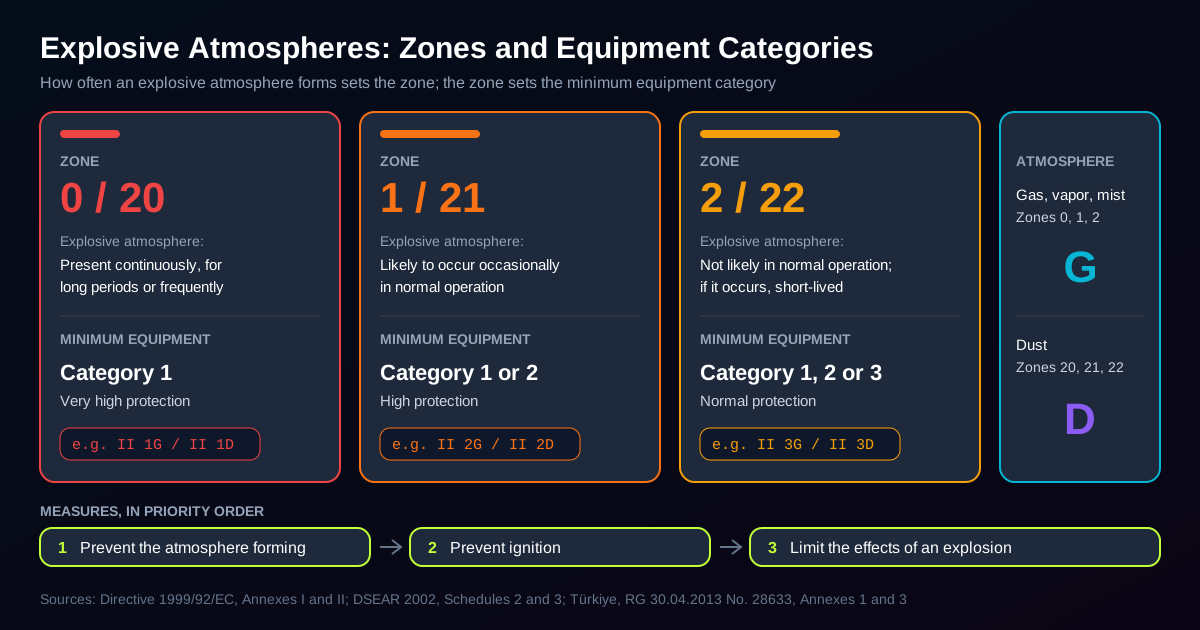
Hazardous area classification divides the places where an explosive atmosphere may occur into zones according to how often it forms and how long it persists. Gases, vapors and mists use zones 0, 1 and 2. Combustible dusts use zones 20, 21 and 22. The definitions are the same in DSEAR Schedule 2, Annex I of the directive and Annex 1 of the Turkish regulation.
| Zone | Atmosphere | Legal definition |
|---|---|---|
| 0 | Gas, vapor or mist | Present continuously, for long periods or frequently |
| 1 | Gas, vapor or mist | Likely to occur in normal operation occasionally |
| 2 | Gas, vapor or mist | Not likely in normal operation; if it occurs, it persists for a short period only |
| 20 | Dust cloud | Present continuously, for long periods or frequently |
| 21 | Dust cloud | Likely to occur in normal operation occasionally |
| 22 | Dust cloud | Not likely in normal operation; if it occurs, it persists for a short period only |
Three details in the legal text change real classifications:
- "Normal operation" means installations used within their design parameters (DSEAR Schedule 2 and the directive's Annex I). A filter's routine cleaning cycle happens within the design, so it is part of normal operation; a burst filter bag is not.
- Dust layers are a source. Layers, deposits and heaps of combustible dust must be treated like any other source of an explosive atmosphere. A dusty beam above a sanding line becomes a cloud when disturbed, so housekeeping is a condition of the classification.
- Connected places count. DSEAR regulation 5(2)(i) asks you to consider places connected by openings, such as a door from a solvent store into a corridor.
How far each zone reaches is normally worked out with the area classification standards IEC 60079-10-1 (gases and vapors) and IEC 60079-10-2 (combustible dusts). It depends on how the substance is released and how well the area is ventilated, so never copy extents from another site's drawing.
Choosing Equipment for Each Zone
Equipment in a zone must belong to an equipment category that matches the zone. Annex II, Part B of the directive, Schedule 3 of DSEAR and Annex 3 of the Turkish regulation set the same minimums. The directive and DSEAR allow a different choice only where the explosion protection document or the risk assessment states otherwise.
| Zone | Minimum equipment category (group II) | Protection level under Directive 2014/34/EU |
|---|---|---|
| 0 or 20 | Category 1 | Very high |
| 1 or 21 | Category 1 or 2 | High |
| 2 or 22 | Category 1, 2 or 3 | Normal |
The equipment must also be suitable for the substance present: gas, vapor or mist on one hand, dust on the other. Under Annex I of Directive 2014/34/EU, group I is for mines and group II for all other places. The marking required by Annex II of that directive includes the explosion protection symbol, the equipment group and category, and for group II the letter G for gases, vapors and mists or D for dust.
So a luminaire marked II 2G is group II, category 2, for gas atmospheres. It may be used in zone 1 or zone 2, but not in zone 0 and not in a dust zone. A sensor marked II 3D is acceptable only in zone 22. Checking the Ex symbol alone is not enough.
Clothing counts too: DSEAR regulation 7(5) requires work clothing that does not cause electrostatic discharges, and Annex 2, point 2.3 of the Turkish regulation requires PPE made of suitable materials.
US note. Under 29 CFR 1910.307, Class I locations (flammable gases or vapors) may be classified by divisions or by zones 0, 1 and 2, while Class II (combustible dust) and Class III (easily ignitable fibers or flyings) locations must use divisions. Classified areas must be documented for those who install, inspect, maintain or operate electrical equipment there.
How to Prepare an Explosion Protection Document in 7 Steps
An explosion protection document is prepared in seven steps, from the substances to the sign-off, and the order matters because each step feeds the next.
Step 1: List the dangerous substances
Record each flammable liquid, gas and combustible dust, where it is used or stored, and the quantity. Take the hazard properties from each safety data sheet. Our chemical safety guide explains how to read them.
Step 2: Find the release sources
For each substance, ask where a flammable atmosphere can form, how often and for how long: open containers, decanting, spraying, filling, sampling, filter cleaning, leaks and spills. DSEAR regulation 5(2)(d) specifically names high-risk activities such as maintenance.
Step 3: Classify and draw the zones
Assign a zone to each release source using the definitions above, set its extent with IEC 60079-10-1 or 60079-10-2, and draw the result on a plan. Include openings into neighboring rooms.
Step 4: Identify ignition sources
Within and near each zone, list what could ignite the atmosphere: electrical equipment, hot surfaces, mechanical sparks, hot work, vehicles and static electricity. The Turkish regulation (Article 6) and DSEAR regulation 5(2)(g) both name electrostatic discharges explicitly.
Step 5: Check equipment against the zones
Build the equipment register. For each item in a zone, compare the installed marking with the minimum category and the G or D letter. Every mismatch becomes a finding.
Step 6: Decide measures in priority order
The Turkish regulation (Article 5) sets the order: prevent explosive atmospheres from forming, then prevent ignition, then reduce the harmful effects. DSEAR regulation 6 spells it out: reduce quantities, control releases, ventilate, avoid ignition sources, then mitigate with pressure relief, suppression, explosion-resistant plant and fewer people exposed. This is the hierarchy of controls applied to explosions.
Step 7: Verify, sign and set review triggers
Before first use, a person competent in explosion protection verifies the overall explosion safety of the workplace (DSEAR regulation 7(4); Turkish Annex 2, point 2.8). Record the verification, train the people who work in the zones, and write down what will trigger a review.
Worked Example: An Explosion Protection Document for a Furniture Finishing Shop
This example continues the fictional shop. The substances, quantities, zone extents and equipment markings are illustrative inputs, not data from a real site and not default extents to copy. A real classification would be worked out with the IEC standards.
Dangerous substances register
| Substance | Form | Location | Quantity | Hazard (from the SDS) |
|---|---|---|---|---|
| Cellulose thinner | Flammable liquid | Solvent store | 4 × 200 L drums | Highly flammable liquid and vapor |
| Solvent-based lacquer | Flammable liquid, sprayed as a mist | Spray booth | 2 × 25 L in use | Flammable liquid and vapor |
| Wood dust (hardwood and MDF) | Combustible dust | Sanding line, extraction, bag filter | Filter hopper and dust bin | Can form an explosive dust cloud |
Zone classification
| Ref | Place | When an explosive atmosphere can form | Zone | Extent (illustrative) |
|---|---|---|---|---|
| Z1 | Inside closed drums and cans | Vapor above the liquid, all the time | 0 | Inside the containers |
| Z2 | Drum decanting point | Each time a can is filled | 1 | 1 m around the drum opening and the can |
| Z3 | Rest of the solvent store | Only after a spill or leak | 2 | Whole room |
| Z4 | Spray booth interior and exhaust duct | During every spraying session | 1 | Inside the booth and duct |
| Z5 | In front of the booth's open face | Only if extraction fails | 2 | 1 m in front of the opening |
| Z6 | Bag filter, dirty side and hopper | Dust cloud in normal operation and during filter cleaning | 20 | Inside the filter housing and hopper |
| Z7 | Filter discharge and dust bin | Briefly, during bin changes | 22 | 1 m around the discharge point |
| — | Sanding hall | No cloud in normal operation with on-tool extraction | Non-hazardous, on condition | Daily cleaning keeps dust layers from building up |
The last row matters. The sanding hall stays non-hazardous only while dust layers are removed. That condition goes into the document and into the inspection checklist, so that a missed cleaning round is treated as a change in classification.
Equipment register
| Item | Zone | Minimum category | Installed marking | Status |
|---|---|---|---|---|
| Store ceiling luminaires | 2 | 3G | II 2G | OK |
| Store extract fan | 2 | 3G | II 3G | OK |
| Booth exhaust fan | 1 | 2G | II 2G | OK |
| Work light inside the booth | 1 | 2G | Standard luminaire, no Ex marking | F1: replace with 2G or move outside the zone |
| Battery charger and socket inside the store door | 2 | 3G | Standard, no Ex marking | F2: move outside the zone |
| Level sensor in the filter hopper | 20 | 1D | II 3D | F3: replace with category 1D |
| Lamp above the dust bin | 22 | 3D | Standard, no Ex marking | F4: replace with 3D or move |
Four of seven items fail. Two of them, the charger and the work light, were added after the original installation without anyone checking the zone, which is exactly what a current zone drawing prevents.
Ignition source and organizational measures
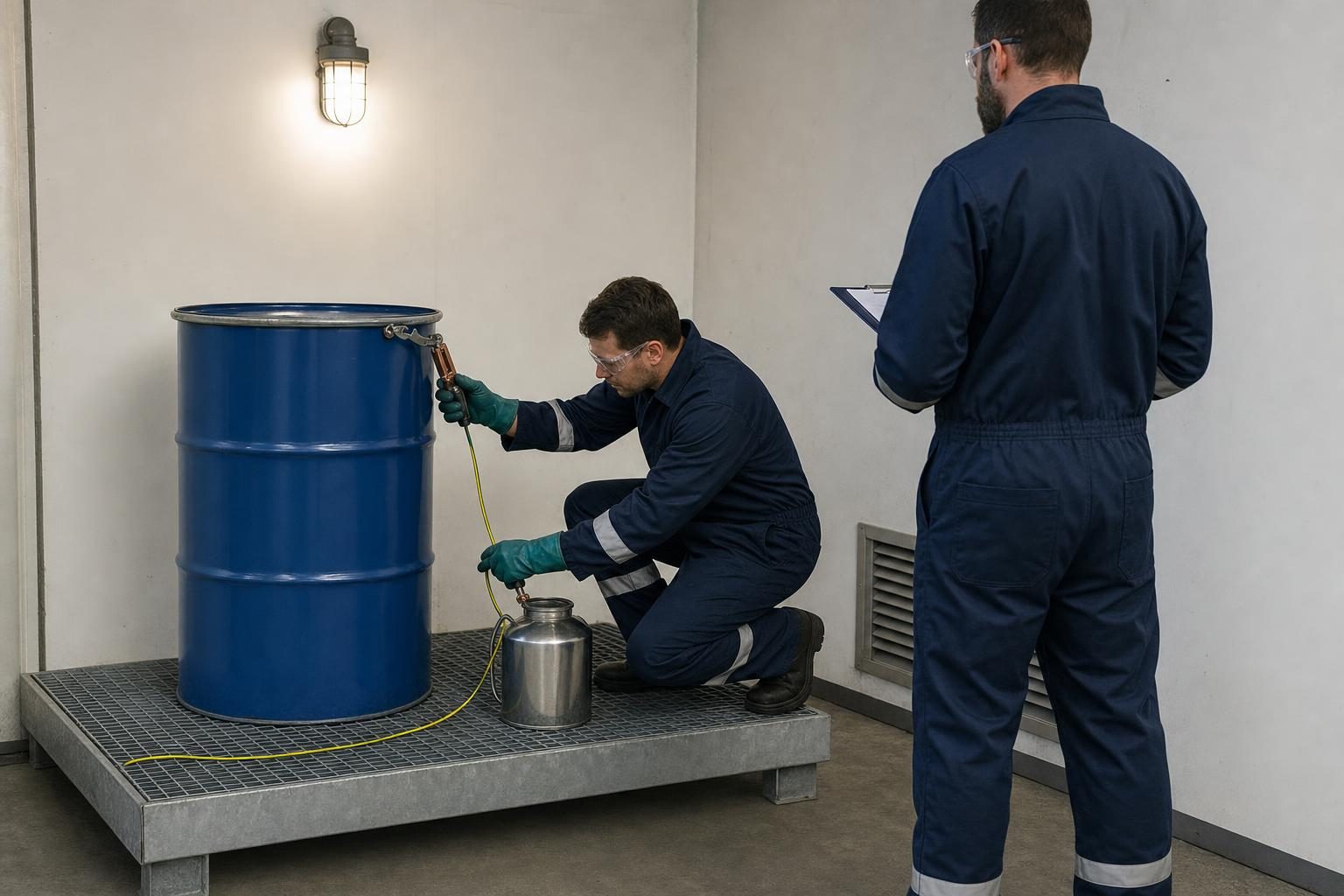
- Static electricity: drums and cans are earthed and bonded during decanting; store and booth staff wear antistatic footwear and clothing.
- Hot work: no welding, cutting or grinding in or near a zone without a permit to work, an atmosphere check and a cleaned area. The duct modification is done with the filter shut down and emptied.
- Vehicles and devices: no powered truck enters the store; phones and other non-Ex devices stay out of zones 0 and 1.
- Spray booth: the spray gun air supply is interlocked with the booth extraction, so spraying cannot start without airflow.
- Housekeeping: the sanding hall is vacuumed daily, never blown down with compressed air, which would raise a cloud.
- Mitigation: the bag filter has an explosion vent discharging to a fenced part of the yard and an isolation device in the inlet duct.
- Organization: zone workers are trained in explosion protection (directive Annex II, Part A, 1.1); decanting and filter maintenance follow written instructions; coordination with the filter service contractor is recorded (Turkish Article 8; DSEAR regulation 11).
- Signs: each zone entrance carries the triangular yellow EX warning sign (Turkish Annex 4; DSEAR Schedule 4).
Action plan in priority order
| # | Action | Priority level | Owner | Due |
|---|---|---|---|---|
| 1 | Cut thinner stock from 4 drums to 2 and switch to a closed dispensing pump | Prevent the atmosphere | Production manager | 4 weeks |
| 2 | Move the charger and socket out of the store (F2) | Prevent ignition | Maintenance lead | 1 week |
| 3 | Replace or relocate the booth work light, hopper sensor and bin lamp (F1, F3, F4) | Prevent ignition | Maintenance lead | 4 weeks |
| 4 | Add a continuity check to the bonding clamps and record it before each decanting shift | Prevent ignition | Store supervisor | 2 weeks |
| 5 | Confirm the vent discharge area stays fenced and clear | Limit the effects | EHS manager | 1 week |
| 6 | Verify overall explosion safety after the duct modification, before restart | Verification | Competent person | Before restart |
| 7 | Mark zone entrances, update the drawing and train store and booth staff | Organizational | EHS manager | 4 weeks |
If you rank actions across the whole site, a scoring method helps compare them with other risks, but the zone and category check is a pass or fail test. A score does not make a non-Ex lamp acceptable in zone 22.
When Must the Document Be Reviewed?
The document must be revised whenever the workplace, the work equipment or the organization of the work undergoes significant changes, extensions or conversions. That is the wording of Article 8(3) of the directive, and Article 10(3) of the Turkish regulation repeats it. DSEAR regulation 5(3) also requires a regular review.
In practice, the following should each trigger a review:
- a new substance, a new supplier or a changed safety data sheet
- a change to ventilation, extraction or the spray booth
- new, moved or repaired equipment in or near a zone
- a layout change, a new door or an extension
- an incident or near miss involving a release or an ignition source
- inspection findings that contradict the zone drawing, such as dust layers in a "non-hazardous" hall
Run these through your management of change process so the zone drawing is checked before the change, not after it. Neither the directive nor the Turkish regulation sets a fixed review period. In Türkiye, if the document sits inside the general risk assessment, as Article 10(4) allows, review it at least whenever the risk assessment is renewed: every 2, 4 or 6 years by hazard class, or sooner after changes.
Common Mistakes in Explosion Protection Documents
1. Writing it once and never revising it
A document dated at commissioning describes a plant that no longer exists. New chargers, sockets and extraction branches appear, and the zone drawing never sees them.
2. A zone drawing without an equipment register
Zones on their own protect nobody. The value is the item-by-item check of what is installed in each zone against the required category and the G or D letter.
3. Forgetting dust layers
A dust hall classified as non-hazardous on the assumption of good housekeeping becomes hazardous when cleaning slips. Record the condition and inspect against it.
4. Ignoring non-routine work
Filter changes, tank cleaning, sampling and maintenance often create the worst atmospheres. DSEAR names maintenance as a high-risk activity for a reason.
5. Leaving contractors out
Contractors bring tools, vehicles and hot work into zones. The Turkish regulation (Article 8) and DSEAR regulation 11 require coordination, and the document is where you write it down. Our fire risk assessment guide covers the wider fire precautions that sit alongside it.
How FindRisk Supports Explosion Protection Work
FindRisk does not classify zones or certify equipment; you still need the area classification and a competent person for verification. What it does is help keep the document true between reviews. You can generate an AI checklist for a hazardous area walk-through (zone signs, Ex markings against the zone, earthing and bonding, dust layers, hot work controls) and mark findings such as a non-Ex lamp or a dust deposit directly on photos.
Each finding can be scored with the built-in Fine-Kinney method, and FindRisk produces a professional report in seconds, with photos, scores and owners, that you can attach to the document's review log. It runs on iOS and Android.
Frequently Asked Questions
Is an explosion protection document a legal requirement?
Yes, in the EU and in Türkiye. Directive 1999/92/EC, Article 8, and Article 10 of the Turkish regulation require every employer where explosive atmospheres may occur to prepare one before work starts. Great Britain does not use the name, but DSEAR requires employers with five or more employees to record the significant findings of the risk assessment, including zones, equipment, verification and coordination.
Who can prepare an explosion protection document?
The employer is responsible for it, but the work should be done by people who understand the process, the substances and explosion protection. Neither the directive's Article 8 nor the Turkish Article 10 names a specific qualification. Verification of explosion safety before first use must be done by a person competent in explosion protection (DSEAR regulation 7(4)) or by trained and/or experienced competent people (Turkish Annex 2, point 2.8).
How often should an explosion protection document be reviewed?
There is no fixed period in the directive or the Turkish regulation. It must be revised whenever the workplace, equipment or work organization undergoes significant changes, extensions or conversions, and DSEAR requires a regular review as well. In Türkiye, if the document is kept with the general risk assessment, review it at least each time the risk assessment is renewed, every 2, 4 or 6 years depending on the hazard class.
What is the difference between a DSEAR risk assessment and hazardous area classification?
Hazardous area classification is one part of the DSEAR risk assessment. It identifies where explosive atmospheres may occur and assigns zones. The risk assessment goes further: it covers the substances, ignition sources, equipment, measures, maintenance work, emergency arrangements and the effects of a fire or explosion. A zone drawing alone does not satisfy DSEAR regulation 5.
Can the explosion protection document be combined with the general risk assessment?
Yes. Article 8(4) of the directive allows the employer to combine existing explosion risk assessments, documents or equivalent reports, and Article 10(4) of the Turkish regulation allows the explosion risk assessment and related documents to be handled together. Whatever the format, every element required by Article 8(2) or Article 10(2) must still be present and easy to find.
Do you need ATEX equipment in Zone 2?
Yes. Zone 2 needs at least category 3 equipment, and category 1 or 2 is also acceptable; the marking must carry a G for gas, vapor or mist. The directive and DSEAR allow a different choice only where the explosion protection document or risk assessment states otherwise, so any exception must be justified in writing.
Conclusion
An explosion protection document does three jobs: it shows that you have found every place where a flammable atmosphere can form, it proves that what is installed in each place is suitable, and it records the measures that keep ignition away and limit the effects. The legal texts in the EU, Türkiye and Great Britain ask for almost the same contents, so one well-built document can satisfy all three.
Use the ten-section structure and the three tables from the worked example (substances, zones, equipment) as your template, add an action plan in priority order, and treat every change on site as a question for the document. Keep it linked to your general risk assessment so explosion risks follow the same review cycle.
To check your zones on the next walk-through, download FindRisk, generate a hazardous area checklist, mark findings on photos and share a scored report the same day.
Try FindRisk
Ready to modernize your safety workflow?
Conduct AI-powered risk assessments, generate reports instantly, and keep your team safe — anywhere, anytime.