

Fine-Kinney Risk Assessment Examples: 16 Scored Hazards
A Fine-Kinney risk assessment example shows how a real hazard is scored with R = Probability × Exposure × Consequence, which risk class the score falls into, and how the score changes once a control is in place. This guide gives 16 worked examples from five kinds of workplace, each scored before and after controls, with the reasoning behind every value.
Most people who search for Fine-Kinney already know the formula. The hard part is choosing the numbers. Is a forklift near pedestrians a 3 or a 6 for probability? Does a face shield change the consequence score? What do you write in the "after" column? Those are the questions a worked example answers, and they are what this page is for.
The scenarios below are illustrative. They are built by the FindRisk Team to show scoring logic, not taken from real incidents. Use the reasoning, then score your own site with your own team.
Why Worked Examples Matter: Two Assessors, One Press Brake
Picture a hypothetical sheet-metal shop. A safety specialist and a production supervisor score the same press brake separately. The specialist writes 6 × 10 × 7 = 420. The supervisor writes 1 × 6 × 3 = 18. Same machine, same day, a 23-fold difference.
The gap is not arithmetic. The supervisor scored the machine as it is supposed to work, with the light curtain on. The specialist saw the jumper wire that bypasses it. The supervisor also counted exposure as "daily" because the operator only bends small parts, while the specialist watched the operator feed parts all shift.
Fine-Kinney gives you a common language, but the language only works when everyone scores the actual condition with the same definitions. The examples below make those definitions concrete.
What Is the Fine-Kinney Method?
The Fine-Kinney method is a semi-quantitative risk assessment technique that multiplies three factors to produce a risk score used for ranking hazards. G.F. Kinney and A.D. Wiruth published it in 1976 as Practical Risk Analysis for Safety Management (NWC TP 5865), building on William T. Fine's 1971 report. For a full explanation of the method, see our Fine-Kinney method guide.
All examples on this page use the scales from the 1976 report:
| Probability (P) | Exposure (E) | Consequence (C) | |||
|---|---|---|---|---|---|
| 10 | Might well be expected | 10 | Continuous | 100 | Catastrophe, many fatalities |
| 6 | Quite possible | 6 | Frequent (daily) | 40 | Disaster, a few fatalities |
| 3 | Unusual but possible | 3 | Occasional (weekly) | 15 | Very serious, one fatality |
| 1 | Only remotely possible | 2 | Unusual (monthly) | 7 | Serious injury |
| 0.5 | Conceivable but very unlikely | 1 | Rare (a few times a year) | 3 | Important, disability |
| 0.2 | Practically impossible | 0.5 | Very rare (yearly) | 1 | Noticeable, minor first aid |
| 0.1 | Virtually impossible |
And the risk classes:
| Risk score (R) | Class | Action in the original report |
|---|---|---|
| > 400 | Very high | Consider discontinuing the operation |
| 200–400 | High | Immediate correction required |
| 70–200 | Substantial | Correction needed |
| 20–70 | Possible | Attention indicated |
| < 20 | Acceptable | Risk perhaps acceptable |
Kinney and Wiruth describe the numbers as "arbitrarily chosen" but self-consistent, giving "a realistic but relative score." The thresholds, they note, are based on experience and can be adjusted. That is why Fine-Kinney works best for ranking hazards within one organization, not as an absolute measure. Our comparison of quantitative and qualitative risk assessment covers where it sits among other methods.
Manufacturing Examples (1–3)
| # | Hazard and situation | Before: P × E × C | R | Main control (hierarchy level) | After: P × E × C | R |
|---|---|---|---|---|---|---|
| 1 | Press brake, light curtain bypassed, operator feeds small parts all shift | 6 × 10 × 7 | 420 Very high | Remove bypass, restore interlocked light curtain, daily function check (engineering + administrative) | 0.5 × 10 × 7 | 35 Possible |
| 2 | Bench grinder, tool rest set wider than the manufacturer's setting, worn wheel, used daily for deburring | 3 × 6 × 7 | 126 Substantial | Reset tool rest and tongue guard, replace wheel, pre-use check, face shield (engineering + PPE) | 1 × 6 × 7 | 42 Possible |
| 3 | Forklifts and pedestrians share an unmarked aisle between packing and the dock | 3 × 10 × 15 | 450 Very high | Barrier-separated walkway with fixed crossing points (engineering) | 0.5 × 6 × 15 | 45 Possible |
Why these values:
- Example 1. Probability is 6 because the safeguard is defeated and hands enter the point of operation many times per shift. Exposure is 10 because feeding is continuous. Consequence is 7 (serious injury: crushed or amputated fingers). After the fix, exposure and consequence stay the same: the operator still feeds parts all day, and a failure would still injure a hand. Only probability drops.
- Example 2. A burst wheel or a workpiece caught between the rest and wheel is unusual but possible (3). The face shield lowers the chance of an eye injury, but the serious-injury potential from a wheel burst is why C stays at 7. The residual 42 still says "attention indicated," so the pre-use check has to actually happen.
- Example 3. A pedestrian struck by a forklift can die, so C is 15. Segregation does two things: it lowers probability, and it cuts exposure from continuous to daily, because people now enter vehicle space only at crossings. This is the clearest case of a control that changes E, not just P.
Construction Examples (4–7)
| # | Hazard and situation | Before: P × E × C | R | Main control (hierarchy level) | After: P × E × C | R |
|---|---|---|---|---|---|---|
| 4 | Open slab edge on an upper floor during formwork, no edge protection, crew near the edge daily | 6 × 6 × 15 | 540 Very high | Stop edge work; install guardrails and toe boards before work resumes (engineering) | 0.5 × 6 × 15 | 45 Possible |
| 5 | Utility trench with vertical, unsupported walls, workers enter daily | 3 × 6 × 15 | 270 High | Trench box or shoring, spoil set back from the edge, daily inspection (engineering + administrative) | 0.5 × 6 × 15 | 45 Possible |
| 6 | Mobile tower scaffold moved with a worker on it, castors not locked, used weekly | 3 × 3 × 7 | 63 Possible | Lock castors, never move while occupied, pre-use check (administrative) | 0.5 × 3 × 7 | 10.5 Acceptable |
| 7 | Angle grinder cutting rebar next to other trades, flying fragments | 3 × 6 × 3 | 54 Possible | Screens between work areas, face shield over safety glasses (engineering + PPE) | 1 × 6 × 3 | 18 Acceptable |
Why these values:
- Example 4. An unprotected edge with people working next to it every day makes a fall "quite possible" (6). A score of 540 falls in the class where the original report says to consider discontinuing the operation, so work at the edge stops. Guardrails are collective protection and come before harnesses, which is consistent with the principle of giving collective measures priority over individual ones in EU Framework Directive 89/391/EEC, Article 6(2).
- Example 5. Collapse of an unsupported trench is not the expected outcome on a given day, but it is unusual and possible (3). A burial can be fatal, so C is 15.
- Example 6. The fall height from a mobile tower is modest, so C is 7 rather than 15. This one relies only on administrative controls, which is acceptable here because the starting score is low. At higher scores, administrative controls alone are a warning sign.
- Example 7. A fragment in the eye usually means lost time, not a fatality, so C is 3. Even though the starting score is only "possible," the fix is cheap and brings it below 20.
Warehouse and Logistics Examples (8–10)
| # | Hazard and situation | Before: P × E × C | R | Main control (hierarchy level) | After: P × E × C | R |
|---|---|---|---|---|---|---|
| 8 | Picking heavy cartons from floor-level pallets onto a conveyor, all shift | 6 × 10 × 3 | 180 Substantial | Pallet lift table and vacuum lift assist to keep lifts between knee and shoulder height (engineering) | 1 × 10 × 3 | 30 Possible |
| 9 | Racking upright visibly bent by a forklift impact, bay fully loaded, pickers in the aisle all shift | 1 × 10 × 40 | 400 High | Offload and cordon the bay now (interim), replace the upright, fit column guards, scheduled rack inspections | 0.1 × 10 × 40 | 40 Possible |
| 10 | Trailer can move away from the dock while a forklift is inside it | 1 × 6 × 15 | 90 Substantial | Dock vehicle restraint or key-control procedure (engineering / administrative) | 0.2 × 6 × 15 | 18 Acceptable |
Why these values:
- Example 8. Back injury from repeated lifting is "quite possible" over a shift pattern (6). Fine-Kinney handles cumulative musculoskeletal risk poorly because it scores a single event, so pair it with a dedicated tool. Our workplace ergonomics guide covers those.
- Example 9. This is a boundary case. The score is exactly 400. With the bands written as "> 400 Very high" and "200–400 High," it is High. Decide in your procedure which side a boundary value falls on, and apply it the same way every time. A rack collapse could kill more than one person (40), so even a remote probability produces a high score. Note the interim control. The OSHA hazard prevention guidance recommends interim controls while long-term solutions are put in place.
- Example 10. A trailer moving away is only remotely possible on any given load (1), but it happens around daily dock work (6) and can be fatal (15).
Laboratory, Healthcare and Office Examples (11–13)
| # | Hazard and situation | Before: P × E × C | R | Main control (hierarchy level) | After: P × E × C | R |
|---|---|---|---|---|---|---|
| 11 | Diluting concentrated acid on an open bench, weekly | 3 × 3 × 7 | 63 Possible | Work in a fume hood, written dilution procedure, face shield and chemical gloves (engineering + administrative + PPE) | 0.5 × 3 × 7 | 10.5 Acceptable |
| 12 | Needle recapping and overfilled sharps containers on a ward | 3 × 10 × 3 | 90 Substantial | Safety-engineered sharps, containers at the point of use, no-recapping rule (substitution + administrative) | 0.5 × 10 × 3 | 15 Acceptable |
| 13 | Extension cables trailing across an office walkway | 3 × 10 × 3 | 90 Substantial | Re-route cables, add floor boxes or cable covers (engineering) | 0.5 × 10 × 3 | 15 Acceptable |
Why these values:
- Example 11. A splash is unusual but possible (3). A chemical burn to the face or eyes is a serious injury (7).
- Example 12. Nurses handle sharps continuously (10). Replacing conventional needles with safety-engineered ones is a substitution, higher in the hierarchy than training.
- Example 13. This is the surprise on most registers. A trailing cable looks trivial, but continuous exposure and a realistic fracture outcome (3) push it into "substantial," above the acid dilution in example 11. Fine-Kinney rewards you for scoring exposure honestly.
Maintenance and High-Energy Task Examples (14–16)
| # | Hazard and situation | Before: P × E × C | R | Main control (hierarchy level) | After: P × E × C | R |
|---|---|---|---|---|---|---|
| 14 | Monthly cleaning inside a product tank (confined space), no gas testing | 1 × 2 × 40 | 80 Substantial | Entry permit, isolation, gas testing, ventilation, standby person and rescue plan (engineering + administrative) | 0.2 × 2 × 40 | 16 Acceptable |
| 15 | Clearing jams on a running conveyor without isolation, weekly | 3 × 3 × 15 | 135 Substantial | Lockout/tagout procedure, interlocked guard, jam-clearing tools (engineering + administrative) | 0.5 × 3 × 15 | 22.5 Possible |
| 16 | Distribution panel left open with exposed live parts in a production area | 1 × 6 × 15 | 90 Substantial | Close and lock the cover, restrict access to qualified persons (engineering + administrative) | 0.2 × 6 × 15 | 18 Acceptable |
Why these values:
- Example 14. Consequence is 40, not 15, because in a confined space the would-be rescuer can become a second victim. Exposure is only monthly (2), which is why the starting score is lower than you might expect for such a hazard. A low E should never make a potentially multi-fatal task look routine.
- Example 15. Unexpected start-up while hands are in the conveyor can be fatal (15). See our lockout/tagout guide for the full procedure.
- Example 16. People pass the open panel daily (6), and contact with live parts can kill (15).
How to Re-Score Residual Risk After Controls
Residual risk is the score that remains after a control is implemented, not after it is planned. Re-scoring is the step most registers skip, and it is the step that proves the control worked.
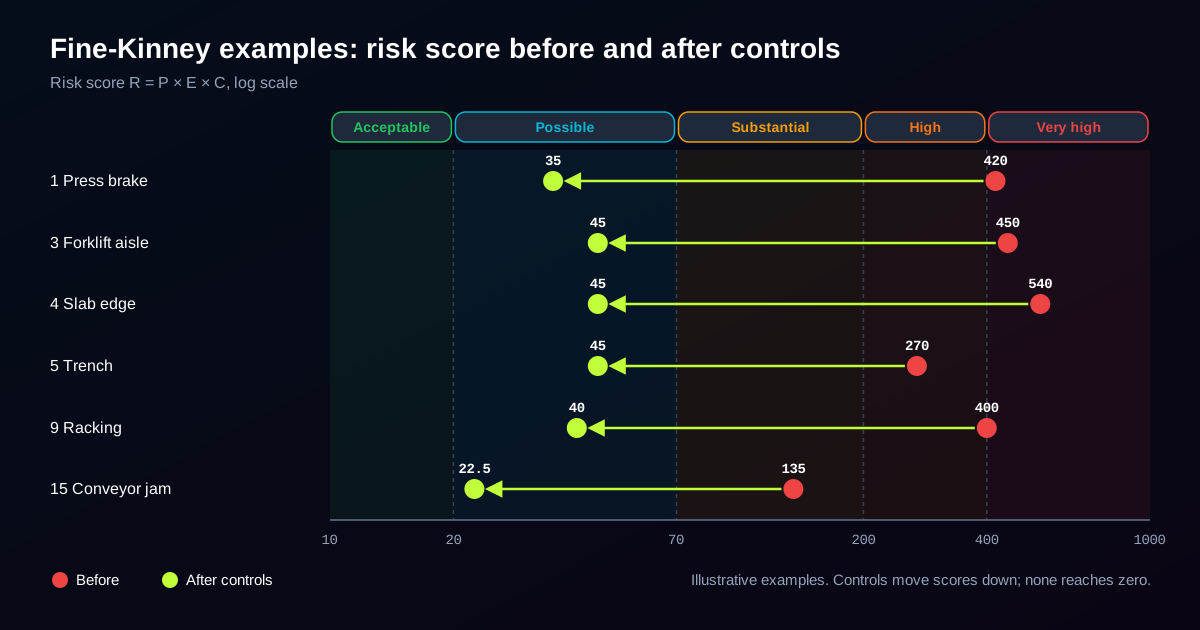
Use this table to decide which factor a control can honestly change:
| Control type | Usually changes | Rarely changes | Example above |
|---|---|---|---|
| Elimination | Removes the hazard; no score needed | — | — |
| Substitution | P, sometimes C | E | 12 (safety-engineered sharps) |
| Engineering: guarding, barriers, interlocks | P | C | 1, 4, 5, 15 |
| Engineering: segregation, relocation | E and P | C | 3 (walkway) |
| Administrative: procedures, permits, training | P (a little) | E, C | 6, 14 |
| PPE | P of the injury, sometimes C | E | 2, 7, 11 |
Three rules keep residual scores honest:
- Change a factor only if the control acts on it. A guardrail does not make falls less severe. It makes them less likely. So C stays at 15 and P drops.
- Do not let PPE carry a high score alone. The NIOSH hierarchy of controls explains that elimination, substitution and engineering controls are more effective because they control exposure without significant human interaction. If your residual score depends only on PPE, look again.
- Repeat until the score is acceptable. If the residual score is still above your acceptable level, add controls and score again. Rank the remaining risks worst-first. That is the approach OSHA's hazard prevention guidance describes.
In the diagram, six of the high-scoring examples move from "very high" or "high" into "possible." None of them reaches zero. That is normal: a residual risk of 20–70 means the control needs monitoring, not that the job is done.
Is the Control Worth It? Kinney's Justification Factor
The 1976 report also includes a second formula that most Fine-Kinney guides leave out. It helps you compare two proposed controls for the same risk:
Justification = (Risk score × Effectiveness) ÷ Cost divisor
- Effectiveness runs from 1 (risk completely eliminated) to 0 (no effect). A control that removes about 60% of the risk is 0.6.
- Cost divisor is the cube root of (cost ÷ 100), in the report's 1976 dollars. So a $100 control has a divisor of 1 and a $100,000 control has a divisor of 10.
- The report reads the result as follows: below about 10, doubtful merit; 10 to 20, justified; above about 20, highly worthwhile.
The report's own example is a propane tank that could be struck by a vehicle. Scored at 0.5 × 3 × 25 (consequence interpolated between the scale points for about $250,000 of damage), the risk is about 30. Relocating the tank would remove about 75% of the risk for about $30,000, giving a justification of 3.3. A sturdy guard rail would remove about 50% for about $400, giving 9.3. The cheaper barrier scores almost three times better.
The dollar figures are from 1976, so treat the divisor as a relative scale, not a price list. The idea still holds: a high-scoring risk can justify an expensive fix, and a cheap fix can beat an expensive one.
Fine-Kinney Risk Assessment Template
A usable Fine-Kinney register needs more than P, E, C and R. This is the column set we recommend, with example 3 filled in:
| Field | Example 3 |
|---|---|
| Area / activity | Packing to dock aisle |
| Hazard | Forklift traffic |
| Risk (what could happen, to whom) | Pedestrian struck by forklift |
| Existing controls | None marked |
| P / E / C / R / class | 3 / 10 / 15 / 450 / Very high |
| Additional control (hierarchy level) | Barrier-separated walkway, fixed crossings (engineering) |
| Responsible person, target date | Logistics manager, date agreed at review |
| Date implemented | Filled in after completion |
| Residual P / E / C / R / class | 0.5 / 6 / 15 / 45 / Possible |
| Next review | Per your review cycle, or earlier after any change or incident |
The "existing controls" column matters. Score the hazard as it is today, with the controls actually working today. Then the "additional control" and "residual" columns show what changed. For the step-by-step process around the register, see our risk assessment guide. For task-level hazards, a job safety analysis often feeds the register.
Common Mistakes in Fine-Kinney Scoring
1. Scoring the worst imaginable outcome
Every hazard can be imagined to kill someone. If every C is 15 or 40, the ranking stops meaning anything. Score the most credible serious outcome for that hazard in that setting, as in example 7 (C = 3 for grinder fragments).
2. Counting frequency twice
Probability is the chance of the event when exposure happens. Exposure is how often people are exposed. Writing a high P "because they do it every day" double counts the daily work already in E.
3. Scoring the planned control
A residual score entered on the day the control is ordered is fiction. Re-score after implementation, and record the date.
4. Lowering C for PPE by default
A harness does not change the severity of a fall that occurs without one. Most PPE lowers the probability of the injury. Change C only when the control truly limits the harm, and write down why.
5. Letting the team's mood set the score
Two assessors can differ by more than 20 times, as in the press brake scenario. Score together, agree on your own examples for each scale value, and keep them in the procedure.
6. Treating a "possible" residual as closed
A residual score of 20–70 still means "attention indicated." Keep those items on the inspection plan.
How FindRisk Supports Fine-Kinney Assessments
FindRisk has Fine-Kinney risk assessment built in. You pick the P, E and C values on your phone during the walk-through, and the score and class are calculated for you, so the arithmetic in the tables above is never done by hand.
You can mark hazards directly on site photos and use AI analysis to help spot hazards you might have missed, such as the bypassed light curtain in example 1. The AI checklist generator builds an inspection list for the area you are assessing, and the finished assessment becomes a professional report in seconds. FindRisk runs on iOS and Android.
Frequently Asked Questions
Can you use values that are not on the Fine-Kinney scale?
Yes. The original 1976 report says situations between reference points can be given intermediate values, and its own propane example uses a consequence of 25, interpolated between 15 and 40. If you do this, record the reason in the register so a reviewer can follow it. Most organizations stick to the scale points for consistency.
What is an acceptable Fine-Kinney risk score?
In the original report, a score below 20 is described as "perhaps acceptable," and 20–70 as "possible risk, attention indicated." The authors state the class thresholds are based on experience and can be adjusted. Your organization should define its acceptable level in writing and apply it consistently, rather than treat 20 as a universal line.
Does PPE reduce the consequence score in Fine-Kinney?
Usually not. PPE mostly reduces the probability that an exposure turns into an injury. A hard hat can lower the severity of some head strikes, so a reduction in C can be justified in narrow cases. Write the reasoning down. Because PPE sits at the bottom of the hierarchy of controls, a high risk should not rely on PPE alone.
Is Fine-Kinney better than a 5x5 risk matrix?
Neither is better in general. Fine-Kinney separates exposure from probability, so it ranks frequently performed tasks more sharply, and its wider number range spreads hazards out. A 5x5 matrix is quicker and easier to explain. Choose the method that fits your hazards, and document the method in the risk assessment.
Who should score a Fine-Kinney risk assessment?
A team, not one person. Include the safety professional, someone who does the work, and a supervisor or engineer who knows the equipment. Workers often know the real exposure and the shortcuts that change probability. Scoring together also reduces the assessor-to-assessor gap shown in the press brake scenario.
How often should a Fine-Kinney risk assessment be reviewed?
Review it when something changes: new equipment, a new process, a relocation, or after an incident or near miss. Local law may also set fixed intervals. In Turkey, for example, the risk assessment regulation requires renewal at least every two, four or six years depending on the workplace hazard class.
Conclusion
Fine-Kinney is easy to calculate and easy to get wrong. The 16 examples above show the part the formula leaves out: why a value was chosen, which factor a control really changes, and what the residual score looks like once the control is in place. Two patterns stand out. Everyday hazards with continuous exposure can outrank dramatic ones, and residual scores rarely fall to zero.
Use these examples to calibrate your team, then score your own site with your own evidence. Download FindRisk to run Fine-Kinney assessments on your phone, with automatic scoring, photo hazard marking and a finished report in seconds.
Try FindRisk
Ready to modernize your safety workflow?
Conduct AI-powered risk assessments, generate reports instantly, and keep your team safe — anywhere, anytime.