

Emergency Action Plan: OSHA Elements and a Filled Example
An emergency action plan (EAP) is a written set of procedures that tells everyone in a workplace how to report an emergency, how and where to evacuate, who shuts down critical equipment, how people are counted at the assembly point and who to contact. Under OSHA 29 CFR 1910.38, it has six minimum elements, an alarm system and trained people to run it.
Most workplaces have a plan. Far fewer have a plan that matches the building, the shifts and the people who are actually on site at 10 p.m. The usual template lists the six OSHA headings and leaves the rest blank, so the first real test of the plan is the first real emergency.
This guide fills in the blanks. You will find the US, UK and Turkish rules side by side, the six required elements with what to write under each, a filled plan for an 85-person fabrication plant on two shifts, the warden and team numbers calculated per shift, the alarm testing intervals, a drill checklist and an after-drill review that feeds back into the plan.
A Plan That Works on Paper
Picture a metal fabrication plant with a welding bay, a small solvent store and a rack of gas cylinders. This is a fictional example built for this guide. The plan in the office binder was written when the plant opened. It names a fire warden who left two years ago, sends everyone to an assembly point that is now a truck loading area, and says nothing about the evening shift.
The fire alarm sounds during a drill. The day shift leaves fine, because they know the building. Nobody checks the washrooms. The visitor log is at the reception desk, which is inside the building, so nobody knows whether the two contractors working on the roof are out. It takes several minutes to confirm that everyone is accounted for.
None of that is unusual. Each gap is something the OSHA standard and the Turkish regulation already require you to cover: a named contact, exit route assignments, accounting for everyone after evacuation, including non-employees. The plan existed. It just had not been kept in step with the workplace.
What Is an Emergency Action Plan?
An emergency action plan is the document and the set of arrangements that organize what people do in the first minutes of an emergency, before and while professional responders arrive. It covers reporting, alarm, evacuation or shelter, shutdown, headcount, rescue and first aid, and contacts. It is built on the emergencies identified in your risk assessment.
| Term | Where it is used | What it means |
|---|---|---|
| Emergency action plan (EAP) | OSHA 29 CFR 1910.38 (US) | Written plan with six minimum elements, required when another OSHA standard calls for it |
| Emergency procedures | UK Management of Health and Safety at Work Regulations 1999, reg. 8 | Procedures for serious and imminent danger, with competent persons nominated for evacuation |
| Acil durum planı | İşyerlerinde Acil Durumlar Hakkında Yönetmelik (Türkiye) | Plan covering identified emergencies, measures, teams, response and evacuation, drills and renewal |
| Fire prevention plan | OSHA 29 CFR 1910.39 (US) | A separate plan about preventing fires: hazards, ignition sources, equipment, responsibilities |
The OSHA appendix to Subpart E says the plan should address the emergencies the employer may reasonably expect in the workplace, and gives fire, toxic chemical releases, hurricanes, tornadoes, blizzards and floods as examples. In other words, an EAP is site-specific by design. A generic plan downloaded from the internet is a starting point, never the finished document.
When Is an Emergency Action Plan Required?
In the US, OSHA 1910.38(a) says an employer must have an emergency action plan whenever an OSHA standard in Part 1910 requires one. The plan OSHA's eTool helps you build covers federal requirements only, so employers in state-plan states should also check their state's rules. In the UK and Türkiye, the duty is general: every employer needs emergency procedures.
| US | UK | Türkiye | |
|---|---|---|---|
| Main rule | 29 CFR 1910.38, when another Part 1910 standard requires it | MHSW Regulations 1999, reg. 8 | 6331 Law art. 11 and the İşyerlerinde Acil Durumlar Hakkında Yönetmelik |
| Who | Employers covered by a standard that calls for an EAP | All employers | All workplaces, from the design or set-up stage |
| Written? | Yes; 10 or fewer employees may communicate it orally | Procedures must be established; reg. 8 does not set a format | Yes, with numbered, initialed and signed pages |
| People | Designate and train employees to assist evacuation | Nominate a sufficient number of competent persons | Firefighting, rescue, protection and first-aid teams, numbers set by hazard class |
| Drills | Not set by 1910.38 | Not set by reg. 8 | At least once a year |
| Review | When developed, when duties change, when the plan changes | Keep procedures appropriate | After relevant changes, and at least every 2, 4 or 6 years by hazard class |
The UK rule, regulation 8, adds two points worth copying anywhere. People must be able to stop work and go immediately to a place of safety when faced with serious, imminent and unavoidable danger. And they must be prevented from going back to work while that danger remains.
The Turkish regulation is the most detailed of the three. It requires the plan to be prepared from the design or set-up stage of the workplace, sets team sizes by hazard class, fixes a drill and renewal cycle, and requires the plan's pages to be numbered, initialed by the people who prepared it and signed on the last page. The Turkish version of this guide follows the regulation article by article.
The Six Minimum Elements Under OSHA 1910.38
OSHA 1910.38(c) lists six things every EAP must contain at a minimum. Below each one is what a usable plan actually writes down.
| 1910.38(c) | Required element | What to write in your plan |
|---|---|---|
| (1) | Procedures for reporting a fire or other emergency | How to raise the alarm (call points, phone number, radio channel), who calls the fire service, what to say |
| (2) | Procedures for emergency evacuation, including type of evacuation and exit route assignments | Full or partial evacuation, shelter-in-place for weather or toxic release, which exit each area uses, the primary and secondary assembly points |
| (3) | Procedures for employees who remain to operate critical plant operations before they evacuate | Named roles, the exact shutdown steps, the point at which they stop and leave |
| (4) | Procedures to account for all employees after evacuation | Who takes the headcount, from which list, how missing persons are reported |
| (5) | Procedures for employees performing rescue or medical duties | Who does first aid (how many first aiders), who meets the ambulance, what rescue is and is not allowed |
| (6) | Name or job title of every employee who may be contacted for more information | A contact table with role, name, phone and backup |
Two further paragraphs of the same standard complete the picture. Paragraph (d) requires an employee alarm system with a distinctive signal for each purpose, complying with 1910.165. Paragraph (e) requires the employer to designate and train employees to assist in a safe and orderly evacuation.
The alarm system (1910.165)
The employee alarm standard sets the rules your alarm must meet:
- It must be perceived above ambient noise or light levels by all employees in the affected areas. Tactile devices may be used for employees who cannot recognize audible or visual alarms.
- It must be distinctive and recognizable as a signal to evacuate or to carry out actions in the plan.
- Employees must be told how to report emergencies, and emergency numbers must be posted near the phones used for reporting.
- In a workplace with 10 or fewer employees, direct voice communication is acceptable if everyone can hear it.
- Non-supervised systems must be tested every two months, using a different actuation device each time where there are several. Supervised systems must be tested at least once a year.
- Manual call points must be unobstructed, conspicuous and readily accessible, and a backup means of alarm such as runners or telephones must be available when the system is out of service.
How to Write an Emergency Action Plan in 7 Steps
A good plan follows the same cycle in every country: find the emergencies, reduce them, assign people, write the procedures, publish them, test them and update them. The Turkish regulation (art. 7) lists almost exactly these stages, and they fit the OSHA elements without any conflict.
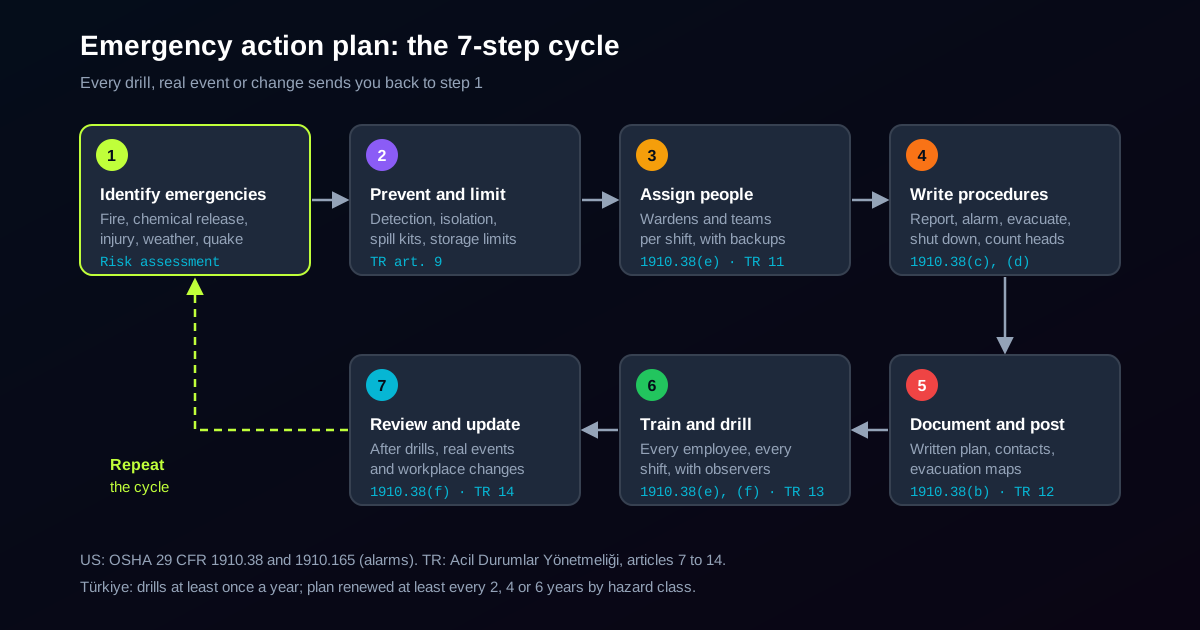
- Identify the emergencies. Start from the risk assessment: fire, explosion, chemical release, serious injury, severe weather, earthquake, utility failure. For fire, the fire risk assessment gives you the escape routes and travel distances. For sites with flammable atmospheres, the explosion protection document gives you the hazardous zones.
- Prevent and limit. List the measures that make each emergency less likely or less severe: detection, isolation valves, spill kits, storage limits. The plan should not repeat the risk assessment; it should reference it.
- Assign people. Name wardens or team members per area and per shift, with backups. Write job titles in the plan and keep names in a contact table that is easy to update.
- Write the response and evacuation procedures. One page per emergency type works well: alarm, first actions, evacuation or shelter, shutdown, headcount, handover to responders.
- Document and post. Draw an evacuation map for each floor or area. OSHA's eTool says maps should show exits, assembly points and equipment such as extinguishers and first aid kits, and should be posted prominently.
- Train and drill. Review the plan with each employee, train wardens, and run drills on every shift.
- Review and update. After every drill, real event, layout change or staff change, and on a fixed cycle.
Worked Example: A Filled Plan for an 85-Person Fabrication Plant
This is a fictional plant built for this guide. It has 85 employees: 60 on the day shift and 25 on the evening shift. There is a welding and cutting bay, a paint booth, a solvent store with about 20 drums, a cylinder cage for oxygen and acetylene, and a two-story office block. Up to 10 visitors and contractors may be on site during the day.
Emergencies covered
| Emergency | Source in the risk assessment | Response type |
|---|---|---|
| Fire in the welding bay or paint booth | Hot work, flammable coatings | Full evacuation |
| Cylinder leak or fire | Acetylene and oxygen cage | Full evacuation, isolate at cage if safe |
| Solvent spill | Drum handling in the solvent store | Local evacuation of the store and paint area, spill team only if trained |
| Serious injury | Machinery, falls, burns | No evacuation; first aid and ambulance |
| Earthquake or severe weather | Site location | Shelter, then evacuate when safe |
The plan, element by element
| Element | What the plant's plan says |
|---|---|
| Reporting (c)(1) | Break the nearest call point and call the gatehouse on extension 200, or the emergency number. The gatehouse calls the fire service and confirms the address and the access gate. |
| Alarm (d) | Continuous bell = full evacuation. Intermittent tone = solvent store and paint area only. Flashing beacons in the welding bay and compressor room because of noise. |
| Evacuation (c)(2) | Production uses the east doors, offices use the main stair. Primary assembly point: the staff car park, north side, upwind in the prevailing wind. Secondary: the field across the access road. The old point by the loading dock is removed. |
| Critical operations (c)(3) | The maintenance technician on shift closes the main gas valve and isolates the paint booth fans if this can be done on the way out. Time limit: leave immediately if smoke reaches the corridor. Nobody else stays. |
| Accounting (c)(4) | Shift supervisor takes the headcount from the electronic attendance list on a tablet. Gatehouse brings the visitor and contractor sign-in sheet. Missing persons: name and last known location go to the incident controller, who briefs the fire service. Nobody goes back in. |
| Rescue and medical (c)(5) | Trained first aiders treat casualties at the assembly point. No rescue inside the building by staff. One person meets the ambulance at the gate. |
| Contacts (c)(6) | Table on page 2: incident controller (plant manager, backup production manager), wardens per area and shift, maintenance on shift, first aiders, with phone numbers. |
| Special needs | One employee who uses a hearing aid has a vibrating pager linked to the alarm and a buddy on both shifts. |
The plan also lists the shutoff points for gas and electricity, the location of extinguishers and first aid kits, and the numbers for the fire service, ambulance, gas supplier and a neighboring plant that shares the access road.
How Many Wardens and Team Members Do You Need?
OSHA does not set a mandatory warden ratio. Its nonmandatory appendix and eTool say that one warden for every 20 employees should be adequate, and that wardens should be available during all working hours. The Turkish regulation sets a mandatory number per team by hazard class. Either way, the count has to be done per shift, because a warden who works days does not protect the evening shift.
| Day shift (60) | Evening shift (25) | |
|---|---|---|
| OSHA guideline, 1 warden per 20 employees | 3 wardens | 2 wardens |
| Türkiye, "hazardous" class, 1 per team per up to 40 employees | 2 per firefighting, rescue and protection team | 1 per team |
| Türkiye, "very hazardous" class, 1 per team per up to 30 employees | 2 per team | 1 per team |
The arithmetic for the Turkish rows: in a hazardous-class workplace, 1 to 40 employees need one person per team and 41 to 80 need two. Sixty people on the day shift fall in the second band. The regulation also requires backups and a posted list of support staff with name, title, area and contact details. The first-aid team is staffed under Türkiye's separate first-aid regulation, so check that regulation for its own numbers.
For this plant, the day shift has three wardens (production east, production west, offices), each with a named backup. The evening shift has two, plus the maintenance technician for shutdown. Cover holidays and sick days through the backup list, not by hoping.
Training, Drills and the After-Drill Review
OSHA 1910.38(f) requires you to review the plan with each employee when the plan is developed or the employee is first assigned, when their responsibilities under the plan change, and when the plan changes. 1910.38 does not set a drill frequency. Türkiye sets one: at least once a year. Running at least one drill per shift per year is a sensible minimum anywhere, and a short toolbox talk before the drill season is a cheap way to refresh the plan.
Drill checklist
Before the drill
- Drill scenario chosen (for example, fire in the paint booth, east exit blocked).
- Observers assigned to the exits, the assembly point and the shutdown points.
- Current attendance list and visitor log available outside the building.
- Alarm tested and the fire service or alarm company informed if needed.
During the drill
- Alarm heard and seen in all areas, including noisy areas, washrooms and the roof.
- People stopped work and left without collecting belongings.
- Wardens checked their areas, including enclosed rooms.
- Shutdown done within the time limit, or abandoned when the limit was reached.
- Secondary route used where the primary was "blocked."
- Headcount completed, including visitors and contractors.
After the drill
- Time from alarm to last person out and to completed headcount recorded.
- Problems listed with the person responsible and a due date.
- Plan, maps and contact list updated.
After-drill review: what our plant found
In the fictional drill, three things went wrong:
| Finding | Why it matters | Corrective action | Owner |
|---|---|---|---|
| The alarm was not heard in the compressor room | Someone working there would not know to leave | Add a beacon and a sounder; re-test | Maintenance manager |
| Two contractors were not on any list | Unaccounted people send rescuers into a burning building | Contractor sign-in moved to the gatehouse; gatehouse brings the list | Gatehouse supervisor |
| The evening warden did not know the secondary route | A blocked route becomes a trap | Walk the route with every warden; add the route to the evening briefing | Shift supervisor |
Treat these findings like any other corrective action: a clear owner, a deadline and a check that the fix worked in the next drill.
When to Review and Update the Plan
Review the plan whenever something it depends on changes, and on a fixed calendar cycle as a backstop. Typical triggers:
- A new building, extension, layout change or blocked exit.
- New processes or chemicals, for example a new solvent covered in your chemical safety program.
- A change of shift pattern, headcount or key people, especially wardens.
- Any drill or real event that showed a gap.
- New neighbors or changes at a shared site.
OSHA requires the plan to be reviewed with affected employees when it changes. In Türkiye, the plan must be renewed, fully or partly, after changes that could affect emergencies, and in any case at least every two years in very hazardous, four years in hazardous and six years in less hazardous workplaces.
Common Mistakes
1. Writing for the day shift only
Night, evening and weekend crews are smaller and have fewer supervisors. If wardens and first aiders are counted only on the day shift, the plan is empty when the risk is highest.
2. An assembly point nobody checked
Assembly points end up in loading areas, next to the gas tank or downwind. OSHA's eTool suggests choosing assembly areas large enough for everyone and upwind of the building.
3. No list of visitors and contractors
The headcount is only as good as the list. If the visitor log is inside the building, it cannot be used at the assembly point.
4. Shutdown duties without a time limit
A person told to "shut down the line" without a clear point to stop may stay too long. The OSHA eTool says the preferred approach for most small businesses is immediate evacuation when the alarm sounds, and anyone who stays must know when to leave.
5. Alarms nobody can hear
Noisy areas, washrooms, roofs and people with hearing loss are the usual gaps. The alarm must be perceived by all affected employees; add beacons or tactile devices where needed.
6. A plan that never comes back from the drill
A drill that ends with "went well" and no changes rarely means the plan is perfect. It usually means nobody was watching closely.
How FindRisk Supports Emergency Planning
A plan is only as current as the last time someone walked the site. FindRisk lets you generate an inspection checklist with AI for emergency arrangements, such as exits, call points, extinguishers, assembly points and evacuation maps, and work through it on a phone during your walk-around or drill.
When you find a blocked exit or a missing sign, mark the hazard directly on a photo and let the AI analyze it. Score the risk with the Fine-Kinney method so the corrective actions from the drill are ranked by risk, not by who shouted loudest.
At the end, FindRisk produces a professional report in seconds, ready to attach to the drill record or the plan review. It is available on iOS and Android.
Frequently Asked Questions
Is an emergency action plan required by OSHA?
Yes, when another OSHA standard in 29 CFR Part 1910 requires one. 1910.38(a) says an employer must have an EAP whenever a Part 1910 standard calls for it, and 1910.38 then sets the minimum content. If you are unsure whether a standard applies to you, writing a plan that meets 1910.38 costs little, and state-plan states may add their own rules.
Do employers with 10 or fewer employees need a written emergency action plan?
No. Under 1910.38(b), an employer with 10 or fewer employees may communicate the plan orally. The content must still cover all six elements, and the alarm rule allows direct voice communication in such workplaces if everyone can hear it. In Türkiye, the plan must be written regardless of size, although one trained person may cover all three teams in workplaces with fewer than 10 employees.
What is the difference between an emergency action plan and a fire prevention plan?
An emergency action plan tells people what to do when an emergency happens: report, alarm, evacuate, shut down, count heads and contact. A fire prevention plan under OSHA 1910.39 is about stopping fires from starting: the major fire hazards, ignition sources and their control, fire protection equipment, control of flammable waste and who is responsible. Many sites keep both in one document.
How often should you run an evacuation drill?
OSHA 1910.38 does not set a drill frequency, but it does require the plan to be reviewed with employees and wardens to be trained. Türkiye requires a drill at least once a year. A practical minimum is one drill per shift per year, plus a drill after any major change to the building, the process or the plan.
Who is responsible for the emergency action plan?
The employer. Wardens, team members and the safety professional who drafts the plan carry out duties under it, but the Turkish regulation states explicitly that assigning people does not remove the employer's responsibility, and the OSHA duty to have, train and review the plan sits with the employer. Name the plan owner by job title in the document.
How many fire wardens do I need?
OSHA's nonmandatory guidance suggests one warden for every 20 employees, available during all working hours. Count per shift, not per site, and name a backup for each warden. In Türkiye, the number is mandatory: at least one support staff member per team for every 30, 40 or 50 employees, depending on the hazard class.
Conclusion
An emergency action plan is short to write and easy to let go stale. The six OSHA elements, the alarm rules and the Turkish team and drill requirements give you the structure. What makes the plan work is the detail: which exit each area uses, who counts heads from which list, who shuts down what and when they stop, and a warden on every shift.
Use the filled plan above as a model, count your wardens per shift, run a drill with observers, and turn what you find into dated actions. Then update the plan, the maps and the contact list before the next drill.
Download FindRisk to build your emergency arrangements checklist, record drill findings with photos and send the report the same day.
Try FindRisk
Ready to modernize your safety workflow?
Conduct AI-powered risk assessments, generate reports instantly, and keep your team safe — anywhere, anytime.