
First Aid Needs Assessment: Factors, Numbers and an Example
A first aid needs assessment is the review an employer does to decide what first aid provision a workplace needs: how many trained first aiders or appointed persons, on which shifts, how many kits and where, whether an eyewash station or a first aid room is required, and how help is called. It is based on the hazards, the workforce, the work pattern and the distance to emergency care.
Most workplaces have a green box on a wall. Far fewer can say why there is one box and not three, who is trained on the night shift, or how long an ambulance takes to reach the loading bay. The needs assessment is the step that turns "we have a kit" into first aid that actually reaches a casualty in time.
This guide covers what the law asks for in the UK, the US, the EU and Türkiye, a five-step method, how to count first aiders across shifts and absences, and a filled needs assessment for a 70-person fabrication workshop.
A Kit on the Wall and Nobody Trained
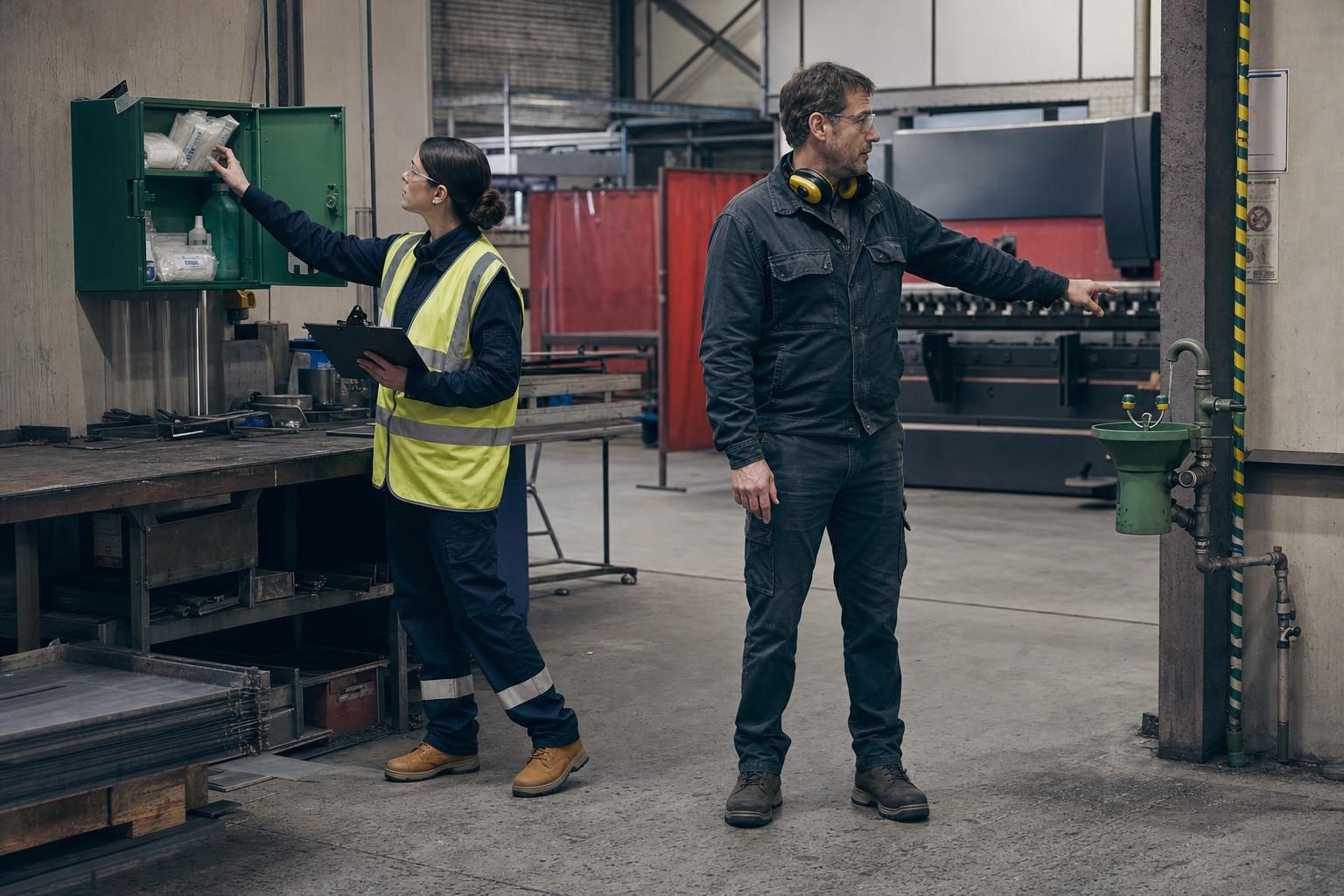
Picture a metal fabrication workshop, made up for this guide. There is a first aid kit in the office. The two trained first aiders both work days. One is on leave this week. The evening shift has 22 people, a press brake, an angle grinder bench and a degreasing tank, and nobody on it has done a first aid course.
At 20:40 a fitter cuts his forearm badly on a sheet edge. His colleagues know where the kit is but not how to control serious bleeding. The supervisor calls an ambulance and then spends minutes finding the gate code. Nobody wrote down that the nearest emergency department is 20 minutes away, or that the evening shift had no cover.
Nothing in this workshop was illegal on paper: there was a kit and there were trained people. The gap was that nobody had asked who would be there, when, and how quickly help would arrive. That is the question a first aid needs assessment answers.
What Is a First Aid Needs Assessment?
A first aid needs assessment is a structured look at the injuries and illnesses that could happen at work, who would be there to respond, and how far away professional help is. Its output is a short list of decisions: people, training level, equipment, facilities and information.
It is separate from, but fed by, your general risk assessment. The risk assessment tells you what can go wrong; the first aid needs assessment plans the response when it does.
| Term | Meaning |
|---|---|
| First aider | A person trained and qualified to give first aid at work (UK: e.g. a one-day EFAW or three-day FAW course; Türkiye: a 16-hour course and an ilkyardımcı belgesi) |
| Appointed person | UK term: someone who takes charge of first aid arrangements and calls the emergency services, without formal first aid training |
| First aid provision | The people, kits, facilities (eyewash, first aid room) and information you put in place |
| Near proximity | US OSHA term for how close a clinic, hospital or trained responder must be before you can rely on them instead of on-site first aiders |
The HSE says employers do not need to record the findings, but doing so shows how you reached your decisions. In practice, a one- or two-page written assessment is what an inspector, auditor or insurer will ask to see.
What the Law Requires: UK, US, EU and Türkiye
The duty is the same everywhere: injured or ill workers must get first aid quickly. How the law sets the amount of provision differs a lot.
| UK | US (OSHA) | EU | Türkiye | |
|---|---|---|---|---|
| Main rule | Health and Safety (First-Aid) Regulations 1981, reg. 3 | 29 CFR 1910.151 | Directive 89/391/EEC Art. 8; 89/654/EEC Annex I item 19 | Law 6331 Art. 11; İlkyardım Yönetmeliği Art. 19 |
| How numbers are set | By your needs assessment: "adequate and appropriate in the circumstances" | By distance: trained first aiders needed unless a clinic, hospital or responder is in "near proximity" | Number, training and equipment "adequate" for the size and specific hazards | Fixed ratios by hazard class |
| Minimum | A stocked kit, an appointed person, information to employees | Adequately trained person(s) and readily available supplies where care is not near | Designated workers; first aid equipment where working conditions require it | 1 first aider per 20, 15 or 10 employees |
| Special equipment | Decided by the assessment | Quick drenching or eye flushing where corrosives are used (1910.151(c)) | First aid rooms where size, activity and accident frequency require | First aid and emergency room by size, work and accident risk; equipment wherever conditions require |
UK
Regulation 3 requires equipment, facilities and "such number of suitable persons as is adequate and appropriate in the circumstances". Paragraph 4 allows an appointed person instead of a first aider where the nature of the work, the number of employees and the location make that adequate, and paragraph 5 requires any first aid room to be easy to reach with a stretcher and signposted.
HSE's FAQ is direct about numbers: "There are no hard and fast rules on exact numbers." The L74 guidance was amended in 2024 to stress that employers take account of employees' mental health in their needs assessment. HSE no longer approves first aid training providers, so the employer has to check the provider is competent.
US
29 CFR 1910.151(b) says that "in the absence of an infirmary, clinic, or hospital in near proximity to the workplace", a person or persons must be adequately trained to render first aid, and adequate supplies must be readily available. In a 2007 letter of interpretation, OSHA says it has long read "near proximity" as emergency care available within no more than 3–4 minutes from the workplace. Where serious injuries are possible, you cannot rely on an outside responder who may not arrive in that time. For offices, where serious injury is more remote, up to 15 minutes may be reasonable.
Paragraph (c) adds a hard requirement: where eyes or body may be exposed to injurious corrosive materials, facilities for quick drenching or flushing must be in the work area. Appendix A (non-mandatory) points to ANSI Z308.1-1998 for kit contents and tells employers to add kits for larger or multiple operations.
EU
Directive 89/391/EEC, Article 8 requires first aid measures adapted to the nature of the activities and the size of the undertaking, taking account of other persons present, with designated workers whose number, training and equipment are adequate. The workplace directive 89/654/EEC requires first aid rooms where the size of the premises, the type of activity and the frequency of accidents so dictate.
Türkiye
Law 6331, Article 11, requires the employer to assign enough trained, equipped people for first aid and to arrange contacts with outside first aid and emergency medical services. The İlkyardım Yönetmeliği (Official Gazette 29.07.2015, No. 29429), Article 19, sets the ratios: one first aider for every 20 employees in less hazardous workplaces, for up to every 15 in hazardous ones and for up to every 10 in very hazardous ones. The first aider certificate is valid for three years. Since an amendment of 27.12.2025 (Official Gazette No. 33120), the refresher must be taken in the three months before it expires, not after.
How to Do a First Aid Needs Assessment in 5 Steps
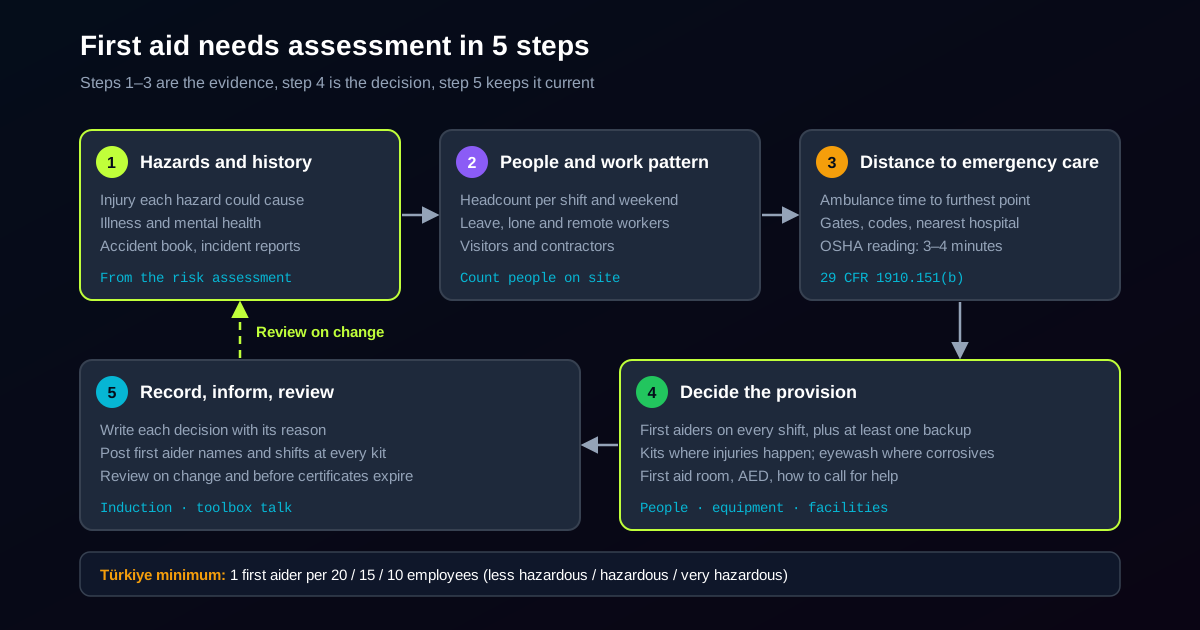
- List the hazards and your injury history. Take the significant hazards from the risk assessment and ask what injury each one would cause: severe bleeding from machinery, burns from hot work, chemical splashes to the eye, falls, crush injuries, electric shock. Add illness: cardiac arrest, asthma, diabetic episodes, and mental health crises. Read the last few years of the accident book and incident reports for what actually happens.
- Map the people and the work pattern. Count people per shift, not per payroll. Note weekend and overtime work, contractors, visitors and members of the public, workers who travel, and anyone who works alone. HSE lists holidays and other absences of first aiders as a factor in its own right.
- Measure the distance to emergency care. How long does an ambulance take to reach the furthest point of the site, including gates, codes and finding the building? Where is the nearest emergency department? This is the core of the US test and a factor in the UK and EU ones.
- Decide the provision. Number and level of first aiders per shift (and backups), kits and their locations, travel kits, eyewash or drench showers, a defibrillator if you decide on one, a first aid room, and how people raise the alarm.
- Record, inform and review. Write the decisions down with the reasons, post the names and locations of first aiders, brief new starters, and set triggers for review.
Treat steps 1 to 3 as evidence and step 4 as decisions. If someone later asks why there are four first aiders and not two, the answer should be in the first three steps.
How Many First Aiders Do You Need?
The answer depends on which rules apply to you, but the method is the same: count per shift, then add cover for absence.
UK. There is no fixed number in the regulations or in HSE's own guidance. Low-risk workplaces may manage with an appointed person; workplaces with higher hazards, more people, shift work or remote locations need trained first aiders, and more of them. The decision has to be "adequate and appropriate" for your circumstances, which is why the reasoning in your assessment matters.
US. If a clinic, hospital or trained responder cannot reliably start care within 3–4 minutes and serious injuries are possible, you need trained people on site. In practice that means at least one trained person on every shift and in every area that is far from the others.
Türkiye. The ratio is fixed by hazard class:
| Hazard class | Ratio (İlkyardım Yönetmeliği Art. 19) | 12 employees | 30 employees | 48 employees |
|---|---|---|---|---|
| Less hazardous (az tehlikeli) | 1 for every 20 employees | 1 | 2 | 3 |
| Hazardous (tehlikeli) | 1 for up to every 15 employees | 1 | 2 | 4 |
| Very hazardous (çok tehlikeli) | 1 for up to every 10 employees | 2 | 3 | 5 |
The regulation does not say how to treat shifts. The safe reading is to apply the ratio to the people on site at the same time, so each shift has its own first aiders. The Emergency Situations Regulation (Art. 11(8)) already requires the shift pattern to be taken into account when appointing its emergency team members and their backups, and the first aid team is staffed under the first aid regulation.
Absence cover. Whatever the rule, first aiders go on holiday, call in sick and change jobs. Add at least one trained backup per shift, or train more people than the minimum. A rota that only works when everyone is at work is not a plan.
Worked Example: A 70-Person Fabrication Workshop
This is a made-up site, used to show the method. For the Turkish calculation, assume its NACE code puts it in the hazardous (tehlikeli) class; check your own code.
The site: 70 employees. Day shift 48 (including 6 office staff and 2 installers who work at customer sites), evening shift 22. Laser cutting, a press brake, welding bays, grinding, forklift loading, a small degreasing area using a corrosive alkaline cleaner, and a mezzanine store. Up to 8 visitors and contractors on site by day. The nearest emergency department is about 20 minutes by road, and the gate is locked in the evening.
Filled needs assessment
| Factor | Finding | Decision |
|---|---|---|
| Hazards | Deep cuts from sheet edges and blades, crush and amputation at the press brake, burns and arc eye from welding, grinding sparks in eyes, falls from the mezzanine, forklift strikes | First aiders trained in severe bleeding control, burns, eye injuries and fractures; at least one with full (not only emergency) level training per shift |
| Chemicals | Corrosive alkaline cleaner in the degreasing area | Plumbed eyewash and drench hose in the degreasing area; eyewash bottles at grinding benches (see chemical safety) |
| Injury history | 3 years of records: mostly cuts and eye foreign bodies, one hand crush, two fainting episodes | Confirms the training focus; add an eye-irrigation kit to each production kit |
| People per shift | Day 48, evening 22, weekend overtime 6–10 | First aiders counted per shift, including weekend overtime |
| Absences | 4 to 5 weeks of leave per person per year; shift swaps | One extra trained person per shift; the shift supervisor checks cover at start of shift |
| Remote work | 2 installers at customer sites | Personal travel kits; both installers trained; they use the customer's arrangements where those exist |
| Lone work | Maintenance technician alone on Saturdays | Check-in arrangement (see lone working); technician trained |
| Others on site | Up to 8 visitors and contractors by day | Included in the day count; visitors briefed at reception on how to call for help |
| Emergency care | ED about 20 min by road; gate locked in the evening | Not "near proximity" by the US test; gate code and site map given to the ambulance service; the evening supervisor meets the ambulance |
| Facilities | No room for treatment; injured staff sit in the canteen | A small first aid room in the office block with a couch, sink and stretcher access, signposted |
| Kits | One kit in the office | One kit per production area (cutting, welding, press brake, dispatch), one in the office, one in the forklift bay; numbered and on the monthly kit check |
| Information | No notice of who the first aiders are | Notice with names, shift and photo at every kit and in the canteen; covered in induction and a toolbox talk |
How many first aiders
- Türkiye (hazardous class, 1 for up to every 15): on the 70-person headcount, 70 ÷ 15 = 4.7, so 5. Counted per shift: day 48 → 4, evening 22 → 2, so 6 people on shift. With one backup per shift, the workshop trains 8.
- UK: no fixed number, but machinery injuries, a 20-minute ambulance journey and two shifts all point the same way. The same 4 + 2 on shift, with backups, is a defensible "adequate and appropriate" answer that you can explain from the table above.
- US: emergency care is clearly not within 3–4 minutes and serious injuries are possible, so trained people are needed on every shift. 1910.151(c) makes the eyewash and drench facility in the degreasing area mandatory.
The arithmetic is easy. What makes the assessment useful is that each decision has a reason next to it.
First Aid Kits, Eyewash and First Aid Rooms
Kits. HSE says you should provide at least one kit for each workplace. Its suggested minimum stock for low-hazard work is a guidance leaflet, individually wrapped sterile plasters, sterile eye pads, triangular bandages, safety pins, large and medium sterile unmedicated wound dressings and disposable gloves. HSE stresses that this is only a suggested list; kits to BS 8599-1 are an option, not a legal requirement. OSHA's Appendix A points to ANSI Z308.1 and says larger or multiple operations should assess the need for more kits. Add what your hazards call for, such as burns dressings, eyewash or large trauma dressings.
Location. Kits should be close to where injuries happen, marked with the first aid safety sign, and never locked away. The Turkish workplace buildings regulation (Annex 1, item 60) requires first aid equipment to be easy to reach wherever working conditions require it, signed, with emergency service addresses and phone numbers on display.
Travel kits. HSE advises that people who travel long distances or are continuously mobile carry a personal first aid kit.
Eyewash and drench. Where corrosives can reach the eyes or body, OSHA requires quick drenching or flushing facilities in the work area. Elsewhere, the needs assessment decides; a bottle on a wall is not a substitute for a plumbed station when a corrosive is in use.
First aid rooms. HSE says a room is usually needed in larger premises or where hazards are higher, with a couch, washable surfaces, heating, ventilation and lighting, ideally a sink, and easy access for an ambulance. EU and Turkish rules link the need for a room to the size of the site, the type of work and the accident risk.
When to Review the Assessment
There is no fixed review period in the UK or US rules. Review the assessment when something that fed into it changes:
- a new process, machine or chemical, or a new hazard in the risk assessment
- a change in headcount, shift pattern or opening hours
- a first aider leaves, moves shift or their certificate is about to expire
- a move to new premises or a new remote site
- an incident where first aid was slow, missing or wrong
- a change in local ambulance response or the nearest emergency department
In Türkiye, track certificate dates closely: since the 2025 amendment, the refresher must be completed in the three months before the three-year validity ends. Build that into the review so no shift drops below its ratio.
Common Mistakes
1. Counting payroll, not people on shift
Seventy employees and five first aiders sounds fine until all five work days. Count per shift, including weekends and overtime.
2. No cover for absence
A rota that assumes every first aider is at work every day fails in the first holiday season. Plan at least one backup per shift.
3. Copying a ratio without reading the hazards
A ratio is a minimum, not the answer. A very hazardous site with a 20-minute ambulance time may need more trained people, higher-level training and equipment the ratio does not mention.
4. Forgetting people who are not at the main site
Installers, drivers, lone maintenance staff and visitors are easy to leave out. HSE lists travelling, remote and lone workers and non-employees as factors to consider.
5. Kits that are locked, empty or out of date
A kit in a locked office or with expired dressings is no kit. Number each kit and check it monthly and after every use.
6. Nobody knows who the first aiders are
If names, shifts and locations are not posted and covered at induction, people waste minutes looking. Post them at every kit.
7. Ignoring illness and mental health
First aiders also respond to fainting, cardiac events, asthma attacks and distress, not only to injuries. HSE's 2024 update of L74 asks employers to take mental health into account in the needs assessment.
How FindRisk Supports First Aid Checks
A needs assessment only stays true if someone checks that the kits, signs, eyewash stations and first aider notices are still in place. FindRisk lets you generate an inspection checklist with AI for your first aid arrangements, and work through it on a phone during your walk-around.
When a kit is missing, an eyewash station is blocked or a notice is out of date, mark the hazard directly on a photo and let the AI analyze it. Score the finding with the Fine-Kinney method so the fixes are ranked by risk.
FindRisk then produces a professional report in seconds, ready to attach to the needs assessment review. It is available on iOS and Android.
Frequently Asked Questions
How many first aiders do I need per number of employees?
It depends on where you are. UK law sets no fixed number; your needs assessment decides what is "adequate and appropriate". OSHA requires trained first aiders where emergency care is not within about 3–4 minutes. In Türkiye the İlkyardım Yönetmeliği sets one first aider per 20 employees in less hazardous, up to 15 in hazardous and up to 10 in very hazardous workplaces. In every case, count per shift and add cover for absences.
Is a first aid needs assessment a legal requirement?
In the UK, regulation 3 requires provision that is "adequate and appropriate in the circumstances", and HSE expects you to assess your needs to decide what that is. In the US and EU, the rules also require provision matched to the hazards and the distance to care, which you cannot show without an assessment. In Türkiye the ratios are fixed, but Law 6331 still requires provision suited to the size and hazards of the workplace.
Does a first aid needs assessment have to be written down?
HSE says you do not have to record the findings, but recording them shows how you reached your decisions. A short written assessment, with the factors, findings and decisions in a table like the one above, is the easiest way to show an inspector or auditor that your provision is adequate and to keep it up to date.
Do I need a first aider on every shift?
If people work on a shift, they can be injured on that shift, so first aid provision has to cover it. HSE says an appointed person's cover must be available at all times when people are at work, and OSHA's near-proximity test applies whenever employees are working. In Türkiye, counting the ratio per shift and adding backups is the safe approach.
Can one person be both a first aider and a fire warden?
It is allowed, but it can leave a gap. During a fire evacuation, the warden is sweeping the building while someone may need first aid at the assembly point. If you combine the roles, make sure each shift still has enough people to do both jobs at the same time, and record that decision in the assessment.
How long is a first aid certificate valid?
In Türkiye, the first aider certificate (ilkyardımcı belgesi) is valid for three years, and since the 27.12.2025 amendment the refresher must be taken in the three months before it expires. In the UK, HSE strongly recommends annual refresher training to keep skills current; check the validity period on the certificate from your training provider.
Do I have to provide first aid for visitors and the public?
UK first aid regulations do not require it, but HSE strongly recommends including the public in your needs assessment. The EU framework directive asks employers to take account of other persons present. Places with many visitors, such as shops, schools or venues, should plan for them explicitly.
Conclusion
A first aid needs assessment answers three questions: what injuries and illnesses could happen here, who will be there to respond on every shift, and how long until professional help arrives. The UK leaves the numbers to your judgment, the US ties them to distance, and Türkiye sets fixed ratios, but all three expect provision that fits the workplace.
Use the five steps and the filled example above as a model: count people per shift, add backups, put kits and eyewash where the injuries happen, post the names, and review when people, processes or certificates change.
Download FindRisk to build your first aid inspection checklist, record missing kits and blocked eyewash stations with photos, and send the report the same day.
Try FindRisk
Ready to modernize your safety workflow?
Conduct AI-powered risk assessments, generate reports instantly, and keep your team safe — anywhere, anytime.