
Electrical Safety Inspection Checklist: 38 Workplace Checks
An electrical safety inspection checklist is a structured list of checks used to confirm that a workplace's electrical installation, panels, cords, portable equipment and electrical work practices will not expose anyone to shock, burns, fire or explosion. It covers access to panels, enclosures and live parts, cords and plugs, ground-fault protection, wet and hazardous locations, and how electrical work itself is controlled.
OSHA's electrical standards exist to protect workers from "electric shock, electrocution, fires, and explosions," and OSHA lists "contact with power lines" and "lack of ground-fault protection" among the frequent causes of electrical injuries (OSHA). Most of what goes wrong is visible long before it hurts someone: a cord with a cut jacket, a panel hidden behind pallets, a missing blank in a breaker panel, a breaker that someone keeps resetting.
Most electrical checklists online are a page of yes/no questions. This one adds what an inspector needs to act: measurable clearances, who inspects what and how often, which findings stop work, and three findings scored before and after the fix.
A Panel Nobody Could Reach
Picture a hypothetical distribution warehouse. The monthly inspection sheet has an electrical line that reads "electrical equipment in good condition," ticked every month.
An inspector who walks the site with a structured checklist finds a different picture in twenty minutes. The main distribution panel is behind two rows of stacked pallets. In the wash bay, a pressure washer runs from an extension cord with tape over a cut in the jacket, lying in standing water. In the battery charging area, a panel has one breaker blank missing, leaving a finger-sized opening next to live parts. A supervisor mentions that one charger breaker "trips every few days, so we just flip it back."
None of these was hidden. The old sheet asked one vague question, and a vague question gets a tick. The scenario is illustrative, but the lesson is general: electrical inspections fail when they ask whether equipment is "in good condition" instead of checking specific, observable conditions.
What Is an Electrical Safety Inspection?
An electrical safety inspection is a planned check of electrical installations, equipment and work practices to find conditions that could cause electric shock, arc burns, fire or explosion, and to get them fixed. It is not the same as electrical testing. A safety professional or supervisor can inspect what is visible; measuring insulation resistance, earth continuity or the trip time of a residual current device is work for a qualified or authorized person with the right instruments.
Under OSHA, electrical equipment must be "free from recognized hazards that are likely to cause death or serious physical harm," judged by factors such as suitability for use, mechanical strength, insulation, heating and arcing (29 CFR 1910.303(b)(1)). A workplace inspection is how you find out whether that is still true after months of use.
Which rules apply?
| Jurisdiction | Main requirements |
|---|---|
| US (OSHA), general industry | 29 CFR 1910 Subpart S: 1910.303 general requirements (working space, guarding of live parts), 1910.305 wiring methods and flexible cords, 1910.333 work practices and lockout, 1910.334 use of equipment |
| US (OSHA), construction | 29 CFR 1926.404(b)(1): GFCIs or an assured equipment grounding conductor program |
| UK | Electricity at Work Regulations 1989, regulation 4: systems constructed and maintained to prevent danger, so far as reasonably practicable |
| Türkiye | Occupational Health and Safety Law No. 6331; work equipment regulation (2013, amended in December 2025), which puts electrical, grounding and lightning protection installations under periodic control by authorized persons; earthing regulation (2001) |
| Work practice standard | NFPA 70E, Standard for Electrical Safety in the Workplace, widely used for arc flash and shock risk assessment and safe work practices |
The Electrical Safety Inspection Checklist
Use this list during a walk-through. You inspect with your eyes, not your hands: do not open energized panels, remove covers or touch conductors. Mark each item Yes, No or N/A. Any "No" on an item marked [STOP] means the equipment is taken out of use or the area is made safe before you move on.
Block 1: Panels, switchboards and disconnects
- Working space in front of every panel and disconnect is clear, with nothing stored in it (1910.303(g)(1)). [STOP] if the main isolation point cannot be reached.
- Panel doors and covers are closed and intact, and no live parts are exposed.
- Every unused opening (missing breaker blanks, knockouts) is closed (1910.303(b)(7)(i)). [STOP] if live parts can be reached through an opening.
- Each circuit breaker and disconnect is legibly labeled with what it feeds (1910.303(f)(2)).
- No signs of overheating: discoloration, burn marks, melted insulation, a burning smell, buzzing or crackling.
- Panel areas are dry, and the panel is not used as a shelf or a place to hang tools and clothing.
- Electrical rooms and panels that need restricted access are locked or marked, and the key holder is known.
Block 2: Fixed wiring, boxes and live parts
- Junction and pull boxes have their covers (1910.305(b)(2)(i)).
- Live parts at 50 volts or more are guarded against accidental contact by enclosures, location or barriers (1910.303(g)(2)(i)). [STOP]
- No damaged conduit, loose or hanging cables, or open splices in fixed wiring.
- Light switches, sockets and fittings are intact, with no cracked faceplates or scorched sockets.
- Equipment carries its ratings and is used within them (1910.303(e)(1)); no "temporary" wiring that has become permanent.
Block 3: Cords, plugs and extension leads
- Extension cords and equipment cords are inspected before use on each shift (1910.334(a)(2)).
- Cords have no cuts, crushed sections, exposed conductors or tape repairs. [STOP] for any cord with exposed conductors or damaged insulation.
- Cords are used in continuous lengths without splices or taps (1910.305(g)(2)(ii)).
- Plugs are intact and strain relief holds the cord jacket, so pulling the cord does not pull on the terminals (1910.305(g)(2)(iii)).
- Grounding pins are present, and no adapter breaks the grounding path (1910.334(a)(3)).
- Flexible cords are not used instead of fixed wiring, run through walls, ceilings or floors, or fastened to building surfaces (1910.305(g)(1)(iv)).
- Cords are not run through doorways, across vehicle routes without protection, or under carpets where damage cannot be seen.
- Extension leads are not plugged into other extension leads, and power strips are not overloaded with high-current equipment such as heaters.
Block 4: Ground-fault protection and wet locations
- Ground-fault protection (GFCI, or RCD in UK and Turkish practice) is fitted where your rules require it, and its test button is used at the interval set by your procedure and the manufacturer.
- On construction sites, 120-volt, 15- and 20-amp temporary outlets have GFCIs, or an assured equipment grounding conductor program is in place (1926.404(b)(1)). [STOP] if neither.
- Equipment and cords used in wet or conductive locations are approved for those locations (1910.334(a)(4)).
- No one plugs or unplugs equipment with wet hands (1910.334(a)(5)(i)).
Block 5: Portable equipment and tools
- Portable tools and appliances are in good condition: housing intact, switch works, no overheating, no missing guards.
- Damaged equipment is tagged and removed from service until repaired and tested (1910.334(a)(2)(ii)).
- Where your program uses inspection or test tags or color codes, every item carries a current one.
- Equipment is not carried, hung or lowered by its cord (1910.334(a)(1)).
Block 6: Fire, explosion and environment
- Combustible materials are not stored against panels, transformers, chargers or heaters (see the fire risk assessment guide).
- Electrical equipment in areas with flammable gases, vapors or dusts is suitable for the location (1910.334(d)).
- Battery charging areas are ventilated, and chargers are on a stable, non-combustible surface.
- Overhead power lines near work areas are identified, and work with ladders, scaffolds, cranes or long tools keeps the required distance (1910.333(c)(3)). [STOP] if anyone is working inside it.
Block 7: Work practices, people and records
- Electrical work on live parts is done only after de-energizing under lockout/tagout, with absence of voltage verified by a qualified person using test equipment (1910.333(a)(1), (b)(2)). [STOP] if live work is being done without justification and controls.
- Only qualified persons work on or near energized parts (1910.333(c)(2)), and their test instruments are inspected before use (1910.334(c)).
- Workers near exposed energized parts do not wear metal jewelry or conductive clothing (1910.333(c)(8)).
- No one resets a tripped breaker or replaces a fuse repeatedly without finding out why it tripped (1910.334(b)(2)).
- Periodic inspections and tests of the installation and equipment are in date, and earlier findings were closed.
- Workers know how to report a damaged cord, a hot socket or a shock, however small, and reports are acted on.
For a full plant walk-through that covers machinery, housekeeping and chemicals alongside electrical, use the manufacturing safety inspection checklist.
Measurable Checks: Clearances, Distances and Tests
Some electrical checks need a tape measure or a record, not judgment. These are the ones most often skipped.
Working space in front of panels. OSHA 1910.303(g)(1) sets the minimum clear working space in front of electrical equipment rated 600 volts or less. The depth depends on the voltage to ground and what is on the other side of the space:
| Voltage to ground | Condition A | Condition B | Condition C |
|---|---|---|---|
| 0–150 V | 3 ft (0.9 m) | 3 ft (0.9 m) | 3 ft (0.9 m) |
| 151–600 V | 3 ft (0.9 m) | 3.5 ft (1.0 m) | 4 ft (1.2 m) |
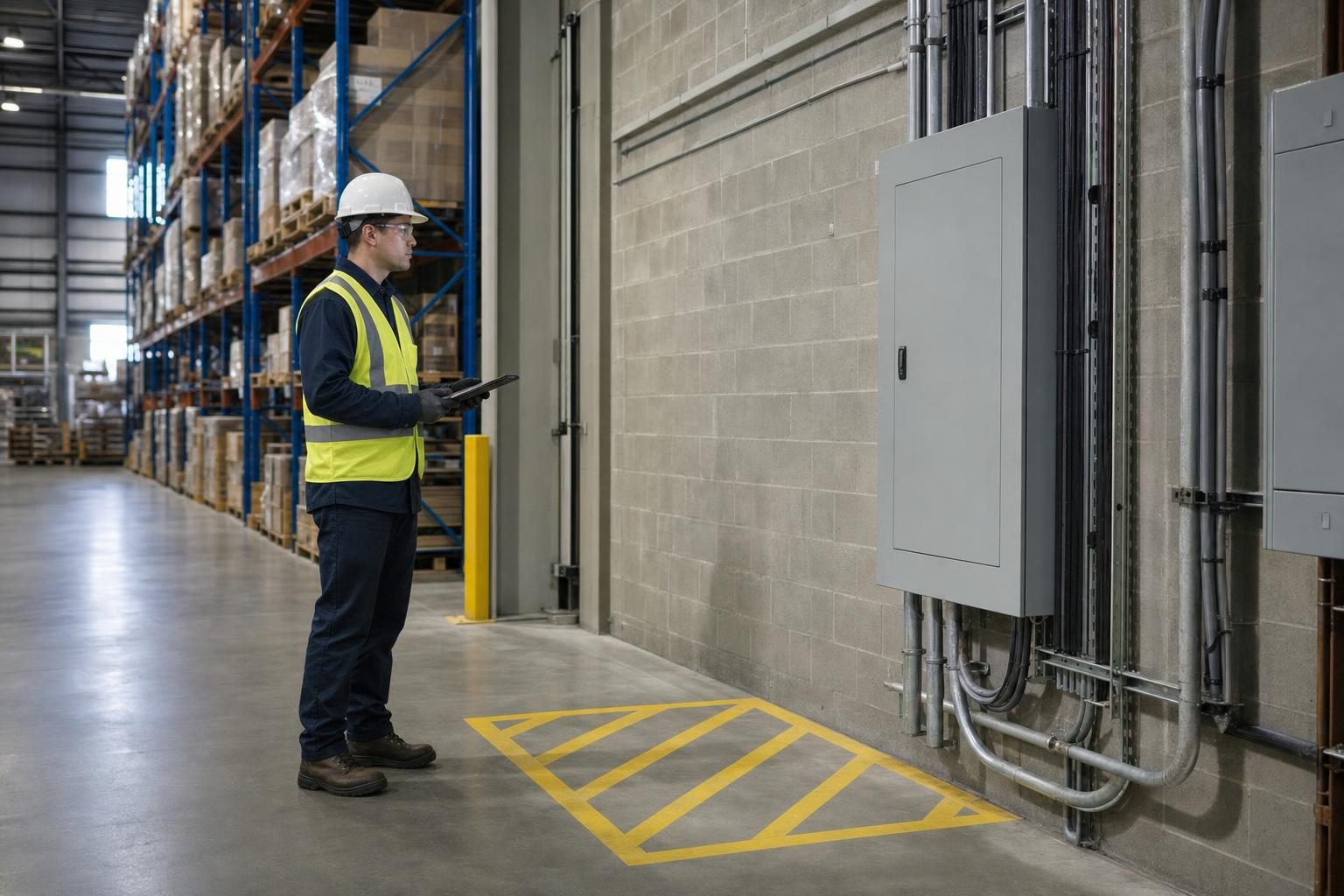
Condition A means exposed live parts on one side and no live or grounded parts on the other; B means exposed live parts on one side and grounded parts (such as a concrete wall) on the other; C means exposed live parts on both sides. The space must also be at least 30 inches (762 mm) wide or the width of the equipment, whichever is greater, let doors open at least 90 degrees, and give at least 6.5 feet (1.98 m) of headroom for installations built on or after August 13, 2007. OSHA is explicit that this space "may not be used for storage." A painted floor zone in front of each panel makes the rule easy to see and easy to check.
Overhead power lines. Unqualified workers, and any conductive object they handle, must stay at least 10 feet (305 cm) from unguarded energized overhead lines of 50 kV or less to ground, with greater distances for higher voltages (1910.333(c)(3)). Measure ladder and pole lengths against this on yard and roof work.
Construction cord programs. Under an assured equipment grounding conductor program, cord sets, plugs and receptacles are visually inspected before each day's use and tested for grounding continuity and correct terminal connection before first use, after repair, after any incident that could have caused damage, and at intervals of no more than 3 months (6 months for fixed cord sets not exposed to damage). The results must be recorded, for example in a log or by color coding (1926.404(b)(1)(iii)). Check that the current color matches the current period.
Temporary wiring. OSHA limits temporary wiring for decorative lighting and similar uses to 90 days and requires temporary wiring to be removed as soon as the project ends (1910.305(a)(2)). Ask when the "temporary" cable was installed.
How Often Should Electrical Equipment Be Inspected?
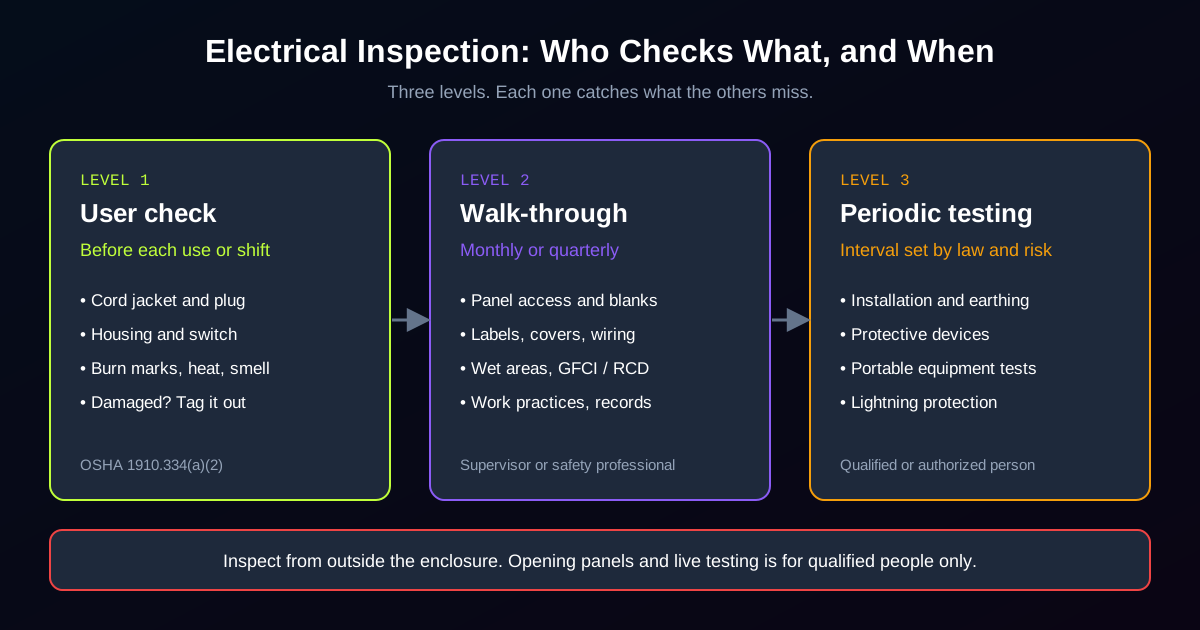
Electrical equipment should be checked by its user before each use or shift, inspected by a supervisor or safety professional on a planned schedule, and tested by a qualified or authorized person at intervals set by law, the manufacturer and your risk assessment. Few intervals are fixed in law, so write yours down and justify them.
| Check | Who | When | Basis |
|---|---|---|---|
| Visual check of cords, plugs and portable equipment | User | Before use on each shift | OSHA 1910.334(a)(2) |
| Construction cord sets and receptacles (AEGCP) | User, competent person | Visual before each day's use; tests at least every 3 months | OSHA 1926.404(b)(1)(iii) |
| GFCI / RCD test button | User or maintenance | Per manufacturer and your procedure | Manufacturer's instructions |
| Walk-through with this checklist | Supervisor or safety professional | Monthly or quarterly, more often in harsh environments | Your risk assessment |
| Portable appliance inspection and testing (UK) | Competent person | Risk-based; no fixed annual legal requirement | HSE PAT guidance, HSG107 |
| Periodic control of electrical, grounding and lightning protection installations (Türkiye) | Authorized person | Period set in Annex III of the work equipment regulation | Work equipment regulation, Art. 7 and Annex III |
HSE makes a point worth copying everywhere: the law requires equipment to be maintained to prevent danger, not tested every year, and a power tool on a construction site needs checking far more often than a lamp in a hotel bedroom. Match the interval to the environment. Our safety inspection checklist guide shows how to build these frequencies into a wider inspection program.
Stop Work or Fix and Record?
Not every "No" carries the same risk. Separate the findings that stop work from the ones you fix and record, so the checklist drives decisions instead of producing a list of equal ticks.
| Stop work or isolate until fixed | Fix promptly and record |
|---|---|
| Exposed live parts or a missing breaker blank in reach | Circuit labels missing or illegible |
| Cord with exposed conductors or damaged insulation in use | Cord routed across a walkway, but undamaged |
| Panel or main isolator blocked so it cannot be reached in an emergency | Storage starting to encroach on the panel's working space |
| Equipment in a wet location without ground-fault protection | Inspection tag or color code out of date on undamaged equipment |
| Live work without de-energizing, lockout or verification | Daisy-chained power strips feeding low-power office equipment |
| Work inside the minimum distance from overhead lines | Panel door closes, but its latch is broken |
| Burn marks, melting or a hot smell at a panel or socket | Test records kept, but in the wrong place |
When a stop-work finding is fixed, recheck it on site and record who fixed it and when. Give each finding in the right-hand column an owner and a due date, as you would any corrective action.
Scoring Electrical Findings: Three Examples
A risk score turns a list of findings into a priority order. The findings from the warehouse scenario are scored below with the Fine-Kinney scales used in our Fine-Kinney risk assessment examples (Risk = Probability × Exposure × Consequence). The values are illustrative; your team should score its own findings.
| Finding | Before: P × E × C | Risk | Control applied | After: P × E × C | Risk |
|---|---|---|---|---|---|
| Pressure washer fed by a taped, cut extension cord lying in water in the wash bay; used every day | 6 × 6 × 15 | 540 (Very high) | Cord destroyed; outlet with ground-fault protection installed at the bay; cords rated for wet locations; pre-shift cord check | 0.5 × 6 × 15 | 45 (Possible) |
| Charging-area panel with a breaker blank missing, live parts reachable at hand height next to a daily walkway | 3 × 6 × 15 | 270 (High) | Blank fitted; panel door locked; panel added to the monthly walk-through | 0.5 × 6 × 15 | 45 (Possible) |
| Main distribution panel blocked by stacked pallets, so it cannot be isolated quickly in an emergency | 3 × 6 × 7 | 126 (Substantial) | Pallets moved; painted keep-clear zone; panel access added to the daily supervisor check | 1 × 6 × 7 | 42 (Possible) |
Scales used: P 6 = quite possible, 3 = unusual but possible, 1 = only remotely possible, 0.5 = conceivable but very unlikely; E 6 = frequent (daily); C 15 = very serious, one fatality, 7 = serious injury. Electric shock in a wet location can kill, which is why the cord and the open panel carry a higher consequence than the blocked panel.
Exposure and consequence do not change after the fix: people still work there every day, and a failure would still be serious. Probability falls, and it falls most when the fix removes the hazard (a destroyed cord, a fitted blank) rather than relying on a rule.
Common Electrical Inspection Mistakes
1. Asking one vague question
"Electrical equipment in good condition?" gets a tick every time. Ask about specific, observable conditions: blanks, covers, labels, clearances, cord jackets, burn marks.
2. Opening panels to look inside
An inspector who removes a panel cover or touches conductors becomes the person at risk. A walk-through is visual from outside the enclosure. Anything that needs a cover removed or a measurement on live parts is for a qualified person with the right controls and PPE.
3. Accepting tape as a repair
Insulating tape over a cut jacket hides the damage and does not restore the cord's mechanical strength. A damaged cord is replaced or properly repaired and tested, not taped.
4. Ignoring the breaker that keeps tripping
A breaker that trips repeatedly is telling you something: an overload, a fault or damaged equipment. Resetting it again and again without finding the cause is prohibited under OSHA 1910.334(b)(2) and is a common route to fires.
5. Treating test stickers as the inspection
A current test tag says the item passed on the day it was tested. It says nothing about the cord that was run over by a forklift this morning. User checks before each use catch what periodic tests cannot.
6. Forgetting the outdoor and temporary installations
Yards, roofs, wash bays, events and construction areas have more water, more damage and more temporary cables than the office floor. Weight your inspection time toward them, and apply the hierarchy of controls: fixed outlets where cords keep failing, ground-fault protection where water is present.
How FindRisk Supports Electrical Safety Inspections
FindRisk lets you run this checklist on your phone during the walk-through. Its AI checklist generator can build an electrical safety checklist for the site you describe, such as a warehouse with battery charging or a construction site with temporary power, which you then adjust to your own rules and stop-work items.
When you find a blocked panel, a missing blank or a damaged cord, you can photograph it and mark the hazard directly on the photo, with AI analysis to help spot hazards you might have missed. Each finding can be scored with the built-in Fine-Kinney risk assessment, and the inspection becomes a professional report in seconds, ready for the maintenance team or the site manager. FindRisk runs on iOS and Android.
Frequently Asked Questions
What does an electrical safety inspection include?
A workplace electrical safety inspection covers access to and condition of panels and disconnects, guarding of live parts, fixed wiring and boxes, cords and plugs, ground-fault protection, equipment in wet or hazardous locations, portable tools, and electrical work practices such as lockout and qualified-person rules. It is visual. Testing of insulation, earthing or protective devices is done separately by a qualified or authorized person.
How often should extension cords be inspected?
Under OSHA 1910.334(a)(2), extension cords and portable cord-and-plug equipment must be visually inspected before use on any shift. Cords that stay connected in one place and are not exposed to damage need not be inspected until they are moved. On construction sites with an assured equipment grounding conductor program, cords are inspected before each day's use and tested at least every three months.
How much clearance is required in front of an electrical panel?
For equipment rated 600 volts or less, OSHA requires a clear working space at least 3 feet deep, rising to 3.5 or 4 feet for 151–600 volts depending on what is opposite the panel. The space must be at least 30 inches wide or the equipment's width, allow doors to open 90 degrees, and must not be used for storage.
Is PAT testing a legal requirement?
In the UK, no. HSE states that the Electricity at Work Regulations 1989 do not require portable appliance testing or require it annually. The law requires equipment to be maintained to prevent danger. Many organizations use a risk-based mix of user checks, formal visual inspections and combined inspection and testing, with intervals that depend on the equipment and the environment.
Who can carry out an electrical safety inspection?
A trained supervisor or safety professional can carry out a visual electrical safety inspection, as long as they do not open enclosures or touch conductors. Work on or near energized parts, and testing of circuits and installations, must be done by a qualified person under OSHA, a competent person under UK law, or an authorized person for periodic controls in Türkiye.
What is an assured equipment grounding conductor program?
It is the alternative to GFCIs that OSHA allows on construction sites under 1926.404(b)(1)(iii). The employer keeps a written program at the jobsite, names a competent person, visually inspects cord sets and receptacles before each day's use, tests grounding continuity and terminal connections at set intervals of no more than three months, and records the results.
Conclusion
An electrical safety inspection checklist works when it checks specific conditions instead of asking whether equipment is "in good condition." That means clear working space in front of panels, closed openings, intact cords with strain relief, ground-fault protection where water and temporary power meet, and work practices that keep people away from live parts.
Use the 38 items above as a base, mark the stop-work items for your site, measure clearances, and score findings so that exposed live parts and damaged cords in wet areas are fixed first. Leave testing to qualified people, and make sure your inspections and their tests talk to each other.
To run this checklist on your next walk-through, download FindRisk, generate an electrical safety checklist for your site, and mark every finding directly on a photo.
Try FindRisk
Ready to modernize your safety workflow?
Conduct AI-powered risk assessments, generate reports instantly, and keep your team safe — anywhere, anytime.