
Cold Stress at Work: Risk Assessment, Thresholds and Example
Cold stress is the strain the body is under when cold air, wind and wetness draw heat away faster than the body can make it. At work it leads to hypothermia, frostbite, trench foot and chilblains, and to accidents caused by numb hands and slow thinking. A cold stress risk assessment looks at temperature, wind, wetness, workload and the person, then sets warm-up breaks, clothing and supervision before the work starts.
Cold is easy to underestimate because it rarely feels like an emergency. A crew on an open slab, a picker in a freezer or a driver changing a tire at night all start the shift feeling fine. The danger builds slowly, and one of its first effects is that people stop noticing their own symptoms.
This guide covers what the law expects in the UK, the US and Türkiye, the factors to assess, how to read wind chill and which thresholds call for which action, two filled assessments with risk scores, controls by the hierarchy of controls, and what to do when someone shows signs of cold illness.
Two Crews, One Cold Morning
Picture two teams, made up for this guide.
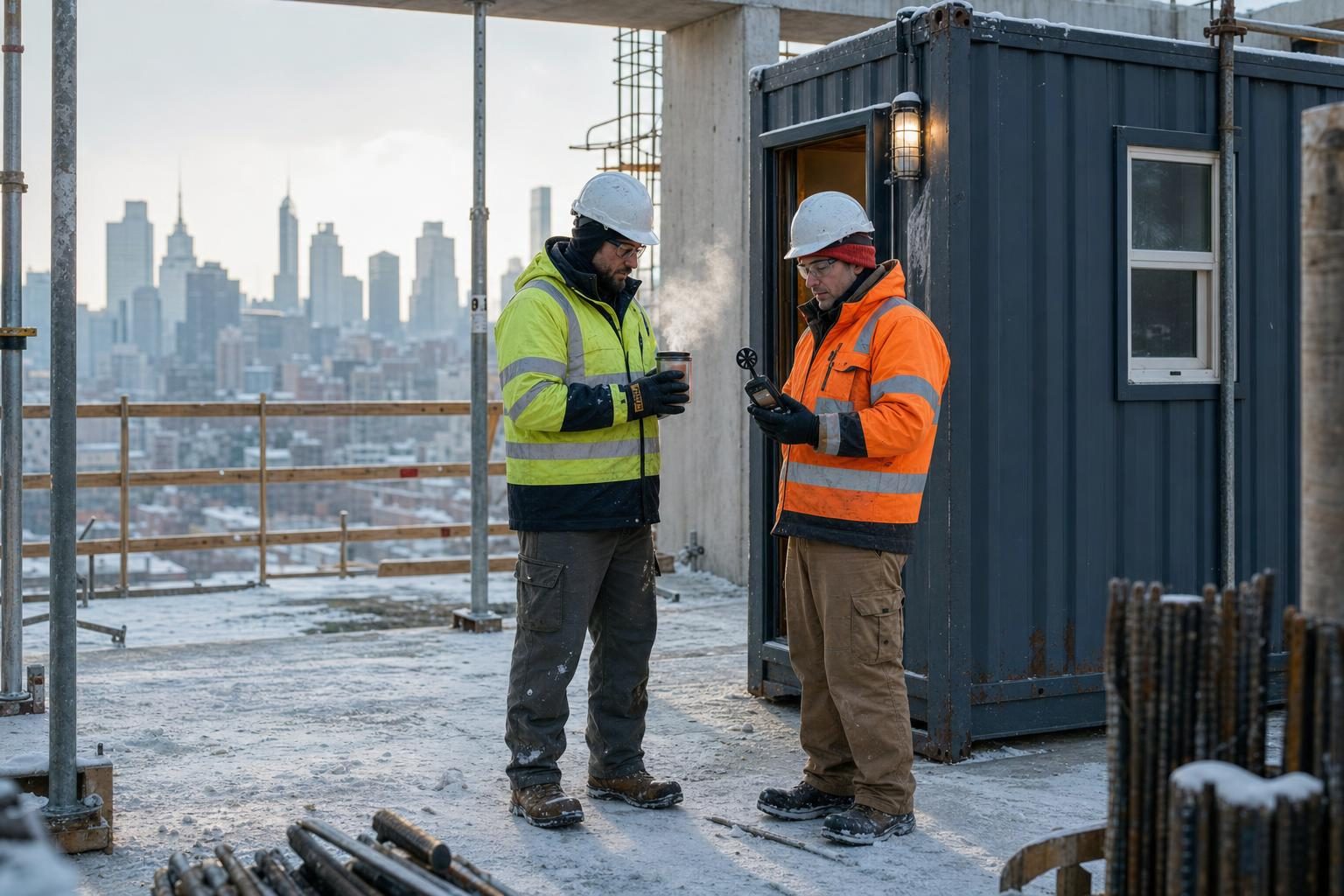
The first is a formwork crew on the top slab of a concrete frame building. It is -5 °C at 07:00 with a steady wind across the open deck, and sleet starts at 09:00. The site has a heated container at ground level, six floors down. The crew works through to lunch because the pour is booked.
The second is a reach-truck driver who picks in a -25 °C freezer. Inside the freezer there is no wind, so the cold "feels" steady. But the truck moves at walking pace and faster, and the driver's face takes the moving air for most of the shift.
Both teams have warm jackets. Neither has a written plan that says when to stop, how long the breaks are, or who watches whom. By late morning, one of the formwork crew is clumsy with the tie wire and slurring his words, and nobody notices because everybody is cold. A cold stress assessment exists to turn "dress warmly" into decisions made before the shift.
What Is Cold Stress?
Cold stress is the body's response to losing heat faster than it can produce it. The Canadian Centre for Occupational Health and Safety (CCOHS) describes four ways heat is lost: radiation, conduction, convection and evaporation. At any air temperature, heat loss rises with wind speed, and wet clothing increases conductive loss.
| Condition | What happens | Key threshold or fact |
|---|---|---|
| Hypothermia | Core body temperature falls too low; thinking and movement are affected | Core temperature below 35 °C (95 °F) (CCOHS) |
| Frostbite | Skin and tissue freeze, usually fingers, toes, ears, nose and cheeks | Tissue temperature below 0 °C (CCOHS) |
| Trench (immersion) foot | Non-freezing injury of feet kept cold and wet | Can occur at up to 60 °F (about 16 °C) if feet stay wet; wet feet lose heat 25 times faster than dry feet (NIOSH) |
| Chilblains | Inflamed skin from repeated exposure to cold above freezing | Skin repeatedly exposed to just above freezing up to 60 °F (NIOSH) |
The trench foot row surprises many people. It is not a frost injury: wet feet in a muddy excavation on a mild winter day are enough.
NIOSH names the people most at risk: outdoor workers, people in poorly insulated or unheated areas and people working without shelter. It adds that in regions not used to winter weather, near-freezing temperatures already count as a risk factor.
What the Law Requires: UK, US and Türkiye
None of the rules cited below sets a minimum temperature for outdoor work. All three systems require the employer to assess the risk and protect workers from it.
| UK | US | Türkiye | |
|---|---|---|---|
| General duty | Risk assessment, MHSWR 1999 reg. 3 | OSH Act Section 5(a)(1) | Law 6331, Art. 4 and Art. 10 |
| Indoor temperature | "Reasonable" (Workplace Regulations 1992 reg. 7); HSE: usually at least 16 °C, or 13 °C for strenuous work | No figure in the general duty clause | Temperature suited to the work and effort (Workplace Buildings Regulation, Annex 1 item 19) |
| Cold work | HSE outdoor advice: warming facilities, hot drinks, more breaks, delay work where possible | Recognized hazards likely to cause death or serious harm must be controlled | Protective measures where very cold work cannot be avoided (Annex 1 item 20); outdoor workers protected against adverse weather (item 64) |
UK
Regulation 7 of the Workplace (Health, Safety and Welfare) Regulations 1992 requires a reasonable temperature in workplaces inside buildings, and enough thermometers for people to check it. HSE's guidance puts a reasonable temperature at usually at least 16 °C, or 13 °C for strenuous work. For outdoor work, HSE's outdoor working page lists mobile warming facilities, soup or hot drinks, more frequent breaks, delaying work to warmer times of the year where that does not compromise safety, and making sure workers can recognize early symptoms. The risk assessment itself is required by MHSWR 1999 regulation 3.
US
The OSH Act's general duty clause, Section 5(a)(1), requires a workplace "free from recognized hazards that are causing or are likely to cause death or serious physical harm". NIOSH's cold stress guidance sets out what employers should do: schedule cold jobs for warmer months or the warmer part of the day, use relief workers on long jobs, provide warm liquids and warm break areas, limit time outside on extremely cold days, monitor workers at risk and train them.
Türkiye
Law 6331 requires the employer to ensure health and safety (Art. 4) and to carry out a risk assessment (Art. 10). The Workplace Buildings Regulation (İşyeri Bina ve Eklentilerinde Alınacak Sağlık ve Güvenlik Önlemlerine İlişkin Yönetmelik, Official Gazette 17.07.2013, No. 28710) adds three relevant points in Annex 1: the temperature must suit the work and the effort, and rest, changing and canteen rooms must be warm enough (item 19); where work must be done in a very cold environment, protective measures are taken (item 20); and outdoor workers are protected against adverse weather after the risks are assessed (item 64). That regulation does not apply to construction sites. For them, the Construction Regulation (Yapı İşlerinde İSG Yönetmeliği, Official Gazette 05.10.2013, No. 28786), Annex 4, asks for protection against weather that could affect health and safety. The Ministry's construction safety cards (İSGGM card 3) give practical advice: plan work for the warmer part of the day, work in pairs, keep clothing dry and schedule breaks by temperature and wind speed.
What to Assess: Cold Stress Risk Factors
A cold stress assessment looks at three groups of factors. The İSGGM card 2 and CCOHS list the same core items.
The environment
- Air temperature at the start, middle and end of the shift, not only the forecast low.
- Wind speed on the actual work position: an open slab, a roof or a quayside is windier than the site gate.
- Wetness: rain, sleet, snow, spray, wet ground, and sweat inside clothing.
- Contact with cold surfaces: metal scaffold tubes, tools, rebar, frozen product.
The work
- Workload: heavy work makes heat but also sweat; light work, such as watching a pump or driving, makes little heat.
- Duration of continuous exposure and distance to a warm shelter.
- Whether the task needs bare hands or fine dexterity.
- Other hazards that cold makes worse: icy walkways and roofs (see slips, trips and falls), stiff hands on tools, and lone work (see lone working).
The person
- Health conditions named in İSGGM card 2: high blood pressure, hypothyroidism, diabetes and asthma, plus some medicines such as antidepressants.
- Fitness, tiredness, and whether the person is new to cold work. CCOHS asks for time for new workers to acclimatize before a full workload.
- Clothing that fits the conditions, and spare dry clothing.
Involve the occupational physician when someone has a health condition that may be affected. The assessment does not need medical details, only the decision that a person's work has been reviewed.
Wind Chill and Action Thresholds
Wind chill (wind chill temperature, WCT) is the temperature that exposed skin "feels" when wind is added to cold air. The İSGGM wind chill card reproduces the US National Weather Service and Meteorological Service of Canada table and its formula:
WCT (°C) = 13.12 + 0.6215T − 11.37V^0.16 + 0.3965T·V^0.16, with T the air temperature in °C and V the wind speed in km/h.
The card's own example: -5 °C with a 30 km/h wind feels like -13 °C.
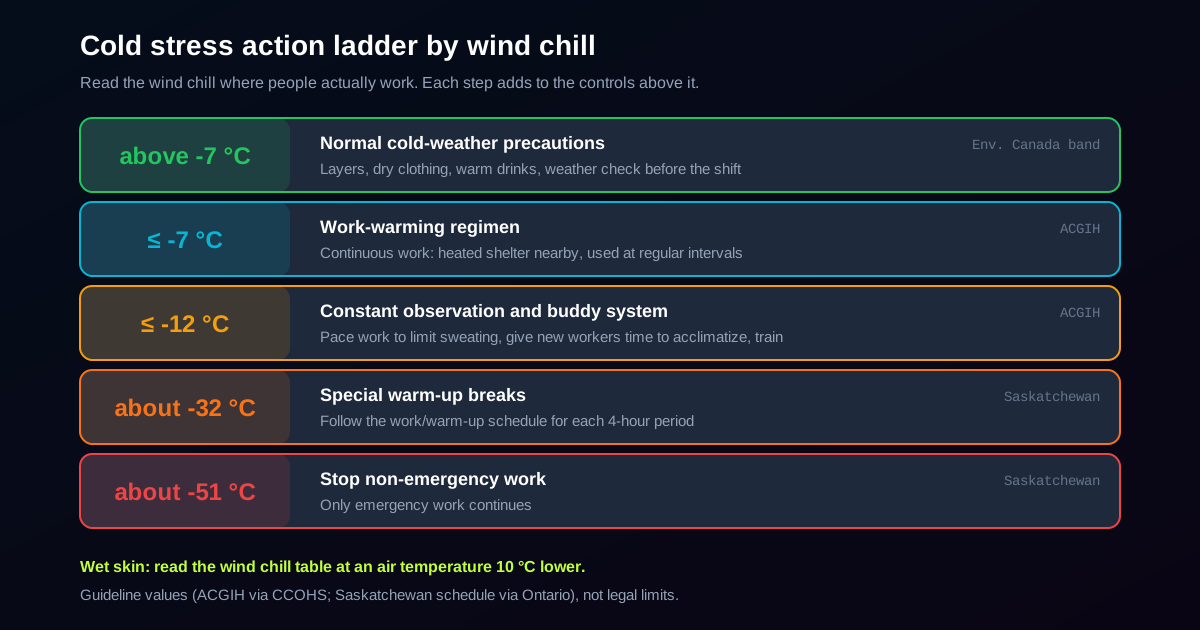
Which thresholds call for which action
These are guidelines, not legal limits in the UK, US or Türkiye. They are still the most widely used reference points, and quoting one in your assessment shows how you set your rules.
| Wind chill (°C) | Source | What to do |
|---|---|---|
| 0 to -9 | Environment Canada band (via CCOHS): low risk | Normal cold-weather precautions: layers, dry clothing, warm drinks |
| At or below -7 | ACGIH (via CCOHS) | Work-warming regimen for continuous work; heated shelter nearby and used at regular intervals |
| At or below -12 | ACGIH (via CCOHS) | Constant observation by a supervisor or buddy; pace work to limit sweating; time for new workers to acclimatize; training |
| -10 to -27 | Environment Canada: moderate risk | Hypothermia and frostbite possible with long exposure without protection |
| -28 to -39 | Environment Canada: high risk | Exposed skin can freeze in 10 to 30 minutes; check faces and fingers |
| About -32 (equivalent temperature) | Saskatchewan schedule (via Ontario) | Start special warm-up breaks |
| About -51 (equivalent temperature) | Saskatchewan schedule (via Ontario) | Stop all non-emergency work |
Two adjustments matter in practice:
- Wet skin. CCOHS says that if skin is wet and exposed to wind, you should read the table at an air temperature 10 °C lower than the actual one.
- Light work. The Saskatchewan work/warm-up schedule covers any four-hour period of moderate or heavy work, assumes 10-minute warm-up breaks in a warm place and dry clothing, and is applied one step lower for work with little physical movement. Look up the full table (published by Saskatchewan and reproduced by Ontario) before you copy its work periods into a procedure.
Worked Example: Two Filled Cold Stress Assessments
Both sites are made up for this guide. The risk scores use the Fine-Kinney scales from the 1976 report (R = Probability × Exposure × Consequence) and are our judgment, with the reasoning shown.
The readings
Formwork crew, top slab. Air -5 °C, wind 30 km/h on the deck. From the table: feels like -13 °C. That is below -12 °C, so the ACGIH "observation and buddy" step applies from the start of the shift. When the sleet arrives and gloves and faces get wet, apply the CCOHS wet-skin rule: read the table at -15 °C and 30 km/h, which gives -26 °C, at the cold end of the "moderate" band.
Freezer picker. Air -25 °C with no wind. The reach truck travels at about 10 km/h for much of the shift. Our assumption: air moving past the face from the truck's own speed cools skin like wind does. From the table, -25 °C at 10 km/h gives -33 °C: the "high risk" band, where exposed skin can freeze in 10 to 30 minutes.
Filled assessment
| Factor | Formwork crew (top slab) | Freezer picker (reach truck) |
|---|---|---|
| Air temperature | -5 °C at 07:00, around 0 °C by noon | -25 °C all shift |
| Wind / air movement | 30 km/h across the open deck | None, but truck travel about 10 km/h |
| Wind chill used | -13 °C dry; -26 °C with wet skin | -33 °C on the face while driving |
| Wetness | Sleet from 09:00; sweat during rebar work | Dry air; sweat under heavy clothing when loading by hand |
| Workload | Moderate to heavy | Light while driving, moderate when hand-picking |
| Cold contact | Steel props, tie wire, rebar | Frozen cartons, metal controls and rack beams |
| Shelter | Heated container six floors down | Heated break room 40 m from the freezer door |
| People | Crew of 5; one new starter from a warm region | Pickers on rotating shifts; one with diabetes (reviewed by the occupational physician) |
| Other hazards made worse | Icy deck and stairs, slips at the slab edge | Ice on the floor near the door seals; lone picking at night |
Scores before and after controls
| # | Hazard | P × E × C (before) | R | Main controls | P × E × C (after) | R |
|---|---|---|---|---|---|---|
| 1 | Crew: hypothermia from long exposure in wind and sleet, shelter far away | 3 × 6 × 7 | 126 Substantial | Heated cabin moved to the slab level; warm-up breaks set from the schedule and written on the plan; work paired, supervisor checks each pair; spare dry gloves and jackets; new starter on a reduced workload for the first week | 0.5 × 6 × 7 | 21 Possible |
| 2 | Crew: slip on the icy deck near the edge | 3 × 6 × 15 | 270 High | Edge protection checked before work; deck cleared and gritted before access; work stops when ice cannot be cleared | 0.5 × 6 × 15 | 45 Possible |
| 3 | Picker: frostbite of face and fingers while driving | 6 × 10 × 7 | 420 Very high | Truck cab or wind screen; face and neck protection; insulated gloves and insulated handles; maximum time in the freezer before a warm-up break written into the rota | 1 × 10 × 7 | 70 Possible / Substantial boundary |
| 4 | Picker: hypothermia while alone at night | 1 × 6 × 15 | 90 Substantial | No lone picking in the freezer; check-in every 30 minutes; door release and alarm checked each shift | 0.2 × 6 × 15 | 18 Acceptable |
How the scores were set. In row 3, probability starts at 6 because the face is exposed to -33 °C air for long stretches and the CCOHS band says skin can freeze in 10 to 30 minutes. Exposure is continuous (10) and stays continuous after the fix: the work does not change, only the protection. In row 4, consequence is 15 because a person who cannot get out of a freezer can die. Row 3 lands on the 70 boundary after controls; decide in your procedure which side a boundary value falls on and apply it the same way every time. In both examples the first controls are engineering or work organization, not clothing alone. That order is the subject of the next section.
Controls by the Hierarchy
The hierarchy of controls applies to cold like any other hazard. Clothing matters, but it is the last line, not the plan.
| Level | Cold stress examples | Source |
|---|---|---|
| Eliminate / reschedule | Move cold maintenance to warmer months; schedule outdoor tasks for the warmer part of the day; delay non-urgent work | NIOSH; HSE; İSGGM card 3 |
| Engineering | Heated shelters close to the work; wind screens; heated or enclosed cabs; insulated metal handles; insulating floor mats or footwear for standing on cold floors | CCOHS; HSE |
| Administrative | Warm-up break schedule; relief workers on long jobs; buddy system and supervision at or below -12 °C; pacing to limit sweating; acclimatization for new workers; training; weather check before each shift | CCOHS; NIOSH; İSGGM card 3 |
| PPE and clothing | Layers (wicking inner, insulating middle, wind- and water-resistant outer); wool or synthetic, not cotton; spare dry clothing; hats, insulated waterproof boots; gloves below 4 °C for light work and below -7 °C for moderate work, mittens below -17 °C | CCOHS; İSGGM card 3 |
Two practical points from the sources are often missed:
- Drinks. CCOHS recommends drinking often, choosing warm non-alcoholic drinks or soup, limiting caffeine and avoiding alcohol. İSGGM card 3 adds that sweet warm drinks help.
- Metal. Bare skin can freeze to cold metal. İSGGM advises against bare-hand contact and, if skin does stick, pouring warm water slowly over the spot instead of pulling it free.
Put the decisions in the site plan and brief them in a toolbox talk at the start of the cold season, then again when the forecast changes.
Recognizing Cold Illness and First Response
Hypothermia is dangerous because confusion is one of its symptoms: the person is often the last to notice. That is why the buddy system appears in every source.
| Condition | Watch for | First response |
|---|---|---|
| Hypothermia | Early: shivering, fatigue, loss of coordination, confusion. Late: shivering stops, blue skin, dilated pupils, slow pulse and breathing, loss of consciousness | Call for medical help (112 in Türkiye). Move the person gently to a warm place. Replace wet clothing. Cover with blankets, including head and neck, and put warm packs at the sides of the chest, the armpits and the groin. Warm drinks only if fully conscious, never alcohol. Start CPR if there is no pulse |
| Frostbite | Numbness, tingling or stinging, aching; red, pale, gray or waxy skin | Get to a warm room. Do not walk on frostbitten feet unless necessary. Warm in warm (not hot) water or with body heat. Do not rub. Do not use a heater, stove or heat lamp: numb skin burns easily |
| Trench foot | Red or blotchy skin, numbness, leg cramps, swelling, blisters | Remove boots and wet socks, dry the feet, avoid walking on them |
| Chilblains | Redness, itching, blistering | Do not scratch, warm slowly, keep blisters clean and covered |
Sources: NIOSH cold-related illnesses; İSGGM card 2. Make sure your first aiders' training covers these, and that the warm shelter, blankets and warm drinks are actually available on the shift, not only in the office.
Common Mistakes
1. Reading the thermometer, not the wind
The site may be -5 °C, but the open deck at 30 km/h feels like -13 °C. Measure or estimate wind where people actually work.
2. Forgetting that wet changes everything
Sleet, sweat and wet ground can turn a manageable day into a dangerous one. Use the 10 °C wet-skin adjustment and keep spare dry gloves, socks and jackets on site.
3. Treating cold stores as "indoor, so fine"
A freezer has no weather, but it has very low air temperature, cold metal and vehicle air movement. Assess it with the same thresholds as outdoor work.
4. A shelter that is too far away
A heated container at the gate does not help a crew six floors up. If getting to the shelter takes too long, people skip the breaks.
5. Relying on clothing alone
Jackets and gloves are the last control. Schedule changes, wind screens, warm-up breaks and supervision come first.
6. No one watching
Confusion is a symptom of hypothermia. Without a buddy system or a supervisor who checks people, the first sign may be a fall or a collapse.
7. Assessing once in November and never again
Cold stress changes by the hour. Check the forecast before each shift and apply the thresholds you wrote down.
How FindRisk Supports Winter Inspections
A cold stress plan only works if the shelters, wind screens, gritting and spare clothing are actually in place on the day. FindRisk lets you generate an inspection checklist with AI for winter conditions, for example warm-up shelter, icy walkways, cold store door releases and PPE stock, and work through it on a phone during your site inspection.
When you find an icy stair, a missing wind screen or a blocked freezer door release, mark the hazard on a photo and let the AI analyze it. Score the finding with the Fine-Kinney method so the fixes are ranked by risk, as in the example above.
FindRisk then produces a professional report in seconds, ready to share with the site manager before the next shift. It is available on iOS and Android.
Frequently Asked Questions
What temperature is too cold to work outside?
None of the UK, US or Turkish rules cited in this guide sets one. The most used guidelines work with wind chill: ACGIH suggests a work-warming regimen at or below -7 °C and closer supervision at or below -12 °C, and the Saskatchewan schedule stops all non-emergency work at about -51 °C equivalent temperature. Your risk assessment should state which thresholds you use and what happens at each.
What is the minimum temperature for working indoors?
In the UK, the law requires a "reasonable" temperature inside buildings, and HSE guidance says this is usually at least 16 °C, or 13 °C for strenuous work. Türkiye's workplace buildings regulation requires a temperature suited to the work and the physical effort without giving a number. Cold stores cannot meet these levels, so they need cold stress controls instead.
How long can you work in the cold before a break?
It depends on air temperature, wind and workload. The Saskatchewan work/warm-up schedule, which CCOHS points to, sets maximum work periods and the number of 10-minute warm-up breaks for each four-hour period of moderate or heavy work. It assumes dry clothing and is applied one step lower for light work. Write your break pattern into the assessment so supervisors do not improvise.
Do warm drinks and coffee help in the cold?
Warm drinks help, but choose them carefully. CCOHS recommends drinking often, preferring warm non-alcoholic drinks or soup and limiting caffeine. The Turkish ministry card suggests sweet warm drinks and avoiding caffeinated tea and coffee because they increase urine output. Alcohol should never be drunk at work in the cold.
What does OSHA require for working in the cold?
The OSH Act's general duty clause requires employers to keep the workplace free from recognized hazards that cause or are likely to cause death or serious physical harm. NIOSH guidance describes what that means for cold: schedule work for warmer periods, provide warm break areas and drinks, limit time outside on extreme days, monitor workers at risk and train them.
Does wind chill matter in a cold store?
There is no wind in a freezer, but moving air still cools skin faster. If a picker drives a truck at about 10 km/h in -25 °C air, the table gives a wind chill of about -33 °C on the face. Treat vehicle speed as air movement in your assessment, and protect the face and hands accordingly.
Conclusion
Cold stress builds slowly and hides its own warning signs, which is why it needs a written plan before the first cold shift. Look at temperature, wind, wetness, workload and the person; read the wind chill where people actually work; and decide in advance what happens at each threshold.
Use the two filled assessments above as a model: bring the shelter closer, change the schedule, pair people up and supervise, then choose clothing and gloves for the conditions. Review the plan whenever the forecast, the task or the team changes.
Download FindRisk to build your winter inspection checklist, record icy walkways and missing shelters with photos, and share the report before the next shift.
Try FindRisk
Ready to modernize your safety workflow?
Conduct AI-powered risk assessments, generate reports instantly, and keep your team safe — anywhere, anytime.