

Slips, Trips and Falls Risk Assessment: 9 Scored Examples
A slips, trips and falls risk assessment is the part of your workplace risk assessment that finds where people could slip on a contaminated or unsuitable floor, trip over an obstruction or uneven surface, or fall on the same level or on stairs. It rates each hazard, sets controls such as cleaning regimes, floor treatment and walkway design, and names who acts and by when.
Slips and trips look like a minor topic until you see the numbers. In Great Britain, slips, trips or falls on the same level caused 30% of the employee non-fatal injuries that employers reported under RIDDOR in 2024/25, the largest single kind of accident (HSE). In the US, falls, slips and trips caused 479,480 private-industry cases with days away from work in 2023–24, with a median of 13 days off (BLS).
Most guides on this topic give you a blank form and one example of a box in a corridor. This guide scores nine hazards in an office, a commercial kitchen and an outdoor yard with two methods side by side, explains why the methods disagree on some of them, and gives you the slip-resistance numbers to ask for and a 30-item walkdown checklist.
A Rainy Monday in the Lobby
This is a fictional example built for this guide. An office building has a polished stone floor in its entrance lobby. On dry days nobody notices it. On a rainy Monday morning, two hundred people walk in from the street within an hour, each carrying water on their shoes and umbrellas. The single doormat is soaked by 08:30. By 08:45 the first three metres of stone are wet, and a visitor in leather-soled shoes goes down hard and fractures a wrist.
The facilities manager's first reaction is to put out a yellow wet-floor sign. The sign is useful, but it treats the symptom. The real questions are about the floor, the mat, the canopy, the cleaning routine and the weather forecast. A slips, trips and falls risk assessment asks them before the first fall, not after. We will score this lobby in the worked example below.
What Is a Slips, Trips and Falls Risk Assessment?
A slips, trips and falls (STF) assessment is not a separate legal document. It is a focused pass of your general risk assessment through every floor, walkway, stair and outdoor route that people use. It treats three different events:
| Event | What happens | Typical causes |
|---|---|---|
| Slip | The foot loses grip and slides | Water, oil, food, dust, ice or polish on a floor that is not rough enough for that contaminant; unsuitable footwear |
| Trip | The foot strikes an object or edge and the person loses balance | Obstructions in walkways, trailing cables, uneven paving, small changes in level, worn mats |
| Fall on the same level or on stairs | The person falls to the floor they were walking on, or down a few steps | The result of a slip or trip; poor lighting, missing handrails, carrying loads that block the view |
Falls from height (ladders, roofs, platforms, open edges) are a separate topic with their own controls. See our working at height checklist for those. This guide covers same-level falls and falls on stairs and steps.
What the Law Requires: UK, US and Türkiye
None of the three jurisdictions below requires a document titled "slips and trips risk assessment," but all three set specific duties for floors and walkways, and all three expect these hazards in your general assessment.
| Jurisdiction | Key requirements for floors and walkways |
|---|---|
| UK | Workplace (Health, Safety and Welfare) Regulations 1992, regulation 12: floors and traffic routes must be suitable, with no hole, slope, uneven or slippery surface that exposes anyone to risk; effective drainage where necessary; kept free, so far as reasonably practicable, of obstructions and of anything that may cause a slip, trip or fall; suitable and sufficient handrails on staircases. |
| US | 29 CFR 1910.22: walking-working surfaces kept clean, orderly and sanitary; floors clean and, to the extent feasible, dry; drainage and dry standing places where wet processes are used; surfaces free of hazards such as protruding objects, loose boards, leaks, spills, snow and ice; surfaces inspected regularly and as necessary; hazards corrected before the surface is used again, or guarded until they are. |
| Türkiye | 6331 sayılı Kanun Article 10 requires a risk assessment. The İşyeri Bina ve Eklentilerinde Alınacak Sağlık ve Güvenlik Önlemlerine İlişkin Yönetmelik (Resmî Gazete 17.07.2013, No. 28710), Annex 1, requires floors to be sound, dry and as far as possible level and non-slip, without dangerous slopes, holes or obstacles; access routes kept free of unevenness and slippery surfaces; stairs with guard rails against falls; and lighting that does not create an accident risk. |
The common thread is that the duty is continuous. OSHA's "corrected before use again" and the UK's "kept free of obstructions" mean an assessment on paper is not enough. You need a routine that catches the spill at 10:15.
What Causes Slips and Trips?
HSE explains slips with a slip potential model of six factors, and trips with three things you need to get right (HSE slips and trips overview). Use both as your hazard prompts during the walkdown.
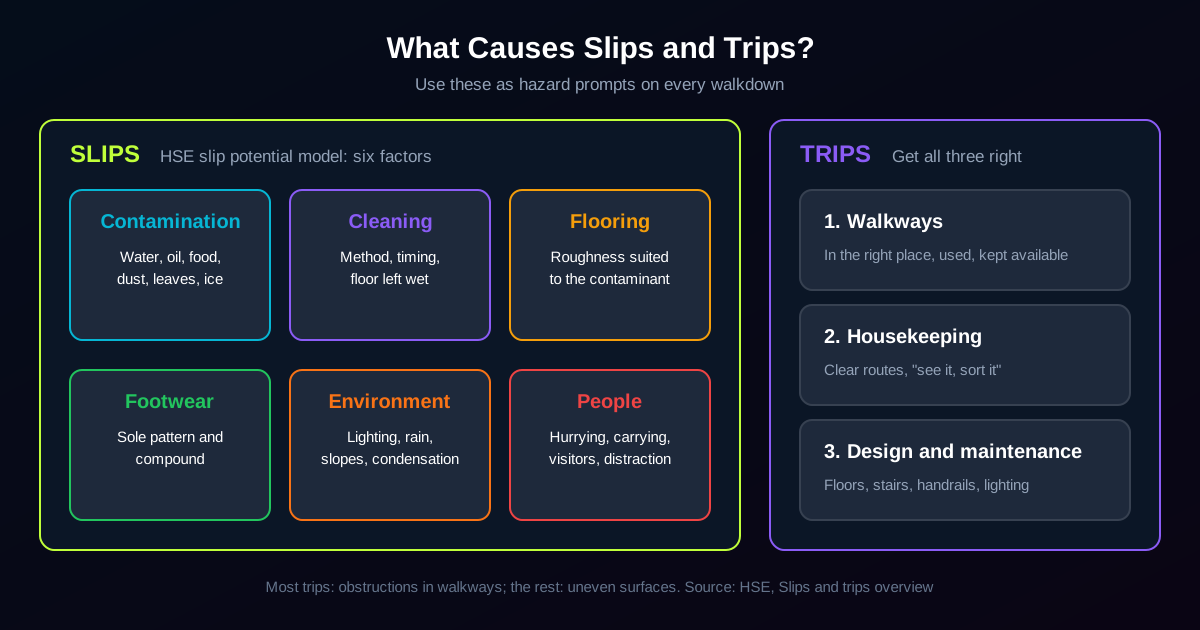
Slips. A slip happens when the grip between shoe and floor is lower than the walking movement needs. The six factors interact:
- Contamination: water, oil, grease, food, dust, leaves, ice. HSE notes that most floors grip well when clean and dry.
- Cleaning: the wrong method can leave a film of water or detergent, or polish a floor smooth.
- Flooring: the surface roughness must suit the contaminant you expect.
- Footwear: sole pattern and compound matter, especially on wet or greasy floors.
- Environment: lighting, glare, rain at entrances, condensation, slopes.
- People: hurrying, carrying loads, distraction, unfamiliar visitors.
Trips. HSE states that "the majority of trips are caused by obstructions in walkways. The rest are caused by uneven surfaces." To prevent them, you need suitable walkways that are actually used, good housekeeping with a "see it, sort it" habit, and floors, stairs, handrails and lighting that are designed and maintained to a good standard.
How to Do a Slips, Trips and Falls Risk Assessment in 5 Steps
Step 1: Walk every route, at the right time
Walk the site with the people who work there. Include entrances, corridors, stairs, kitchens, washrooms, production floors, loading docks, car parks and outdoor routes. Go back when conditions change: during a rainy shift change, at the end of kitchen service, on a frosty morning, on the night shift when lighting is the only light. A walkdown at 11:00 on a dry Tuesday misses most of the problem.
Step 2: Record each hazard with a photo and its condition
For each location, note what the hazard is, when it occurs (always, when it rains, during cleaning, in winter) and what you saw. A photo with the hazard marked saves an argument later about which step or which drain.
Step 3: Decide who could be harmed
Employees, cleaners, contractors, delivery drivers, visitors and members of the public. Visitors do not know the floor, and often wear the wrong shoes. Older workers and people carrying loads also need specific attention.
Step 4: Score each hazard
Use your normal method, and score seasonal hazards for the season when they occur. The worked example below uses Fine-Kinney and a 5×5 matrix side by side.
Step 5: Set controls, owners and a review
Apply the hierarchy of controls: remove the contamination or the obstruction at source first, then fix the floor and the layout, then cleaning routines and signs, then footwear. Give each action an owner and a date. Review after any slip or trip, after a floor or layout change, and before winter.
Worked Example: 9 Hazards Scored With Fine-Kinney and a 5×5 Matrix
The three areas and nine hazards below are fictional, written by FindRisk Team to show the scoring logic.
Fine-Kinney uses Kinney and Wiruth's (1976) scales: risk R = Probability × Exposure × Consequence. Classes: above 400 very high, 200–400 high, 70–200 substantial, 20–70 possible, below 20 acceptable. For the full scales, see our Fine-Kinney examples.
5×5 matrix (scales defined for this example): Likelihood 1 very unlikely, 2 unlikely, 3 possible, 4 likely, 5 almost certain. Severity 1 no injury, 2 first aid, 3 medical treatment or a few days off, 4 fracture or long absence, 5 fatality or permanent disability. Risk = L × S, banded 1–4 low, 5–9 medium, 10–16 high, 20–25 very high.
Area 1: Office building
| Hazard | Fine-Kinney before (P × E × C) | 5×5 before (L × S) | Main controls | Fine-Kinney after | 5×5 after |
|---|---|---|---|---|---|
| Rainwater tracked onto a polished stone lobby floor on wet days | 6 × 3 × 7 = 126 Substantial | 4 × 4 = 16 High | Canopy over the door, entrance matting long enough to dry shoes, wet-weather plan with extra mats and drying rounds, signs while wet | 1 × 3 × 7 = 21 Possible | 2 × 4 = 8 Medium |
| Extension cables trailing across walkways to hot desks | 3 × 10 × 3 = 90 Substantial | 4 × 3 = 12 High | Floor boxes or re-routed power, cable covers as an interim measure | 0.5 × 10 × 3 = 15 Acceptable | 1 × 3 = 3 Low |
| Main staircase with worn, low-contrast nosings; people carry drinks and look at phones | 3 × 10 × 7 = 210 High | 3 × 4 = 12 High | Replace with slip-resistant, contrasting nosings; handrails on both sides; better lighting; "hand on the rail" campaign | 0.5 × 10 × 7 = 35 Possible | 1 × 4 = 4 Low |
Area 2: Commercial kitchen
| Hazard | Fine-Kinney before (P × E × C) | 5×5 before (L × S) | Main controls | Fine-Kinney after | 5×5 after |
|---|---|---|---|---|---|
| Oil and food debris on smooth tiles at the fryer line during service | 6 × 10 × 7 = 420 Very high | 5 × 4 = 20 Very high | Drip trays and splash guards at the fryers, floor with surface roughness suited to oil, clean-as-you-go with spill kits at the line, slip-resistant footwear | 0.5 × 10 × 7 = 35 Possible | 2 × 4 = 8 Medium |
| Floor left wet after mopping while staff still walk through | 3 × 6 × 7 = 126 Substantial | 3 × 4 = 12 High | Clean after the area closes, mop in halves, dry-mop or squeegee afterwards, barriers instead of signs alone | 0.5 × 6 × 7 = 21 Possible | 1 × 4 = 4 Low |
| Step down into a walk-in cold room, wet with condensation, staff carrying crates | 3 × 10 × 7 = 210 High | 3 × 4 = 12 High | Replace the step with a gentle ramp, or mark the edge and fit anti-slip strip; trolleys for crates | 0.5 × 10 × 7 = 35 Possible | 1 × 4 = 4 Low |
Area 3: Outdoor yard and car park
| Hazard | Fine-Kinney before (P × E × C) | 5×5 before (L × S) | Main controls | Fine-Kinney after | 5×5 after |
|---|---|---|---|---|---|
| Ice on the footpath from the car park to the entrance on frosty mornings | 6 × 1 × 7 = 42 Possible | 4 × 4 = 16 High | Gritting triggered by the forecast the evening before, a single treated route, closure of untreated shortcuts | 1 × 1 × 7 = 7 Acceptable | 2 × 4 = 8 Medium |
| Potholes and lifted paving on the pedestrian route, poorly lit for the night shift | 3 × 6 × 7 = 126 Substantial | 3 × 4 = 12 High | Repair the surface, add lighting along the route, monthly route inspection | 0.5 × 6 × 7 = 21 Possible | 1 × 4 = 4 Low |
| Wet leaves and algae on the concrete loading ramp in autumn | 3 × 3 × 7 = 63 Possible | 3 × 4 = 12 High | Weekly sweeping in autumn, pressure washing, anti-slip surface treatment, handrail along the ramp | 1 × 3 × 7 = 21 Possible | 2 × 4 = 8 Medium |
What the numbers show
The two methods agree on the top of the list. The fryer line is the worst hazard by both methods, and the staircase and cold room step come next. If you only need a ranking for action, either method works.
They disagree on the ice. The 5×5 matrix rates ice on the footpath as high (16), the same as the wet lobby. Fine-Kinney rates it as possible (42), because frost happens only a few times a year, so exposure is 1. Neither answer is wrong. They answer different questions. Fine-Kinney asks about the year; the matrix asks about the condition. The practical fix is to score seasonal hazards for their season: during a cold month with daily frost, exposure is 6 and the same ice scores 6 × 6 × 7 = 252, high. Write the season into the hazard description so the score makes sense to the next reader.
Signs do not change the score much. Look at what lowered each score: canopies, matting, floor treatment, re-routing cables, ramps, gritting routes. A wet-floor sign on its own would barely change probability, because people still walk across.
Residual risk is honest. The lobby and the ramp stay at "medium" on the matrix after controls. Rain still comes in, and leaves still fall. These residual scores tell management that the controls need monitoring, not that the job is finished.
Slip Resistance: The Numbers to Ask For
Slip resistance is a measurable property of a floor, and HSE publishes thresholds for it. Most floors grip well when clean and dry. What matters is how they behave with the contaminant you actually expect. HSE uses two measurements (Assessing the slip resistance of flooring):
| Test | What it measures | High slip potential | Moderate | Low slip potential |
|---|---|---|---|---|
| Pendulum test value (PTV), wet | Friction under a simulated heel strike | 0–24 | 25–35 | 36 and above |
| Surface micro-roughness (Rz), water-wet floors | Mean peak-to-valley height of the surface | Below 10 µm | 10–20 µm | Above 20 µm |
The roughness needed rises with the thickness of the contaminant. HSE's catering guidance HSG252 gives at least 20 µm for water, 45 µm for milk and 70 µm for cooking oil. That is why the fryer line in our example needs a different floor from the lobby.
Three practical points:
- A dry test is irrelevant for a floor that gets wet. HSE says so directly. Ask for wet pendulum results.
- Ask a flooring supplier for wet PTV and Rz values, not only a marketing slip-resistance rating, and for the cleaning method that keeps those values.
- Floors wear. A floor that tested well when new can polish smooth in heavy traffic areas. Re-test where people slip.
Controls by Hierarchy
Effective slips and trips control starts at the source of the contamination or obstruction, not at the shoe. This table maps common controls to the hierarchy of controls.
| Level | Slip controls | Trip controls |
|---|---|---|
| Elimination | Fix leaks, enclose processes that spill, canopies and drainage at entrances | Remove the obstruction; give equipment a permanent home off walkways |
| Substitution | Replace smooth flooring with a floor rough enough for the contaminant; choose cleaning products and methods that leave the floor dry | Replace steps with ramps; replace damaged paving with a level surface |
| Engineering | Drip trays, splash guards, entrance matting systems, anti-slip treatment, heated or covered routes | Floor boxes for power, cable management, handrails on both sides, contrasting nosings, lighting |
| Administrative | Clean-as-you-go, spill kits at high-risk points, cleaning when areas are closed, gritting plans, inspections | Housekeeping standards, "see it, sort it," marked walkways, delivery storage areas |
| PPE | Slip-resistant footwear selected for the contaminant, trialled on your floor | Footwear that fits and is fastened |
Footwear is the last line, but in kitchens and food plants it is a significant one. Trial it on your own floor with your own contaminant before you buy for everyone.
Slips, Trips and Falls Checklist: 30 Checks for a Photo Walkdown
Use this list during the walkdown. Take a photo of every "no" and mark the hazard on it. Our safety inspection checklist guide covers the wider workplace inspection.
Entrances and lobbies
- Canopy or porch protects the door from rain.
- Entrance matting is long enough to dry shoes and lies flat with no curled edges.
- A wet-weather plan exists: extra mats, drying rounds, who does it.
- Floor material near the door suits wet conditions.
Floors and walkways 5. No spills, leaks or standing water. 6. No damaged, loose or lifted floor coverings, tiles or boards. 7. No holes, unmarked slopes or sudden changes in level. 8. Walkways are clear of boxes, pallets, tools and waste. 9. No cables trail across walkways. 10. Walkways are marked where vehicles or storage are nearby. 11. Drainage works where processes are wet.
Stairs and steps 12. Handrails are fitted, secure and continuous. 13. Nosings are intact, slip-resistant and visually contrasting. 14. Treads are not worn, loose or cluttered. 15. Single steps and level changes are marked or replaced by ramps. 16. People can use the handrail (not carrying loads that need two hands).
Kitchens, washrooms and wet areas 17. Drip trays and splash guards are in place at sources of spills. 18. Spill kits or absorbent material are kept at high-risk points. 19. Cleaning happens when the area is closed or in sections. 20. Floors are dry, or barriers keep people off wet areas. 21. Staff wear slip-resistant footwear suited to the contaminant.
Lighting and environment 22. Lighting is adequate on all routes, including at night. 23. No glare that hides changes in level or spills. 24. Emergency lighting covers stairs and escape routes.
Outdoor routes 25. Paths and car parks have no potholes or lifted paving. 26. A gritting or snow-clearing plan exists with named people and triggers. 27. Leaves, moss and algae are cleared from ramps and steps. 28. Outdoor routes are lit for dark shifts.
Management 29. Slips and trips (including near misses) are reported and investigated. 30. The assessment was reviewed after the last floor, layout or season change.
Common Mistakes in Slips, Trips and Falls Risk Assessments
1. Relying on wet floor signs
Signs warn people about a hazard that is still there. If the floor is wet every lunchtime, the fix is in cleaning timing, drainage or the floor itself. Signs left out all day also get ignored.
2. Assessing on a dry day
The lobby, the ramp and the yard look safe at 11:00 on a dry day. Walk the site when the hazard exists: in rain, at the end of service, on frosty mornings, at night.
3. Recording "floor slippery" without asking why
A slippery floor is the result of contamination, flooring, cleaning and footwear together. Without the cause, the control becomes "take care." Ask which of the six factors is driving the slip.
4. Choosing flooring on appearance or a dry test
Polished stone and glossy vinyl look good in a lobby and grip poorly when wet. Ask for wet pendulum and roughness values matched to the contaminant.
5. Ignoring visitors and contractors
They do not know the floor, the step into the cold room or the dark corner of the car park. Include them when you decide who could be harmed.
6. Never reviewing after a slip
Every slip or trip, even without injury, is free information about the floor. Investigate it and update the assessment, not only the incident log.
How FindRisk Supports Slips, Trips and Falls Assessments
FindRisk lets you build a slips, trips and falls checklist with AI from a short description of the site, such as "office building with a commercial kitchen and an outdoor car park," and then edit it to match your areas. You can work through it on your phone during the walkdown.
When you find a problem, such as a curled mat, a worn stair nosing or a pothole on the night-shift route, you can photograph it, mark the hazard on the photo and use the AI analysis as a second pair of eyes. Each hazard can then be scored with the built-in Fine-Kinney risk assessment, with before and after scores side by side, as in the tables above.
When you are done, FindRisk produces a professional report in seconds that you can share with facilities, cleaning contractors and managers. It runs on iOS and Android.
Frequently Asked Questions
What is the most common cause of slips, trips and falls at work?
Obstructions in walkways cause most trips: HSE states that the majority of trips are caused by obstructions and the rest by uneven surfaces. Slips usually involve contamination such as water, oil, food or dust on a floor that is not rough enough for it, often made worse by unsuitable footwear, poor cleaning methods or rain at entrances.
What is the difference between a slip, a trip and a fall?
A slip happens when the foot loses grip and slides, usually on a contaminated floor. A trip happens when the foot hits an object or an edge and the person loses balance. A fall is the result: the person ends up on the floor or down a few steps. Falls from height, such as from a ladder or platform, are assessed separately.
Do you need a separate slips and trips risk assessment?
Usually not. UK, US and Turkish law require you to assess and control slip and trip hazards, but they can sit in your general workplace risk assessment. Many employers still write a separate section or form for slips and trips because the hazards are spread across every area, change with weather and cleaning, and benefit from their own walkdown checklist.
What is a good slip resistance value for a floor?
HSE classes a floor with a wet pendulum test value of 36 or more as low slip potential, 25 to 35 as moderate and 24 or below as high. For surface micro-roughness on water-wet floors, above 20 microns is low slip potential. Floors exposed to thicker contaminants need more roughness: HSE gives at least 45 microns for milk and 70 microns for cooking oil.
Are wet floor signs enough to control a slip hazard?
No. A sign warns people but leaves the hazard in place, so it is a short-term measure while you clean or dry the floor. Lasting control comes from stopping the contamination at source, choosing a floor that suits the contaminant, cleaning when areas are closed or in sections, and using barriers where people must be kept off a wet floor.
Who is responsible for slips and trips caused by weather?
The employer or the person who controls the premises. UK regulation 12 requires floors and traffic routes to be kept free of anything that may cause a slip, trip or fall so far as reasonably practicable, and OSHA 1910.22 names snow and ice among the hazards that walking-working surfaces must be kept free of. In practice, that means a winter plan with gritting triggers, treated routes and named people.
How often should a slips and trips assessment be reviewed?
Review it after any slip, trip or near miss, after changes to floors, layout, cleaning methods or contractors, and before seasons that bring new hazards, such as autumn leaves or winter ice. OSHA 1910.22 also requires walking-working surfaces to be inspected regularly and as necessary, so routine floor inspections should feed into the assessment between reviews.
Conclusion
Slips, trips and same-level falls are the most common kind of reported workplace injury in Great Britain, and most of them come from causes you can see on a walkdown: contamination, obstructions, unsuitable floors, poor lighting and missing handrails. A good assessment walks the site when the hazard exists, records the cause rather than just "slippery," and scores each hazard for the conditions when it occurs.
Fix the source first: stop the leak, move the cable, change the floor, replace the step with a ramp. Use cleaning routines, signs and footwear to cover what remains, and review after every slip. Score seasonal hazards for their season, so ice and autumn leaves get the attention they need when they arrive.
Download FindRisk to build a slips, trips and falls checklist with AI, mark hazards on photos during your walkdown and share a scored report the same day.
Try FindRisk
Ready to modernize your safety workflow?
Conduct AI-powered risk assessments, generate reports instantly, and keep your team safe — anywhere, anytime.