
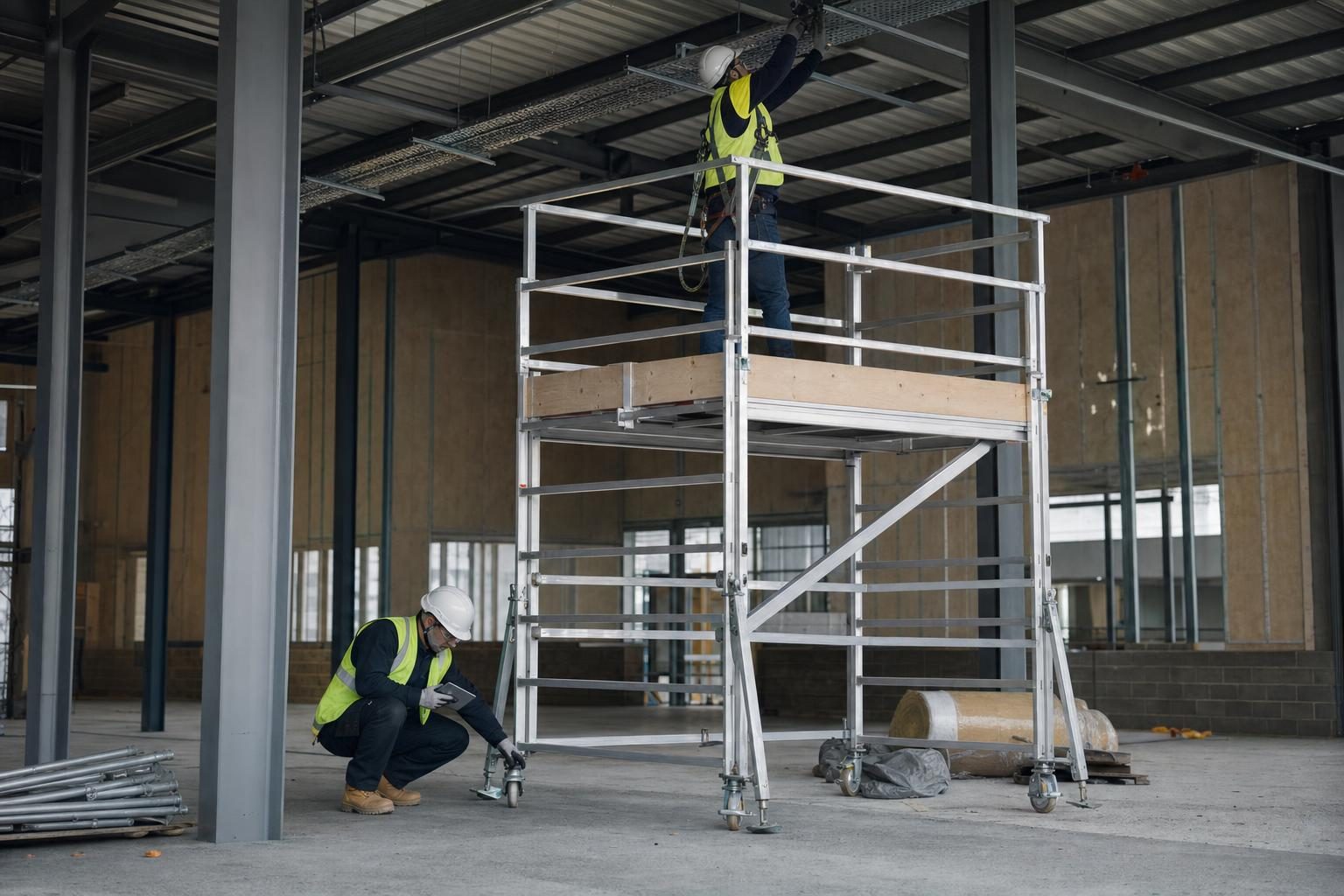
Working at Height Checklist: 30 Checks and Inspection Intervals
A working at height checklist is a structured list of checks a supervisor or safety inspector completes before and during any task where someone could fall and be injured. It confirms the work is planned, edges and openings are protected, access equipment and fall arrest gear are in good condition, and a rescue plan is ready, so the job stops before a fall, not after.
Falls are still one of the most common ways people die at work. The US Bureau of Labor Statistics counted 844 fatal falls, slips and trips in 2024, out of 5,070 fatal work injuries (BLS CFOI, 2026). In construction and extraction occupations alone, 370 workers died that way. OSHA's list of most frequently cited standards for fiscal year 2025 puts fall protection first, with ladders third, scaffolding sixth and fall protection training seventh (OSHA Top 10).
Most free checklists online are a page of yes/no boxes. This one is built the way inspections actually run: a 30-item pre-task check in six blocks, a separate periodic inspection schedule for harnesses, ladders and scaffolds, a list of findings that must stop the job, and three findings scored before and after the fix.
A Walk-Through That Looks Fine
Picture a hypothetical warehouse retrofit. A contractor crew is installing cable trays under the roof. There is a mobile scaffold tower, two stepladders and a roof hatch left open for ventilation. Every worker on the scaffold is wearing a harness, and the supervisor signed the permit at 7:30.
A quick look says the job is under control. A structured check finds four problems in ten minutes: the tower's castor brakes are off on one side, one stepladder is being used from the top step, the open roof hatch has no guard or cover, and nobody can say how they would get a worker down if a harness caught a fall. None of these is exotic. Each one appears on the checklist below, and each one would otherwise be found only after an incident.
The scenario is illustrative. It shows why a working at height checklist is less about paperwork and more about forcing a look at the things that are easy to walk past.
What Counts as Working at Height?
Working at height is any work where a person could fall a distance liable to cause injury, including falls through openings, from ladders and from the edge of an excavation. The UK Health and Safety Executive defines it as "work in any place where, if there were no precautions in place, a person could fall a distance liable to cause personal injury" (HSE). Turkish law uses the same idea: work in any area with a level difference where a fall could cause injury.
Where regulations set numeric thresholds, they set them for when fall protection becomes mandatory, not for whether the work is "at height":
| Jurisdiction / rule | When fall protection is required |
|---|---|
| OSHA general industry, 29 CFR 1910.28(b)(1) | Unprotected side or edge 4 feet (1.2 m) or more above a lower level |
| OSHA construction, 29 CFR 1926.501(b)(1) | Unprotected side or edge 6 feet (1.8 m) or more above a lower level |
| OSHA scaffolds, 29 CFR 1926.451(g)(1) | More than 10 feet (3.1 m) above a lower level |
| UK Work at Height Regulations 2005 | No minimum height; any fall liable to cause injury |
| Türkiye, Yapı İşlerinde İSG Yönetmeliği | No numeric limit; a short job on a 50 cm platform counts, according to the Ministry's guidance |
The practical rule for an inspector: do not let a threshold decide whether you check a task. A fall from a stepladder or into an open pit can be serious well below 4 feet. Use the thresholds to know what the law demands, and use the checklist for everything.
Before You Use the Checklist: Avoid, Prevent, Minimize
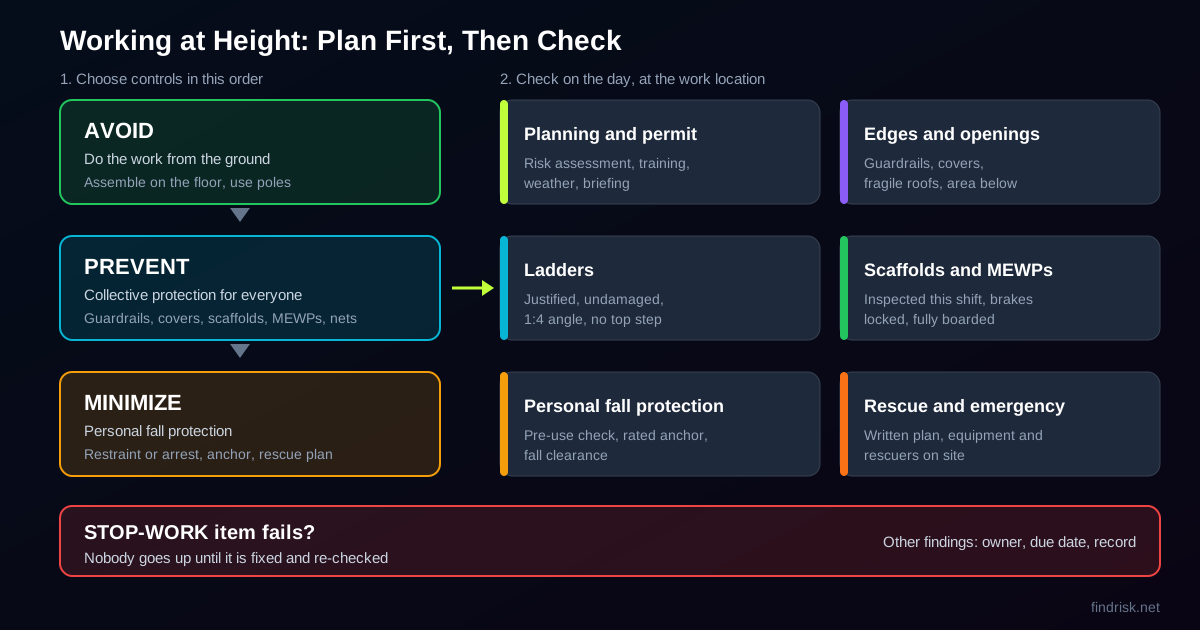
A checklist verifies controls. It cannot fix a plan that chose the wrong ones. Before any inspection, check the plan follows the order HSE sets out: avoid work at height where reasonably practicable, prevent falls using an existing safe place or the right equipment, and where the risk cannot be eliminated, minimize the distance and consequences of a fall (HSE).
In practice this means:
- Avoid. Could the task be done from the ground? Assemble on the floor and lift into place, use extension poles, or monitor equipment remotely. Turkish construction rules say the same: assembly that does not have to be done at height should, as far as possible, be done on the ground first.
- Prevent. Use collective protection that works for everyone without anyone's action: guardrails, covers, working platforms, scaffolds, mobile elevating work platforms (MEWPs), safety nets.
- Minimize. Only where prevention is not practicable, use personal fall protection: restraint that stops a worker reaching the edge, or fall arrest that stops a fall already happening.
This is the hierarchy of controls applied to falls. If the plan jumps straight to "harness and lanyard," raise it before you start ticking boxes.
The Pre-Task Working at Height Checklist
Use this list on the day, at the work location, before the task starts and again when conditions change (new crew, weather, a moved edge protection, a different access method). Mark each item Yes, No or N/A. Any "No" on an item marked [STOP] means work does not start until it is fixed.
Block 1: Planning and authorization
- A task-specific risk assessment or job safety analysis covers this job and this location. [STOP]
- The avoid → prevent → minimize order was followed, and the reason for any personal fall protection is written down.
- A permit to work is issued where your system requires one (roofs, fragile surfaces, work near live equipment), and its conditions match what you see.
- Workers are trained for the equipment they are using (harness, MEWP, scaffold tower) and can say what to do in a fall. [STOP] if not.
- Weather is suitable: no high wind, ice, heavy rain or lightning beyond the limits in the equipment manufacturer's instructions.
- The pre-task briefing or toolbox talk covered the edges, the access route and the rescue plan.
Block 2: Edges, openings and fragile surfaces
- Every open edge within reach of the work is protected by a guardrail with top rail, midrail and toeboard. For OSHA construction, the top rail is 42 inches ± 3 inches and must withstand 200 lb (1926.502(b)). [STOP] if an edge is open and no other protection is in place.
- Floor and roof openings are guarded or covered. Covers are secured, strong enough (OSHA: at least twice the load they may carry) and marked "HOLE" or "COVER."
- Fragile surfaces (roof lights, cement sheet, old skylights) are identified, and nobody works on or near them without stagings, covers or nets. [STOP]
- Any guardrail removed for a task has equivalent protection in place, and is put back when the task ends.
- The area below is barricaded or protected against falling objects, and people below wear hard hats.
Block 3: Ladders and stepladders
- A ladder is justified: the task is light, short and low risk, and a platform is not practicable. HSE guidance limits ladder work to light work of short duration, a maximum of 30 minutes at a time.
- The ladder is undamaged: rails straight, rungs and feet intact, locking bars working. Defective ladders are tagged "Do Not Use" and removed (1926.1053(b)(16)). [STOP]
- Leaning ladders are set at about 1 out for every 4 up, secured or footed, and extend at least 3 feet (0.9 m) above the landing they are used to reach.
- Nobody stands on the top step or top cap of a stepladder, and nobody carries loads that affect balance. Workers face the ladder when climbing.
- Non-conductive ladders are used near exposed energized electrical equipment.
Block 4: Scaffolds, towers and MEWPs
- The scaffold has a current inspection tag or record, and has been inspected before this shift by a competent person (1926.451(f)(3)). [STOP]
- Base plates and sole boards sit on firm, level ground. Mobile tower castors are locked. [STOP] if a tower can roll.
- Platforms are fully boarded, with no gaps or loose boards, and guardrails and toeboards are complete on all open sides.
- Safe access is provided (built-in ladder, stair tower). Nobody climbs the frame or cross-braces.
- Unfinished or modified sections are marked and physically closed off.
- The MEWP was pre-use checked by the operator, controls and emergency lowering work, and occupants use the fall protection and anchor point that the manufacturer specifies.
Block 5: Personal fall protection
- Harness, lanyard and connectors were checked by the user before use for cuts, abrasion, damaged stitching, heat or chemical damage, deformed hardware and a deployed energy absorber. [STOP] on any defect.
- Equipment carries its label and has a recorded detailed inspection within the interval set by your regime (see the next section).
- Anchors are designated, rated and located above the worker where possible. OSHA requires 5,000 lb (22.2 kN) per person attached, or a system designed by a qualified person with a safety factor of at least two (1910.140(c)(13)).
- Fall clearance is enough: the lanyard, energy absorber, harness stretch and worker height fit between the anchor and the nearest obstruction below. Under OSHA, free fall is limited to 6 feet and deceleration distance to 3.5 feet.
- Connectors are self-locking. Body belts are not used for fall arrest.
Block 6: Rescue and emergency
- A written rescue plan exists for this task, the rescue equipment is on site and the people named in the plan are present. [STOP]
- The rescue can reach a suspended worker quickly. OSHA requires "prompt rescue" (1910.140(c)(21)); a plan that relies on calling the fire service is rarely prompt.
- Communication works (radio or phone signal at height), and everyone knows who to call and where the nearest first aid is.
For a broader site-wide list, the construction site safety inspection checklist covers housekeeping, electrical, excavation and plant alongside falls.
Periodic Inspections: What to Check and How Often
The pre-task check catches today's problems. Periodic inspections catch slow deterioration that a quick look misses. Build both into your regime and keep records.
| Equipment | Before each use | Periodic / detailed inspection | Source |
|---|---|---|---|
| Harness, lanyards, webbing and rope | User check, tactile and visual, every time | At least every 6 months; at least every 3 months for frequent use in arduous conditions (demolition, steel erection, scaffolding). Recorded | HSE INDG367 |
| Personal fall arrest system (OSHA) | Before initial use during each work shift | Per manufacturer and your program | OSHA 1910.140(c)(18) |
| Equipment that arrested a fall | Remove from service immediately | Do not reuse; destroy or return to the manufacturer | OSHA 1910.140(c)(17), HSE INDG367 |
| Scaffolds (OSHA construction) | Competent person, before each shift and after any event that could affect integrity | Same | OSHA 1926.451(f)(3) |
| Construction working platforms, fall of 2 m or more (UK) | After assembly in any position | Within the previous 7 days, and after events such as severe weather; report kept | WAHR 2005 reg. 12 |
| Construction scaffolds (Türkiye) | Before use | Periodic inspection by an authorized person; every 6 months where the standard does not set a period | İş Ekipmanları Yönetmeliği Ek-III |
| Portable ladders | User check before use | Competent person, periodically and after any event that could affect safe use | OSHA 1926.1053(b)(15) |
| Anchor points and lifelines | Visual check before attaching | Per manufacturer and installer; after any fall | Manufacturer instructions |
Two points often missed in audits. First, the detailed inspection needs a named competent person and a record, not just a sticker. Second, anything that has stopped a fall is finished. HSE is blunt: a lanyard that has been used to arrest a fall "should never be reused."
In Türkiye, Annex III of the work equipment regulation was revised on 23 December 2025 (Official Gazette No. 33116), which widened the professions authorized to inspect scaffolds. Check the current consolidated text for the period and the authorized person.
Stop-Work Findings vs Fix-and-Record Findings
Not every "No" is equal. Separate the findings that mean nobody goes up from the ones you fix and record. This keeps the checklist from turning into a list of equally weighted ticks.
| Stop work until fixed | Fix promptly and record |
|---|---|
| Open edge or unguarded opening within reach, with no other protection | Missing toeboard section where no one works below |
| Harness, lanyard or connector with any defect, or no label | Inspection record not on site but confirmed by phone |
| Scaffold not inspected this shift, or tagged unsafe | Minor housekeeping on the platform |
| Mobile tower that can roll, or on soft ground | Faded edge marking on a warning line |
| No rescue plan, or rescuers and equipment not present | Briefing held but not signed |
| Work on or next to a fragile surface without protection | Ladder storage untidy |
| Weather beyond the equipment's limits |
When a stop-work finding is fixed, re-check that item on the spot and record who fixed it and when. For findings in the right-hand column, give each an owner and a date, as you would any corrective action.
Scoring Working at Height Findings: Three Examples
A risk score turns a list of findings into a priority order. Here are three typical findings scored with the Fine-Kinney scales from our Fine-Kinney examples (Risk = Probability × Exposure × Consequence). The values are illustrative; your team should score its own site.
| Finding | Before: P × E × C | Risk | Control applied | After: P × E × C | Risk |
|---|---|---|---|---|---|
| Open roof hatch next to a daily work area, no guard or cover | 3 × 6 × 15 | 270 (High) | Hinged guardrail around the hatch; hatch closed when not in use | 0.5 × 6 × 15 | 45 (Possible) |
| Webbing lanyard with a cut at the edge, used weekly | 3 × 3 × 15 | 135 (Substantial) | Lanyard destroyed; pre-use check training; 6-month detailed inspection logged | 1 × 3 × 15 | 45 (Possible) |
| Stepladder used from the top step for daily ceiling work | 6 × 6 × 7 | 252 (High) | Replaced with a podium step with guardrails | 1 × 6 × 7 | 42 (Possible) |
Scales used: P 6 = quite possible, 3 = unusual but possible, 1 = only remotely possible, 0.5 = conceivable but very unlikely; E 6 = frequent (daily), 3 = occasional (weekly); C 15 = very serious, one fatality, 7 = serious injury.
The table makes one pattern visible. The two engineering fixes (guardrail, podium) cut probability for everyone who uses the area. The lanyard fix depends on people doing the pre-use check every time, which is why a residual score of 45 still deserves follow-up in the next inspection.
Common Mistakes With Working at Height Checklists
1. Checking the harness but not the anchor
Teams inspect the equipment they can hold and forget what it is clipped to. A perfect harness on an unrated anchor, a handrail or a conduit is not fall protection.
2. No fall clearance calculation
A 2 m lanyard with an energy absorber needs far more than 2 m of clear space below the anchor. Without the calculation, a worker can hit the floor or a lower structure before the fall is arrested.
3. Treating "rescue" as a phone number
A worker suspended in a harness needs to be reached quickly. If the plan is to call emergency services, check how long they would take to reach that roof or that tank.
4. Ticking the scaffold tag without looking
A green tag says someone inspected it at some point. It does not show that a board was moved at 10:00. Walk the platform, look at the base and check the guardrails yourself.
5. One checklist for every task
Roof work, MEWP work and ladder work share a core, but each has its own critical items. Mark the blocks that apply and add task-specific items rather than using one generic sheet.
6. No record of what failed
A checklist full of "Yes" with no findings is either a very good site or a quick walk. Record failed items with a photo and a location, so the next inspection can check the fix.
How FindRisk Supports Working at Height Inspections
FindRisk lets you turn this checklist into an inspection you run on your phone. Its AI checklist generator can build a working at height checklist for the specific task and site you describe, such as roof work or a mobile scaffold tower, which you can then adjust to your own procedure.
During the walk-through you can photograph an open edge, a damaged lanyard or an unlocked castor and mark the hazard directly on the photo, with AI analysis to help spot hazards you might have missed. Findings can be scored with the built-in Fine-Kinney risk assessment, and the inspection becomes a professional report in seconds, ready to send to the contractor or site manager. FindRisk runs on iOS and Android.
Frequently Asked Questions
What height is considered working at height?
There is no single height. In the UK and Türkiye, working at height means any place where a fall could cause injury, with no minimum. OSHA sets thresholds for when fall protection is required: 4 feet in general industry, 6 feet in construction and 10 feet on scaffolds. A fall from a stepladder can still cause serious injury, so check every task where a fall is possible.
How often should a safety harness be inspected?
Every harness should be checked by the user before each use, by touch and by eye. HSE recommends a recorded detailed inspection by a competent person at least every six months, and at least every three months for frequently used equipment in arduous work such as scaffolding or steel erection. Follow the manufacturer's instructions, and remove any harness that has arrested a fall.
Who can inspect a scaffold?
A competent person, meaning someone with the training and experience to recognize scaffold defects. Under OSHA construction rules, a competent person inspects the scaffold before each shift and after any event that could affect its integrity. In the UK, construction working platforms are inspected after assembly and at least every seven days. In Türkiye, periodic scaffold inspections are done by persons authorized under the work equipment regulation.
Is using a ladder allowed for work at height?
Yes, but only when a safer option is not justified. HSE guidance allows ladders for light work of short duration, up to 30 minutes at a time, where the risk is low. Turkish work equipment rules have a similar condition. For longer or heavier tasks, use a platform, podium step, scaffold tower or MEWP instead.
Do you need a rescue plan for working at height?
Yes, whenever personal fall protection is used. OSHA requires employers to provide prompt rescue of anyone who falls, and Turkish construction rules require falls from height to be covered in the emergency plan. The plan should name the rescuers, list the equipment on site and describe how a suspended worker is brought down without relying only on outside emergency services.
Does working at height require a permit?
The law does not require a permit for all work at height, but many organizations require one for higher-risk tasks such as roof work, fragile surfaces or work near live equipment. A permit to work adds a formal check that controls are in place before the job starts and a handback when it ends.
Conclusion
A working at height checklist works when it follows the job: a plan that avoids and prevents falls before it relies on harnesses, a pre-task check at the location on the day, a periodic inspection regime for harnesses, ladders and scaffolds, and a clear line between findings that stop work and findings that can be fixed and recorded.
Use the 30 items above as a base, mark the stop-work items for your site, and score the findings so the worst ones are fixed first. Rescue belongs on the list every time personal fall protection is used.
To run this checklist on your next inspection, download FindRisk, generate a working at height checklist for your task, and mark every finding directly on a photo.
Try FindRisk
Ready to modernize your safety workflow?
Conduct AI-powered risk assessments, generate reports instantly, and keep your team safe — anywhere, anytime.