
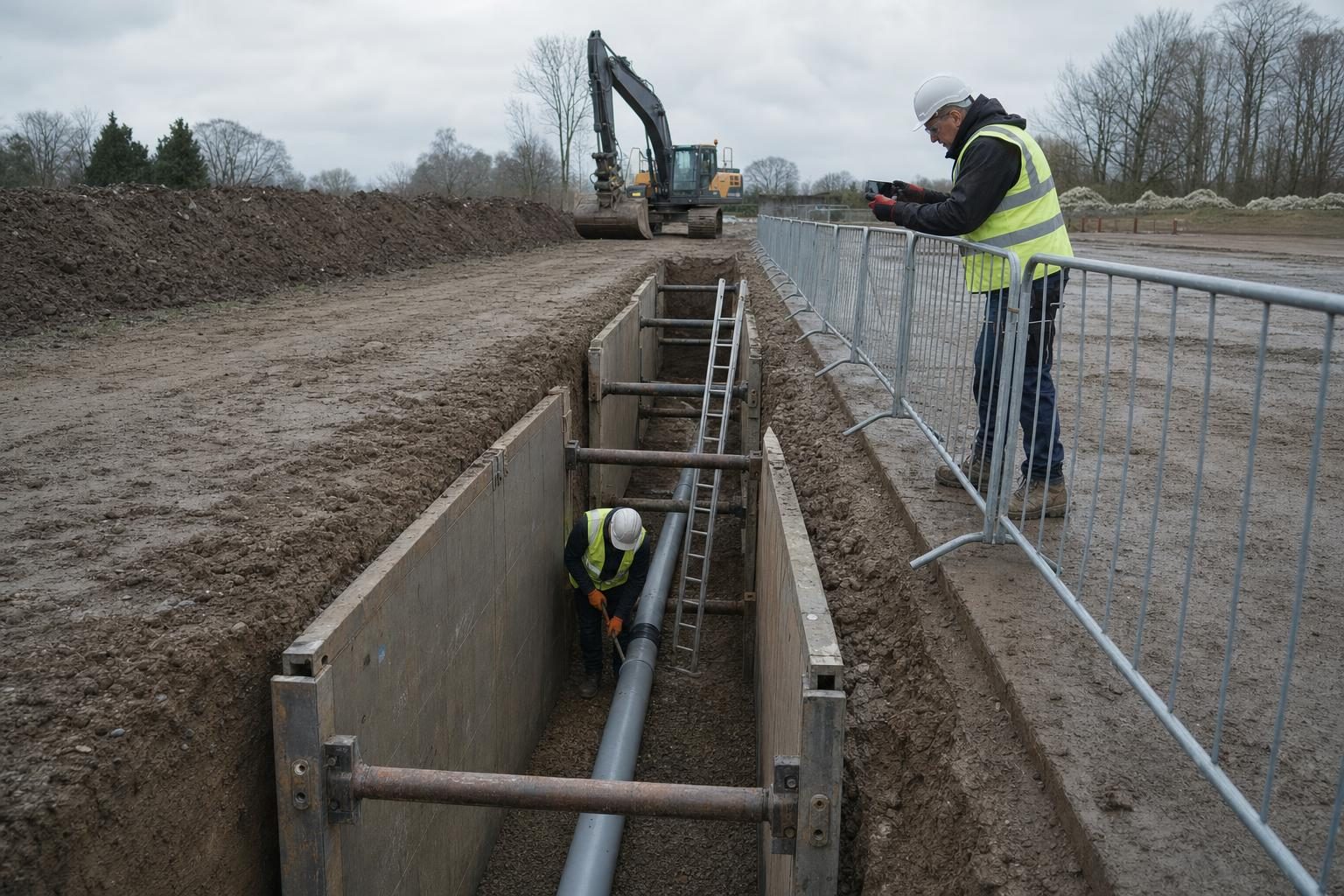
Excavation Safety Checklist: 32 Daily Checks for Trenches
An excavation safety checklist is the list a competent person works through before anyone enters a trench or excavation, and again whenever conditions change. It confirms utilities are located, the soil is classified, the protective system matches the depth and soil, spoil is kept back, a way out is close by, the air is safe and water is controlled.
Trench work kills people every year. OSHA counted 39 deaths in trench or excavation work in the US in 2022, more than double the 2021 figure, and Bureau of Labor Statistics data showed 166 workers killed in trench cave-ins from 2011 to 2018, an average of 21 a year (OSHA, 2023). By late June 2025, OSHA had received reports of 11 trench-related deaths that year. Its reminder of why: "one cubic yard can weigh as much as a car" (OSHA, 2025).
Most excavation checklists online are bare yes/no forms. This one groups the checks by hazard, cites the rule behind every threshold (OSHA 29 CFR 1926 Subpart P, UK CDM 2015 and Türkiye's construction OHS regulation), and adds what a form leaves out: protective system choice, re-inspection triggers, stop-work findings and three scored examples.
What OSHA Found After One Trench Collapse
On 18 November 2025, at a worksite in Yarmouth, Massachusetts, workers were removing sandy soil and installing steel plates outside a trench when the backfilled sand collapsed and trapped two of them. One worker died and the other was seriously injured. In April 2026, OSHA cited the contractor for 7 willful, 33 repeat and 17 serious violations, with $4,699,362 in proposed penalties (OSHA, 2026). The release notes that the penalties may not reflect the final outcome of the case.
The conditions OSHA cited read like the blocks of a daily checklist:
| Cited condition | Checklist block below |
|---|---|
| Unsupported underground utilities | Block 1: services and structures |
| Inadequate cave-in protection, shoring not installed per the design, a damaged protective system | Block 2: soil and cave-in protection |
| Spoil piles within two feet of the excavation | Block 3: spoil, materials and edges |
| No safe way to exit the trench | Block 4: access and egress |
None of these needs special equipment to spot. Each one needs someone to look, every shift, with a list that does not skip it.
What Is an Excavation Safety Checklist?
An excavation safety checklist is a structured inspection record that a competent person completes at the excavation to confirm that cave-in protection, access, atmosphere, water, spoil and traffic controls are in place before workers enter. It is the written form of the daily inspection that OSHA, the UK and Türkiye all require.
The terms on the checklist have precise meanings:
| Term | Meaning | Source |
|---|---|---|
| Excavation | "Any man-made cut, cavity, trench, or depression in an earth surface, formed by earth removal" | 29 CFR 1926.650 |
| Trench | A narrow excavation, generally deeper than it is wide, no wider than 15 feet (4.6 m) at the bottom | 29 CFR 1926.650 |
| Cave-in | Soil or rock separating from the side of an excavation, or soil lost from under a shield or support, in a quantity that could trap or injure someone | 29 CFR 1926.650 |
| Protective system | Sloping, benching, shoring or shielding that protects workers from cave-ins | 29 CFR 1926.650 |
| Competent person | Someone able to identify existing and predictable hazards and authorized to take prompt corrective action | 29 CFR 1926.650 |
| Tabulated data | Tables and charts approved by a registered professional engineer, used to design a protective system (shoring and trench box manufacturers publish them) | 29 CFR 1926.650 |
In the UK, CDM 2015 regulation 22 forbids work in a supported or battered excavation until a competent person has inspected it (legislation.gov.uk). In Türkiye, excavation work must be supervised by a competent person (ehil kişi) appointed by the employer, and the excavation faces must be checked before every shift (Yapı İşlerinde İSG Yönetmeliği, Annex 4, Part B, articles 63 and 64).
Key Excavation Thresholds at a Glance
Most numbers on an excavation checklist come from OSHA. Turkish regulation describes the same controls with almost no figures, and the UK rules set none for depth: HSE's position is that "no ground can be relied upon to stand unsupported in all circumstances" (HSE).
| Item | OSHA (29 CFR 1926 Subpart P) | Türkiye (Annex 4, Part B) |
|---|---|---|
| Cave-in protection | Required unless the cut is entirely in stable rock, or under 5 ft (1.52 m) deep and a competent person finds no sign of a potential cave-in (1926.652(a)) | Slope angle and/or statically calculated support, set from soil, climate, vibration, water and loads (art. 63(c)); no depth figure |
| Engineer design | Sloping or benching deeper than 20 ft (6.1 m) designed by a registered professional engineer | Statically calculated supports where needed (art. 63(c)) |
| Ladder, stair or ramp | In trenches 4 ft (1.22 m) or deeper, within 25 ft (7.62 m) of lateral travel (1926.651(c)(2)) | Safe means of access; supports are not used as ladders (art. 63(b), 70) |
| Spoil and materials | At least 2 ft (0.61 m) from the edge, or retaining devices (1926.651(j)(2)) | "Sufficient distance," barrier if spoil could flow in (art. 68) |
| Atmosphere | Test before entry deeper than 4 ft where a hazardous atmosphere could exist; below 19.5% oxygen is deficient; flammable gas kept below 20% of the lower flammable limit (1926.651(g)) | Breathable, harmless air; workers removed at once if harmful gas or dust is found (art. 63(d), 65) |
| Water | No work in accumulated or accumulating water without adequate precautions (1926.651(h)) | No excavation work during rain (art. 69) |
| Walkways over the excavation | Guardrails where 6 ft (1.8 m) or more above the bottom (1926.651(l)) | In built-up areas, at least 80 cm wide with guardrails on both sides (art. 66) |
| Trench box gap | Digging up to 2 ft below the shield bottom, only if the shield is rated for full depth and no soil is lost (1926.652(g)(2)) | Not specified |
Two practical rules follow. First, these are legal minimums, not safe limits. A trench under 5 feet in wet, previously disturbed ground can still collapse, which is why the 5-foot exception depends on a competent person's examination. Second, where a Turkish or UK site uses the 2-foot spoil rule or the 25-foot travel distance to a ladder, it is applying OSHA as good practice. Write that into the site procedure so the number has an owner.
Choose the Protective System Before You Inspect It
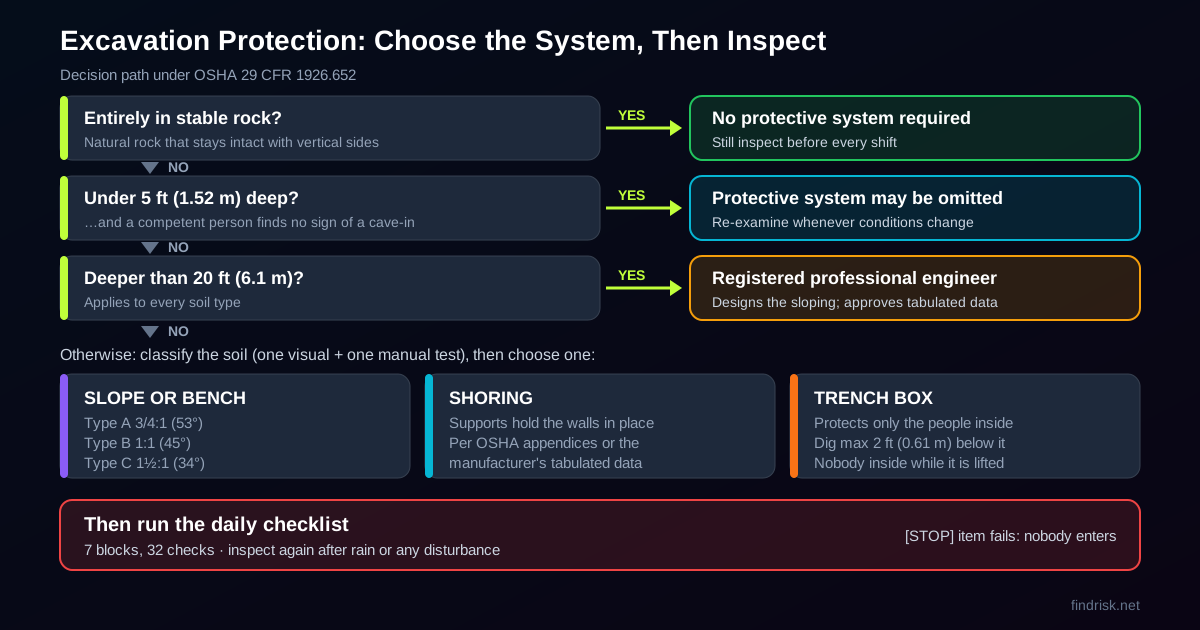
A daily checklist confirms that a protective system is in place and working. It cannot tell you which system the job needed. That choice comes first, and HSE advises deciding on temporary support before digging starts, with the equipment on site before work begins. Under 29 CFR 1926.652 the decision runs in a short sequence:
- Is the cut entirely in stable rock? If so, no protective system is required.
- Is it under 5 feet deep, and has a competent person examined the ground and found no indication of a potential cave-in? If so, a system is not required, but the daily inspection still is.
- Is it deeper than 20 feet? Sloping or benching must then be designed by a registered professional engineer, and supports or shields must come from engineer-approved tabulated data or an engineer's design.
- Otherwise, classify the soil and choose: slope or bench to the angle in Appendix B, or install shoring or a trench box according to the manufacturer's tabulated data.
Soil classification is done by a competent person using at least one visual and one manual test, such as rolling a thread of soil, thumb penetration or a pocket penetrometer (Appendix A). It must be redone when conditions change.
| Soil type | Description | Unconfined compressive strength | Maximum slope, under 20 ft deep |
|---|---|---|---|
| Stable rock | Natural solid mineral material that stays intact with vertical sides | n/a | Vertical (90°) |
| Type A | Cohesive soil such as clay; cannot be Type A if fissured, subject to vibration, previously disturbed or in layers dipping into the cut at 4H:1V or steeper | 1.5 tsf (144 kPa) or more | 3/4H:1V (53°) |
| Type B | Cohesive soil of medium strength; also granular soils such as angular gravel and silt | Over 0.5 and under 1.5 tsf | 1H:1V (45°) |
| Type C | Weak cohesive soil, granular soils, submerged soil or soil with freely seeping water | 0.5 tsf (48 kPa) or less | 1½H:1V (34°) |
Source: Appendix B, Table B-1. A short-term slope of 1/2H:1V (63°) is allowed in Type A soil for excavations 12 feet or less deep. OSHA's simplest option, 1926.652(b)(1), skips classification and slopes at 1½H:1V, the Type C angle.
Know which system you are inspecting. Shoring supports the trench walls so they do not move. A shield (trench box) does not stop a cave-in; it protects the people inside it. With shoring, the checklist asks whether every member is in place as designed. With a shield, it asks whether people stay inside it and whether the gap below it stays within limits.
The Daily Excavation Safety Checklist
Use this list at the excavation, before the first entry of the shift, and again after any trigger in the next section. Mark each item Yes, No or N/A. A "No" on any item marked [STOP] means nobody enters until it is fixed.
Block 1: Services, structures and planning
- Utility owners were contacted before digging and locate marks are visible on the ground. In the US, 811 reaches the one-call center, and every state requires the call 48 to 72 hours before digging (PHMSA). [STOP] if nobody has located the services.
- Near marked services, the exact location was confirmed by safe means, such as careful hand excavation or detection equipment, before machines dig close (1926.651(b)(3)).
- Exposed services are supported, protected or removed while the excavation is open (1926.651(b)(4)). [STOP] for an unsupported gas or water main.
- Nearby buildings, walls, pavements and poles were assessed, and shoring, bracing or underpinning is in place where their stability is at risk. Nobody digs below a foundation unless a 1926.651(i)(2) condition is met.
- The excavation is covered by the site plan or a permit to work, and the chosen protective system and its equipment were on site before digging started.
- Overhead power lines near the dig and the truck route are identified and controlled. HSE warns of arcing and electrocution from raised tipper bodies and excavators.
Block 2: Soil and cave-in protection
- A competent person classified the soil with at least one visual and one manual test, and reclassified it after rain, seepage or new vibration. Without a classification, the only sloping option is 1½H:1V, the Type C angle.
- The protective system matches the depth and soil: the slope angle from Table B-1, or shoring or a shield used within the manufacturer's tabulated data. [STOP] if a trench 5 feet or deeper has no protective system.
- No sign of movement: tension cracks along the edge, bulging or sloughing walls, soil falling from the face, water seeping from the wall. [STOP] on any of these.
- Shoring is installed as designed, with every strut, cylinder and waler in place.
- Shoring and shield components are free of damage. Damaged parts are taken out of service until a competent person evaluates them (1926.652(d)). [STOP]
- With a trench box, everyone works inside it, the dig is no more than 2 feet below the bottom of the shield, and nobody is inside while it is installed, removed or moved vertically. [STOP]
- When supports come out, removal starts at the bottom and backfilling follows it up.
Block 3: Spoil, materials and edges
- Spoil, pipes, materials and equipment are at least 2 feet (0.61 m) from the edge, or held back by retaining devices. [STOP] if spoil sits on the edge above people in the trench.
- Loose rock and soil on the face are scaled off or held back by barricades.
- Edges where people could fall in are protected by barriers, and the excavation is fenced off from the public in built-up areas. For falls into deep excavations, apply the same edge rules as the working at height checklist.
- Walkways across the excavation have guardrails where they are 6 feet (1.8 m) or more above the bottom.
- Nothing heavy surcharges the edge: no parked plant, stacked pipe or crane outrigger close to the sides. HSE advises against parking plant and vehicles near excavation sides.
Block 4: Access and egress
- Trenches 4 feet (1.22 m) or deeper have a ladder, stairway or ramp within 25 feet (7.62 m) of lateral travel for every worker. [STOP]
- The ladder stands inside the shield or the shored section, so nobody climbs out through unprotected ground.
- Ladders extend at least 3 feet above the landing (1926.1053(b)(1)), are secured and are undamaged.
- Ramps used only by workers were designed by a competent person; ramps for equipment by someone qualified in structural design. Nobody climbs struts, walers or box walls to get in or out.
Block 5: Atmosphere and water
- Where a hazardous atmosphere could exist (landfill, stored chemicals or fuel, a damaged gas or sewer line), the air was tested before entry into excavations deeper than 4 feet: oxygen at least 19.5%, flammable gas below 20% of the lower flammable limit. [STOP]
- Testing is repeated as often as needed while ventilation or other controls are in use.
- No petrol or diesel engine runs in the excavation unless the exhaust is ducted away or forced ventilation is provided (HSE).
- Rescue equipment such as breathing apparatus, a harness and a line is ready where the atmosphere could turn hazardous. Deep, narrow pits may also meet the definition in our confined space entry guide.
- Nobody works in accumulated or rising water unless precautions are in place, pumps are watched by a competent person, and surface water is diverted away from the excavation. [STOP] if water is rising and no precautions are in place.
Block 6: Plant, traffic and loads
- Nobody stands under loads lifted or swung by excavators or cranes, and workers stay clear of vehicles being loaded or unloaded (1926.651(e)).
- Where an operator cannot see the edge clearly, a warning system is used: barricades, hand or mechanical signals, or stop logs (1926.651(f)).
- Workers exposed to public traffic wear high-visibility vests, and nobody stands in the excavator's swing area.
Block 7: Inspection, people and rescue
- A named competent person inspected the excavation, adjacent areas and protective system before work this shift, and signed the record (1926.651(k)(1)). [STOP]
- The crew was briefed on today's hazards, knows to leave the trench at once on seeing cracks, water or falling soil, and knows how a trapped worker would be reached without sending others into unprotected ground.
For a site-wide inspection that puts excavations next to scaffolds, plant and electrics, use the construction site safety inspection checklist.
When to Inspect Again During the Shift
An excavation inspected at 7:00 can be a different excavation by 13:00. All three rule sets require the inspection to be repeated after events, not just at the start of the day:
| Trigger | OSHA 1926.651(k) | UK CDM 2015 reg. 22(4) | Türkiye, Annex 4 Part B art. 64 |
|---|---|---|---|
| Start of work | Prior to the start of work | At the start of the shift | Before every shift |
| During the shift | As needed throughout the shift | Not specified | Not specified |
| Rain and weather | After every rainstorm | After any event likely to affect strength or stability | After heavy rain, frost or snow |
| Material falls | After any hazard-increasing occurrence | After any material unintentionally falls or is dislodged | After unexpected falls of material |
| Damage to supports | Damaged material examined by a competent person (1926.652(d)) | After any event likely to affect stability | After significant damage to supports |
| Blasting | After any hazard-increasing occurrence | After any event likely to affect stability | After each blast |
In practice, treat these as hazard-increasing events too: a pile driver or compactor starting nearby, a loaded truck parked near the edge, a burst water main, the trench box being moved, or a new cut opened alongside.
When an inspection finds a problem, people come out first. OSHA requires exposed employees to be removed until precautions are taken (1926.651(k)(2)). CDM 2015 says work must not resume until the matter "has been satisfactorily remedied," and the Turkish regulation says work does not start until the excavation is found safe.
Stop-Work Findings vs Fix-and-Record Findings
Not every "No" carries the same weight. Splitting findings into two groups keeps the checklist from becoming a list of equal ticks.
| Stop work until fixed | Fix promptly and record |
|---|---|
| Trench 5 ft or deeper with no protective system, or any trench showing cracks, bulging or sloughing | Warning tape broken on a section away from today's work |
| Damaged shield or shoring, or shoring not installed as designed | Inspection done but the record not yet signed |
| Workers outside the trench box, or the dig too far below it | Locate marks fading in an area with no digging planned today |
| Spoil, materials or plant at the edge above workers | Untidy tool storage on the berm, beyond 2 ft from the edge |
| No ladder or ramp within 25 ft in a trench 4 ft or deeper | Briefing held but attendance not recorded |
| Missing atmosphere test where a hazardous atmosphere could exist | Minor gaps in the site sign layout |
| Exposed gas or water main left unsupported | |
| Rising water with no pumping or monitoring | |
| No competent person inspection this shift |
When a stop-work item is fixed, re-check it on the spot and record who fixed it and when. Give each item in the right-hand column an owner and a due date, as you would any corrective action.
Scoring Excavation Findings: Three Examples
A risk score turns findings into a priority order. The three findings below are scored with the Fine-Kinney scales used in our Fine-Kinney examples (Risk = Probability × Exposure × Consequence). That post already scores an unsupported trench; these cover three other findings that daily inspections often turn up. The values are illustrative; your team should score its own site.
| Finding | Before: P × E × C | Risk | Control applied | After: P × E × C | Risk |
|---|---|---|---|---|---|
| Spoil heaped at the edge of a 1.8 m trench with a trench box; crew in the trench daily | 3 × 6 × 15 | 270 (High) | Spoil moved beyond 2 ft and kept on one side; edge checked at each inspection | 0.5 × 6 × 15 | 45 (Possible) |
| Ladder placed at the open end of the trench, outside the box; workers climb through unprotected ground several times a day | 6 × 6 × 15 | 540 (Very high) | Work stopped; ladder moved inside the box; end of the trench sloped back | 0.5 × 6 × 15 | 45 (Possible) |
| Exposed gas main spanning the trench without support; pipe laid beneath it daily | 1 × 6 × 40 | 240 (High) | Work under the main stopped; main supported as the utility owner specified; bucket kept clear | 0.2 × 6 × 40 | 48 (Possible) |
Scales used: P 6 = quite possible, 3 = unusual but possible, 1 = only remotely possible, 0.5 = conceivable but very unlikely, 0.2 = practically impossible; E 6 = frequent (daily); C 40 = disaster, a few fatalities, 15 = very serious, one fatality. Risk classes: above 400 very high, 200–400 high, 20–70 possible.
Why these values. The ladder scores highest because the unsafe act happens many times a day by design, so P is 6, not 3. The gas main has a low probability (1) but a consequence of 40, because a ruptured main can burn or injure everyone in and around the trench. All three residual scores sit in the "possible" band, which means the controls need checking at every inspection, not that the hazard is gone.
Common Mistakes With Excavation Checklists
1. Treating the trench box as the whole answer
A shield protects only the people inside it. Workers step out of the open end to guide a pipe, the dig drops further below the box than its rating allows, or the box is lifted while someone is still in it. Each one puts a person in unprotected ground next to a protected trench.
2. Classifying the soil once
Soil that was Type B on Monday can behave like Type C after a night of rain. Backfilled ground is previously disturbed soil, which can never be Type A under Appendix A. The Yarmouth collapse involved backfilled sand. Reclassify whenever conditions change and write the reason on the record.
3. Inspecting at the start of the shift only
A checklist with one time stamp per day usually means the afternoon storm was never followed by a second look. Use the triggers table above.
4. Treating 5 feet as a safe depth
Five feet is OSHA's threshold for when a protective system is mandatory, and even below it the exception depends on a competent person's examination. A worker kneeling in a 4-foot trench has their head and chest below the top of the wall. HSE does not set a safe depth at all.
5. Leaving spoil "just for now"
Spoil dropped at the edge to finish a run loads the wall, can roll back onto the crew and blocks the way out. Plan where the spoil goes before digging and check the 2-foot line at every inspection.
How FindRisk Supports Excavation Inspections
FindRisk turns this checklist into an inspection you run on your phone. Its AI checklist generator can build an excavation checklist for the job you describe, such as a utility trench with a trench box or a basement dig next to a neighboring building, which you can then adjust to your own procedure and local rules.
At the trench you can photograph a crack along the edge, a spoil heap or a ladder outside the shield and mark the hazard directly on the photo, with AI analysis to help spot hazards you might have missed. Findings can be scored with the built-in Fine-Kinney risk assessment, and the inspection becomes a professional report in seconds, ready for the site manager or the contractor. FindRisk runs on iOS and Android.
Frequently Asked Questions
How deep can a trench be before it needs shoring or a trench box?
Under OSHA, a protective system is required in excavations 5 feet (1.52 m) or deeper, unless the cut is entirely in stable rock. Below 5 feet, a system can be omitted only if a competent person examines the ground and finds no sign of a potential cave-in. Excavations deeper than 20 feet need a system designed or approved by a registered professional engineer. UK and Turkish rules set no safe depth.
What is a competent person for excavations?
OSHA defines a competent person as someone who can identify existing and predictable hazards and is authorized to take prompt corrective measures to eliminate them. On an excavation, the competent person classifies the soil, inspects the trench and protective system every shift, and has the authority to stop work and pull people out. UK and Turkish rules also require excavations to be inspected or supervised by a competent person.
How far back must spoil be kept from the edge of a trench?
OSHA requires excavated material and equipment to be kept at least 2 feet (0.61 m) from the edge, or held back by retaining devices, or both. Turkish regulation requires a "sufficient distance" without giving a number, plus a barrier if spoil could flow back in. In wet or loose ground, a greater distance is often needed to avoid loading the wall.
When is a ladder required in a trench?
OSHA requires a stairway, ladder, ramp or other safe means of exit in trench excavations 4 feet (1.22 m) or deeper, placed so that no worker has to travel more than 25 feet (7.62 m) sideways to reach it. Put the ladder inside the protected area and extend it at least 3 feet above the top so workers can step off safely.
Do you need to test the air in a trench?
Yes, where a hazardous atmosphere exists or could reasonably be expected, such as near landfills, stored hazardous substances or gas lines. OSHA requires testing before workers enter excavations deeper than 4 feet. Air with less than 19.5% oxygen is oxygen deficient, and flammable gas must be kept below 20% of its lower flammable limit.
Conclusion
An excavation safety checklist works when it follows the excavation through the day: services located before digging, a protective system chosen for the depth and soil, a competent person inspecting before every shift and after every rainstorm or disturbance, and a clear line between findings that stop work and findings that can be fixed and recorded.
Use the 32 items above as the base for your own list. Mark the stop-work items, add the rules that apply where you work, and score the findings so the worst are fixed first. The cited conditions in the Yarmouth case show how ordinary the gaps tend to be.
To run this checklist on your next site walk, download FindRisk, generate an excavation checklist for your job and mark every finding directly on a photo.
Try FindRisk
Ready to modernize your safety workflow?
Conduct AI-powered risk assessments, generate reports instantly, and keep your team safe — anywhere, anytime.