
Lifting Plan: Lift Categories, Contents and a Filled Example
A lifting plan is the written record of how one lifting operation will be carried out safely: the load and its verified weight, the crane and its configuration, the working radius and chart capacity, the rigging, the ground, the hazards around the lift, the people and their roles, and the sequence from set-up to landing. UK law requires every lifting operation to be planned by a competent person.
Most pages on this topic are templates. They tell you which boxes exist, not what to write in them or how to know when a one-page generic plan is enough and when you need a site visit, an engineer and a rehearsal. The decisions that matter are made with a handful of numbers: the gross load, the radius, the percentage of the chart, the sling angle and the pressure under the outrigger pads.
This guide works through those numbers for one mobile-crane lift, explains the lift categories used in UK and US practice, maps the contents of a plan to the rules behind them in the UK, the US and Türkiye, and ends with a filled plan you can copy.
A Rooftop Unit, a Street and an Overhead Line
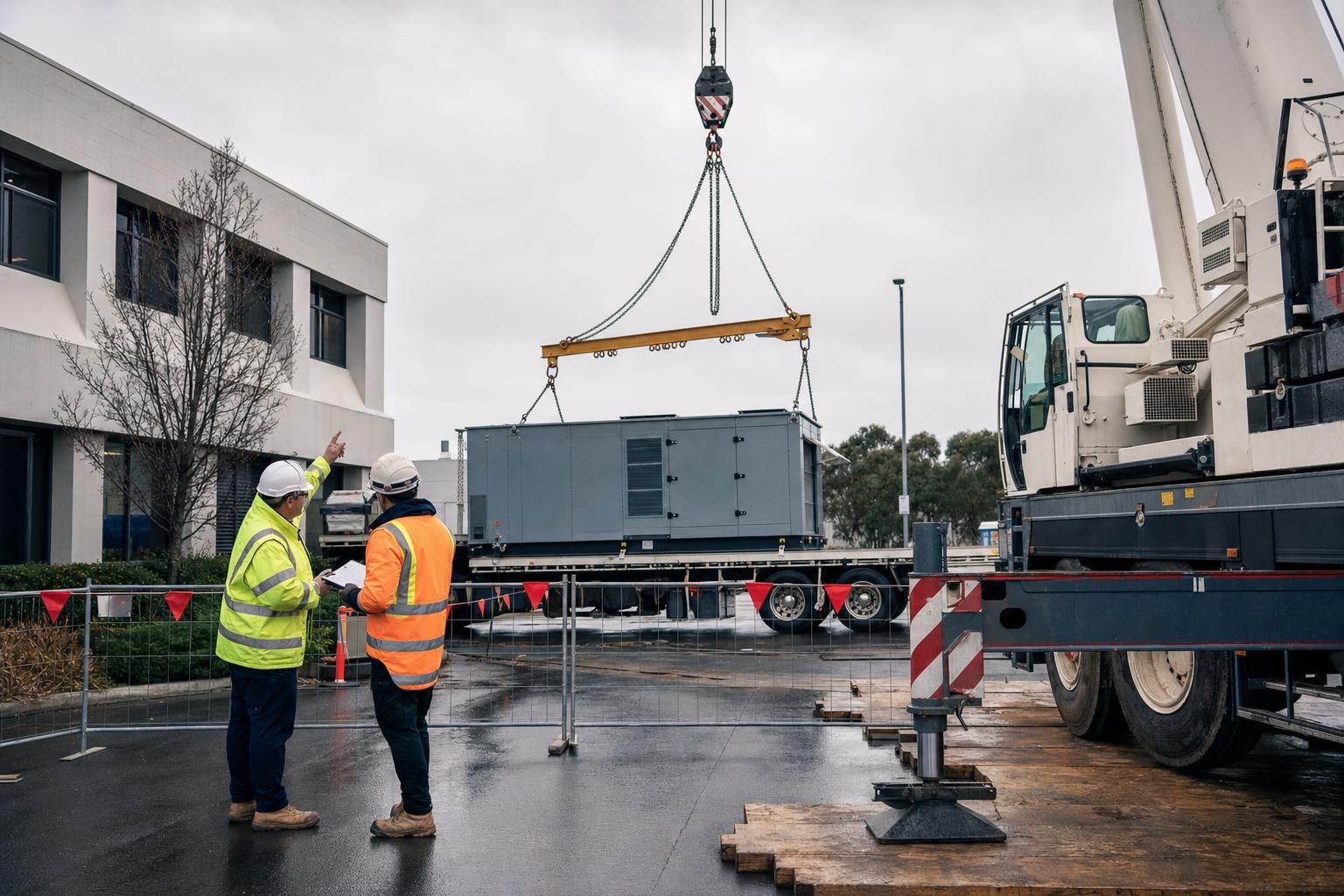
Picture a two-storey office building on a city street. This is a fictional example built for this guide. A new air-handling unit has to go onto the roof: the manufacturer's data sheet says 7,800 kg, 4.0 m long, 2.2 m wide and 2.4 m high, with four lifting lugs on top. The only place for a mobile crane is the car park beside the building. An overhead distribution line runs along the street on the other side of the crane. The delivery truck will park on the street.
The site manager has hired cranes before and asks for "the usual plan". The lift planner says no. The load is large and has a sail area, the lift passes over a building in which people work, the landing point is out of the operator's sight, and there is a power line within reach of the boom. Each of those facts moves the lift up a category and adds items to the plan. The rest of this guide shows what the planner wrote and why.
What Is a Lifting Plan?
A lifting plan is the document that turns a risk assessment of a lifting operation into a safe system of work. In the UK, regulation 8 of the Lifting Operations and Lifting Equipment Regulations 1998 (LOLER) requires every lifting operation involving lifting equipment to be "properly planned by a competent person", "appropriately supervised" and "carried out in a safe manner". HSE's construction guidance says the plan should result in a safe system of work and that this information should be recorded, "sometimes called a method statement".
| Term | Meaning |
|---|---|
| Lifting operation | An operation concerned with the lifting or lowering of a load (LOLER reg. 8(2)) |
| Lift planner / appointed person | The competent person who plans the lift and signs the plan; "appointed person" is the BS 7121 term |
| Lift director | US term (OSHA 1926.1432) for the person who directs a multiple-crane lift and reviews the plan with the crew |
| Rated capacity | The maximum working load the manufacturer permits for a given configuration, radius and boom length |
| Working radius | Horizontal distance from the crane's center of rotation to the hook; capacity falls as radius grows |
| Gross load | Everything the crane lifts: the load plus slings, shackles, spreader beams and the hook block. OSHA's definition of "load" includes the load-attaching equipment |
| Fall zone | The area, including directly beneath the load, where suspended materials could fall; kept clear except for rigging and landing tasks |
| Derating | Any reduction of the chart capacity for the actual set-up: partially extended outriggers, slewing sector, wind, attachments |
The plan is not the crane hire quotation and it is not the crane's thorough-examination certificate, although it refers to both. In practice it sits inside or alongside the risk assessment and method statement (RAMS) for the task and is a condition of the permit to work where the site runs one.
Lift Categories: Basic, Standard and Complex
The amount of planning should be proportionate to the foreseeable risk. HSE puts it this way: for straightforward, common lifts a single generic plan may be enough and can form part of the normal risk assessment; slightly more complex routine lifts "may, depending on the circumstances, need to be planned each time"; complex, high-risk lifts such as a tandem lift with two cranes must be planned "extensively and meticulously" (HSE, planning lifting operations).
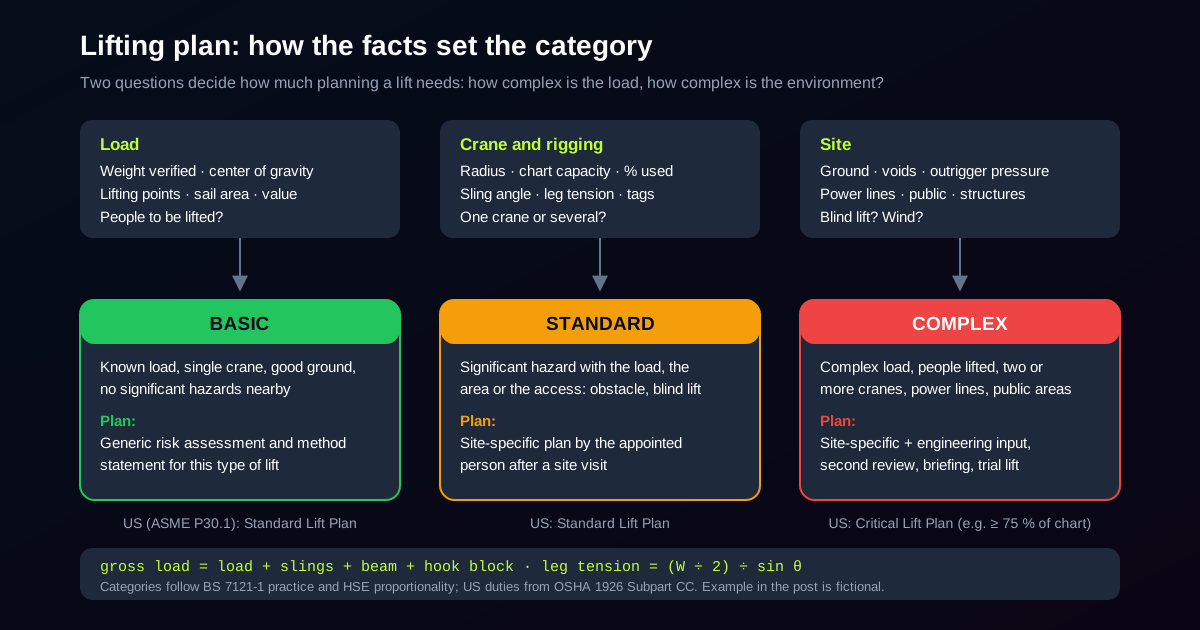
UK practice formalizes this in the code of practice BS 7121-1:2016, which groups crane lifts into three categories. The standard is paywalled, so the table below describes the categories as they are used in the industry rather than quoting it.
| Category | What makes a lift fall into it | Planning expected |
|---|---|---|
| Basic | A load whose weight and center of gravity are easily established, a single crane, good ground, no significant hazards in the area. Example: unloading pallets or bags beside a truck in an open yard | A generic risk assessment and method statement for that type of lift, by a competent person; the crew plans the details |
| Standard | Significant hazards with the load, the working area or the crane's access route: a lift over an obstacle, a blind lift, limited space, nearby structures | A site-specific plan by the appointed person, normally after a site visit |
| Complex | A complex load (unknown center of gravity, awkward shape, high sail area), lifting people, two or more cranes, or exceptional site hazards (power lines, public areas, live plant) | A site-specific plan with engineering input where needed, a second competent person's review, a detailed briefing and often a trial lift |
Two things decide the category: how complicated the load is and how complicated the environment is. Delivering bags of sand beside a truck is basic. The same load lifted blind over a wall becomes standard. A grand piano through a window in a busy street is complex. Our rooftop unit is complex: a large load with sail area, lifted over an occupied building, blind, near a power line and the public.
The US uses two tiers. ASME P30.1 Planning for Load Handling Activities designates a Standard Lift Plan and a Critical Lift Plan. OSHA does not define "critical lift", but 29 CFR 1926 Subpart CC attaches extra planning duties to the situations that most owners treat as critical:
- More than one crane on the load. The operation must be planned in advance by a qualified person, directed by a lift director, and the plan reviewed with all workers in a meeting (1926.1432).
- Hoisting people. Allowed only when conventional access would be more hazardous or is not possible; the total load may not exceed 50 % of rated capacity; a trial lift and a proof test to 125 % of the platform's rated capacity are required, plus a pre-lift meeting (1926.1431).
- Near power lines. A planning meeting and encroachment-prevention measures are required whenever any part of the crane or load could get within 20 ft of a line (1926.1408).
- Heavy relative to the chart. If the load exceeds 75 % of the maximum rated capacity at the longest radius to be used, the operator may not rely on the load indicator alone: the weight must be verified from the manufacturer, a recognized calculation or an equally reliable source before the lift (1926.1417(o)(3)).
That 75 % figure is also the threshold many owners use to declare a lift critical and require a written critical lift plan, among them the US Army Corps of Engineers in its safety manual EM 385-1-1. Whatever label your site uses, the planning effort should follow the hazards, not the paperwork.
What the Law Requires: UK, US and Türkiye
| Topic | UK (LOLER 1998, HSE) | US (29 CFR 1926 Subpart CC) | Türkiye (İş Ekipmanları Yönetmeliği, RG 25.04.2013/28628) |
|---|---|---|---|
| Planning | Every lifting operation planned by a competent person, supervised, carried out safely (reg. 8) | No single "lift plan" rule; planning duties for multiple-crane lifts, personnel hoisting, power lines, weight verification | Ek-II 3.2.5: all load-lifting work is planned and carried out under supervision to protect workers |
| Ground | Proximity hazards include buried services (HSE) | Ground must be firm, drained and graded; controlling entity provides preparations and discloses voids, tanks, utilities (1926.1402) | Ek-II 3.1.1: mobile lifting equipment used "sağlam ve kararlı" under all foreseen conditions, ground taken into account; 3.2.2: measures against tilting, overturning, sliding |
| People under the load | Avoid suspending loads over occupied areas; long suspensions create a danger zone (HSE) | No employee in the fall zone except for hooking, unhooking, guiding and landing (1926.1425) | Ek-II 3.1.3: no one under the load unless technically unavoidable; loads not passed over unprotected workplaces |
| Visibility and signals | Visibility is a plan factor (HSE) | Signal person when the point of operation is not in full view; only one person signals at a time (1926.1419) | Ek-II 3.2.3: a trained, experienced person guides the operator when the load path is not fully visible |
| Weather | Environment of use is a plan factor (HSE) | Competent person adjusts for wind, ice and snow (1926.1417(n)) | Ek-II 3.2.7: outdoor use stopped when weather makes safe use impossible |
| Several cranes | Tandem lifts are the HSE example of a complex lift | Plan by a qualified person, lift director, crew meeting (1926.1432) | Ek-II 3.2.5: coordination arrangements between operators |
| Lifting people | Equipment for lifting persons examined every 6 months (reg. 9) | Only when conventional access is worse; 50 % capacity limit, trial lift, proof test, meeting (1926.1431) | Ek-II 3.1.2: only equipment provided for that purpose; an operator at the controls at all times |
| Examination and inspection | Thorough examination at least every 12 months, 6 months for accessories and equipment lifting persons (reg. 9) | Inspection each shift, monthly (documented), annual by a qualified person (1926.1412); rigging inspected before each shift (1926.251) | Ek-III 2.2: periodic control at least yearly with a load test at operating capacity; every 3 years or after major repair a test at rated capacity with the 1.25 (1.5 hand-operated) static and 1.1 dynamic factors |
In the UK, LOLER regulation 9 sets the thorough-examination intervals, and HSE notes that although the hire company usually arranges them, the crane user must make sure they have been done. In Türkiye the planning duty is written into the annex of the İş Ekipmanlarının Kullanımında Sağlık ve Güvenlik Şartları Yönetmeliği rather than in a stand-alone "lifting plan" rule; on construction sites the Yapı İşlerinde İş Sağlığı ve Güvenliği Yönetmeliği (RG 05.10.2013/28786) adds that a trained signaller guides the operator where visibility is restricted, and that the lifting accessories and method must suit the type, size and shape of the load (Ek-4 B items 52 and 58).
What Goes Into a Lifting Plan
The list below is the planner's checklist. Each line names the rule or guidance that asks for it, so you can defend every item if someone wants to shorten the plan.
- Lift description and category. What is lifted, from where to where, when, and whether the lift is basic, standard or complex (BS 7121 practice; HSE: planning proportionate to risk).
- Load data. Weight from a recognized source (data sheet, drawing, weighbridge ticket, calculation), dimensions, center of gravity, lifting points and any manufacturer's lifting instructions (OSHA 1926.1417(o)(3)).
- Rigging. Each sling, shackle and beam with its rated capacity and tag, the hitch, the sling angle and the calculated leg tension, edge protection, tag lines (OSHA 1926.251; sling angle rules in OSHA's sling guidance).
- Crane and configuration. Make and model, boom length, counterweight, outrigger extension, slewing sector, the chart page used, the hook block weight, and the thorough-examination or annual-inspection report (LOLER reg. 9; OSHA 1926.1412).
- Radius and capacity check. Working radius at pick-up and at landing, chart capacity at the larger radius, gross load as a percentage of that capacity, and any derating (OSHA 1926.1417(o)).
- Ground and set-up. Bearing capacity of the ground, outrigger loads from the manufacturer's data, mat sizes, buried services and voids checked, drainage and level (OSHA 1926.1402; HSE proximity hazards; TR Ek-II 3.1.1 and 3.2.2).
- Proximity hazards. Overhead lines and the option chosen (deenergize, 20 ft, or Table A distance), structures, roads, other cranes, the public (OSHA 1926.1408; HSE).
- Exclusion and fall zones. Where the barriers go, who may enter and when, how the landing crew receives the load (OSHA 1926.1425; TR Ek-II 3.1.3).
- Weather limits. The manufacturer's maximum wind speed for the configuration, how wind is measured on the day, and the rule that the lift stops when the limit is reached (OSHA 1926.1417(n); TR Ek-II 3.2.7).
- People and communication. Named lift supervisor, operator, slinger/signaller and rigger with their qualifications, the signal system, the radio channel, and the one person who gives signals (OSHA 1926.1419; TR Ek-II 3.2.3; Sağlık ve Güvenlik İşaretleri Yönetmeliği hand signals).
- Sequence. Step-by-step method from site set-up through trial lift, main lift, landing and de-rigging, with hold points.
- Stop conditions and emergency arrangements. What stops the lift, who can stop it, what happens to a suspended load if power is lost (TR Ek-II 3.2.6), and the emergency contacts.
- Briefing and sign-off. Who was briefed and when, the planner's signature, and the review rule: the plan is re-approved if anything on site differs from it.
HSE's own list of plan factors covers the same ground in fewer words: working under suspended loads, visibility, attaching and detaching loads, environment, location, overturning, proximity hazards, derating, lifting people, overload, pre-use checking and the continuing integrity of the equipment.
The Four Calculations That Decide the Lift
1. Gross load
Add everything below the boom tip: the load, the slings and shackles, any spreader beam or lifting frame, and the hook block. Load charts normally assume the hook block is part of the load, so it must be deducted from the capacity or added to the load, never ignored. Round weights up, not down.
2. Percentage of the chart
Find the working radius at the landing point (usually the larger one), read the capacity for the exact configuration on that chart page, and divide the gross load by it. Charts drop fast with radius: on the fictional chart in the example below, the capacity at 20 m is about 27 % lower than at 16 m. Planners keep a margin below the chart because the radius measured on the day is rarely the radius drawn on the plan.
3. Sling leg tension
A sling leg at an angle carries more than its share of the weight. For a two-leg bridle lifting a load W with each leg at angle θ to the horizontal:
Tension per leg = (W ÷ 2) ÷ sin θ
OSHA measures the angle between the inclined leg and the horizontal plane and advises against angles below 30° unless the manufacturer or a qualified person recommends it (OSHA sling guidance). The multiplier is 1.15 at 60°, 1.41 at 45° and 2.0 at 30°, where each leg carries the whole load.
4. Pressure under the outrigger pads
The manufacturer's outrigger-load data or calculator gives the maximum load on one outrigger for the configuration and the worst slewing position. Divide it by the pad area to get the pressure, compare with the allowable bearing pressure of the ground, and if it is too high, spread the load with mats. Pressure in t/m² multiplied by 9.81 gives kPa.
A fifth check is not a calculation but a distance: under OSHA, if any part of the crane or load could come within 20 ft (6.1 m) of a power line, you must choose one of three options: have the utility deenergize and ground the line, keep 20 ft with the encroachment measures, or determine the voltage and keep the Table A distance (10 ft up to 50 kV, 15 ft over 50 to 200 kV, 20 ft over 200 to 350 kV) with the same measures. All lines are assumed energized until the utility confirms otherwise.
Worked Example: A Filled Lifting Plan for One Mobile-Crane Lift
All crane, rigging and ground figures below are hypothetical, chosen to show the arithmetic. Use your crane's chart, your slings' tags and your site's ground data.
Load and rigging. The air-handling unit weighs 7,800 kg (data sheet) with the center of gravity at its geometric center (manufacturer's drawing). The planner chooses a modular spreader beam so that the four lugs are pulled upward rather than inward. Rigging: spreader beam 350 kg; two lower two-leg chain bridles (13 mm grade 80, 2.0 m legs) 80 kg; four shackles 32 kg; top two-leg chain bridle (13 mm grade 80, 4.2 m legs) 50 kg; hook block 450 kg.
| Item | kg |
|---|---|
| Air-handling unit (data sheet) | 7,800 |
| Spreader beam | 350 |
| Lower bridles (2 × two-leg) and 4 shackles | 112 |
| Top bridle | 50 |
| Hook block | 450 |
| Gross load | 8,762 |
Sling tension. The top bridle legs are set at 60° to the horizontal and carry everything below them, 8,262 kg. Tension per leg = 4,131 ÷ sin 60° = 4,131 ÷ 0.866 = 4,770 kg. OSHA's Table 1 rates a two-leg 13 mm (1/2 in) grade 80 chain bridle at 20,800 lb (9,435 kg) at 60°, 17,000 lb (7,711 kg) at 45° and 12,000 lb (5,443 kg) at 30°. At 60° the bridle is at 88 % of its rating. If a shorter bridle had been used and the angle fell to 45°, the same load would overload it. The lower bridles, also at 60°, each carry 3,900 kg against the same 9,435 kg rating. The slings' own tags govern on the day; the table is used here to show the effect of angle.
Radius and chart. The first plan put a 100-tonne-class all-terrain crane in the car park at 16 m radius, where its chart (40.1 m main boom, full counterweight, outriggers fully extended, 360°) shows 14.2 t: 62 % utilization. The site visit found a parapet and existing rooftop plant that push the landing point 2 m further in: 18 m, 11.9 t, 74 %. Then the building owner's drawings showed a basement vault under the pavement where the street-side outriggers were going. Under OSHA 1926.1402 the controlling entity must disclose exactly this kind of void, and the crane cannot be set up over it. Moving the crane 2 m back gave 20 m radius, 10.4 t and 84 %.
| Radius | Chart capacity (fictional) | Utilization at 8,762 kg |
|---|---|---|
| 16 m | 14.2 t | 62 % |
| 18 m | 11.9 t | 74 % |
| 20 m | 10.4 t | 84 % |
| 20 m, 130-tonne-class crane | 14.9 t | 59 % |
At 84 % the lift is still within the chart, but it crosses the 75 % line at which OSHA requires the weight to be verified from documentation before the lift and at which the planner's company (like many owners) requires a critical lift plan and a second review. The planner chose a 130-tonne-class crane instead, which brought utilization back to 59 % at 20 m. Four meters of radius turned a comfortable lift into a critical one; a bigger crane bought the margin back.
Ground. The 130-tonne crane's outrigger-load calculation gives a maximum of 41 t on one pad at the worst slewing position. On the 0.6 × 0.6 m pad alone that is 114 t/m², about 1,120 kPa. On 2.0 × 2.0 m timber mats it is 10.3 t/m², about 100 kPa, against an allowable bearing pressure of 150 kPa from the client's geotechnical report for the car park. The mats go on levelled, drained ground, away from the vault, and the temporary works engineer signs the set-up position.
Power line. The distribution line along the street is assumed energized. The utility confirms 34.5 kV within two working days, so Table A would allow 10 ft (3.05 m) under Option 3, but the planner keeps the simpler Option 2: 20 ft (6.1 m) at all times, with a planning meeting for the crew, non-conductive tag lines, an elevated warning line with flags at 6.1 m from the line that the operator can see, and the crane's slewing limiter set to stop the boom before it reaches that line.
People, zones and sequence. The lift is blind from the cab, so a signaller on the roof directs the landing by radio and is the only person giving signals. A second slinger handles the tag lines at street level. The fall zone on the street and in the car park is barriered and the sidewalk closed; only the two roof workers needed to receive the load enter the roof fall zone when it is landed, and they are tied off under the site's working at height rules. Sequence: set up and level the crane; competent-person shift inspection; rig the unit on the truck; trial lift to 300 mm to check balance and brakes; lift, slew and boom out to 20 m; land on the roof steel; de-rig; stand down. Hold points: after the trial lift and before slewing over the building. The wind limit is the manufacturer's value for the configuration, measured with an anemometer at the boom tip, and the planner notes the unit's sail area as a reason to stop below it if the load starts to rotate.
Stop conditions. Anyone who sees a problem gives the stop signal and the operator must obey it. The lift also stops if the wind limit is reached, if the load indicator disagrees with the calculated weight, if anyone enters the fall zone, or if the site differs from the plan in any way, in which case the plan is revised and re-approved before work resumes.
Roles, Briefing and the Authority to Stop
A plan that only the planner has read protects nobody. Before the crane arrives, the lift supervisor walks the crew through the plan in a pre-lift briefing, which can be run as a toolbox talk: the load weight and the chart figure, the radius marks on the ground, the sling arrangement, the exclusion zones, the signals, the wind limit and the stop conditions. OSHA requires exactly this meeting for power-line work, personnel hoisting and multiple-crane lifts, and it is good practice for every standard or complex lift.
Roles in a typical mobile-crane lift:
| Role | Does | Must be |
|---|---|---|
| Lift planner (appointed person) | Writes and signs the plan, chooses crane and rigging, classifies the lift | Competent in planning lifts of this type (LOLER reg. 8; HSE) |
| Lift supervisor | Runs the lift on the day, briefs the crew, holds the stop authority, checks the site against the plan | Competent person; present for the whole operation |
| Crane operator | Sets up, confirms the chart page and load indicator, lifts, stops on any stop signal | Trained and, where required, certified for the crane |
| Slinger / rigger | Selects and inspects slings, attaches the load, confirms weight and balance | Qualified rigger (OSHA) / trained slinger |
| Signaller | Gives signals, the only person doing so; keeps the operator informed when the load is out of sight | Trained in the signal system used |
Under OSHA the operator must obey a stop or emergency stop signal from anyone who becomes aware of a safety problem. The Turkish regulation requires a trained, experienced person to be assigned to guide the operator when the load path is out of view, and the Sağlık ve Güvenlik İşaretleri Yönetmeliği defines the signaller as the person who gives the signal and the operator as the person who acts on it. Write these names into the plan. If anyone changes on the day, the briefing is repeated.
Common Mistakes in Lifting Plans
1. Using the net weight
The data sheet weight is not the gross load. Slings, a spreader beam and a hook block added 962 kg in our example, 12 % of the unit's weight. Charts and the 75 % check are based on the gross load.
2. Measuring the radius at the pick-up point only
The landing radius is usually larger and is the one that governs. Mark both radii on the ground and check both against the chart, with the crane in the position it will actually occupy.
3. Reusing a generic plan for a non-generic lift
HSE accepts a generic plan for straightforward, routine lifts. A load over a building, a blind landing or a power line within reach makes the lift standard or complex, and the plan must be site-specific. Singapore's Workplace Safety and Health Council puts the operating rule plainly: never deviate from the approved plan; if the site does not match it, stop until the plan is updated and re-approved.
4. Ignoring the sling angle
A bridle that was fine at 60° can be overloaded at 45° with the same slings and the same load. Specify leg lengths and the resulting angle in the plan, and keep angles at or above the sling manufacturer's minimum.
5. Treating mats as optional
Outrigger pads alone produced about 1,120 kPa in the example; the ground could take 150 kPa. Mats are part of the plan, with their size written down, and the ground under them must be checked for voids and services.
6. Trusting the load indicator instead of the documentation
Load moment indicators are a safety device, not a weighing method for critical lifts. OSHA allows hoisting to check the weight only below 75 % of the chart; above that, the weight must be verified from a recognized source first.
7. Nobody named as signaller
Two people signaling at once means conflicting instructions; OSHA allows only one person to signal at a time. Name the signaller, agree the system, and make sure everyone knows the stop signal.
How FindRisk Supports Lifting Operations
Lifting plans live or die on the checks made before the hook moves. FindRisk lets the lift supervisor build a pre-lift inspection checklist with AI from the plan itself: ground and mats, outrigger position, chart page and configuration, sling tags and angle, exclusion zone, signaller, wind reading, power-line measures. Each item is answered on a phone at the crane with a photo attached.
Photos of the set-up can be marked up to show the hazard: the outrigger pad near the service cover, the sling angle that looks shallow, the gap in the barrier. The app's Fine-Kinney scoring can be used to rank the findings of the site visit when the planner is deciding whether the lift is standard or complex, and the report that goes to the client and the crane company is produced in seconds, with the photos and the sign-off in one document. FindRisk is available on iOS and Android.
Frequently Asked Questions
Is a lifting plan a legal requirement?
In the UK, yes in substance: LOLER regulation 8 requires every lifting operation to be properly planned by a competent person, supervised and carried out safely, and HSE expects a written plan for complex lifts. In Türkiye, Ek-II 3.2.5 of the work equipment regulation requires all load-lifting work to be planned and supervised. US federal law has no single "lift plan" rule, but OSHA requires a plan developed by a qualified person for multiple-crane lifts and planning meetings for personnel hoisting and work near power lines.
Who is responsible for writing the lifting plan?
The employer in control of the lift must have it planned by a competent person. In UK practice this is the appointed person, often provided by the crane company in a contract lift, while the client's representative approves it. In the US a qualified person prepares the plan and a lift director runs multiple-crane lifts. In Türkiye the employer assigns the task; in practice the iş güvenliği uzmanı and the lifting supervisor prepare it together with the crane supplier.
What is a critical lift?
A lift that needs more than the standard level of planning because of its consequences or its margins. ASME P30.1 splits plans into Standard and Critical. Common triggers are a load at or above 75 % of the chart capacity, two or more cranes on one load, hoisting people, lifts near power lines, and loads that are unique or very costly. OSHA does not define the term but attaches specific duties to each of those situations.
How do you calculate the weight of the load for a crane lift?
Start from a recognized source: the manufacturer's data sheet, a shipping document, a weighbridge ticket or a calculation from dimensions and material density by a qualified person. Add every item below the boom tip: slings, shackles, spreader beams, lifting frames and the hook block. Under OSHA, a load indicator may be used to check the weight only if the load is below 75 % of the chart at the longest radius; above that the documented weight is required first.
How close can a crane work to power lines?
Under OSHA 1926.1408, if any part of the crane or load could come within 20 ft (6.1 m) of a line, you must either have the line deenergized and grounded, keep 20 ft with encroachment measures, or determine the voltage and keep the Table A distance: 10 ft up to 50 kV, 15 ft over 50 to 200 kV, 20 ft over 200 to 350 kV. All lines are assumed energized until the utility confirms otherwise. UK and Turkish rules treat overhead lines as a proximity hazard that the plan must address.
Does a lifting plan need to be site-specific or can we use a generic one?
A generic plan is acceptable for straightforward, repetitive lifts of known loads in a controlled area, such as forklift work in a factory or unloading pallets in an open yard. As soon as the load or the environment introduces a significant hazard, the lift is standard or complex and needs a plan written for that site, usually after a visit, with the radius, ground, hazards and crew of that particular lift.
How often should lifting equipment be inspected or examined?
In the UK, thorough examination at least every 12 months for cranes and every 6 months for lifting accessories and equipment that lifts people, plus inspections between them. In the US, OSHA requires a visual inspection by a competent person each shift, a documented monthly inspection and an annual inspection by a qualified person; rigging is inspected before each shift. In Türkiye, cranes and accessories get a periodic control at least yearly with a load test at operating capacity, and a test at rated capacity with the regulation's factors every three years or after major repair.
Conclusion
A lifting plan is a short document when the lift is simple and a long one when it is not, and the lift decides which. The planner's job is to establish the facts that set the category: the gross load, the radius and the chart, the sling angles, the ground under the outriggers, and the hazards within reach of the boom. In the fictional example, two meters of radius and a basement vault moved a routine-looking lift to 84 % of the chart and into critical territory, and the plan is what caught it.
Write the plan so that the crew can run the lift from it: named people, marked radii, specified slings and angles, mat sizes, exclusion zones, wind limit and stop conditions. Brief it, sign it, and treat any difference between the plan and the site as a reason to stop.
Download FindRisk to build the pre-lift checklist from your plan, record the set-up with marked-up photos, and hand the client a report before the crane leaves site.
Try FindRisk
Ready to modernize your safety workflow?
Conduct AI-powered risk assessments, generate reports instantly, and keep your team safe — anywhere, anytime.