
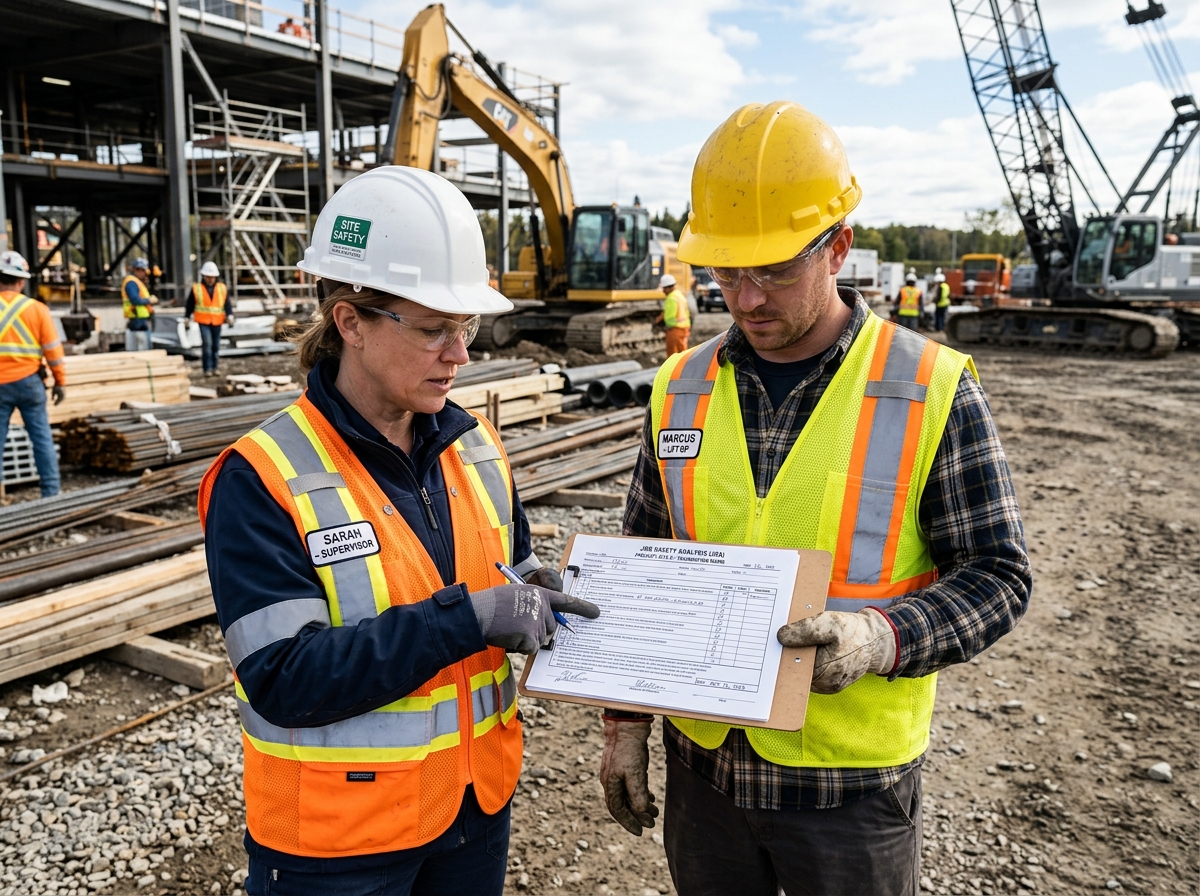
Job Safety Analysis (JSA/JHA): How to Write One, With a Free Template
The Task That Everyone Had Done a Thousand Times
In 2016, an experienced electrical technician at a manufacturing facility in Germany was replacing a motor on a ventilation fan. He had performed the same task dozens of times. He knew the equipment. He knew the site. No one had written a Job Safety Analysis for that specific task.
What no one had formally identified: the ventilation fan served a confined space below the work platform. When the motor was removed, the fan blade — now unrestrained — dropped through the platform grating and struck the technician on the foot, causing a complex fracture.
The investigation found that the hazard — an unrestrained fan blade at height — was entirely predictable. It had been present on every previous occasion the motor was replaced. No one had ever formally broken the task into steps and asked: what can go wrong at each step?
A Job Safety Analysis is not complicated paperwork. It is the disciplined practice of thinking through a task before performing it — and writing down what you find so that the next person benefits from what you learned.
What Is a Job Safety Analysis (JSA)?
A Job Safety Analysis (JSA) — also called a Job Hazard Analysis (JHA) or Safe Work Method Statement (SWMS) in some jurisdictions — is a systematic process for identifying the hazards associated with each step of a specific work task and determining appropriate control measures before the work begins.
JSA differs from broader risk assessment methods in one important way: it is task-specific and step-specific. Rather than assessing the general hazards of a work area, a JSA breaks a single task into its individual steps and asks, for each step: what could go wrong here?
JSA vs Risk Assessment vs Method Statement
| Document | Focus | Level of Detail |
|---|---|---|
| Risk Assessment | Hazards associated with a work area, activity category, or operation | Broad — identifies hazard types and general controls |
| JSA / JHA | Hazards at each step of a specific task | Task-specific — step-by-step hazard and control identification |
| Method Statement | How the task will be performed safely, step by step | Procedural — includes task sequence, equipment, personnel |
| Permit to Work | Authorization to proceed with a specific task at a specific time and location | Administrative — confirms controls are in place before work starts |
For high-risk non-routine tasks, all four documents may be required — each providing a different layer of the safety case.
When Is a JSA Required?
JSAs are required or strongly recommended for:
- Non-routine or infrequent tasks where workers may be unfamiliar with hazards
- Tasks with significant injury potential (work at height, confined space, electrical work, hot work)
- Tasks involving new equipment, new chemicals, or new procedures
- Tasks where multiple work crews interact or where simultaneous operations create combined hazards
- Tasks following an incident investigation, as part of the corrective action
JSAs are NOT designed for:
- Routine, highly repetitive tasks with no significant hazard (a JSA here becomes administrative overhead that workers ignore)
- System-level process hazard analysis (use HAZOP)
- Area-level hazard identification (use risk assessment)
The 5-Step JSA Process
Step 1: Select the Task
Not every task requires a JSA. The selection criteria should prioritize:
- Incident history: Tasks that have previously caused injuries or near misses
- Potential severity: Tasks where the most likely injury would be severe or fatal
- Frequency: Tasks performed by many different workers or that change frequently
- New procedures: Tasks being performed for the first time or with new equipment
The JSA register should be maintained as a living document — new tasks added as they are identified, existing JSAs reviewed and updated after incidents or significant changes.
Step 2: Break the Task Into Steps
Observe the task being performed and document each distinct step in sequence. A "step" is a significant action — not a micro-movement.
Too broad: "Replace conveyor belt" — this covers dozens of specific hazardous actions Too detailed: "Pick up the wrench with the right hand" — this is not a useful safety breakpoint Appropriate: "Isolate the conveyor motor and apply lockout device" — a meaningful step with identifiable hazards
Most JSAs have between 8 and 15 steps. Fewer than 5 suggests the task has been described too broadly. More than 20 suggests the analysis is capturing motions rather than steps.
Important: Observe an experienced worker performing the task. Do not write a JSA from memory or assumption. Real task performance consistently reveals steps that were not anticipated.
Step 3: Identify Hazards for Each Step
For each step, identify all hazards — the conditions or actions that could cause harm. Hazard categories to consider:
| Hazard Category | Examples Relevant to Task Steps |
|---|---|
| Energy hazards | Electrical, mechanical, hydraulic, pneumatic, thermal energy present during the step |
| Struck by / struck against | Falling objects, moving equipment, pressure releases, flying debris |
| Caught in / caught between | Moving parts, pinch points, nip points |
| Fall hazards | Unguarded edges, slippery surfaces, unstable work platforms |
| Chemical hazards | Skin contact, inhalation, ingestion of hazardous substances |
| Ergonomic hazards | Awkward posture, repetitive motion, heavy lifting |
| Environmental hazards | Extreme temperature, poor lighting, limited visibility, noise |
| Biological hazards | Bloodborne pathogens, contaminated waste, biological agents |
Challenge assumptions at this step. The most dangerous hazards are those that experienced workers have stopped seeing. If an experienced worker says "we've always done it this way," that is often precisely where a JSA finds its most important finding.
Step 4: Determine Controls for Each Hazard
For each hazard identified, determine the control measure — using the Hierarchy of Controls:
| Control Level | Action | Example |
|---|---|---|
| Elimination | Remove the hazard entirely | Redesign the process to eliminate manual handling |
| Substitution | Replace with a less hazardous alternative | Use a less toxic cleaning chemical |
| Engineering controls | Physical safeguards that isolate people from hazards | Install machine guards, install ventilation |
| Administrative controls | Procedures, training, supervision | Written procedure, competency requirement, permit |
| PPE | Personal protective equipment as last resort | Safety glasses, gloves, hard hat |
Controls should always target the highest applicable level of the hierarchy. PPE-only controls are the weakest — they must be worn correctly every time to provide protection, and they do not reduce the hazard itself.
Step 5: Document, Review, and Communicate
The completed JSA must be:
- Reviewed by the supervisor responsible for the work
- Reviewed by the safety officer
- Communicated to all workers who will perform the task (toolbox talk or pre-task briefing)
- Signed by the workers before work begins — confirming they understand the hazards and controls
- Available at the work location during task execution
The JSA is not a once-and-done document. It should be reviewed:
- After any incident involving the task
- After significant changes to equipment, procedures, or chemicals
- Annually at minimum for high-risk tasks
Free JSA Template: 12-Step Format
The following table format is ready to use for any task. Copy and adapt for your specific workplace.
Task: _____________________________ Date: _______________ Work Location: _____________________ Prepared By: _______________ Reviewed By: ______________________ Valid Until: _______________
| Step # | Task Step Description | Potential Hazards | Control Measures | PPE Required |
|---|---|---|---|---|
| 1 | ||||
| 2 | ||||
| 3 | ||||
| 4 | ||||
| 5 | ||||
| 6 | ||||
| 7 | ||||
| 8 | ||||
| 9 | ||||
| 10 | ||||
| 11 | ||||
| 12 |
Worker Acknowledgment: I confirm that I have read, understood, and will comply with the controls identified in this JSA.
| Name | Job Title | Signature | Date |
|---|---|---|---|
JSA Examples: Two Worked Scenarios
Example 1: Replacing a Light Fitting at Height (3 metres)
| Step | Task Step | Hazards | Controls | PPE |
|---|---|---|---|---|
| 1 | Inspect access equipment (mobile scaffold) | Unstable or defective scaffold | Inspect scaffold before use per manufacturer checklist; do not use if defective | Safety footwear |
| 2 | Isolate electrical circuit at distribution board | Electric shock; inadvertent re-energization | Lock out circuit breaker using personal padlock; test with voltage tester | Insulated gloves; safety glasses |
| 3 | Climb scaffold to working height | Fall from height | Use three-point contact on all access; ensure platform is at correct working height | Hard hat; safety harness if >2m to platform edge |
| 4 | Remove existing light fitting | Falling components; residual electrical charge | Ensure circuit is verified dead; second person below to catch dropped components | Safety glasses; insulated gloves |
| 5 | Install new fitting and make electrical connections | Electric shock; poor connection creating fire risk | Re-verify circuit is dead before connections; follow manufacturer wiring diagram | Insulated gloves |
| 6 | Restore power and test | Unexpected arc flash; fitting failure | Ensure all personnel are clear of energized area before restoring power | Safety glasses |
| 7 | Descend and remove scaffold | Falls; struck by scaffold components | One person guides scaffold movement from ground level | Safety footwear; hard hat |
Example 2: Chemical Transfer from Drum to Process Vessel
| Step | Task Step | Hazards | Controls | PPE |
|---|---|---|---|---|
| 1 | Review Safety Data Sheet (SDS) for chemical | Unrecognized chemical hazard | Consult SDS before beginning; confirm correct PPE for this specific chemical | — |
| 2 | Inspect pump, hoses, and connections | Hose failure; leaking connections; pump failure | Inspect visually before use; replace damaged equipment; pressure test connections | Chemical-resistant gloves; safety glasses |
| 3 | Position drum on tipping frame | Drum falling; back injury from manual handling | Use drum tipping equipment; never tip manually; ensure frame is rated for drum weight | Safety footwear; gloves |
| 4 | Connect pump inlet to drum | Chemical splash; loose connections | Ensure drum is secure before connecting; use correct fitting size | Chemical-resistant gloves; face shield |
| 5 | Connect pump outlet to vessel | Overpressure if vessel is closed; incompatible connection | Verify vessel vent is open; verify connection compatibility before pumping | Chemical-resistant gloves; face shield |
| 6 | Operate pump and monitor transfer | Overfill; hose rupture; vapor inhalation | Monitor level continuously; set high-level alarm; stay upwind of transfer | Respirator if vapor hazard; chemical apron |
| 7 | Disconnect and clean up | Residual chemical on connections; slip hazard | Depressurize before disconnecting; absorb any spills; dispose of absorbent correctly | Chemical-resistant gloves; face shield |
JSA and ISO 45001
JSAs satisfy ISO 45001 requirements in several clauses:
| ISO 45001 Clause | Requirement | How JSA Satisfies It |
|---|---|---|
| Clause 6.1.2 | Identify hazards and assess risks | JSA is a task-level hazard identification and control document |
| Clause 8.1 | Operational planning and control | JSA defines the controls for specific high-risk operations |
| Clause 8.1.3 | Management of change | JSA reviews are required before implementing task changes |
| Clause 7.3 | Awareness | Worker sign-off on JSA demonstrates hazard awareness |
| Clause 7.4 | Communication | Pre-task JSA briefing documents communication of hazards to workers |
How AI Transforms JSA Development
The most time-consuming element of JSA development is the hazard identification step. Experienced safety officers can identify many hazards from memory, but:
- Hazard categories are easily missed under time pressure
- Hazards specific to the interaction between this task, this location, and this equipment may not be apparent without systematic prompting
- JSAs written from memory rather than observation tend to reflect what the writer knows, not what is actually present
FindRisk's AI-powered assessment addresses this directly. Describe the task, the equipment, the location, and the energy sources present — and the AI generates a structured list of potential hazards organized by step, including hazard categories that a manual process might overlook. The AI draws on the Fine-Kinney methodology to prioritize identified hazards by calculated risk level, so the highest-risk steps receive the most rigorous control measures.
The result: a JSA that would typically take 60–90 minutes to develop manually is completed in 20 minutes, with more consistent hazard coverage and a professional output ready for supervisor review.
Frequently Asked Questions
What is the difference between a JSA and a JHA?
JSA (Job Safety Analysis) and JHA (Job Hazard Analysis) are the same methodology, referred to by different names in different jurisdictions and industries. OSHA uses "Job Hazard Analysis" (JHA); many other organizations and jurisdictions use "Job Safety Analysis" (JSA). In Australia and some other countries, the equivalent document is called a Safe Work Method Statement (SWMS). The format and methodology are identical regardless of the name.
How long should a JSA take to complete?
A well-executed JSA for a moderately complex task (8–12 steps) typically takes 30–60 minutes when the assessor observes the task being performed and consults with an experienced worker. Rushing a JSA to fill a form quickly defeats the purpose. The time invested in a thorough JSA is typically a small fraction of the time lost to a single preventable incident.
Can workers develop their own JSA?
Workers with appropriate training can and should contribute to JSA development — particularly in identifying hazards and realistic controls from their operational experience. However, the JSA should be reviewed and approved by a qualified safety officer before use. JSAs developed entirely by workers without safety review may miss systematic hazard categories or specify controls that are not at the highest level of the hierarchy.
How often should JSAs be updated?
JSAs for high-risk tasks should be reviewed annually and updated whenever: the task procedure changes; equipment or materials change; an incident or near miss occurs during the task; workers raise concerns about hazards not captured in the current JSA. A JSA that is never updated eventually becomes a document that reflects how the task used to be performed, not how it is performed now.
Is a JSA the same as a Permit to Work?
No. A JSA identifies the hazards and controls for a specific task. A Permit to Work is a formal authorization to proceed with that task at a specific time and location, confirming that all controls identified in the JSA (and other prerequisite documents) are in place. For high-risk tasks, both are required: the JSA defines the safe approach; the permit confirms the conditions for that approach have been established.
Conclusion
A Job Safety Analysis is the most direct way to turn the thinking that prevents accidents into a document that every worker who performs the task can use.
The best JSAs are written by safety professionals who understand the task, consult with the workers who perform it, and are willing to challenge assumptions about how the task "has always been done." They identify hazards that experienced workers have stopped seeing. They specify controls that reflect the hierarchy — not just PPE. And they are communicated to workers in a pre-task briefing that treats the JSA as a working tool, not a signature page.
The JSA is not the end of the safety process. It is the beginning of the conversation about how to perform this specific task, with these specific hazards, in this specific environment — safely.
Download FindRisk to develop AI-assisted Job Safety Analyses in the field, generate professional JSA documentation automatically, and ensure every high-risk task begins with a briefed and signed safety plan.
Try FindRisk
Ready to modernize your safety workflow?
Conduct AI-powered risk assessments, generate reports instantly, and keep your team safe — anywhere, anytime.