

HAZOP Study: The Complete Guide for Process Safety Professionals
When the Design Looks Safe but Isn't
On 23 March 2005, the BP Texas City refinery suffered a catastrophic explosion that killed 15 workers and injured 180 others. Among the root causes identified by the US Chemical Safety Board was a failure in the design and operation of a blowdown drum system — a vessel that was allowed to overfill, resulting in a hydrocarbon geyser and subsequent ignition.
A HAZOP study, properly conducted at the design stage, would have identified the overfill scenario as a credible deviation. The guideword "MORE THAN" applied to the level parameter would have raised the question: what happens if the drum level exceeds its design limit? What is the consequence? What is the safeguard? Is the safeguard adequate?
HAZOP does not guarantee that all hazards are found. But it provides a structured, systematic framework for asking the right questions about process deviations — the kind of questions that are routinely not asked during normal engineering design reviews.
What Is a HAZOP Study?
A Hazard and Operability Study (HAZOP) is a structured and systematic technique for identifying hazards and operability problems in process systems. It was developed in the late 1960s by ICI (Imperial Chemical Industries) in the UK and has since become the industry-standard methodology for process safety risk identification in chemical, petrochemical, pharmaceutical, oil and gas, and other process industries.
HAZOP works by systematically examining a process design — using engineering drawings, process flow diagrams, and piping and instrumentation diagrams (P&IDs) — and applying a set of standardized guide words to each process parameter at each defined point in the system (called a node) to generate potential deviations, their causes, consequences, and safeguards.
The core question HAZOP answers: What can go wrong with this process design, and what are the consequences?
HAZOP is classified as a qualitative risk identification method. It identifies hazards and operability problems; it does not quantify their likelihood or frequency (that is the role of quantitative risk assessment techniques like Fault Tree Analysis or QRA).
When Should a HAZOP Be Conducted?
| Stage | When | Purpose |
|---|---|---|
| Design HAZOP | During detailed engineering — before construction | Identify hazards while changes are still low-cost |
| Pre-startup HAZOP | Before commissioning a new or modified facility | Verify that safety systems are in place |
| Operational HAZOP | Periodic revalidation of existing plants (typically every 5–10 years) | Capture changes since last HAZOP; revalidate against current P&IDs |
| Management of Change HAZOP | Before implementing any significant modification to the process | Assess new hazards introduced by the change |
| Incident-triggered HAZOP | After a serious incident or near miss | Assess whether similar deviations can occur elsewhere in the system |
The HAZOP Methodology: Guidewords and Parameters
HAZOP is built on two foundational concepts: parameters and guide words.
Process Parameters
A parameter is any measurable property of the process at a given node. Common parameters include:
| Parameter | Examples |
|---|---|
| Flow | Rate, direction, quantity of material flowing in a pipe |
| Temperature | Temperature of process fluid, vessel contents, utilities |
| Pressure | Operating pressure in vessels, pipelines, and equipment |
| Level | Liquid level in vessels, columns, and tanks |
| Composition | Concentration of reactants, products, or contaminants |
| Phase | Liquid vs. vapor phase transition |
| Reaction | Rate of reaction, selectivity, heat of reaction |
| Time | Duration of steps in batch processes |
Guide Words
Guide words are standard words that, when combined with a process parameter, generate a meaningful deviation to examine:
| Guide Word | Meaning | Example Deviation |
|---|---|---|
| NO / NONE | Complete negation of the parameter | No flow (pipe blockage, pump failure) |
| MORE THAN | Quantitative increase | High flow, high temperature, high pressure |
| LESS THAN | Quantitative decrease | Low flow, low temperature, low pressure |
| AS WELL AS | Qualitative increase — something extra | Contamination, impurity, additional phase |
| PART OF | Qualitative decrease — something missing | Missing component, incomplete composition |
| REVERSE | Opposite direction | Reverse flow, back-pressure |
| OTHER THAN | Complete substitution | Wrong material, wrong phase |
| EARLY / LATE | Timing in batch processes | Step initiated too early or too late |
| BEFORE / AFTER | Sequence deviation in batch processes | Step performed out of sequence |
The 7-Step HAZOP Process
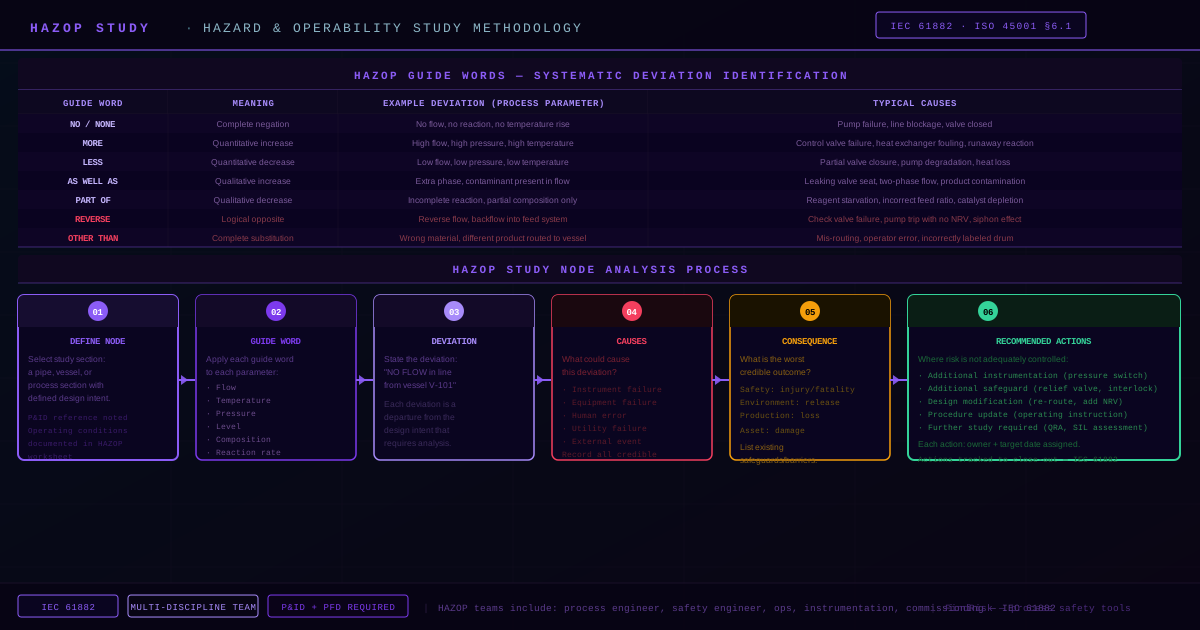
Step 1: Define the Scope and Objectives
Before the HAZOP begins, the study leader must define:
- The boundary of the system to be studied
- The objectives (design review, revalidation, MoC assessment)
- The level of detail required
- The documentation to be used (P&IDs, PFDs, operating procedures)
- The acceptance criteria for risk (what level of risk requires a recommendation?)
Step 2: Assemble the HAZOP Team
A HAZOP is a team exercise. The multi-disciplinary team typically includes:
| Role | Contribution |
|---|---|
| HAZOP Leader (Facilitator) | Qualified HAZOP specialist; guides the methodology; ensures systematic coverage |
| Process Engineer | Design intent; process knowledge |
| Instrument/Control Engineer | Control system design; alarm philosophy |
| Operations Representative | Operational experience; real-world deviations |
| Maintenance Engineer | Equipment failure modes; maintenance access |
| Safety Engineer | Consequence assessment; safeguard evaluation |
| Scribe | Records all findings in real time |
Team size of 5–8 people is optimal. Larger teams become difficult to facilitate.
Step 3: Divide the System into Nodes
A node is a defined section of the process where the design intent is uniform — a length of pipe between two pieces of equipment, a vessel, a heat exchanger. The study leader divides the P&ID into nodes before the study begins.
Node selection is a critical facilitator skill. Nodes that are too large miss specific hazards. Nodes that are too small make the study unnecessarily slow.
Step 4: Apply Guide Words to Each Node
For each node, the team works systematically through each relevant parameter and applies each guide word:
- The leader states the parameter and guide word: "FLOW — MORE THAN"
- The team identifies plausible causes for that deviation at that node
- For each credible cause, the team identifies consequences
- The team identifies existing safeguards that prevent, detect, or mitigate the consequence
- The team assesses whether the existing safeguards are adequate
- If safeguards are inadequate, a recommendation (action item) is recorded
Step 5: Record Findings in the HAZOP Worksheet
The HAZOP worksheet is the formal record of the study. Standard worksheet columns:
| Column | Content |
|---|---|
| Node | Reference number and description of the node being studied |
| Guide Word + Parameter | The deviation being examined |
| Causes | Plausible causes of the deviation |
| Consequences | Outcomes if the deviation occurs and safeguards fail |
| Safeguards | Existing controls, alarms, interlocks, procedures |
| Likelihood / Severity | Qualitative risk rating (if used) |
| Recommendations | Actions required to reduce risk |
| Action Party | Named owner for each recommendation |
Step 6: Follow Up on Recommendations
The HAZOP study generates recommendations — proposed design changes, additional interlocks, procedural modifications, further study requirements. The HAZOP is not complete until all recommendations have been:
- Reviewed and accepted, modified, or rejected by engineering management
- Assigned to a named owner with a completion date
- Tracked to close-out
A HAZOP that generates 200 recommendations and tracks none of them to completion has not reduced risk — it has created a false sense of security.
Step 7: Document the Study
The HAZOP report must include:
- Study scope, objectives, and basis
- Team composition and dates
- Complete HAZOP worksheets
- Summary of all recommendations
- Record of final dispositions (accepted, rejected, modified)
- Sign-off by the study leader and engineering management
HAZOP vs Other Risk Assessment Methods
HAZOP is one of several process safety risk identification methods. Understanding when to use HAZOP versus alternatives is essential:
| Method | Type | Best For | Not Suitable For |
|---|---|---|---|
| HAZOP | Qualitative, systematic | Complex continuous process systems with P&IDs | Simple systems; batch processes without detailed procedures |
| Fine-Kinney | Semi-quantitative | General workplace risk assessment; non-process hazards | Detailed process system analysis |
| FMEA | Qualitative, systematic | Equipment failure mode analysis; mechanical systems | Process chemistry hazards |
| What-If Analysis | Qualitative, less structured | Early concept stage; simpler systems | Complex interlinked process systems |
| Fault Tree Analysis (FTA) | Quantitative | Frequency estimation for specific top events | Broad hazard identification |
| Bow-Tie Analysis | Qualitative/quantitative | Barrier visualization for identified hazard scenarios | Primary hazard identification |
| JSA/JHA | Qualitative | Task-level hazard analysis for specific operations | System-level process hazard analysis |
When HAZOP is the right choice:
- You are designing or modifying a continuous chemical or process plant
- The system has complex interactions between process streams, equipment, and control systems
- Detailed P&IDs are available
- The consequences of a process deviation could be severe (fire, explosion, toxic release, loss of containment)
When HAZOP is not the right choice:
- The system is simple and does not have complex process interactions
- No P&IDs exist (early design concept stage — use What-If instead)
- The hazards are primarily task-based rather than process system-based (use JSA instead)
Common HAZOP Failures
A poorly executed HAZOP can be more dangerous than no HAZOP — it creates a documented record that hazards were reviewed, while missing significant risks.
Incomplete P&IDs: The HAZOP is only as good as the drawings it reviews. Out-of-date P&IDs, missing instrument details, or drawings that don't reflect as-built conditions produce incomplete findings.
Wrong team composition: A HAZOP conducted without operational experience misses real-world deviations. A HAZOP without instrument engineering expertise misses control system failure scenarios.
Superficial consequence assessment: Teams that accept "operator response" as a safeguard without questioning whether the operator can realistically respond in time and with the right information will systematically underestimate risk.
Recommendations not tracked: The most common HAZOP failure. Recommendations are generated, presented to management, and then not tracked. Six months later, none have been implemented.
Insufficient time: A complex process unit cannot be adequately reviewed in a single day. Rushed HAZOP studies systematically skip difficult deviations and underestimate consequence severity.
HAZOP and ISO 45001 / Process Safety Standards
HAZOP satisfies several key requirements of ISO 45001 and major process safety standards:
| Standard / Clause | Requirement | How HAZOP Satisfies It |
|---|---|---|
| ISO 45001 Clause 6.1 | Hazard identification and risk assessment | HAZOP is a systematic hazard identification method for process hazards |
| OSHA PSM 29 CFR 1910.119 | Process Hazard Analysis (PHA) for highly hazardous chemicals | HAZOP is one of the accepted PHA methodologies |
| EU Seveso III Directive | Major accident hazard identification | HAZOP is the most commonly used Seveso-compliant PHA method |
| API RP 14C | Analysis of safety systems on offshore platforms | HAZOP is required for offshore process system review |
| IEC 61511 | Safety instrumented systems (SIS) | HAZOP identifies the initiating events that SIS design must address |
How FindRisk Supports Process Safety Reviews
While HAZOP is a specialist workshop-based methodology, FindRisk supports the broader process safety ecosystem that surrounds it:
Pre-HAZOP hazard screening: Before commissioning a full HAZOP, use FindRisk's AI-assisted assessment to conduct a preliminary hazard identification. This helps scope the HAZOP, identify the highest-priority nodes, and ensure the team comes to the workshop with a shared understanding of the system's hazard profile.
Post-HAZOP recommendation tracking: HAZOP recommendations are corrective actions. Use FindRisk to track each recommendation to close-out — with assigned owners, deadlines, and verification evidence — ensuring the study's findings are actually implemented.
Operational risk assessment: For operational tasks associated with the process plant (vessel entry, hot work, chemical handling), FindRisk's Fine-Kinney methodology provides task-level risk quantification that complements the system-level HAZOP findings.
Frequently Asked Questions
Who should lead a HAZOP study?
The HAZOP leader (facilitator) must be a trained specialist in the HAZOP methodology — not simply someone with process engineering experience. The leader's role is to facilitate the systematic application of guide words, manage team dynamics, ensure all deviations are examined, and maintain the pace and quality of the review. Many organizations use external independent HAZOP facilitators for critical studies to ensure objectivity and specialist expertise. The leader should hold formal training in HAZOP facilitation — typically from organizations such as the IChemE or equivalent.
How long does a HAZOP study take?
Duration depends entirely on the complexity of the system and the level of detail in the P&IDs. As a rough guide, a typical process unit (one major vessel with associated pipework, instrumentation, and utilities) takes 3–5 days of HAZOP workshopping to review thoroughly. A complete refinery unit may require several weeks of study time. Attempting to compress a HAZOP into less time than the system warrants is a systematic way to miss hazards.
What is the difference between HAZOP and HAZID?
A HAZOP is a detailed, systematic review of a process design using guide words and P&IDs. A HAZID (Hazard Identification Study) is a less structured, higher-level brainstorming session used at early project stages — before detailed P&IDs exist — to identify major hazard categories. HAZID typically precedes HAZOP in a project's safety lifecycle.
Does HAZOP identify all hazards?
No — HAZOP is a structured search, but it is not exhaustive. It systematically examines the design against a defined set of guide words and parameters, but the quality of the output depends critically on the quality of the team, the completeness of the P&IDs, and the adequacy of time allocated. HAZOP is best understood as the primary hazard identification method in a suite of complementary techniques — not a guarantee that all hazards have been found.
Is HAZOP required by law?
In the United States, OSHA's Process Safety Management (PSM) Standard (29 CFR 1910.119) requires a Process Hazard Analysis (PHA) for facilities handling highly hazardous chemicals above threshold quantities. HAZOP is one of the accepted PHA methodologies (along with What-If, Checklist, What-If/Checklist, FMEA, and FTA). In the EU, Seveso III Directive requirements effectively require equivalent systematic hazard identification for major-hazard facilities. HAZOP is the dominant methodology used for Seveso compliance in European process industries.
Conclusion
HAZOP is the most rigorous and widely used tool available for identifying hazards in process systems. When conducted properly — with the right team, adequate time, complete P&IDs, and systematic follow-through on recommendations — it identifies scenarios that would not emerge from engineering judgment alone.
The disasters that HAZOP is designed to prevent — overpressure events, loss of containment, runaway reactions, toxic releases — are not rare accidents. They are predictable consequences of process deviations that were either not identified or identified but not adequately controlled.
According to the IChemE, HAZOP studies conducted at the design stage typically generate recommendations that, if implemented, reduce the risk of major accidents by 50–80%. The cost of a HAZOP team for two weeks is trivial compared to the cost of a single major incident.
Download FindRisk to support your process safety workflow — from preliminary hazard screening through post-HAZOP recommendation tracking — with AI-assisted assessment, mobile documentation, and professional report generation.
Try FindRisk
Ready to modernize your safety workflow?
Conduct AI-powered risk assessments, generate reports instantly, and keep your team safe — anywhere, anytime.