
HAZID Study: Guidewords, Worksheet Example and Steps
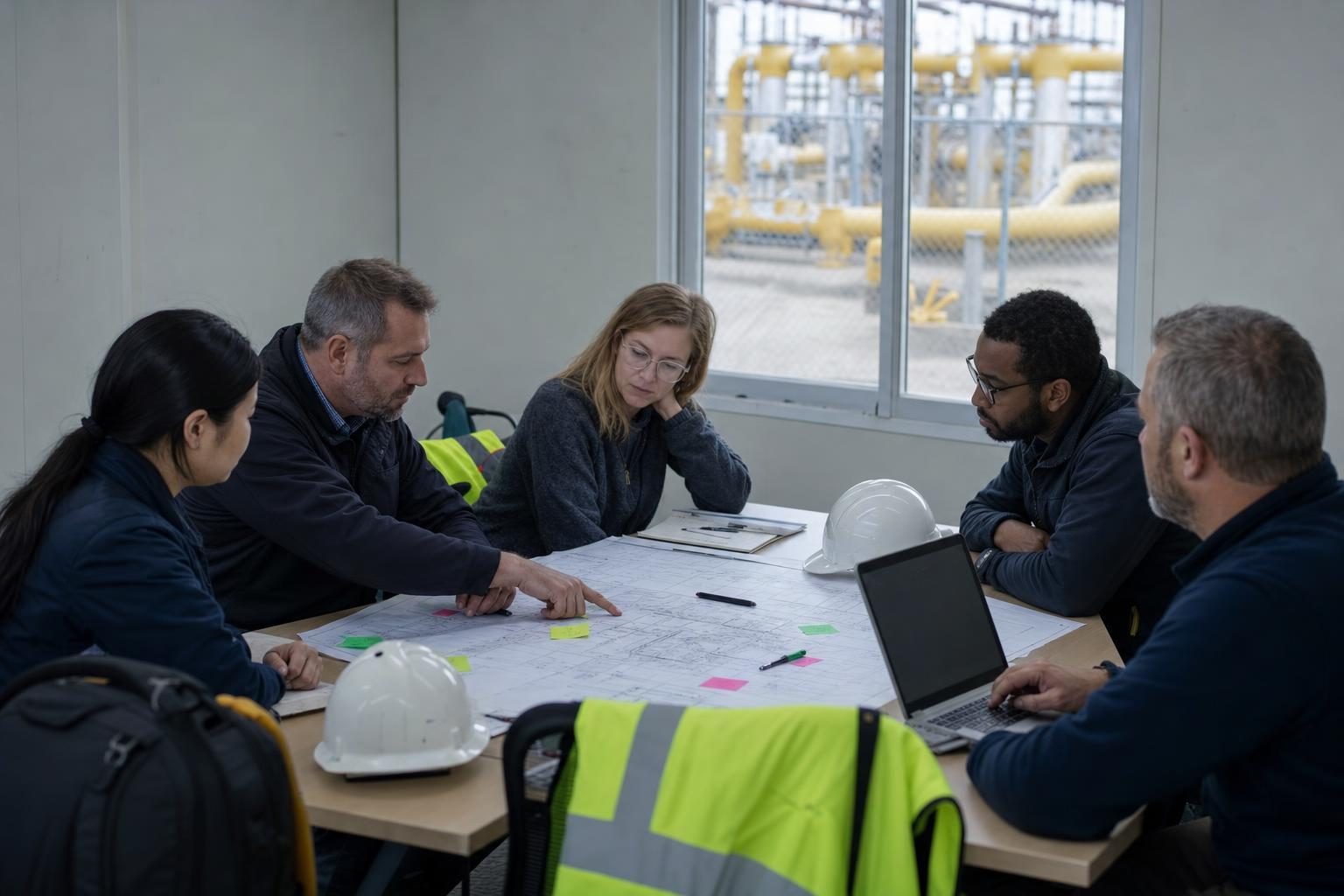
A HAZID study (hazard identification study) is a structured workshop in which a multidisciplinary team applies guidewords to each area or activity of a planned or existing facility to list its hazards, their causes and consequences, and the safeguards in place or planned. It is usually run early in design, before HAZOP, and produces a ranked hazard register with actions.
Most teams meet HAZID for the first time when a client, insurer or project manager writes it into the schedule: "HAZID workshop, week 6." What follows is often a day of guessing. Which drawings do we need? Who should be in the room? Is this a HAZOP without the P&IDs?
This guide answers those questions. You will get the point in a project where HAZID fits, the team and inputs, a seven-step process, a practical guideword set in four groups, a fully filled HAZID worksheet for a small gas facility, and a table that shows when to use HAZID, What-If or HAZOP.
A New Gas Station Before Anyone Draws a P&ID
Picture a food factory that is switching its boilers from fuel oil to natural gas (a fictional example). The gas distribution company will bring a supply line to the site boundary. The factory has to build a small pressure-reduction and metering station: a kiosk with filters, two regulator streams, safety shut-off valves, a meter and a vent.
At this point there is a site plan with a rectangle drawn on it, a vendor's standard station design and a budget. There are no P&IDs. The rectangle sits next to the road that delivery trucks use, on the low corner of the site near a drainage channel, and across the boundary fence from a school.
Nobody can run a HAZOP yet, because there is no detailed design to deviate from. But the most expensive decisions are being made now: where the station goes, what protects it and how people reach it in an emergency. Those decisions are what a HAZID is for. We will run one on this station later in the guide.
What Is a HAZID Study?
A HAZID is a qualitative, workshop-based technique for identifying the hazards of a facility, project or operation. ISO 17776:2016, the standard on major accident hazard management during the design of offshore installations, uses the term HAZID for a "Hazard Identification Study". The IADC's offshore HSE case guidelines define hazard identification as "a process to find, list and characterize hazards."
The method has a few defining features:
| Feature | What it means in practice |
|---|---|
| Workshop format | A facilitated session with a multidisciplinary team, not a desk study by one person |
| Guidewords | Prompt words grouped by category (external, process, occupational, lifecycle) applied to each area |
| Breadth over depth | Covers a wide range of hazards at a high level; detail is left to later studies |
| Early timing | Usually one of the first formal safety studies on a new project |
| Output | A hazard register: hazards, causes, consequences, safeguards, ranking and actions |
The term is most common in oil and gas and offshore work. Australia's offshore regulator, NOPSEMA, publishes a dedicated hazard identification guidance note (N-04300-GN0107, revised October 2025) that covers planning, technique selection, the team, workforce involvement and the outputs of the study. The method itself is general. It works for a warehouse, a tunnel project or a new production line just as well as for a platform.
When Should You Run a HAZID?
Run a HAZID as soon as there is enough information to describe the facility or activity, and before the layout and main design choices are frozen. That is usually the concept or feasibility stage, with an update in front-end engineering design (FEED). At that point the study can still move a building, change a process route or remove a hazard entirely, which costs far less than adding protection later.
The table shows how HAZID fits with the other studies across a typical project.
| Project stage | Design information available | Typical study | What the study can still change |
|---|---|---|---|
| Concept / feasibility | Site options, block layout, process description | HAZID | Site, layout, process route, inventory size |
| FEED / basic design | Process flow diagrams, plot plan, preliminary P&IDs | HAZID update, What-If on specific operations | Separation distances, safeguard concepts, access |
| Detailed design | Approved P&IDs, cause-and-effect charts | HAZOP | Instruments, valves, alarms, procedures |
| Operation | As-built drawings, procedures, incident history | HAZID or What-If for changes, periodic review | Procedures, maintenance, modifications |
HAZID is not only a design tool. Teams also use it for a change to an existing site, a new type of operation (a first shutdown, a decommissioning campaign) or a site that has never had a structured hazard review. For changes, it fits inside your management of change process as the hazard identification step.
Who Attends a HAZID Workshop?
A HAZID needs people who know the design, people who will operate and maintain the facility, and someone who knows the method and keeps the session moving. Keep the team small enough to discuss, but make sure every role below is covered.
| Role | Why they are in the room |
|---|---|
| Chair (facilitator) | Runs the method, keeps the team at the right level of detail, makes sure every guideword is considered. Ideally independent of the design team. |
| Scribe | Records each hazard, cause, consequence, safeguard and action in the agreed wording, live on screen |
| Project or process engineer | Explains the design intent and the options still open |
| Operations representative | Knows how the facility will actually be run, including abnormal and night-shift work |
| Maintenance representative | Knows access, isolation, lifting and confined space issues |
| OHS / process safety professional | Brings incident history, legal requirements and the risk ranking method |
| Discipline specialists as needed | Civil, electrical, instrument, fire, environmental, or a supplier or utility representative |
The same logic appears in regulation for related studies. OSHA's Process Safety Management standard requires a process hazard analysis team with expertise in engineering and process operations, at least one employee with experience of the specific process, and one member who knows the method being used (29 CFR 1910.119(e)(4)). OSHA's non-mandatory Appendix C adds that the team leader "should be impartial in the evaluation."
Do not let the chair also act as scribe. Facilitating and recording at the same time means one of them is done badly, and the record is what the project keeps.
How to Run a HAZID Study in 7 Steps
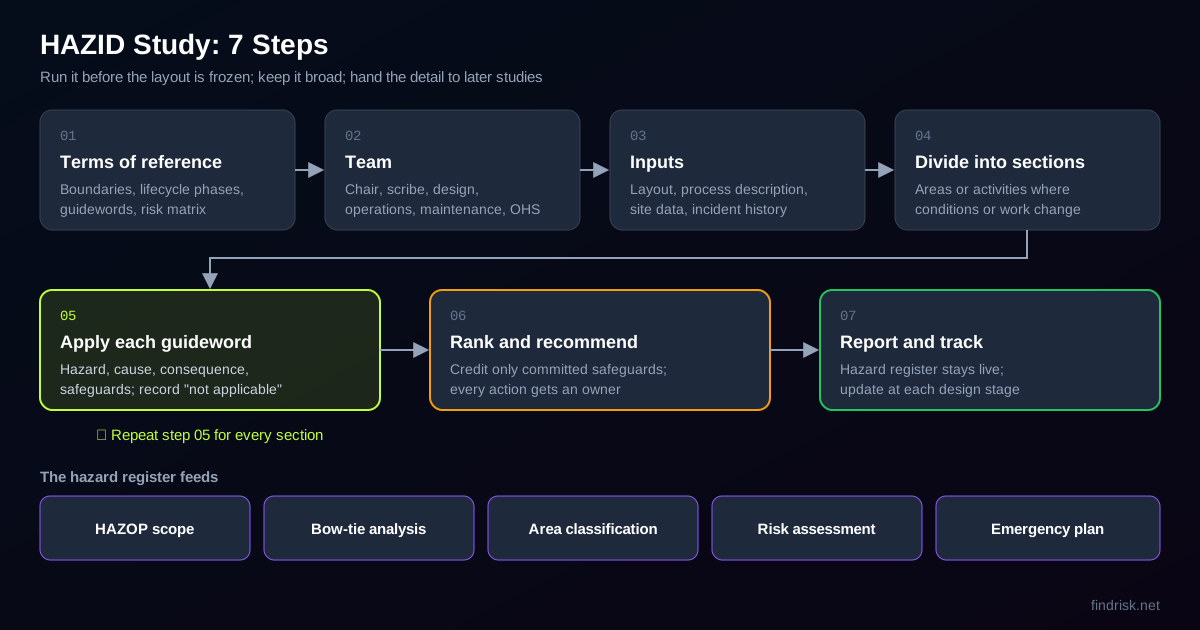
A HAZID follows the same seven steps whatever the facility: set the terms of reference, build the team, collect the inputs, divide the scope into sections, work through the guidewords, rank and recommend, then report and track the actions.
Step 1: Write the terms of reference
Agree in writing what the study covers: the facility boundaries, the lifecycle phases (construction, commissioning, operation, maintenance, decommissioning), the guideword list, the risk matrix and the level of detail. Send it to the team with the pre-reading.
Step 2: Build the team
Pick the chair and scribe first, then fill the roles in the table above. Confirm that operations and maintenance people can attend for the whole session, not only for the first hour.
Step 3: Collect the inputs
A HAZID does not need P&IDs, but it does need facts. Typical inputs are the site plan and layout options, a process or activity description, the inventory of hazardous materials, site data (weather, flooding, ground conditions, neighbors, access), incident history from similar facilities and the applicable legal requirements.
Step 4: Divide the scope into sections
Split the facility into manageable areas or activities, usually where conditions, location or the type of work change. For a small station that might be three sections: the incoming supply and boundary, the kiosk, and the outgoing line to the users. For a construction project the sections are often activities rather than areas.
Step 5: Work through the guidewords
For each section, the chair reads each guideword and asks: can this happen here, what would cause it, what would the consequence be, and what protects against it? The scribe records credible hazards. If a guideword does not apply, record that too, with a short reason. A blank row tells a reviewer nothing; "not applicable, no hazardous inventory in this area" tells them the question was asked.
Step 6: Rank and recommend
Rank each hazard with the agreed matrix, using the consequence and likelihood with the safeguards that exist or are firmly in the design. Write a recommendation wherever the team is not satisfied, with an owner. Typical recommendations are layout changes, further studies (HAZOP, hazardous area classification, dispersion modeling), design requirements and procedures.
Step 7: Report and track the actions
Issue the worksheet and a short report that states the scope, team, inputs, assumptions and the list of actions. The hazard register becomes a live document: each action is closed with evidence, and the register is updated at the next design stage.
HAZID Guidewords: A Practical Set in Four Groups
Guidewords are short prompts that make the team think about one type of hazard at a time. Many operators and project terms of reference supply their own list. If yours does not, the set below is a workable start for small and medium facilities. Add or remove words to suit the operation; a guideword list that is never adapted is a common weakness.
| Group | Guideword | The question it asks |
|---|---|---|
| External and environmental | Natural hazards | Flooding, extreme heat or cold, wind, lightning, earthquake, ground movement? |
| Neighbors and siting | Who and what is nearby, and what could reach them, or reach us from them? | |
| Third parties and security | Vandalism, unauthorized access, theft, interference with valves? | |
| Transport and access | Vehicle impact, traffic routes, emergency service access? | |
| Facility and process | Hazardous inventory | Flammable, toxic, pressurized or hot materials, and how much? |
| Loss of containment | Leaks, ruptures, overfilling, venting; where would the material go? | |
| Ignition and explosion | Ignition sources, enclosed spaces where gas or vapor can build up? | |
| Overpressure and temperature | Can pressure or temperature exceed what equipment is designed for? | |
| Utilities failure | Loss of power, instrument air, water, telemetry or heating? | |
| Dropped and moving objects | Lifting over live equipment, moving machinery? | |
| Occupational health and safety | Access and work at height | Can people reach equipment safely for operation and maintenance? |
| Confined spaces | Pits, tanks, kiosks or trenches where people may enter? | |
| Noise, vibration, chemicals | Health exposures during normal work and maintenance? | |
| Manual handling and ergonomics | Heavy, awkward or repetitive tasks? | |
| Lifecycle and emergency | Construction and commissioning | Work near live plant, tie-ins, first introduction of hazardous material? |
| Maintenance and isolation | Can equipment be isolated, drained and made safe? | |
| Emergency response | Detection, isolation, escape, firefighting and medical access? | |
| Decommissioning | How will the facility be emptied, cleaned and removed? |
Use the guidewords in the order that fits the section. External guidewords often produce the biggest design changes at concept stage, so do not leave them until the end of the day when the team is tired.
Worked Example: HAZID Worksheet for a Gas Pressure-Reduction Station
Here is the HAZID for the fictional factory gas station from the opening scenario. The team was the chair, a scribe, the factory's project engineer, the boiler house supervisor, a maintenance technician, the site OHS specialist and an engineer from the gas distribution company. Inputs were the site plan, the vendor's standard station design, a flood map of the site and the factory's emergency plan.
Ranking used an illustrative 5×5 matrix: severity (S) × likelihood (L) gives a risk score (R). Scores of 1–6 are low, 8–12 medium and 15–25 high. Safeguards marked "planned" are in the vendor's standard design but not yet confirmed for this site.
| # | Guideword | Hazard and cause | Consequence | Existing or planned safeguards | S | L | R | Action (owner) |
|---|---|---|---|---|---|---|---|---|
| 1 | Natural hazards | Kiosk on the low corner of the site near the drainage channel; flood water enters the kiosk | Damage to regulators and instruments, loss of supply or uncontrolled pressure | None at concept stage | 3 | 3 | 9 | Check the flood map; raise the plinth or move the station to higher ground (project engineer) |
| 2 | Transport and access | Delivery trucks reverse along the road next to the kiosk; impact on above-ground pipework | Gas release, fire, injury to the driver and passers-by | None | 5 | 3 | 15 | Move the station away from the truck route; if not possible, install impact barriers (project engineer) |
| 3 | Third parties and security | Kiosk on the boundary fence beside a public road; vandalism or someone operating a valve | Supply interruption, release | Site perimeter fence | 4 | 2 | 8 | Lockable enclosure, valves locked in position, add the kiosk to security rounds (site security lead) |
| 4 | Neighbors and siting | School across the fence; vent outlet position not yet decided | Gas released from the vent drifts toward people | None | 5 | 2 | 10 | Fix the vent location and run a hazardous area classification before layout freeze; agree with the gas distribution company (OHS specialist) |
| 5 | Natural hazards | Lightning strike on the kiosk | Damage to equipment, ignition of a release | Lightning protection on the main building only | 4 | 2 | 8 | Include the station in the lightning protection and earthing design (electrical engineer) |
| 6 | Loss of containment | Flange or joint leak inside the kiosk | Gas builds up in the enclosure, ignition, explosion | Planned: ventilation louvres | 5 | 3 | 15 | Confirm ventilation design and gas detection; use equipment suitable for the hazardous area (project engineer) |
| 7 | Overpressure and temperature | Regulator fails open | Pressure above the rating of the factory pipework and burners | Planned: safety shut-off valve and relief valve per stream | 5 | 2 | 10 | Confirm downstream design pressure; carry this scenario into the HAZOP once P&IDs exist (project engineer) |
| 8 | Ignition and explosion | Smoking shelter and occasional hot work near the planned location | Ignition of a small leak | None | 4 | 2 | 8 | Set an exclusion zone, move the smoking shelter, require a hot work permit inside the zone (OHS specialist) |
| 9 | Utilities failure | Power loss to gas detection and telemetry | A leak goes undetected; no remote alarm | None | 3 | 3 | 9 | Battery backup for detection and telemetry; detection fails to alarm state (electrical engineer) |
| 10 | Confined spaces | Vendor design places the meter in a below-ground pit | Gas collects in the pit; a technician is overcome or caught in an ignition | None | 5 | 2 | 10 | Put the meter above ground in the kiosk to remove the pit (project engineer) |
| 11 | Noise, vibration, chemicals | Regulator noise at peak flow | Noise exposure during inspection | None | 2 | 3 | 6 | Ask the vendor for noise data; acoustic lining if needed (maintenance lead) |
| 12 | Construction and commissioning | Tie-in to the live supply line while the factory runs | Release during connection, fire | Gas company procedures | 5 | 2 | 10 | Tie-in by the gas company under a permit to work with an agreed isolation plan and method statement (project engineer) |
| 13 | Emergency response | No agreed position for emergency isolation; fire service access unclear | Delay in isolating a release | Factory emergency plan (does not cover gas yet) | 4 | 3 | 12 | Place an emergency isolation valve reachable from the road; add gas release to the emergency plan and drill it (OHS specialist) |
The worksheet produced 13 hazards: 2 high, 10 medium and 1 low. More useful than the scores are the decisions it forced while they were still cheap.
- Two layout changes: the station moves away from the truck route and onto higher ground, which reduces rows 1 and 2 together.
- One hazard designed out: the meter pit disappears (row 10). No pit, no confined space entry.
- Three items carried forward: overpressure to the HAZOP (row 7), vent location to the hazardous area classification (row 4), and ventilation with gas detection to detailed design (row 6).
- Two procedure items: the hot work exclusion zone and the emergency plan update (rows 8 and 13).
Notice what the team did not do. Nobody argued about the set pressure of the relief valve or the type of slam-shut actuator. Those are HAZOP questions, and the chair parked them.
HAZID vs HAZOP vs What-If: Which Study, When?
HAZID asks "what hazards does this facility have?", What-If asks "what if this specific thing goes wrong?" and HAZOP asks "how can this design deviate from its intent?" They are complementary, not alternatives, and most process projects use all three at different stages.
| HAZID | What-If | HAZOP | |
|---|---|---|---|
| Core question | What hazards does this facility or activity have? | What happens if this goes wrong? | How can each part of the design deviate from its intent? |
| Best stage | Concept, feasibility, FEED | Any stage, for a defined system or change | Detailed design with approved P&IDs |
| Inputs | Layout, process description, site data | System or procedure description, checklist | P&IDs, design intent per node |
| Structure | Guideword categories applied to areas or activities | Free questions, often grouped by category | Process parameter plus guide word (no, more, less, reverse) for each node |
| Depth | Broad and high level | Medium | Narrow and detailed |
| Typical output | Hazard register with ranking and actions | Question list with consequences, safeguards and recommendations | Deviation worksheet with causes, safeguards and actions |
| Main risk if misused | Too shallow if run late as a substitute for HAZOP | Misses hazards nobody thought to ask about | Wasted if run before the design is stable |
For detail on the other two methods, see our What-If analysis guide and the HAZOP study guide.
Does a HAZID satisfy OSHA PSM?
OSHA's process hazard analysis rule lists What-If, Checklist, What-If/Checklist, HAZOP, FMEA, Fault Tree Analysis "or an appropriate equivalent methodology" (29 CFR 1910.119(e)(2)). HAZID is not named. Whether a HAZID counts as equivalent depends on whether it addresses everything in (e)(3), including facility siting, human factors and the consequences of control failures. A concept-stage HAZID is usually too high level for that. OSHA's Appendix C notes that "a preliminary or gross hazard analysis may be useful in prioritizing the processes," which is the role a HAZID often plays before the detailed PHA.
Where HAZID Outputs Go Next
A HAZID that ends with a filed report has done half its job. The value comes from what the hazard register feeds into:
| HAZID output | Where it goes |
|---|---|
| Major hazards ranked high | Bow-tie analysis to map threats, consequences and barriers |
| Scenarios needing design detail | HAZOP scope and node list |
| Release and ignition hazards | Hazardous area classification, fire and explosion studies |
| Layout and siting issues | Plot plan revisions, separation distances |
| Occupational hazards | The site risk assessment and method statements |
| Emergency scenarios | The emergency plan, drills and training |
| Open actions | The project action tracker, with closure evidence |
Revisit the register at each design stage and whenever the facility changes. For operating oil and gas sites, the hazards from the register also make good inspection prompts; our oil and gas safety inspection checklist covers the field side.
Common HAZID Mistakes
1. Running it after the layout is frozen
A HAZID run once the plot plan is fixed can only add protection. The cheapest fixes, moving or removing a hazard, are gone. Schedule the HAZID before layout freeze and treat its siting actions as inputs to the design, not comments on it.
2. Turning it into a HAZOP without drawings
Teams with HAZOP experience drift into valve-by-valve discussion. The session overruns, the external and lifecycle guidewords get skipped, and the detail is guessed because the P&IDs do not exist. The chair should park detailed points as actions for the HAZOP.
3. No operations or maintenance people in the room
A design team alone will identify design hazards. The people who will drain, isolate, lift and work night shifts know where access is poor and where shortcuts will happen. Without them, the occupational and maintenance guidewords produce thin rows.
4. Counting planned safeguards as existing
At concept stage most safeguards are intentions. If the worksheet credits a gas detector that is not yet in the design, the ranking looks better than reality. Mark safeguards as existing, planned or proposed, and rank with what is actually committed.
5. Recording only the hazards found
If a guideword produced nothing, the record should say why. Otherwise a reviewer cannot tell a considered "not applicable" from a skipped line.
6. Actions with no owner and no closure
A recommendation like "consider impact protection" with no owner rarely gets done. Give every action an owner, a due stage and a closure method, and review the open list at each design milestone.
7. Forgetting the lifecycle
Construction, commissioning, tie-ins and decommissioning carry some of the highest risks, and they are easy to miss when the team pictures the finished plant. Include lifecycle guidewords in every HAZID.
How FindRisk Supports Hazard Identification
A HAZID is a workshop, and FindRisk does not replace the team or the chair. Where it helps is before and after the session. During a site visit for the inputs, you can photograph the proposed location, mark hazards on the photo (the drainage channel, the truck route, the fence line) and let the AI analysis suggest what else is visible. Those annotated photos make the external guidewords much more concrete in the workshop.
After the HAZID, FindRisk's AI can turn the hazard register into an inspection checklist for construction and for the finished facility, so the actions are checked in the field rather than only closed on paper. If your site ranks risks with the Fine-Kinney method, you can score the occupational hazards from the HAZID there and produce a professional report in seconds, on iOS and Android.
Frequently Asked Questions
What is the difference between HAZID and HAZOP?
HAZID is a broad, early study that identifies the hazards of a facility or activity using guideword categories, usually at concept or FEED stage. HAZOP is a detailed study of how each part of an approved design, node by node on the P&IDs, can deviate from its intent using guide words such as no, more, less and reverse. HAZID shapes the layout and scope; HAZOP checks the detailed design.
Is a HAZID a risk assessment?
A HAZID is the hazard identification part of risk assessment, with a first, qualitative ranking. It lists hazards, causes, consequences and safeguards and ranks them on a simple matrix, but it does not usually quantify risk. High-ranked hazards are then assessed in more depth with HAZOP, bow-tie, consequence modeling or a quantitative risk assessment, depending on the hazard.
How long does a HAZID workshop take?
It depends on the size of the scope and the number of sections. As a planning rule of thumb, a small facility like a gas metering station often fits in one day, while a large project with many units can take several days. Plan in sessions of a few hours with breaks, so the last guidewords of the day get the same attention as the first.
Who should chair a HAZID?
The chair should be experienced in the HAZID method and in facilitation, and ideally independent of the design team so the review is not steered toward the existing design. The chair keeps the team at the right level of detail, makes sure every guideword is considered and agrees the wording of each record with the scribe. Many projects bring in an external facilitator for this.
Is HAZID required by OSHA?
No OSHA standard requires a HAZID by name. OSHA's Process Safety Management standard (29 CFR 1910.119(e)(2)) requires a process hazard analysis using What-If, Checklist, What-If/Checklist, HAZOP, FMEA, Fault Tree Analysis or an appropriate equivalent method. A HAZID is commonly used earlier to prioritize and scope that analysis. Clients and project contracts may still specify a HAZID as a project deliverable.
What is the output of a HAZID study?
The main output is a hazard register: each hazard with its cause, consequence, existing or planned safeguards, risk ranking and recommended actions with owners. The study report adds the scope, team, inputs, assumptions and guideword list. The register then feeds the HAZOP scope, bow-tie analysis, hazardous area classification, the emergency plan and the site risk assessment.
Can HAZID be used outside oil and gas?
Yes. The method suits any facility or project where hazards should be identified before design choices are fixed: chemical storage, warehouses, tunnels and rail projects, power and water plants, food factories or a new production line. Replace the oil and gas guidewords with ones that fit the operation, such as vehicle movements, racking, lifting or dust.
Conclusion
A HAZID study is the first structured look at the hazards of a facility, and its value is timing. Run before the layout is frozen, with operations and maintenance people in the room and a guideword list adapted to the site, it moves hazards away from people and removes some of them entirely. The gas station example shows the pattern: two layout changes, one hazard designed out and three questions handed on to the right studies.
Keep the HAZID broad, rank with committed safeguards only, give every action an owner and treat the hazard register as a live document through design and into operation. Then use HAZOP, What-If and bow-tie where the detail is needed.
Download FindRisk to document your site visits with marked-up photos and turn the hazard register into field checklists your team can use.
Try FindRisk
Ready to modernize your safety workflow?
Conduct AI-powered risk assessments, generate reports instantly, and keep your team safe — anywhere, anytime.