
Hand-Arm Vibration Risk Assessment: Calculation and Example
A hand-arm vibration risk assessment identifies who uses vibrating tools, works out each person's daily exposure, A(8), from the tool's vibration magnitude and trigger time, and compares it with the legal values: 2.5 m/s² (action value) and 5 m/s² (limit value) in the UK, EU and Türkiye. It ends with recorded controls and health surveillance.
Most guides give you the two numbers and a link to a calculator. The hard part is the real working day: one person picks up a breaker, a grinder and a drill, each with its own vibration level and trigger time, and you need one daily figure, the tool that drives it, and proof that your controls bring it down.
This guide works through that for a refurbishment operative using three tools. You will find the UK, Turkish and US rules side by side, the A(8) formula and the exposure points system in plain arithmetic, the time each tool takes to reach the action and limit values, a control plan with the exposure recomputed after each change, and what health surveillance has to cover.
A Refurbishment Crew With a Vibration Question
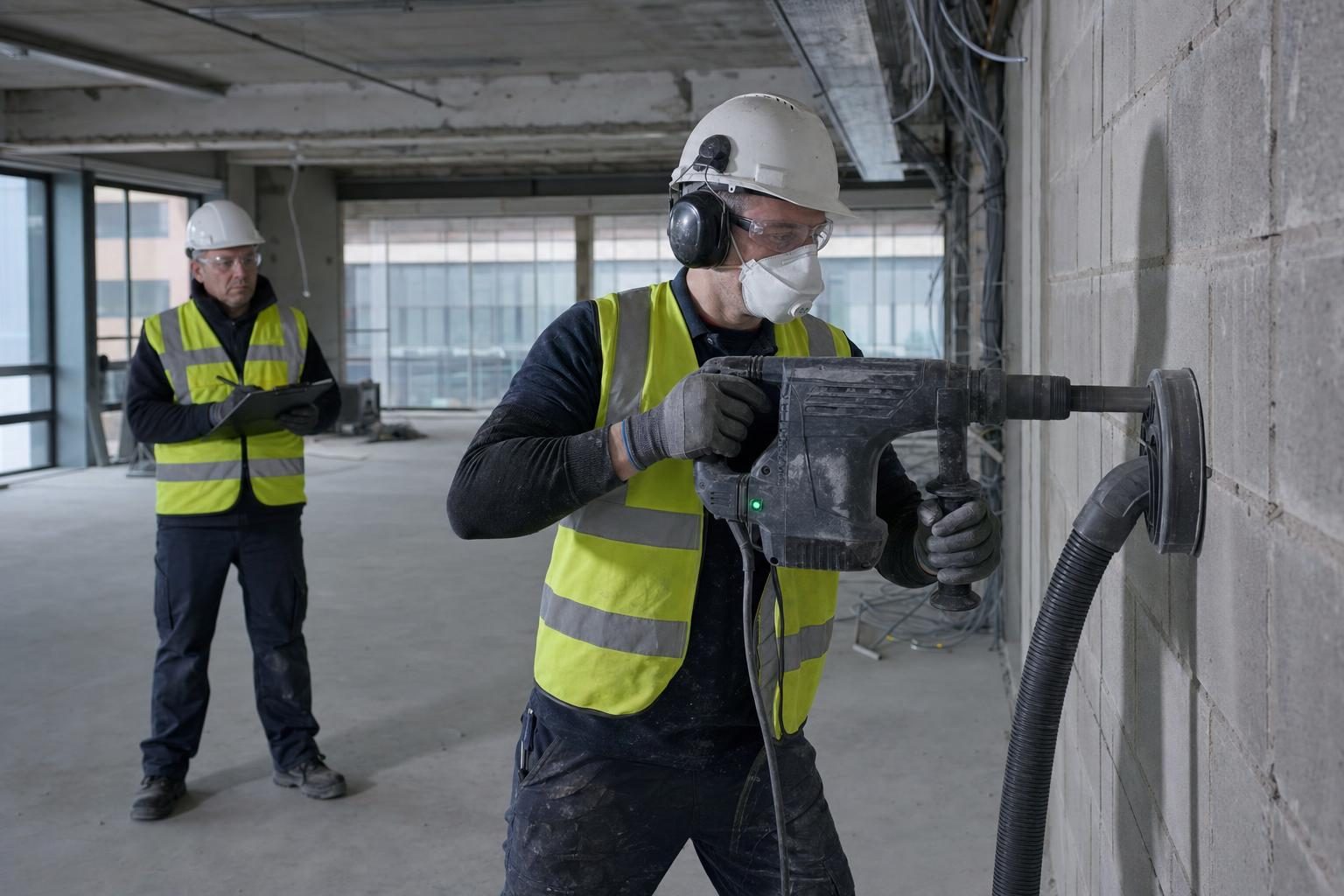
Picture a small crew stripping out the ground floor of an office building. This is a fictional example built for this guide. One operative spends part of each day breaking out old floor screed with a rotary hammer, cutting chases in block walls with an angle grinder and drilling fixings with an impact drill. Gloves are in the van. Nobody has written anything about vibration down, and one of the crew mentions tingling fingers after a long day.
The site manager asks whether this is a problem. HSE gives a quick screen: people who regularly use hammer action tools for more than about 15 minutes a day are likely to be above the action value, and more than about one hour a day likely above the limit value. The rotary hammer alone runs for about half an hour a day here, so the answer is "probably, and we need numbers."
Tingling and numbness in the fingers are also among HSE's early signs of hand-arm vibration syndrome. That makes the assessment urgent, and health surveillance part of it from the start.
What Is a Hand-Arm Vibration Risk Assessment?
A hand-arm vibration (HAV) risk assessment is the part of the general workplace risk assessment that deals with vibration transmitted into the hands and arms by powered tools and hand-guided machines. In the UK, regulation 5 of the Control of Vibration at Work Regulations 2005 requires a "suitable and sufficient assessment" of the risk. In Türkiye, Articles 6 and 7 of the Çalışanların Titreşimle İlgili Risklerden Korunmalarına Dair Yönetmelik (Resmî Gazete 22.08.2013, No. 28743) place the same duty on the employer.
| Term | Meaning |
|---|---|
| Vibration magnitude (a_hv) | The tool's frequency-weighted vibration total value in m/s², combining three measurement axes |
| Trigger time | The time the tool is actually running and in contact with the hands, not the time spent on the job |
| Daily exposure, A(8) | The day's vibration dose expressed as the level that would give the same energy over 8 hours, in m/s² |
| Exposure action value (EAV) | 2.5 m/s² A(8): the level at which a program of controls and health surveillance becomes required |
| Exposure limit value (ELV) | 5 m/s² A(8): the level that must not be exceeded |
| Exposure points | HSE's simplified scale: 100 points a day equals the EAV, 400 points equals the ELV |
| HAVS | Hand-arm vibration syndrome: vascular, nerve and muscle damage to the fingers and hands |
Both regulations list what the assessment must take into account. Among them: the magnitude, type and duration of exposure (including intermittent vibration and repeated shocks), workers at particular risk, the manufacturer's vibration information, whether lower-vibration replacement equipment exists, working conditions such as low temperatures, and the results of health surveillance.
A measurement is not an assessment. HSE notes that you only need to measure when suitable data cannot be obtained from other sources. The assessment decides what the numbers mean for each person and what has to change.
HAV Exposure Action and Limit Values
The UK, the EU and Türkiye use the same values, set in Directive 2002/44/EC; the Turkish regulation states that it was prepared in parallel with that directive. The US has no federal vibration standard.
| Threshold | UK (2005 Regulations, reg. 4) | Türkiye (Titreşim Yönetmeliği, Art. 5) | US |
|---|---|---|---|
| Exposure action value | 2.5 m/s² A(8) | 2.5 m/s² for an 8-hour day | No OSHA standard |
| Exposure limit value | 5 m/s² A(8) | 5 m/s² for an 8-hour day | No OSHA standard |
| Guidance used instead | — | — | ACGIH TLVs; NIOSH criteria document (1989) |
The values in regulation 4 are daily exposures, not tool ratings. A tool vibrating at 7 m/s² does not "exceed the limit" on its own. Whether the worker does depends on how long they hold it.
What each band means in practice under the UK and Turkish rules:
| Daily exposure | Employer duties |
|---|---|
| Below 2.5 m/s² A(8) | Eliminate the risk at source or reduce it as far as reasonably practicable; keep the assessment up to date |
| 2.5 to 5 m/s² A(8) | A program of technical and organizational measures to reduce exposure; health surveillance; information and training for exposed workers |
| Above 5 m/s² A(8) | Not allowed. Reduce exposure immediately, find out why the limit was exceeded and change the controls so it does not happen again |
These duties come from regulations 6, 7 and 8 of the UK regulations and Articles 8, 9, 10 and 12 of the Turkish regulation. The UK training duty in regulation 8 also applies below the action value wherever the assessment shows a risk to health.
In the US, the OSHA Technical Manual states that "OSHA does not have standards concerning vibration exposure" and points to the ACGIH Threshold Limit Values for hand-held tools. NIOSH published its Criteria for a Recommended Standard on hand-arm vibration (DHHS Publication No. 89-106) in 1989. If your organization works across regions, it is simpler to assess against the 2.5 and 5 m/s² values everywhere and then confirm local requirements.
How to Do a HAV Risk Assessment in 6 Steps
A hand-arm vibration risk assessment follows six steps, and the screening step often tells you how much work the rest will take.
Step 1: Screen for a vibration problem
Use HSE's risk groups. High risk, likely above the limit value: hammer action tools for more than about one hour a day, or rotary and other action tools for more than about four hours a day. Medium risk, likely above the action value: hammer action tools for more than about 15 minutes a day, or some rotary and other action tools for more than about one hour a day. If nobody comes close, record that and keep it under review.
Step 2: List people, tools and tasks
Assess by person, not by tool. A refurbishment operative may use five tools in a day; a maintenance fitter may borrow a needle scaler once a week. For each person, list the tools, the task each tool is used for and the typical number of times the task is done per shift.
Step 3: Get a vibration magnitude and trigger time for each tool
Take magnitudes from HSE's typical values, the tool handbook or supplier, or your own measurement (see "Where Vibration Data Comes From" below). For trigger time, HSE suggests observing for a short period, such as half an hour, and scaling up to the shift, or timing a few repetitions of a task and multiplying by the number per shift.
Step 4: Calculate daily exposure and compare
Combine the tools into one A(8) or points total for each person (next section) and compare it with 2.5 and 5 m/s². Note which tool contributes the most.
Step 5: Plan controls by the hierarchy
Change the work method first, then choose lower-vibration equipment, maintain it, then limit trigger time with planning and rotas, and keep hands warm and dry. Recalculate exposure for each planned change so the plan shows its effect. HSE advises tackling high-risk tasks first.
Step 6: Health surveillance, training, records and review
Put workers at or above the action value under health surveillance and give them information and training. Record the significant findings and an action plan with dates and owners. Review when tools, tasks or rosters change. HSE says to check whether a review is needed at least every two years. In Türkiye, vibration sits inside the general risk assessment, which must be renewed at least every 2, 4 or 6 years depending on the hazard class, and sooner after changes.
How to Calculate Daily Vibration Exposure: A(8) and Exposure Points
Daily vibration exposure is calculated by combining each tool's magnitude and trigger time into one figure normalized to an 8-hour day. Schedule 1 of the UK regulations sets out the formulas, and Annex 1 of the Turkish regulation uses the same A(8) definition:
Partial exposure for one tool:   A(8) = a × √(T / 8)
Daily exposure for several:      A(8) = √( A1(8)² + A2(8)² + A3(8)² + … )
Here a is the tool's vibration magnitude in m/s² and T is its trigger time in hours.
HSE's exposure points system is the same calculation in a friendlier form. HSE's table gives about 50 points per hour at 5 m/s², 100 at 7 m/s² and 200 at 10 m/s²: that is roughly points per hour = 2 × a². Multiply by trigger hours, add the tools, and compare with 100 (EAV) and 400 (ELV). To convert back, A(8) = 2.5 × √(points ÷ 100). HSE's free exposure calculator spreadsheet does the same arithmetic for up to six tools.
The table below shows how quickly each magnitude used in this guide reaches the two values. Time to EAV = 8 × (2.5 ÷ a)² hours; time to ELV is four times that.
| Tool vibration (m/s²) | Points per hour | Trigger time to reach EAV | Trigger time to reach ELV |
|---|---|---|---|
| 18 | 648 | about 9 minutes | about 37 minutes |
| 11 | 242 | about 25 minutes | about 1 h 39 min |
| 7 | 98 | about 1 hour | about 4 h 5 min |
| 4 | 32 | about 3 h 8 min | more than a shift (12.5 h) |
Three rules of thumb follow from the formula:
- Magnitude matters more than time. Points rise with the square of the vibration magnitude. Halving the magnitude cuts the points by 75%; halving the trigger time cuts them by 50%.
- High-vibration tools use up the day in minutes. At 18 m/s², ten minutes of trigger time is already above the action value.
- Never average magnitudes. Add points (or squared partial exposures). An average of 18, 7 and 11 m/s² says nothing about the dose.
Worked Example: One Operative, Three Tools
This example continues the fictional refurbishment crew. The vibration magnitudes are HSE's recommended initial values for each tool type, taken from the typical tool vibration table; the trigger times are illustrative. All results are computed with the formula above.
Daily exposure at baseline
| Tool and task | Vibration (m/s²) | Trigger time | Partial A(8) (m/s²) | Points | Share of dose |
|---|---|---|---|---|---|
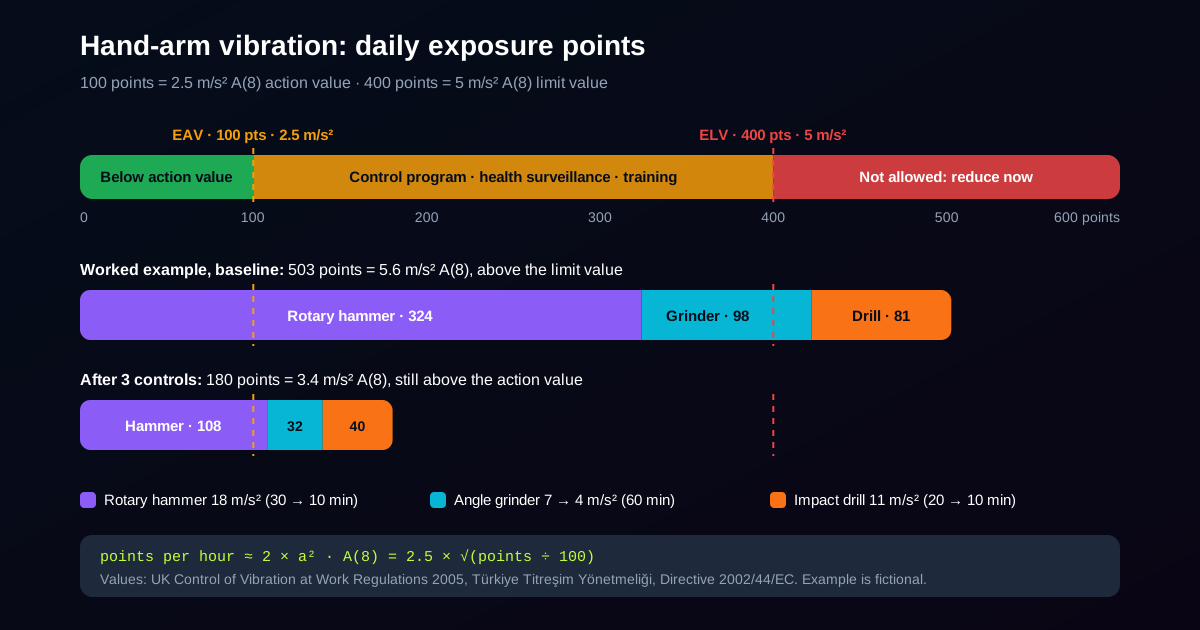
| Rotary/demolition hammer, breaking out screed | 18 | 30 min | 4.50 | 324 | 64.5% |
| Angle grinder (100–180 mm), cutting chases | 7 | 60 min | 2.47 | 98 | 19.5% |
| Impact drill (masonry bit), fixings | 11 | 20 min | 2.25 | 81 | 16.0% |
| Total | 1 h 50 min | 5.6 | 503 |
The operative is above the 5 m/s² limit value with less than two hours of trigger time in the whole day. The rotary hammer alone is close to the limit, and it is the obvious first target.
Findings
| # | Finding | Who | Result |
|---|---|---|---|
| 1 | Daily exposure 5.6 m/s² A(8) (503 points), above the limit value | Operatives doing strip-out | Reduce immediately; work cannot continue in this pattern |
| 2 | Rotary hammer contributes 64.5% of the dose | Operatives | First target for controls |
| 3 | Tool magnitudes are generic HSE values, not this crew's tools | All | Check suppliers' data and confirm with in-use measurement where the result is close to a value |
| 4 | One operative reports tingling fingers | One operative | Refer to occupational health; start health surveillance |
| 5 | No information or training on vibration; gloves seen as protection | All | Brief on risks, symptoms, reporting and controls |
Control plan with recalculated exposure
Each row adds one change to the previous one. The new magnitudes and times are hypothetical results you would confirm on site.
| Step | Change (hierarchy level) | What changes | Operative A(8) |
|---|---|---|---|
| 0 | Baseline | — | 5.6 m/s² (503 points) |
| 1 | Break out the screed with a mechanized method, such as a remote-controlled demolition machine; hand-held hammer only for 10 minutes of edge trimming (change the work method) | Hammer 10 min | 4.2 m/s² (287 points) |
| 2 | Replace the grinder with a lower-vibration model chosen from suppliers' data and in-use trials, with a maintenance schedule for discs (equipment) | Grinder re-measured at 4 m/s² | 3.7 m/s² (221 points) |
| 3 | Share the drilling between two operatives on a rota (organizational) | Drill 10 min each | 3.4 m/s² (180 points) |
The table makes three points visible. First, changing the method for the dominant task did more than everything else combined. Second, ten minutes of hand-held breaking is still 108 points, above the action value on its own, so the remaining hammer work is the next thing to engineer out. Third, the rota spreads exposure to a second person, whose own tools must be added to their own total. At 3.4 m/s², the operative is below the limit value but above the action value, so health surveillance, information and training stay in the plan. This order follows the hierarchy of controls and the lists of measures in UK regulation 6 and Turkish Article 8, which start with other working methods and lower-vibration equipment.
If you rank findings across a whole site, a scoring method such as the Fine-Kinney method helps sort vibration actions against other risks. The scored risk does not replace the exposure calculation, because the law is written in m/s².
Where Vibration Data Comes From
Vibration magnitudes come from four places, and each needs a different level of trust.
| Source | Use it for | Watch out for |
|---|---|---|
| HSE typical values table | A first estimate when you know the tool type | Ranges are wide (an angle grinder: 3–10 m/s²); your tool may sit anywhere in the range |
| Manufacturer's or supplier's data | Comparing models before buying | HSE warns that laboratory-based data may substantially underestimate vibration in real use |
| In-use measurement | Results close to the EAV or ELV, unclear sources, confirming that a control worked | Needs a competent person and the method in ISO 5349-2; results vary with the operator, the tool's condition and the material |
| Tool timers and data loggers | Recording trigger time and checking controls | Not a vibration measurement; HSE found systems can differ by up to 20% on the same task |
HSE's measurement and monitoring guidance also warns that retrospective recording can mean a worker exceeds the limit before anyone knows. Electronic monitoring helps check a plan; it does not replace one.
In Türkiye, Annex 1 of the regulation requires measurement to the TS EN ISO 5349-1 and 5349-2 standards, with each hand measured separately for two-handed tools and the higher value used. Workplace measurements must be made by a laboratory holding a competence or pre-competence certificate under the İş Hijyeni Ölçüm, Test ve Analizleri Hakkında Yönetmelik (Resmî Gazete 27.01.2023, No. 32086), Article 5(3), which lists vibration among the physical agents it covers.
Health Surveillance and Early Symptoms
Health surveillance is required for workers likely to be exposed at or above the action value, and for anyone the risk assessment shows to be at risk. UK regulation 7 and Turkish Article 12 both set this trigger. Its purpose is to catch early signs before the damage becomes disabling, because HSE is clear that once the damage is done it is permanent.
The early signs HSE asks workers to report:
- tingling and numbness in the fingers, which can disturb sleep
- not being able to feel things properly with the fingers
- loss of strength in the hands
- in the cold and wet, fingertips going white, then red and painful as they recover (vibration white finger)
HSE describes a tiered approach: a basic level where the employer regularly collects information on symptoms with a questionnaire (an initial screening questionnaire and an annual one), and referral of anyone with positive answers to a suitably qualified occupational health provider. The employer keeps health records, while the confidential medical records stay with the doctor. In Türkiye, Article 12 gives the workplace physician (işyeri hekimi) the duty to inform the worker of any finding.
If a worker is found to have a vibration-related condition, both regulations require the same response: the worker is informed, the employer reviews the risk assessment and the controls, considers moving the worker to work without further exposure, and arranges health surveillance for others exposed in a similar way.
Whole-Body Vibration in Brief
Whole-body vibration is transmitted through the seat or the feet rather than the hands, and it has its own, lower values: an action value of 0.5 m/s² A(8) and a limit value of 1.15 m/s² A(8) in both the UK regulations and the Turkish regulation. The assessment follows the same steps, and the Turkish Article 8 list of measures explicitly includes seats that reduce vibration. If your site has both, assess them separately; hand-arm and whole-body exposures are not added together.
Common Mistakes in HAV Risk Assessments
1. Counting time on the job instead of trigger time
A worker may spend four hours "grinding" and hold a running grinder for one. Using the wrong time overstates the dose; guessing low understates it. Observe and time it.
2. Taking the label value at face value
Declared values come from standard laboratory tests. HSE warns that real use can be much higher. Use HSE's typical values or measure when the result is close to a value.
3. Averaging magnitudes
Vibration exposure adds as energy. Average the magnitudes and you hide the tool that drives the dose.
4. Treating anti-vibration gloves as a control
HSE says gloves help keep hands warm but should not be relied upon to provide protection from vibration. Treat them like other PPE in your PPE hazard assessment: part of keeping hands warm and dry, not a reason to skip engineering controls.
5. Confusing monitoring with measurement
A trigger-time logger with a default magnitude produces a number, but only as good as the magnitude you entered.
6. Stopping once the limit value is met
Getting below 5 m/s² is not the finish line. Between 2.5 and 5 m/s², the program of controls, health surveillance and training all still apply.
7. Forgetting cold, grip and maintenance
HSE lists maintenance, such as replacing worn grinding wheels, among the controls, along with jigs and suspension that reduce grip force, and keeping workers warm and dry to help circulation. The UK and Turkish lists of measures include maintenance programs and clothing against cold and damp for the same reason.
How FindRisk Supports HAV Risk Assessments
FindRisk does not measure vibration; you still need suppliers' data, HSE's values or a competent measurement for the magnitudes. What it speeds up is the walk-through and the reporting. You can generate an AI checklist for a vibration walk-through of a site or workshop, covering the tool inventory, tool condition and maintenance, observed trigger times, glove and warm-clothing provision and symptom reporting, then mark findings such as worn discs or high-vibration tools directly on photos.
Each finding can be scored with the built-in Fine-Kinney method, so vibration actions sit in the same ranked plan as the rest of the site's risks. FindRisk then produces a professional report in seconds with photos, scores and owners, ready for the site manager or the occupational health provider. It runs on iOS and Android. For the wider site walk, combine it with our construction site safety inspection checklist.
Frequently Asked Questions
How do you calculate hand-arm vibration exposure?
Multiply each tool's points per hour, roughly 2 × the vibration magnitude squared, by its daily trigger time in hours, then add the tools. 100 points equals the 2.5 m/s² action value and 400 points the 5 m/s² limit value. In A(8) terms, each tool's partial exposure is a × √(T/8), and the daily total is the square root of the sum of the squared partial exposures. HSE's free calculator does both.
How long can you use a vibrating tool before reaching the action value?
It depends on the tool's vibration magnitude: the time to reach the action value is 8 × (2.5 ÷ a)² hours. A tool at 7 m/s² reaches it after about an hour of trigger time, one at 11 m/s² after about 25 minutes, and one at 18 m/s² after about 9 minutes. The limit value takes four times as long. Use the magnitude for your own tool in real use.
Do anti-vibration gloves protect against HAVS?
Not reliably. HSE advises that gloves should not be relied upon to provide protection from vibration. Gloves and warm clothing are still useful, because keeping hands warm and dry supports blood circulation, and the UK and Turkish regulations both list protective clothing against cold and damp among the measures. Reduce exposure by changing the method, choosing lower-vibration tools and limiting trigger time first.
Can I use the manufacturer's vibration figure in my assessment?
You can use it as a starting point and for comparing models, but check that it represents how you actually use the tool. HSE warns that laboratory-based manufacturer data may substantially underestimate vibration in the workplace. Where the result is close to the action or limit value, or the tool is worn or used on hard materials, use HSE's typical values or have in-use measurements made.
What are the first signs of HAVS?
HSE lists tingling and numbness in the fingers, being unable to feel things properly, loss of hand strength, and fingertips turning white and then red and painful in the cold and wet. Workers should report these early to their employer or occupational health provider, because the damage becomes permanent. Carpal tunnel syndrome can also be linked to vibrating tools.
How often should a HAV risk assessment be reviewed?
Review it whenever tools, tasks, trigger times or rosters change, and when health surveillance finds a problem. HSE suggests checking at least every two years whether a review is needed, even if nothing seems to have changed. In Türkiye, the overall risk assessment must be renewed every 2, 4 or 6 years by hazard class, or sooner after changes.
Who needs health surveillance for hand-arm vibration?
Workers likely to be exposed at or above the 2.5 m/s² action value, and anyone the risk assessment shows to be at risk; HSE notes, for example, that people with Raynaud's disease, a circulatory condition, are more at risk. Under UK regulation 7 and Turkish Article 12, the employer must provide it. In HSE's approach, it starts with a symptom questionnaire, with referral to an occupational health professional when answers are positive.
Conclusion
A hand-arm vibration risk assessment comes down to three questions for each worker: how much vibration, for how long, and compared with which value. Once you add points instead of averaging magnitudes, the arithmetic shows quickly which tool drives the dose. In the refurbishment example, the rotary hammer produced almost two-thirds of the exposure, and changing the method for that task did more than any other control.
Use the calculation tables as a template for your own crew, plan controls in hierarchy order and recalculate after each change, then keep health surveillance going for anyone still above the action value. Our noise risk assessment guide uses the same format for noise exposure, and the workplace ergonomics guide covers the grip, force and posture factors that make vibration worse.
To run your next vibration walk-through on your phone, download FindRisk, generate a checklist for the area, mark findings on photos and share a scored report the same day.
Try FindRisk
Ready to modernize your safety workflow?
Conduct AI-powered risk assessments, generate reports instantly, and keep your team safe — anywhere, anytime.