
COSHH Assessment Example: How to Write One, Step by Step
A COSHH assessment is the written risk assessment that UK employers must make before work exposes anyone to a substance hazardous to health. It records which substances are present, how people are exposed, which controls prevent or adequately control that exposure, and when monitoring, health surveillance and review are needed. Türkiye's chemical regulation asks for the same assessment.
Most COSHH assessments fail in the same place. The form is filled in from the safety data sheet, product by product, and nobody writes down what actually happens at the bench: how long the task takes, how much is used, which way the substance gets into the body. The result looks complete and controls nothing.
This guide walks through the assessment the way an inspector reads it: the substance list (including what the process makes), the safety data sheet, the exposure, the controls in the order the law sets, and a filled example for two substances in one workshop. It also covers when monitoring and health surveillance are required and when the assessment has to be reviewed, under UK COSHH and the Turkish regulation.
A Workshop With Two Problems
This workshop is made up for the guide.
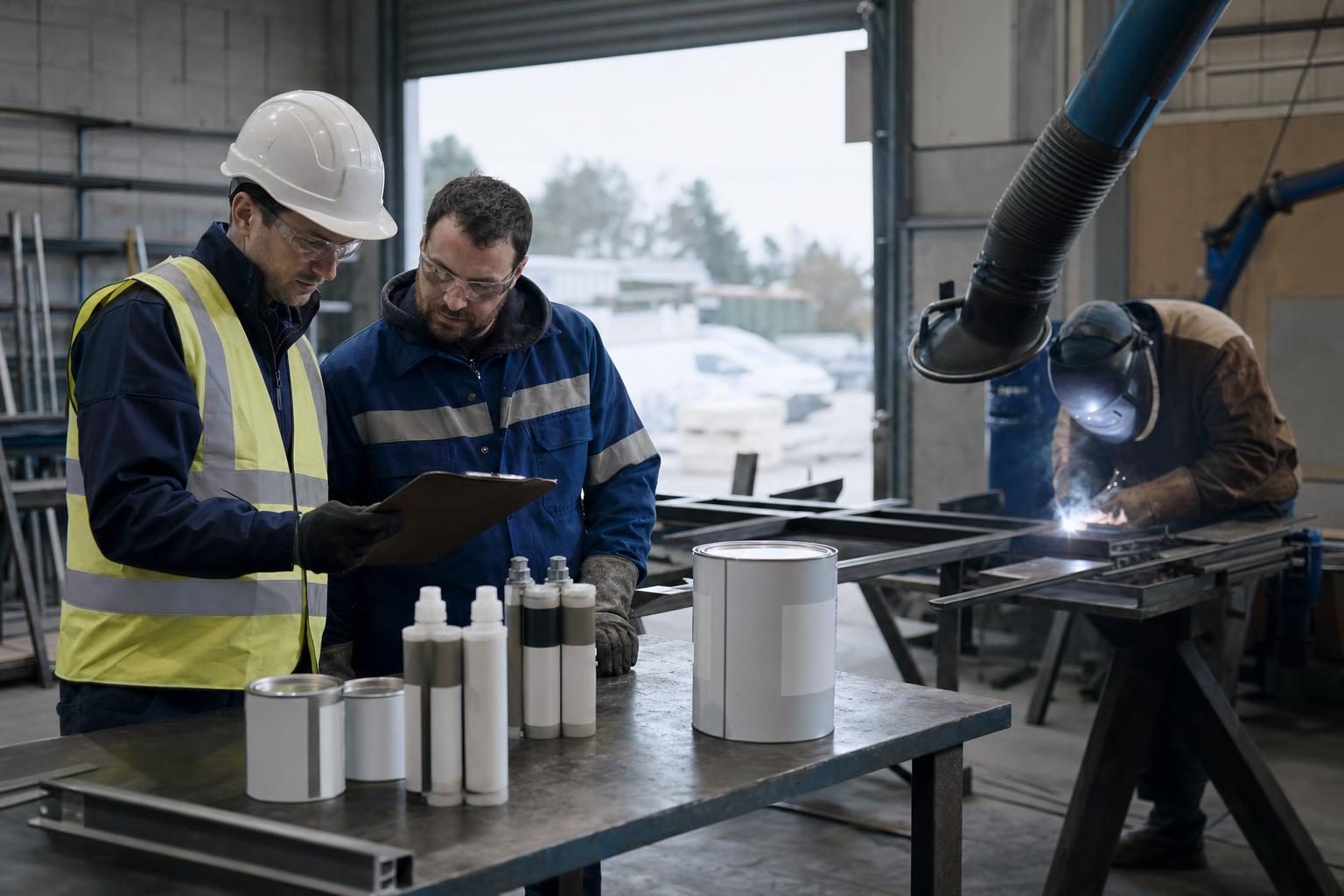
A fabrication shop with nine employees builds steel frames for agricultural machinery. Two welders MIG weld mild steel for most of each shift in a bay with a large roller door and a roof fan. Twice a week, a fitter bonds plastic guards onto the frames with a two-part epoxy adhesive, mixing small batches on a bench and wiping off the excess with a rag.
The shop has a COSHH folder. It holds the safety data sheets for the adhesive, the degreaser and the paint, each with a one-page form that says "wear gloves, ensure good ventilation." There is no entry for welding fume, because welding fume does not come in a tin and has no safety data sheet. And the fitter has had red, itchy patches on the backs of both hands since the summer.
Both gaps are common. The first comes from treating COSHH as a filing exercise for purchased products. The second comes from writing "gloves" without asking which glove, for how long, and whether skin contact happens anyway when the rag is used.
What Is a COSHH Assessment?
A COSHH assessment is the risk assessment required by regulation 6 of the Control of Substances Hazardous to Health Regulations 2002. The employer must not carry out work liable to expose employees to a substance hazardous to health until a suitable and sufficient assessment has been made and the steps it identifies have been put in place.
HSE's definition of a substance hazardous to health is wide: chemicals and products containing chemicals; fumes, dusts, vapours and mists; nanotechnology; gases, including asphyxiating gases; and biological agents. Lead, asbestos and radioactive substances are outside COSHH because they have their own regulations.
| Name | Where it is used | Legal basis |
|---|---|---|
| COSHH assessment | Great Britain | COSHH 2002, regulation 6 |
| Chemical risk assessment (kimyasal risk değerlendirmesi) | Türkiye | Chemical Agents Regulation (RG 12.08.2013, No. 28733), Article 6 |
| Hazardous substances risk assessment | General term, many countries | National chemical agents rules |
Regulation 6(2) lists what the assessment must consider. In plain terms:
- the hazardous properties of the substance
- the supplier's health information, including the safety data sheet
- the level, type and duration of exposure
- the circumstances of the work, including the amount used
- activities such as maintenance where exposure can be high
- any workplace exposure limit (WEL)
- the effect of the controls taken or to be taken
- results of health surveillance
- results of exposure monitoring
- the combined risk where more than one substance is involved
- the classification of any biological agent
- any other information needed to complete it
That list is the best checklist for your own form. If your template has no place for item 3 or item 5, it cannot produce a suitable and sufficient assessment.
What the Law Requires: UK and Türkiye
Both systems require the same core steps: identify the substances, assess exposure, apply controls in a fixed order, measure where needed, provide health surveillance where needed, and keep the assessment current.
| Duty | UK: COSHH 2002 | Türkiye: Chemical Agents Regulation (2013, amended 2023) |
|---|---|---|
| Assessment | Reg. 6(1): before the work starts | Art. 6(1); a new activity starts only after the assessment and its measures (Art. 6(4)) |
| What it must cover | Reg. 6(2)(a)–(l) | Art. 6(2)(a)–(ğ); maintenance and decommissioning added in 2023 |
| Written record | Significant findings, if 5 or more employees (reg. 6(4)) | Part of the workplace risk assessment under the general Risk Assessment Regulation (Art. 6(1)) |
| Control order | Substitution, then engineering and process, then control at source, then PPE (reg. 7) | Substitution, then process and engineering controls, then collective measures, then personal protection (Art. 7) |
| Exposure limits | WELs in HSE's EH40/2005 | Annex 1 (8-hour TWA, 15-minute STEL, skin notation) |
| Monitoring | Where the assessment shows it is needed (reg. 10) | Regular measurement, repeated when conditions change, by an authorized laboratory (Art. 6(2)(c), 7(1)(h)) |
| Health surveillance | Where appropriate (reg. 11); records 40 years | For workers found at risk (Art. 12) |
| Review | Regularly and at once after changes (reg. 6(3)) | With the general assessment: at most every 2, 4 or 6 years by hazard class, and after changes |
UK
Regulation 7 sets the order of controls and defines adequate control. Control is adequate only when the principles of good practice in Schedule 2A are applied and any WEL is not exceeded. For carcinogens and mutagens (hazard statements H340, H350, H350i), Schedule 1 substances and respiratory sensitisers (H334), exposure must also be reduced to as low a level as is reasonably practicable. So staying under a WEL is not enough for a carcinogen such as welding fume.
Regulation 9 requires a thorough examination and test of local exhaust ventilation (LEV) at least once every 14 months, with records kept for at least five years.
Türkiye
The Kimyasal Maddelerle Çalışmalarda Sağlık ve Güvenlik Önlemleri Hakkında Yönetmelik (RG 12.08.2013, No. 28733, amended RG 20.10.2023, No. 32345) asks the employer to find out whether hazardous chemicals are present and to assess the risk under the general Risk Assessment Regulation (RG 29.12.2012, No. 28512). The current text names the Turkish-language safety data sheet as an input, and since the 2023 amendment exposure data must come from a laboratory authorized under the Occupational Hygiene Measurement Regulation (RG 27.01.2023, No. 32086). The Turkish definition of a chemical covers substances that arise from a process, including waste, so welding fume belongs in the assessment there too.
Step 1: Build the Substance List, Including What the Process Makes
The substance list is the inventory the whole assessment rests on. Build it in two passes.
Pass 1: what you buy. Walk every area, including stores, the maintenance cupboard and the cleaner's trolley. HSE says that packaging with any hazard symbol marks a hazardous substance. Record the product name, supplier, where it is used, typical amount per week and the date of the safety data sheet you hold.
Pass 2: what the work makes. HSE's assessment page tells you to consider substances your processes produce. These never arrive with a safety data sheet:
| Process | Substance produced |
|---|---|
| Welding, hot cutting | Welding fume, gases |
| Cutting, grinding, sanding | Dusts (wood, stone, metal, paint) |
| Spraying | Mists of paint, solvent or oil |
| Machining with coolant | Metalworking fluid mist |
| Cleaning drains, sumps, cooling towers | Biological agents |
| Combustion engines indoors | Exhaust fumes |
Group the list by task, not by product. The adhesive is used in the guard-fitting task; the welding fume comes from the welding task. The task is where the exposure happens, so the task is what you assess.
Step 2: Read the Safety Data Sheet Into the Assessment
The safety data sheet (SDS) is the supplier's information, not your assessment. In the 16-section GHS format (set out, for example, in 29 CFR 1910.1200(g)), it tells you what the substance can do. It cannot tell you how your people use it.
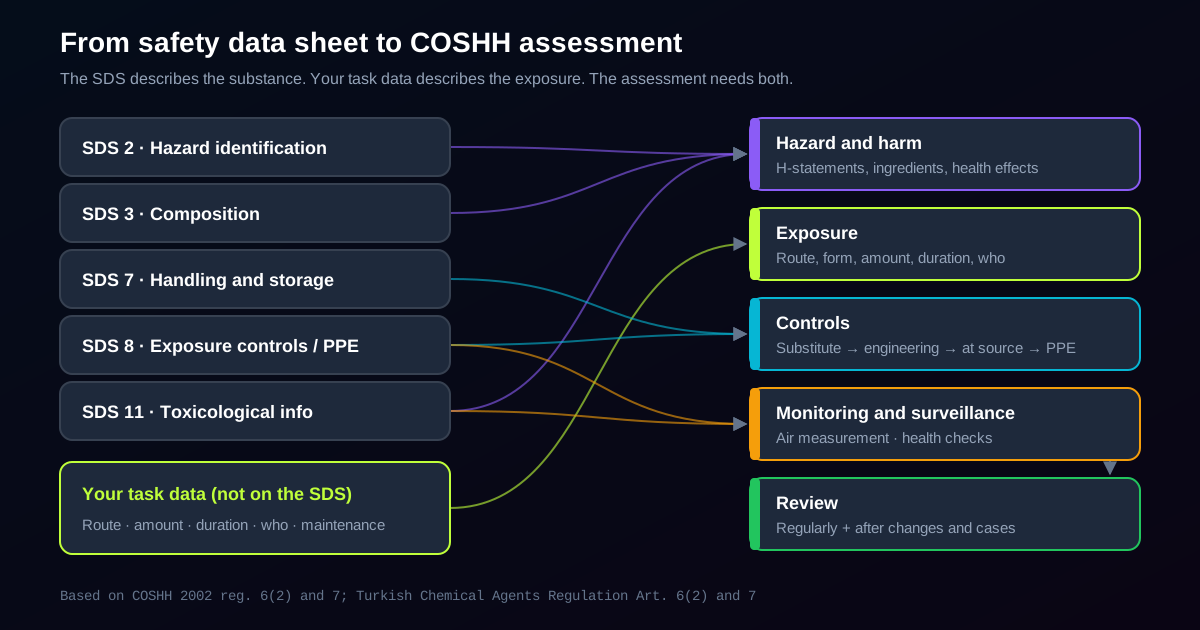
Five sections do most of the work:
| SDS section | What to take from it | Where it goes in the assessment |
|---|---|---|
| 2. Hazard(s) identification | Hazard statements (H-codes), signal word | Hazard and harm |
| 3. Composition | Ingredients with their own limits or classifications | Hazard; WEL check |
| 7. Handling and storage | Handling precautions, incompatibles | Controls |
| 8. Exposure controls / personal protection | Exposure limits, ventilation, glove material, eye and respiratory protection | Controls, PPE specification |
| 11. Toxicological information | Routes of exposure, effects, sensitisation | Harm; health surveillance |
Read the hazard statements first, because they decide how strict the control must be. A few that change an assessment:
| Hazard statement | Wording | What it changes |
|---|---|---|
| H315 | Causes skin irritation | Skin route matters; glove and washing controls |
| H317 | May cause an allergic skin reaction | Sensitiser: once sensitised, small contact can trigger dermatitis; consider skin surveillance |
| H334 | May cause allergy or asthma symptoms or breathing difficulties if inhaled | Respiratory sensitiser: reduce exposure as low as reasonably practicable |
| H335 | May cause respiratory irritation | Inhalation control at source |
| H336 | May cause drowsiness or dizziness | Solvent vapor; ventilation, confined spaces |
| H350 | May cause cancer | Carcinogen: ALARP, not just below the WEL |
Wording from the GHS hazard statement list. Two practical checks: the SDS date (an old SDS may predate a reclassification), and whether section 8 names a glove material and breakthrough time or just says "suitable gloves." If it says only that, ask the supplier. Türkiye's regulation says the supplier must give the employer the information needed for the assessment on request (Art. 6(3) and 9(3)).
The SDS also has to reach the people using the product. OSHA requires SDSs to be readily accessible to employees during each work shift (1910.1200(g)(8)), and the Turkish regulation requires workers to be informed about the Turkish SDS (Art. 9(1)(ç)).
Step 3: Work Out Exposure: Route, Amount, Duration, Who
Exposure is what turns a hazard into a risk. Regulation 6(2)(c) and (d) ask for the level, type and duration of exposure and the amount of substance involved. Write these as facts about the task.
| Question | What to write | Example answer |
|---|---|---|
| Route | Inhalation, skin, eyes, ingestion (hand to mouth) | Inhalation of fume in the breathing zone |
| Form | Gas, vapor, mist, fume, dust, liquid, paste | Fume (very fine particles) |
| Amount | Quantity per task or per day | 6–7 hours of arc time per welder per shift |
| Duration and frequency | Minutes per task, tasks per week | Daily, most of the shift |
| Who | Users, people nearby, cleaners, maintenance, contractors, visitors | 2 welders; fitter and apprentice working 5 m away |
| Non-routine tasks | Cleaning, maintenance, spills, filter changes | Emptying the extraction unit's filter |
HSE asks you to decide who might be harmed and how, including maintenance workers, contractors and visitors. The Turkish regulation added exposure during maintenance, repair, installation, commissioning and decommissioning in 2023 (Art. 6(2)(ğ)). Both point to the same blind spot: the person emptying the filter often gets a higher dose in ten minutes than the user gets in a day.
Then compare with the limit. If the substance has a WEL in EH40 (or a value in the Turkish Annex 1), note it with its time basis (8-hour TWA or 15-minute STEL) and any skin notation. Only about 500 substances have a GB WEL, according to HSE, so for many products there is no number to compare. That does not lower the duty: you still control the exposure.
Step 4: Choose Controls in the Legal Order
The order of controls is set in law, and the assessment should show that you worked down it. Under COSHH regulation 7 and Article 7 of the Turkish regulation, the order is:
- Eliminate or substitute. Do you need the substance at all? Is there a less hazardous product or a less hazardous form (paste instead of powder, brush instead of spray)?
- Engineering and process controls. Enclosure, closed transfer, LEV that captures at source, lower-temperature processes.
- Control at source and organisational measures. General ventilation, fewer people in the area, shorter tasks, good housekeeping, washing facilities.
- PPE. Gloves, eye protection, respiratory protective equipment (RPE), only where the measures above do not give adequate control.
HSE puts it directly: "Do not automatically opt for personal protective equipment (PPE)." When PPE is part of the control, the assessment must specify it: glove material and thickness, change interval, RPE type and its assigned protection factor, face-fit testing, storage and who checks it. "Gloves" is not a control; "nitrile gloves, 0.4 mm, changed every two hours or at once if splashed" is. Our hierarchy of controls guide has worked examples for each level, and the PPE hazard assessment guide covers how to specify and record PPE.
COSHH Assessment Example: Two Substances in One Workshop
This is a filled example for the workshop in the scenario. The products, SDS entries, ratings and dates are made up for illustration. The rating is our own simple scale: hazard (from the H-statements) combined with exposure (from Step 3) gives High, Medium or Low. COSHH does not prescribe a scoring method; in Türkiye many teams use the Fine-Kinney method for the same purpose.
Workplace: steel fabrication shop, 9 employees. Assessor: safety adviser with the workshop supervisor and both welders. Date: 10 November 2026. Review: November 2027, or earlier after any change listed in the review section.
Substance A: Mild steel MIG welding fume
| Field | Entry |
|---|---|
| Task | MIG welding of mild steel frames, welding bay |
| Source of information | No SDS (process-generated). Wire and gas SDSs; HSE Safety Alert STSU1-2019 |
| Hazard | Mild steel welding fume can cause lung cancer (IARC reclassification, cited by HSE). Fume also contains manganese |
| Route and form | Inhalation of fume in the breathing zone |
| Who and how long | 2 welders, 6–7 hours arc time per shift; fitter and apprentice nearby; maintenance technician when changing filters |
| Current controls | Roller door open, roof fan, disposable FFP2 masks available |
| Gap | HSE states that general ventilation does not achieve the necessary control of welding fume. No extraction at the torch. Masks not face-fit tested. Nothing for filter changes |
| Rating | High (carcinogen, daily long exposure, no source control) |
| Actions | 1. Fit on-torch fume extraction or extraction arms at each welding station (owner: supervisor, by 15 December 2026). 2. Until then, and where LEV alone does not control exposure: tight-fitting RPE with face-fit test, or powered air helmets (owner: safety adviser, within 1 week). 3. Screens to keep the fitter's bench out of the plume (2 weeks). 4. Written method and RPE for emptying the extractor filter. 5. LEV commissioning, then thorough examination and test at least every 14 months; keep records 5 years |
| Monitoring | Air sampling after the LEV is installed, to show the controls work |
| Health surveillance | Ask the occupational health provider whether surveillance is needed for the welders (respiratory questionnaire, lung function) |
Substance B: Two-part epoxy adhesive (resin and hardener)
| Field | Entry |
|---|---|
| Task | Mixing 50–100 g batches and bonding guards, 2 sessions of about 1.5 hours per week |
| Source of information | Supplier SDS for resin and hardener (both dated 2025) |
| Hazard (SDS section 2) | Resin: H315, H317, H319. Hardener: H317 plus a corrosive classification. Epoxy resin components can cause skin sensitisation (HSE RR79) |
| Route and form | Skin contact with liquid and paste during mixing, application and wiping; eye splash |
| Who and how long | 1 fitter; apprentice occasionally |
| Current controls | Thin disposable gloves "when available," rag wiping, hands washed at the end of the shift |
| Gap | SDS section 8 names nitrile gloves of a stated thickness; thin disposable gloves were not that type. The rag and wiping give direct skin contact. The fitter has symptoms on both hands |
| Rating | High (skin sensitiser, regular skin contact, symptoms present) |
| Actions | 1. Ask the supplier about a pre-measured cartridge with a mixing nozzle to remove hand mixing (supervisor, 2 weeks). 2. Gloves as specified in SDS section 8, with change interval and safe removal method. 3. Disposable spatulas and wipes into a lidded bin instead of rags. 4. Goggles for mixing. 5. Washing facilities with warm water and skin-care products at the bench. 6. Refer the fitter to occupational health now |
| Monitoring | Not needed for airborne exposure at this scale; the route is skin |
| Health surveillance | Yes: skin surveillance for everyone using the adhesive (see next section) |
Two notes on the example. First, both substances end up High, but for different reasons and with different fixes: one is solved at the torch, the other at the bench and the glove. Second, the fitter's symptoms are a reason to act now, not a note for the next review. HSE's engineering workshop example adds a point that applies here too: gloves are never acceptable near rotating parts, because of entanglement.
When Do You Need Exposure Monitoring and Health Surveillance?
Monitoring and health surveillance are required by the assessment's own findings, not by a fixed calendar. Monitoring measures the substance in the air; health surveillance checks the worker.
| Question | If yes | Source |
|---|---|---|
| Does the assessment show monitoring is needed to keep control adequate or to protect health? | Monitor exposure, at regular intervals and after changes; keep personal records 40 years, others 5 years | COSHH reg. 10 |
| Can you show adequate control another way (e.g. a well-tested enclosed process)? | Monitoring may not be needed; record the reasoning | COSHH reg. 10 |
| Is there a disease linked to the exposure, likely under your conditions, with a valid way to detect it? | Health surveillance; keep health records at least 40 years from the last entry | COSHH reg. 11 |
| Is the substance a skin sensitiser, or are you relying on gloves, or have there been dermatitis cases? | Skin surveillance | HSE skin surveillance |
| Türkiye: do substances pose a health risk? | Regular measurement by an authorized laboratory, repeated when conditions change | Art. 7(1)(h) |
| Türkiye: are workers found to be at health risk? | Health surveillance; personal health and exposure records kept and updated | Art. 12 |
For skin, HSE describes two levels. Where there is a clear hazard or significant exposure, start with a baseline skin check before or soon after the person starts the job, then regular visual checks; a brief monthly routine is often appropriate. Where exposure is occasional or well controlled, an annual questionnaire is typical. A trained "responsible person" can do the checks, with an occupational health professional interpreting the results.
HSE's COSHH surveillance page names asthma, dermatitis and cancers as the diseases linked to substances, and lung function and skin condition as examples of what is checked. The results come back into the assessment: regulation 6(2)(h) requires you to consider them.
When to Review a COSHH Assessment
A COSHH assessment must be reviewed regularly and at once when something makes it doubtful. Regulation 6(3) gives three triggers: reason to suspect the assessment is no longer valid, a significant change in the work, or monitoring results that show a review is needed.
| Trigger | UK (COSHH reg. 6(3) and HSE) | Türkiye (Risk Assessment Regulation Art. 12) |
|---|---|---|
| Fixed interval | "Regularly" (no fixed period in the regulation) | At most every 2, 4 or 6 years for very hazardous, hazardous and less hazardous workplaces |
| New product, new supplier, changed formulation | Significant change | Change in substances |
| New process, equipment or method | Significant change | Change in technology, equipment or production method |
| Monitoring above the limit or controls not working | Monitoring shows review necessary | Workplace measurement results |
| Health surveillance finds a case | Reason to suspect it is no longer valid | Health surveillance results |
| Accident, near miss, worker complaint | HSE lists accidents, near misses and problems reported by workers | Accident, occupational disease or near miss |
| New exposure limit | Assessment may no longer be valid | Change in exposure-limit legislation |
In practice, a yearly review date on the form plus a short list of these triggers works well. The yearly date is our suggestion, not a legal period.
Flammable and explosive properties of the same substances are assessed under separate rules. See the explosion protection document guide for DSEAR and ATEX.
Common Mistakes
1. One assessment per product, none per task
The same degreaser wiped on with a cloth and sprayed into a hot part are two different exposures. Assess the task.
2. Missing process-generated substances
Welding fume, wood dust and coolant mist have no SDS, so they never reach a folder built from purchased products. They are often the highest risk in the building.
3. Copying the SDS and calling it the assessment
The SDS describes the substance. The assessment must describe your exposure and your controls. A form that only repeats section 8 has skipped regulation 6(2)(c) and (d).
4. "Wear suitable gloves"
Without material, thickness, change interval and removal method, a glove may let the chemical through or hold it against the skin. HSE lists reliance on gloves as a reason to consider skin surveillance.
5. Treating "below the WEL" as safe for carcinogens and sensitisers
For carcinogens, mutagens and respiratory sensitisers, COSHH requires exposure as low as reasonably practicable, not just under the limit.
6. Forgetting maintenance and cleaning
Changing a filter, cleaning a sump or clearing a spill can give the highest dose of the year. Both COSHH 6(2)(e) and the Turkish Article 6(2)(ğ) name it.
7. Never closing the loop
Monitoring and health surveillance results that are filed but not read back into the assessment do nothing. Each result should either confirm the controls or trigger a change.
How FindRisk Supports Chemical Risk Assessments
FindRisk is built for the walk-round part of the job. You can generate an inspection checklist with AI for a chemical store, a welding bay or a mixing bench, so the substance list and the "what does the process make" pass are not left to memory.
On the shop floor, you photograph the area and mark the hazards on the photo: the rag bin, the open hardener tin, the welding station without extraction. The AI analysis of the photo suggests hazards you may have missed, and each one can be scored with the Fine-Kinney method.
The report is produced in seconds, with photos, scores and actions, so the findings are in front of the supervisor the same day. FindRisk runs on iOS and Android. The COSHH reasoning, the SDS review and the control choices remain the assessor's work.
Frequently Asked Questions
What substances are covered by COSHH?
COSHH covers chemicals and products containing chemicals, fumes, dusts, vapours and mists, nanotechnology, gases including asphyxiating gases, and biological agents such as bacteria. HSE says that packaging with any hazard symbol marks a hazardous substance. Lead, asbestos and radioactive substances are not covered by COSHH because they have their own specific regulations.
Who can carry out a COSHH assessment?
COSHH puts the duty on the employer and does not name a job title for the assessor. In practice the person needs to understand the substances, the work and the controls: in a small firm often a trained manager, for complex processes a safety adviser or occupational hygienist. Involve the people who do the task, because they know the real amounts, durations and shortcuts.
Do you need a COSHH assessment for every product?
Every substance hazardous to health that people are exposed to must be covered, but not necessarily on a separate form. Products used the same way in the same task can share one assessment. A product with no hazard classification may need only a note on the inventory. What matters is that every task with exposure is assessed.
How long should COSHH records be kept?
Under COSHH 2002, health surveillance records must be kept for at least 40 years from the last entry. Exposure monitoring records for identifiable employees are kept for 40 years, other monitoring records for 5 years, and LEV examination and test records for at least 5 years. For the assessment itself, keep the current version and, as good practice, the earlier ones.
Is a safety data sheet the same as a COSHH assessment?
No. The safety data sheet is the supplier's information about the substance's hazards and recommended precautions. The COSHH assessment is the employer's evaluation of how workers are actually exposed during specific tasks and which controls are in place. The SDS is one of the inputs listed in regulation 6(2)(b).
Does a small business with fewer than 5 employees need a written COSHH assessment?
The assessment itself is required at any size. The duty to record its significant findings applies to employers with 5 or more employees under regulation 6(4). HSE still says it makes sense for smaller businesses to write down the steps they have taken, because it is the easiest way to show the work was done.
Conclusion
A useful COSHH assessment starts with a substance list that includes what the process makes, uses the safety data sheet as an input rather than an answer, and writes exposure down as facts about the task. Controls follow the legal order, and PPE is specified precisely when it is used.
Monitoring and health surveillance follow from the assessment's findings, and their results feed back into it. In both the UK and Türkiye, the assessment is reviewed after changes, cases and accidents, not only on a calendar date. For the broader picture of GHS labels, SDSs and exposure limits, see our chemical safety guide, and for the general method, the risk assessment guide.
Download FindRisk to build your next chemical walk-round checklist with AI, mark what you find on photos and have the report ready before you leave the workshop.
Try FindRisk
Ready to modernize your safety workflow?
Conduct AI-powered risk assessments, generate reports instantly, and keep your team safe — anywhere, anytime.