
Young Workers Risk Assessment: Law, 6 Steps and 2 Examples
A young workers risk assessment is the part of your risk assessment that checks whether the tasks you plan to give someone under 18 are safe for them in particular. It weighs their inexperience, immaturity and physical limits, applies the legal bans and working-time limits for their age, and decides for each task: allowed, allowed under supervision, or not allowed.
Most workplaces already have a risk assessment that covers "employees" as one group. That works until a 16-year-old apprentice or a summer worker arrives. The same machine, the same ladder and the same closing shift carry a different risk for someone who has never worked before, wants to impress the team and does not yet know what a near miss looks like. The law in the UK, the EU and Türkiye says so directly: the assessment must be made or reviewed before the young person starts, with their age-specific factors in mind.
This guide covers who counts as a young person or a child, what the law requires in four jurisdictions, the factors that make young workers different, a six-step method, two filled assessments (a workshop apprentice and a retail summer worker), and how to run induction, supervision and the conversation with parents.
A New Starter Who Is 16
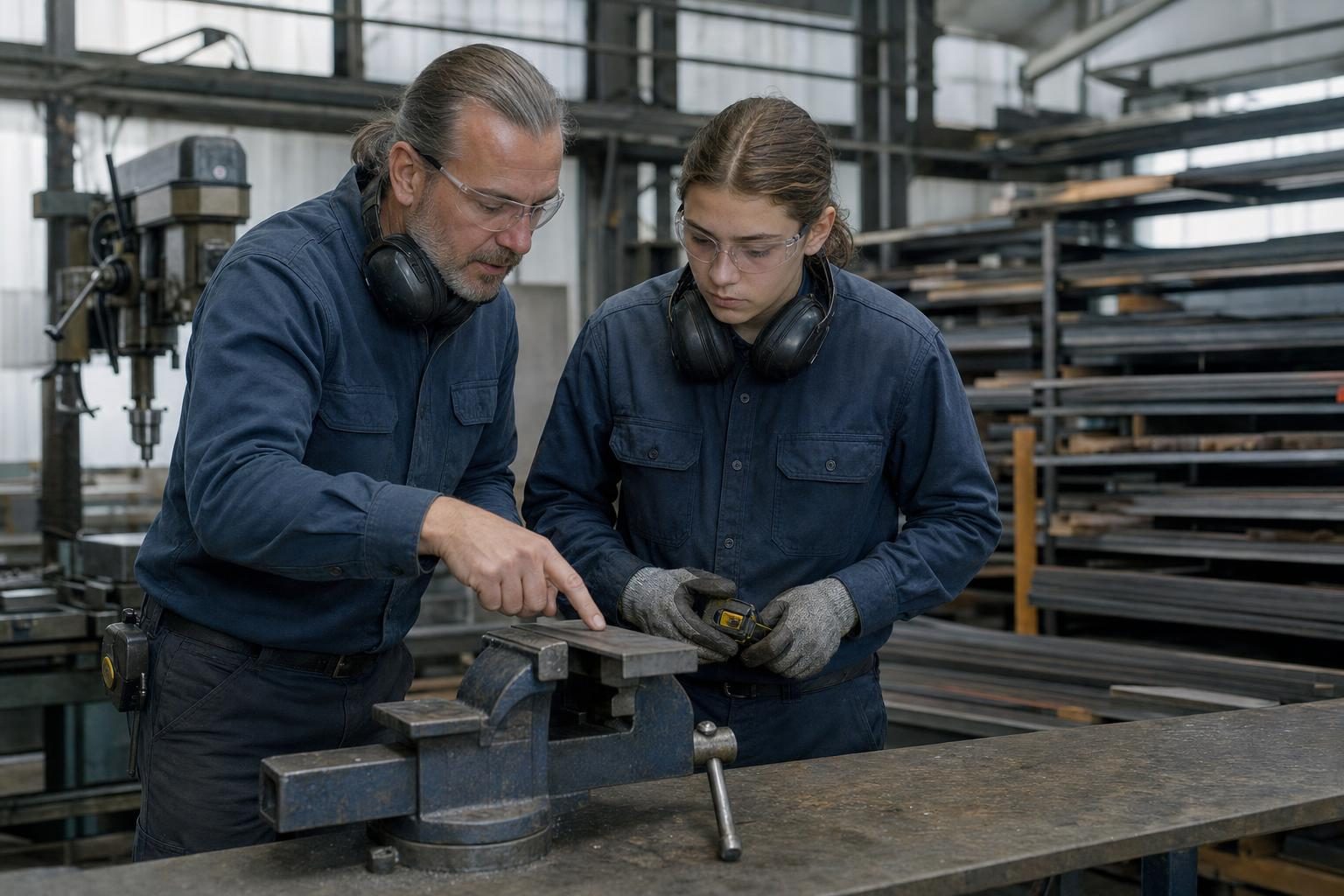
This is a fictional example built for this guide. A metal fabrication company with 40 employees takes on its first apprentice in five years. He is 16, has just finished school and starts in three weeks. The workshop manager plans to "show him the ropes" on the press brake in the first week, because that is how he learned.
The safety adviser opens the workshop risk assessment. It lists hazards by machine and names the controls: guarding, interlocks, hearing protection, local exhaust ventilation on the welding bays. It does not mention age anywhere. Nothing in it says which tasks a 16-year-old may do on day one, which only after training, and which not at all. There is no plan for supervision and nothing about working hours, even though the shop sometimes runs late to finish orders.
That gap is what a young workers risk assessment fills. It is not a new document from scratch. It is a review of the existing assessment through the eyes of someone who is under 18, ending in a clear task list, a supervision plan and hours that respect the legal limits.
What Is a Young Workers Risk Assessment?
A young workers risk assessment is a review of the hazards a person under 18 will meet at work, made before they start, that takes particular account of their lack of experience, lack of awareness of risks and immaturity. In the UK it is a legal precondition: under regulation 3(4) of the Management of Health and Safety at Work Regulations 1999, an employer shall not employ a young person unless it has made or reviewed an assessment that covers these factors.
It goes by several names:
| Term | Where you will see it |
|---|---|
| Young person risk assessment | UK (MHSWR 1999 uses "young person") |
| Young workers risk assessment | EU-OSHA, HSE web pages, most templates |
| Work experience risk assessment | Schools and placement organizers (UK) |
| Child employment risk assessment | UK local councils, for workers under school-leaving age |
| Genç çalışan risk değerlendirmesi | Türkiye (6331 Article 10, "special policy groups") |
It is not always a separate form. HSE's work experience guidance says you do not need to repeat your assessment for each new student of similar maturity and understanding, but you should review it if you have not recently employed a young person, are taking a student for the first time, or the student has particular needs. In practice, most employers keep a short young-worker annex attached to the main risk assessment.
Who Counts as a Young Person or a Child?
A young person is anyone under 18. A child is a younger subset, and the cut-off depends on schooling or age.
| Jurisdiction | Young person | Child | Source |
|---|---|---|---|
| UK | Under 18 | Not over compulsory school age | MHSWR 1999 reg. 1(2) |
| EU | Under 18 | Under 15, or still in compulsory full-time schooling | Directive 94/33/EC Art. 3 |
| US (federal) | Under 18 for hazardous occupations | 14–15 have hour limits; basic minimum age 16 | DOL Fact Sheet #43 |
| Türkiye | Genç işçi: 15 to under 18 | Çocuk işçi: 14 to under 15, primary education completed | Çocuk ve Genç İşçi Yönetmeliği Art. 4 |
The difference matters. In the UK, some duties apply only to children: before employing a child, the employer must give a parent comprehensible information on the risks, the controls and any risks from other employers on site (MHSWR regulation 10(2)). And the training exemption in regulation 19(3), which lets a young person do otherwise restricted work, is open only to a young person "who is no longer a child".
What the Law Requires: UK, EU, US and Türkiye
All four systems share one idea: some work is off-limits to under-18s, the rest must be assessed with their age in mind, and their hours are capped. They differ in how they draw the lines.
| Requirement | UK | EU (94/33/EC) | US (FLSA) | Türkiye |
|---|---|---|---|---|
| Assessment before starting | Yes, reg. 3(4) | Yes, Art. 6(2) | Not how the FLSA works: hazardous jobs are banned by order | Yes, 6331 Art. 10(1)(ç) and Yönetmelik Art. 13 |
| Banned work | Five categories, reg. 19(2) | Same five categories, Art. 7(2) | 17 Hazardous Occupations Orders | Only work on the Ek-1/2/3 lists, plus absolute bans |
| Training exception | Over school age, needed for training, competent supervision, risk as low as reasonably practicable | Member states may allow for vocational training | Limited exemption from 7 orders for apprentices and student-learners aged 16+ | Vocational students: work and sites set by the Ministry of National Education |
| Daily/weekly hours (15–17, out of school) | 8 h / 40 h | 8 h / 40 h | 16–17: no federal limit | Up to 8 h / 40 h for 15+ not in formal education |
| Night work | Not 10 p.m.–6 a.m. (or 11 p.m.–7 a.m.) | Not 10 p.m.–6 a.m. or 11 p.m.–7 a.m. | 14–15: only 7 a.m.–7 p.m. (9 p.m. in summer) | Not in the night period (starts by 8 p.m., ends no earlier than 6 a.m.) |
| Inform parents | Of a child, before starting | Legal representatives of children | Not in the federal rules above; check state law | Parent or guardian of every under-18 |
UK
The Management of Health and Safety at Work Regulations 1999, regulation 19(2), say an employer must not employ a young person for work that:
- is beyond their physical or psychological capacity;
- involves harmful exposure to agents that are toxic or carcinogenic, cause heritable genetic damage or harm to the unborn child, or chronically affect health in another way;
- involves harmful exposure to radiation;
- involves accident risks a young person cannot reasonably be expected to recognize or avoid, because of insufficient attention to safety or lack of experience or training;
- carries a risk to health from extreme cold or heat, noise or vibration.
Regulation 19(3) allows such work for a young person who is no longer a child only if it is necessary for their training, they are supervised by a competent person, and the risk is reduced to the lowest level reasonably practicable. The Working Time Regulations 1998 cap young workers at eight hours a day and 40 a week, ban work in the restricted period (10 p.m. to 6 a.m., or 11 p.m. to 7 a.m. if the contract provides for work after 10 p.m.), and give 12 consecutive hours of daily rest and a 30-minute break when the day exceeds four and a half hours.
EU
Council Directive 94/33/EC is the source of the UK rules and of national laws across the EU. Article 6 requires the assessment before young people begin work and at any major change, paying attention to the workplace layout, exposure to agents, work equipment, work organization and the level of training. Where a risk is found, free health assessment and monitoring must be provided at regular intervals. Article 7 lists the same five banned categories, and the Annex lists agents and processes to check. Adolescents are capped at eight hours a day and 40 a week (Article 8), and night work is banned between 10 p.m. and 6 a.m. or 11 p.m. and 7 a.m. (Article 9).
US
Federal law takes a different route. The child labor rules of the Fair Labor Standards Act work by listing banned occupations rather than by asking for an age-specific assessment. The Department of Labor's Fact Sheet #43 lists 17 Hazardous Occupations Orders that ban under-18s from work such as driving motor vehicles, operating power-driven hoisting equipment (including forklifts), power-driven woodworking machines and saws, balers and compactors, roofing, and trenching and excavation. Sixteen- and 17-year-olds may work unlimited hours in any other job. Fourteen- and 15-year-olds are limited to 3 hours on a school day, 18 hours in a school week, 8 hours on a non-school day and 40 hours in a non-school week, between 7 a.m. and 7 p.m. (9 p.m. from June 1 through Labor Day). Apprentices and student-learners aged 16 or more in approved programs have a limited exemption from seven of the orders. State laws can be stricter, so check yours.
Türkiye
Turkish law uses a whitelist. Under the Çocuk ve Genç İşçilerin Çalıştırılma Usul ve Esasları Hakkında Yönetmelik (Official Gazette 6 April 2004, No. 25425, amended 2013), child workers may only do the light work in Annex 1, young workers the work in Annexes 1 and 2, and 16- and 17-year-olds the work in Annexes 1 to 3. Even inside those lists, under-18s may not do night work, cash transport and collection, piece-rate work, or work with high noise or vibration, extreme temperatures or harmful substances. Law No. 6331 covers apprentices and interns explicitly (Article 2) and requires the risk assessment to consider young workers as a special policy group (Article 10(1)(ç)). The Turkish version of this guide covers these rules in full.
Why Young Workers Face Different Risks
Young workers are not simply "less experienced adults". Several factors combine, and each one points to a different control.
| Factor | What it looks like on the floor | What the assessment does about it |
|---|---|---|
| Inexperience | Does not recognize a jam building up, a load about to slip, or a smell that means trouble | Restrict tasks until competence is shown; name a supervisor |
| Lack of awareness of risks | Has never seen what a grinder disc failure does; trusts that "if it were dangerous it would not be allowed" | Explain the why, not only the rule; show the hazard at induction |
| Immaturity | Takes shortcuts to keep up, accepts dares, does not ask questions | Buddy system; a named person they can ask without losing face |
| Eagerness to please | Says "yes" to a task they have not been trained for | Tell them in writing which tasks they may refuse, and back them when they do |
| Physical development | HSE notes muscle strength may not be fully developed and handling technique and pacing are less practiced | Lower manual handling limits, team lifts, task rotation |
| Training level | Knows the theory from school, has never applied it under time pressure | Supervised practice, then a recorded sign-off per task |
HSE's guidance makes the same points: young people "may lack experience or maturity", "may not have reached physical maturity", may be "eager to impress or please people they work with", and "may need more supervision than adults" (HSE, Risks to young people at work). EU-OSHA adds that statistics show 18- to 24-year-olds are more likely to have a serious accident at work than older adults, which is why habits formed in the first job matter (EU-OSHA, Young workers).
How to Do a Young Workers Risk Assessment in 6 Steps
The method below works in any jurisdiction. Each step produces something you can record.
Step 1: Confirm age, status and the rules that apply
Record the date of birth, whether they are still in compulsory schooling, and the type of arrangement: employee, apprentice, work experience student, intern. This decides which rules apply: child or young person in the UK, child, adolescent or student in the EU, child worker or young worker in Türkiye. In the US, age 14–15 versus 16–17 decides the hours and the orders.
Step 2: List the actual tasks, not the job title
Write down what they will do in the first weeks: each machine, tool, substance, location and shift. "Production assistant" says nothing. "Feeds sheets into the guillotine, carries offcuts to the skip, sweeps the bay at 5 p.m." can be assessed.
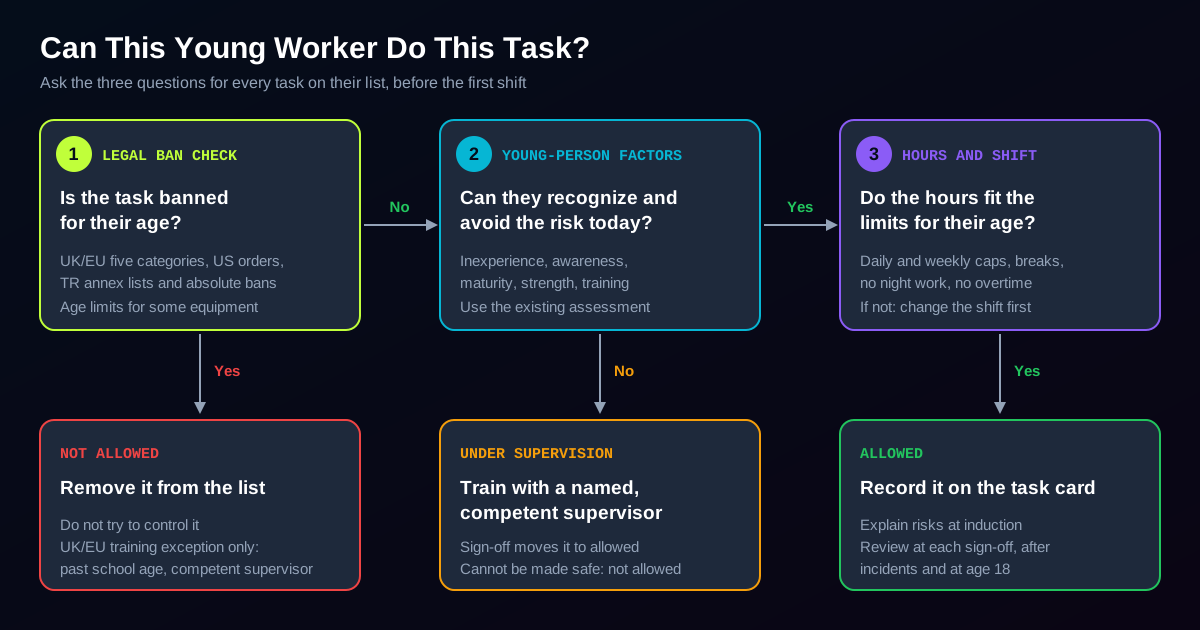
Step 3: Check each task against the legal bans
Go through the banned categories for your jurisdiction: the five UK and EU categories, the US Hazardous Occupations Orders, or the Turkish annex lists and absolute bans. HSE also reminds employers to check legally required age limits for some equipment and machinery, giving forklift trucks and some woodworking machinery as examples. A task that is banned outright is removed from the list. Do not try to "control" it.
Step 4: Assess the remaining tasks with the young-person factors
For each remaining task, open the existing assessment and ask what changes for this person. UK regulation 3(5) gives the checklist: workplace layout, exposure to agents, work equipment and how it is handled, work organization, the training provided, and the agents and processes in the Annex to Directive 94/33/EC. Apply the hierarchy of controls as usual, then add the age-specific layer: supervision, lower handling limits, restricted access, task sign-off.
Step 5: Decide per task and set hours
Every task gets one of three decisions: allowed, allowed under supervision after training, or not allowed. Write the condition for moving a task up a level (for example, "after five supervised shifts and a sign-off by the shift lead"). Then set the working pattern inside the legal limits for their age and check overtime, early starts and late closes.
Step 6: Inform, record and review
Explain the risks and controls to the young person at induction and check they understood. Inform parents where the law requires it. Record the significant findings: in the UK this is mandatory with five or more employees (MHSWR regulation 3(6)). Review at the first sign-off point, after any incident or near miss, when tasks or equipment change, and at their 18th birthday, when the age rules fall away but the experience gap does not.
Worked Example 1: Workshop Apprentice (16)
This example uses the fictional fabrication shop from the opening scenario, under UK law. The apprentice has left school, so he is a young person but no longer a child. His apprenticeship program needs him to learn cutting, drilling, bending and welding.
| Task | Hazard | Young-person factor | Decision | Controls and condition |
|---|---|---|---|---|
| Pillar drill, small parts | Entanglement, ejected parts | Inexperience with clamping, loose clothing | Allowed under supervision | Guard and vise checked by supervisor; sign-off after 3 supervised sessions; see the machine guarding checklist |
| Angle grinder, deburring | Disc failure, kickback, sparks | Does not know what a damaged disc looks like | Allowed under supervision, training task | Supervisor present for the first month; disc check taught at induction; face shield and gloves |
| Press brake | Crushing at the point of operation | Cannot yet judge safe hand positions under time pressure | Not allowed for the first 3 months; then reassess | Observes setups only; reassess at month 3 with training records |
| MIG welding in training bay | Fume, UV, burns, fire | First exposure; may lift the mask to see the weld | Allowed under supervision, training task | Training bay with extraction only; supervisor confirms extraction is running; correct helmet, jacket and gloves issued and fitted |
| Carrying sheet steel | Manual handling, cut edges | Strength and technique still developing | Allowed with limits | Sheets above a set weight are two-person lifts or use the sheet trolley; cut-resistant gloves; see workplace ergonomics |
| Overhead crane and forklift | Struck by load, overturn | No license, no experience | Not allowed | Company rule for all apprentices under 18; checked against legal age limits |
| Shop noise | Hearing damage | Will not ask for hearing protection if no one else wears it | Allowed with controls | Hearing protection zones marked; supervisor wears protection too; noise exposure checked against the noise assessment |
| Hours | Fatigue | Late finishes when orders run over | Fixed pattern | 7:30 to 16:00 with a 30-minute break; no overtime; never in the restricted period |
The supervision plan names the welding instructor as competent person for the training tasks and the shift lead for the rest. The apprentice gets a one-page card with three lists: tasks he may do, tasks he may do only when the named supervisor is present, and tasks he must not do. The card tells him he can stop and ask at any point without it counting against him.
Worked Example 2: Retail Summer Worker (17)
A supermarket hires a 17-year-old for the summer holidays. She has finished compulsory schooling. The general store assessment covers shelf filling, the backroom, the tills and the car park. Again, UK law applies.
| Task | Hazard | Young-person factor | Decision | Controls and condition |
|---|---|---|---|---|
| Shelf filling from roll cages | Manual handling, cage tipping | Will copy the fastest colleague, not the safest | Allowed with limits | Shown how to pull, not push, loaded cages; heavy cases on low shelves are two-person; team leader checks in on day 1 and 3 |
| Box cutter, opening cases | Cuts to hands | First use of a blade at work | Allowed after training | Safety cutters with retracting blade only; cutting direction shown at induction |
| Cardboard baler | Crushing, entanglement | Could be tempted to clear a jam by hand | Not allowed | Baler loading and operation by trained adults only; she flattens boxes and places them in the cage beside it |
| Step ladder for top shelves | Falls from height | Over-reaching to finish quickly | Allowed with conditions | Platform steps only, never on shelving; toolbox talk on ladder use in week 1 |
| Tills | Verbal abuse, cash handling | Less experienced with aggressive customers | Allowed, not alone | Never the only person on the tills; supervisor called to any dispute; no cash collection from other tills |
| Backroom alone | Lone working, trapped behind cages | Will not raise the alarm early | Not alone | Backroom tasks only with a colleague on the floor in sight or radio contact |
| Late close until 22:30 | Fatigue, travel home late | Restricted period for young workers | Changed | Shifts end by 22:00 so no work falls in the restricted period; 12 hours rest before the next shift |
This assessment took one short meeting with the store manager, because a shop is a lower-risk setting where, as HSE notes, existing arrangements for other workers are usually enough. The extra controls sit on the baler, the late close and working alone, which are the three places a young person's behavior and the law both point to. A warehouse and logistics checklist is a useful cross-check for the backroom.
Induction, Supervision and Telling Parents
The assessment only works if the people around the young worker apply it. Three practices make the difference.
Induction before the first task. Cover the site rules, emergency arrangements, the task card from Step 5, PPE and how to report a hazard or near miss. HSE advises explaining risks and controls at induction and checking that the student understood them. Ask them to show you, not tell you.
Named supervision. HSE says young people "need clear and sufficient instruction, training and supervision" and "may need more supervision than adults". Name a supervisor for each shift, tell the team who the young person is, and agree what "under supervision" means: in sight, within reach, or available on call. Under the UK training exemption, the supervisor must be competent for that task.
Parents and carers. In the UK you must inform a parent before employing a child, and HSE's work experience guidance says to explain to parents or carers of children what the significant risks are and what has been done to control them. This can be done verbally and is often handled through the school or college. Talk to the placement organizer in advance too, and take account of what they and the parents say about the student's physical and psychological capacity and any particular needs. In Türkiye, the employer must inform the parent or guardian of every child and young worker about the job, its risks and the measures taken.
Common Mistakes in Young Worker Risk Assessments
1. Assuming the general assessment already covers them
The general assessment covers hazards. It rarely says who may do which task at which age. Without the young-person review, nobody can say whether a 16-year-old may use the press brake.
2. Controlling work that is simply banned
If a task falls under a legal ban for their age, no amount of supervision makes it lawful (except within the narrow training exemptions). Teams sometimes write elaborate controls for a task that should have been removed from the list.
3. "Under supervision" that means nothing
A supervisor on another floor is not supervision. Define it per task and make sure the named person knows they are responsible.
4. Forgetting hours and shifts
Overtime to finish an order, an early delivery, a late close: these are where young workers' working-time limits are broken, usually with good intentions. Put the pattern in the assessment and tell the shift leads.
5. Assessing once and filing it
Young workers learn fast. A task that was "not allowed" in week one may be fine in month three with training records. Review at each sign-off point, or the restrictions become either ignored or permanent.
6. No route to say no
A young person who wants to impress will not refuse a task unless you tell them, in writing, that they may. Put it on the task card and back them when they use it.
How FindRisk Supports Young Worker Risk Assessments
FindRisk helps you run the review step on site rather than from memory. Ask the AI to build an inspection checklist for the young worker's area (for example, "workshop apprentice, first month") and walk the actual tasks with it, photographing the machines, ladders and backroom spaces they will use. You can mark hazards directly on each photo and get an AI analysis of what the image shows.
Each hazard can be scored with the Fine-Kinney method, so the "allowed, supervised, not allowed" decisions sit next to a recorded risk level. FindRisk then turns the findings into a professional report in seconds, which you can attach to the main risk assessment and share with the supervisor. It runs on iOS and Android.
Frequently Asked Questions
Do you need a separate risk assessment for a young worker?
Not always a separate document, but you must make or review your assessment with young people in mind before they start. In the UK, MHSWR regulation 3(4) forbids employing a young person until that review is done. Most employers add a short young-worker annex to the main assessment listing allowed, supervised and banned tasks, hours and the named supervisor.
Do you need a risk assessment for work experience students?
Yes, but you may not need a new one each time. HSE says you need not repeat the assessment for a new student of similar maturity and understanding. Review it if you have not recently employed a young person, if this is your first student, or if the student has particular needs, and explain the risks and controls at induction.
Can a 16-year-old use machinery or power tools?
It depends on the machine and the law. In the UK, a 16-year-old who has left school may do otherwise restricted work only if it is needed for training, supervised by a competent person and the risk is as low as reasonably practicable. In the US, several Hazardous Occupations Orders ban power-driven woodworking machines, saws and metal-forming machines for under-18s, with limited apprentice exemptions.
How many hours can a 16 or 17 year old work?
In the UK and the EU, eight hours a day and 40 hours a week, with a 30-minute break after four and a half hours and 12 hours of daily rest. US federal law sets no hour limit for 16- and 17-year-olds in non-hazardous jobs, though states may. In Türkiye, those aged 15 or over who are not in formal education may work up to eight hours a day and 40 a week.
Can under-18s work night shifts?
Generally no. In the UK, young workers may not work between 10 p.m. and 6 a.m., or 11 p.m. and 7 a.m. if their contract provides for work after 10 p.m. Directive 94/33/EC sets the same windows for adolescents. In Türkiye, under-18s may not work in the night period at all, which starts no later than 8 p.m. under Labor Law No. 4857.
Do you have to tell parents about the risk assessment?
In the UK, yes for a child: before employing them, give a parent clear information on the risks found and the controls. For older young people it is good practice, not a legal duty. The EU directive requires informing the legal representatives of children, and Turkish law requires informing the parent or guardian of every worker under 18.
Conclusion
A young workers risk assessment is a focused review, not a new system. Confirm age and status, list the real tasks, strike out anything the law bans for their age, assess the rest with inexperience, immaturity and physical development in mind, and give every task a clear decision with a named supervisor and hours that fit the limits.
The two examples show where the effort goes: on machines and training tasks in a workshop, on the baler, the late close and working alone in a shop. Review the decisions as the young person gains skills, so the restrictions keep pace with their competence.
To run the review on site, photograph the tasks, score the hazards and produce the report the same day, download FindRisk on iOS or Android.
Try FindRisk
Ready to modernize your safety workflow?
Conduct AI-powered risk assessments, generate reports instantly, and keep your team safe — anywhere, anytime.