
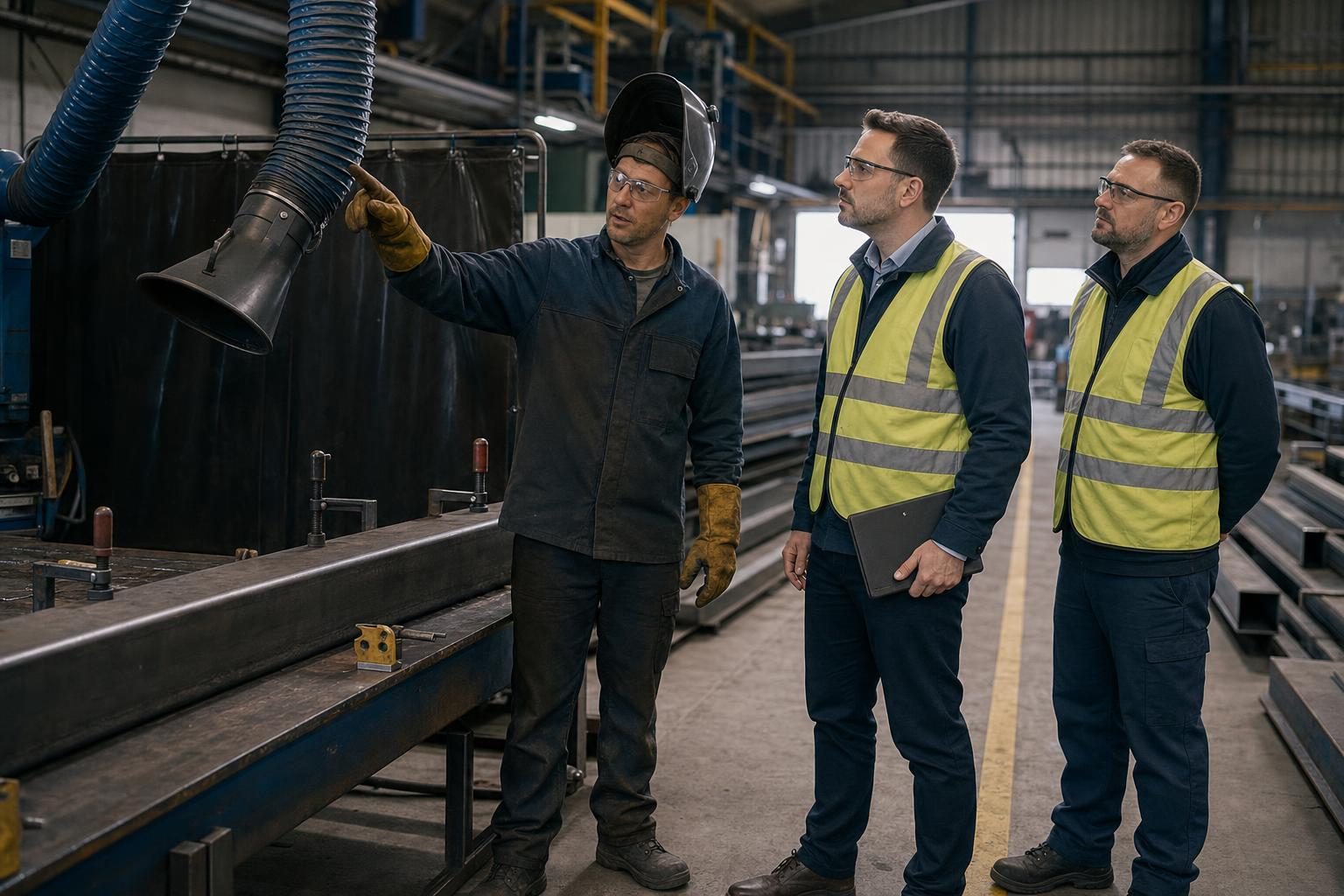
Safety Walk Checklist: How to Run a Leadership Safety Walk
A safety walk (also called a leadership safety walk or safety walk-around) is a short, planned visit by a manager to the place where work is done, to see hazards first-hand, talk with workers about the risks in their jobs and agree actions. Unlike a formal inspection, its main outputs are honest conversations and a short list of owned, dated actions.
Most managers are told to "get out on the floor more." Far fewer are told how. Without a method, a safety walk turns into a polite tour with a large group, a few comments about housekeeping and no follow-up. Workers notice, and the next walk gets even less candid answers.
This guide gives you the method. It draws on two OSHA fact sheets written for exactly this purpose and on the UK Health and Safety Executive's (HSE) guidance for leaders. You will find a comparison of safety walks with inspections and other field activities, a before-during-after process, open questions to ask, a one-page safety walk checklist and a worked example that takes one walk from first observation to closed action.
A Plant Manager's First Safety Walk
Picture a plant manager (a fictional example) at a 120-person metal fabrication shop. After a bad quarter for injuries, the board asks for "visible leadership," so the manager announces a weekly safety walk.
The first walk goes the way many do. The manager arrives with the production director, the maintenance lead, the safety specialist and two supervisors. Six people in clean high-visibility vests move through the shop as a block. Operators stop their machines and stand up straight. The manager asks, "Everything okay here? Any safety problems?" Everyone says no. The group notes some offcuts on the floor and leaves after twenty minutes. Nothing is written down, and nobody hears about the walk again.
Three weeks later, a welder mentions to the safety specialist that the fume extraction arm has not reached the end of long workpieces for months. "Nobody asked," the welder says. The manager had walked past that bay three times.
The problem was not effort. It was method: too many people, closed questions, no preparation and no follow-up. The rest of this guide fixes each of those.
What Is a Safety Walk?
A safety walk is a field activity in which a leader observes work, talks with the people doing it and agrees improvements. OSHA's fact sheet Safety Walk-Arounds for Managers describes its two purposes: to identify hazards in the workplace and to communicate with workers about the hazards in their jobs.
It is easy to confuse a safety walk with other activities that also happen on the floor. The table shows how they differ.
| Activity | Who does it | Main purpose | Typical output |
|---|---|---|---|
| Safety walk | Managers and leaders | Show commitment, see conditions first-hand, hear workers' views | A short list of actions with owners and dates |
| Safety inspection | Safety officer, supervisor or competent person | Check conditions and equipment systematically against a checklist or standard | A findings list or inspection report |
| Behavior-based safety (BBS) observation | Trained peers or supervisors | Record specific safe and at-risk behaviors and discuss them | Anonymous observation data and feedback |
| Gemba walk | Managers (lean practice) | Understand how work flows at "the actual place" and remove waste | Process improvement ideas |
| Audit | Independent internal or external auditor | Verify that the management system works as designed | Audit findings and nonconformities |
The line between a walk and an inspection is not sharp. OSHA's manager fact sheet itself uses the words "inspection" and "walk-around" for the same activity. The practical difference is emphasis: an inspection aims to find every hazard in an area, while a leadership walk aims to understand what workers face and to prove that leaders act on what they hear. A walk does not replace your scheduled inspections. See our safety inspection checklist guide for those.
Why Leaders Should Walk the Floor: What OSHA and HSE Say
Safety walks are voluntary good practice in most countries. No regulation we know of sets their frequency. Their value comes from what they show and what they reveal.
OSHA gives "at least two reasons" why managers and owners should periodically inspect the workplace themselves. First, it demonstrates management's commitment to improving safety and health by finding and fixing hazards. Second, it lets managers see for themselves whether the safety and health program is working. A walk also tells a manager whether workers are engaged, whether they feel properly trained and whether they know how to report an incident or concern.
HSE makes the same point for directors in its leaflet Leading health and safety at work (INDG417): "Leadership is more effective if visible board members can reinforce health and safety policy by being seen on the 'shop floor', following all safety measures themselves and addressing any breaches immediately." The same leaflet suggests board members make extra "shop floor" visits to gather information for the formal annual review, and its checklist for leaders opens the "Check" section with: "How well do you know what is happening on the ground, and what audits or assessments are undertaken to inform you about what your organisation and contractors actually do?"
In Türkiye, Law No. 6331 on Occupational Health and Safety, Article 4(1)(b), requires the employer to monitor and inspect whether safety measures are followed and to make sure nonconformities are corrected. Article 18 requires the employer to seek workers' views on health and safety. A well-run safety walk serves both duties.
How to Run a Safety Walk: Before, During and After
A safety walk has three phases. Most failed walks skip the first and the last.
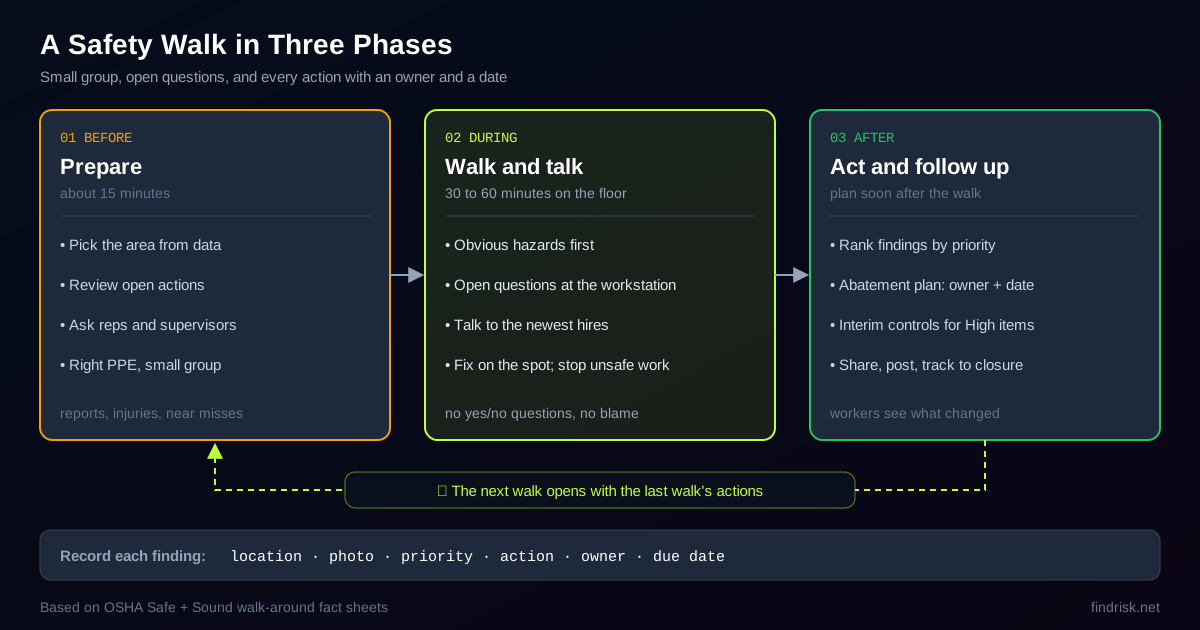
Before the walk: prepare in 15 minutes
- Choose the area from data, not habit. OSHA recommends looking at past inspection reports, injury records, incident investigation reports and recent near misses to find the most hazardous areas.
- Check what is still open. Review the actions from your last walk in that area. OSHA advises checking whether previously identified hazards have been abated or need further action.
- Ask people who know. Talk to safety representatives, supervisors and, if you have one, the safety committee about their concerns.
- Get the right PPE and know how to wear it. OSHA is blunt: "Nothing takes away credibility faster than having the wrong PPE or not wearing it properly."
- Keep the group small. Large groups stifle open conversation. We suggest no more than two or three people, ideally the manager and the area supervisor.
During the walk: look, listen, ask
- Follow the safety rules of every area you enter. Don't expose yourself to hazards to get a closer look.
- Spot the obvious hazards first. OSHA lists tripping hazards, blocked exits, frayed or exposed electrical wires, missing machine guards, poor housekeeping and poorly maintained equipment.
- Read the damage. Walls, doors or racking damaged by forklift traffic may point to future injuries.
- Talk to workers at their workstations. Make it clear you are there to find and fix problems, not to blame anyone. Avoid yes/no questions.
- Find the newest hires. OSHA calls their perspective "fresh eyes." They notice what long-serving staff no longer see.
- Watch the task, not just the workplace. Look for heavy lifting, awkward postures and repetitive motions. Take notes and photos.
- Know when to call a specialist. OSHA's safety officer fact sheet names chemical hazards such as solvents, welding fumes or toxic dust, noise (where you need to raise your voice to be heard), excessive heat and combustible dust as hazards that need a safety professional or industrial hygienist.
- Fix what you can on the spot, with the workers. It is the fastest way to show you meant it.
- Stop work that is clearly unsafe. HSE expects visible leaders to address breaches immediately.
- Before you leave, list and rank what you found. OSHA recommends prioritizing by the severity of the potential injury.
After the walk: act, share, track
- Write an abatement plan very soon after the walk. OSHA's list: the hazards found, the corrective actions needed and a reasonable timeline, plus interim controls for hazards that need engineering work. Use the hierarchy of controls to choose actions that last.
- Share it with managers, supervisors and the workers you spoke to.
- Track every action to closure and post progress updates. OSHA warns that "failure to follow up can often stifle worker participation and enthusiasm, which can be hard to regain." Our guide to corrective action and CAPA covers closing actions properly.
What Questions Should You Ask on a Safety Walk?
The best safety walk questions are open, specific to the job and impossible to answer with "yes" or "no." OSHA suggests three:
- "What is the most hazardous task in your job? What makes it hazardous?"
- "If you have been injured in your job, what was the injury and how did it happen? What was done to make your job safer?"
- "How would you report an injury, hazard, or near-miss?"
The third question is a quick test of your reporting system. If people hesitate, read our guide to near miss reporting.
These follow-up questions are our own suggestions. They work because they ask about real work rather than rules:
- "Walk me through this job when something goes wrong. What do you do then?"
- "Where do people take shortcuts here, and why?"
- "What slows you down or gets in the way of doing this safely?"
- "When did someone last stop a job here? What happened next?"
- "If you could change one thing about this area tomorrow, what would it be?"
- "Is there anything in the procedure that doesn't match how the job is really done?"
How you ask matters as much as what you ask.
| Instead of this | Ask this |
|---|---|
| "Is everything safe here?" | "What worries you most about this job?" |
| "You know you should wear your glasses, right?" | "What makes the glasses hard to keep on during this task?" |
| "Do you follow the procedure?" | "Show me how you actually do this step." |
| "Any problems?" | "What did you have to work around this week?" |
| "Who left this here?" | "Where is this supposed to go, and is there room for it?" |
The Safety Walk Checklist
This one-page safety walk checklist follows the three phases above. Items marked with an asterisk come from OSHA's fact sheets; the rest are our additions. Adapt the condition items to your site's main hazards.
Before the walk
- Area chosen from inspection reports, injury records, incident reports and near misses*
- Open actions from the last walk in this area reviewed*
- Concerns collected from safety representatives, supervisors or the safety committee*
- Correct PPE for every area on the route, and you know how to wear it*
- Group kept small, ideally two or three people*
- Route planned so that no area is skipped (for example, receiving to shipping)*
On the floor: conditions
- Walkways and work areas free of tripping hazards*
- Emergency exits and routes unobstructed*
- No frayed or exposed electrical wiring*
- Machine guards in place and working*
- Housekeeping acceptable: materials stored in marked areas*
- Equipment visibly maintained (no leaks, damage or improvised repairs)*
- Damage to walls, doors, racking or barriers checked as a warning sign*
- PPE worn as required and in good condition
On the floor: people and work
- Several workers asked open questions at their workstations*
- At least one recently hired worker asked for their view*
- Tasks observed for heavy lifting, awkward postures and repetitive motions*
- Workers asked how they would report an injury, hazard or near miss*
- Complex hazards (chemicals, noise, heat, combustible dust) noted for specialist assessment*
- Positive practices noted, and the team thanked
Close-out
- Findings listed and prioritized by severity and likelihood*
- Quick fixes made on the spot with the workers*
- Abatement plan written with actions, owners, dates and interim controls*
- Plan shared with the area team and posted where workers can see it*
- Next walk in this area scheduled; open actions carried forward*
Record each observation in one line so that it can become an action:
| # | Location | Observation | Photo | Priority | Action | Owner | Due | Status |
|---|---|---|---|---|---|---|---|---|
| 1 |
Worked Example: One Walk, Six Observations, Six Actions
Back to the fictional fabrication shop. A month after the first attempt, the plant manager runs the walk again, this time with the method. Preparation takes fifteen minutes: the near-miss log shows two forklift incidents at the shipping dock, and the safety specialist mentions the welders' extraction complaint. The manager walks with the area supervisor only, follows the material flow from receiving to shipping, and spends about 45 minutes on the floor.
To rank the findings, the manager uses the example matrix in OSHA's safety officer fact sheet, which OSHA adapted from ANSI/AIHA Z10-2012:
| Likelihood ↓ / Severity → | Negligible | Marginal | Critical | Catastrophic |
|---|---|---|---|---|
| Frequent | Medium | Serious | High | High |
| Probable | Medium | Serious | High | High |
| Occasional | Low | Medium | Serious | High |
| Remote | Low | Medium | Medium | Serious |
| Improbable | Low | Low | Low | Medium |
Sites that use Fine-Kinney can score the same findings with the Fine-Kinney method. What matters is using the same method on every walk.
The record of the walk:
| # | Location | Observation | Likelihood × severity | Priority | Action | Owner | Due |
|---|---|---|---|---|---|---|---|
| 1 | Roller conveyor, assembly | Chain-drive guard removed during maintenance and not refitted | Probable × Critical | High | Conveyor locked out on the spot; guard refitted the same day; maintenance close-out step added to the work order | Maintenance lead | Today |
| 2 | Welding bay | Welders say the extraction arm does not reach the far end of long parts; visible fume | Frequent × Critical (provisional) | High | Exposure assessment by a competent person; interim: reposition long parts so the arm reaches | EHS manager | Assessment in 30 days; interim today |
| 3 | Shipping dock | Door frame and column protector dented by forklifts | Occasional × Critical | Serious | Review the forklift route and pedestrian separation; interim: marked exclusion zone during loading | Logistics supervisor | 14 days |
| 4 | Cutting area | A worker hired three weeks ago thought near misses only need reporting if someone is hurt | Probable × Marginal | Serious | Brief all shifts on near-miss reporting at the next toolbox talk; add it to induction | Production supervisor | 7 days |
| 5 | Cutting area | Pallets and offcuts stored in the walkway | Occasional × Marginal | Medium | Cleared on the spot with the team leader; storage zone to be marked on the floor | Team leader | 7 days |
| 6 | Assembly | Shadow board complete, aisles clear; operator explained isolation steps clearly | — | Positive | Thanked the team; shared the example at the supervisors' meeting | Plant manager | Done |
Three details make this record useful. Every finding has one owner and one date. The two High items have interim controls the same day, because a 30-day assessment is not a reason to accept 30 days of exposure. And the positive observation is recorded too, so the walk is not only about faults.
The next morning the manager posts the plan on the shop notice board. Four weeks later, the next walk in this area starts with the open items. When workers see item 2 closed, the conversation at the welding bay changes: they start pointing things out before anyone asks.
How Often Should Leaders Do Safety Walks?
No law sets a frequency for leadership safety walks, so choose a cadence you can keep. The only figure in the guidance is for safety officers: OSHA suggests "perhaps" weekly walk-arounds on construction sites and monthly inspections in other types of facilities.
For leaders, consistency matters more than frequency. Some practical rules:
- Put walks in the calendar and protect them like any other meeting.
- Rotate areas and shifts. Walk the night shift, weekends and contractor areas, not only the day shift near your office.
- Keep each walk short and focused on one or two areas. We suggest 30 to 60 minutes.
- Measure the process, not the number of findings. Walks completed against plan and actions closed on time are useful leading indicators.
Over time, the walks themselves tell you something about your safety culture: when workers start raising issues before you ask, the method is working.
Common Safety Walk Mistakes
1. Turning the walk into a fault-finding tour
When a walk produces reprimands, workers learn to hide problems from leaders. OSHA's guidance is explicit: assure workers you are interested in fixing problems, not blaming anyone.
2. Walking with an entourage
Six managers moving through a work area feel like an inspection by authority. Workers stop talking. Keep the group to two or three people.
3. Asking questions that invite "yes" or "no"
"Is everything safe?" gets "yes." Open questions about the job get real information.
4. Breaking the rules you expect others to follow
A manager without safety glasses in an eye-protection zone undoes months of messaging in seconds. Wear the right PPE and follow every area rule.
5. Leaving without a written plan
Unrecorded findings are forgotten. Workers who raised an issue and never heard back will not raise the next one.
6. Always walking the same area at the same time
A walk at 10 a.m. on Tuesdays in the area next to the office shows you the best version of the site. Vary areas, shifts and days.
7. Treating walks as a replacement for inspections
A leadership walk is broad and short. Statutory and periodic inspections of equipment, racking, lifting gear and electrical systems still need their own schedule and competent people.
How FindRisk Supports Safety Walks
FindRisk lets you carry the safety walk checklist on your phone (iOS and Android) instead of on a clipboard. You can generate a checklist with AI from a short description of the area you are visiting.
During the walk, take a photo of each observation and mark the hazard directly on the image. FindRisk's AI photo analysis suggests possible hazards you might have missed, and you can score each finding with the Fine-Kinney method if your site uses it instead of a matrix.
After the walk, FindRisk produces a professional report in seconds. Share it with the area team the same day and use it as the starting point of your abatement plan, so the walk ends with something workers can see.
Frequently Asked Questions
What is the difference between a safety walk and a safety inspection?
A safety inspection checks conditions and equipment systematically, usually against a checklist, and aims to find every hazard in an area. A safety walk is led by a manager and focuses on seeing work first-hand, talking with workers and showing commitment. OSHA's fact sheet for managers uses both words, so the line is not sharp, but a walk never replaces scheduled inspections.
Who should do a safety walk?
Anyone with authority to fix what they find: site managers, department heads, directors and supervisors. HSE's guidance for directors says leadership is more effective when board members are seen on the shop floor. The safety specialist can coach leaders and join walks, but if only the safety team walks, workers will conclude that safety belongs to one department.
How long should a safety walk take?
No standard sets a duration. In our experience, 30 to 60 minutes on one or two areas works better than a long tour of the whole site, because it leaves time for real conversations. Add about 15 minutes of preparation before the walk and time afterwards to write and share the action plan.
What should you look for on a safety walk?
Start with easily observable hazards: tripping hazards, blocked exits, damaged wiring, missing machine guards, poor housekeeping and poorly maintained equipment. Then look at how work is done, such as heavy lifting, awkward postures and repetitive motions. Treat damage from forklifts or equipment as a warning sign, and note complex hazards like fumes, noise or heat for specialist assessment.
Is a Gemba walk the same as a safety walk?
Not quite. A Gemba walk comes from lean management and focuses on how work flows at the place where value is created, to remove waste and improve processes. A safety walk focuses on hazards and on workers' views about risk. Many sites combine the two, but if safety is only one item on a Gemba walk, it tends to get less attention.
Should safety walks be announced in advance?
Tell the area supervisor you are coming, so the walk does not disrupt critical work, but do not announce exact times to the whole workforce. The aim is to see normal conditions, not a cleaned-up version. Unannounced does not mean surprise inspection: explain the purpose when you arrive and keep the tone collaborative.
Do you need to record a safety walk?
Yes. Without a record, findings are forgotten and workers see no result. Record each observation with its location, a photo where useful, a priority, an action, an owner and a due date. OSHA recommends preparing an abatement plan very soon after the walk and sharing progress updates with the workforce.
Conclusion
A safety walk works when it has a method: prepare from your data, walk with a small group, ask open questions at the workstation, rank what you find and close every action where workers can see it. OSHA and HSE agree on the reasons. Leaders who walk the floor show commitment and learn what is really happening on the ground.
Start with the checklist above. Run one walk this week, record it in the table format and post the plan. The second walk, the one that starts by closing the first walk's actions, is where trust begins.
Download FindRisk to carry your safety walk checklist, mark hazards on photos and share the report before you are back at your desk.
Try FindRisk
Ready to modernize your safety workflow?
Conduct AI-powered risk assessments, generate reports instantly, and keep your team safe — anywhere, anytime.