

Safety Inspection Report: How to Write One, With an Example
A safety inspection report is the written record of a workplace inspection: what was inspected, which hazards and good practices were found, how serious each finding is, and who will fix what by when. A good report lets someone who was not on the inspection find each problem, understand the risk and track the action to closure.
Most inspectors are trained to find hazards. Few are trained to write them up. The result is familiar: a checklist full of ticks, a comments column that says "poor housekeeping" and "guard needed," and the same findings coming back month after month because nobody could act on them.
This guide covers the part after the walk. It is built on the Canadian Centre for Occupational Health and Safety (CCOHS) guidance on effective inspections and OSHA's recommended practices for safety and health programs. You will get the seven sections a report needs, a four-part formula for writing each finding, a way to prioritize findings with a risk score, and a complete filled report for a fictional workshop that you can use as a model.
The Report Nobody Acted On
Picture a safety officer at a mid-sized workshop (a fictional example) who inspects every month. In July, the report says: "Walkway markings poor – loading bay." In August, the same line appears. In September, again.
In October, a forklift and a pedestrian have a near miss at the loading-bay crossing. During the review, the maintenance manager says they read every report. But "markings poor" did not say which crossing, what exactly was worn, why it mattered or who was expected to fix it by when. It had no owner, no due date and no risk score. It sat at line 23 of a 30-line list, between "bin lid missing" and "notice board out of date."
The hazard was found three times. The report failed three times. The inspection did its job; the write-up did not. The rest of this guide is about making the write-up do its job too.
What Is a Safety Inspection Report?
A safety inspection report is a document that turns the observations from one inspection into prioritized, owned and dated actions. The checklist tells you what to look at. The report tells management what was found, how much it matters and what should happen next.
It is often confused with other safety documents. They overlap, but each answers a different question:
| Document | What it records | When it is written | Main reader |
|---|---|---|---|
| Inspection checklist | Pass, fail or N/A against a list of items (see our checklist guide) | During the inspection | The inspector |
| Safety inspection report | Findings, risk, recommendations, owners, due dates, status of earlier findings | After each inspection | Managers who must act |
| Incident report | What happened in one event and why (incident report template) | After an incident or near miss | Investigators, management |
| Audit report | Whether the safety management system works as designed (internal audit guide) | At scheduled audits | Top management, certification body |
Is a written inspection report required?
Few rules prescribe a report format, but many expect a record. OSHA's hazard identification guidance tells employers to "document inspections so you can later verify that hazardous conditions are corrected." In US construction, accident prevention programs must provide for "frequent and regular inspections of the job sites, materials, and equipment" by competent persons (29 CFR 1926.20(b)(2)). Some standards demand specific records: portable fire extinguishers need a monthly visual inspection and a recorded annual maintenance check under 29 CFR 1910.157(e). If you run an ISO 45001 system, Clause 9.1 expects you to retain documented information as evidence of the results of monitoring, and workplace inspections are one of the main ways you monitor.
What Goes in a Safety Inspection Report?
A complete safety inspection report has seven blocks: a header, a summary, the status of previous findings, the numbered findings, positive findings, an action plan, and sign-off with distribution. The order matters. Managers read the first two blocks, action owners read the findings, and the next inspector starts from block three.
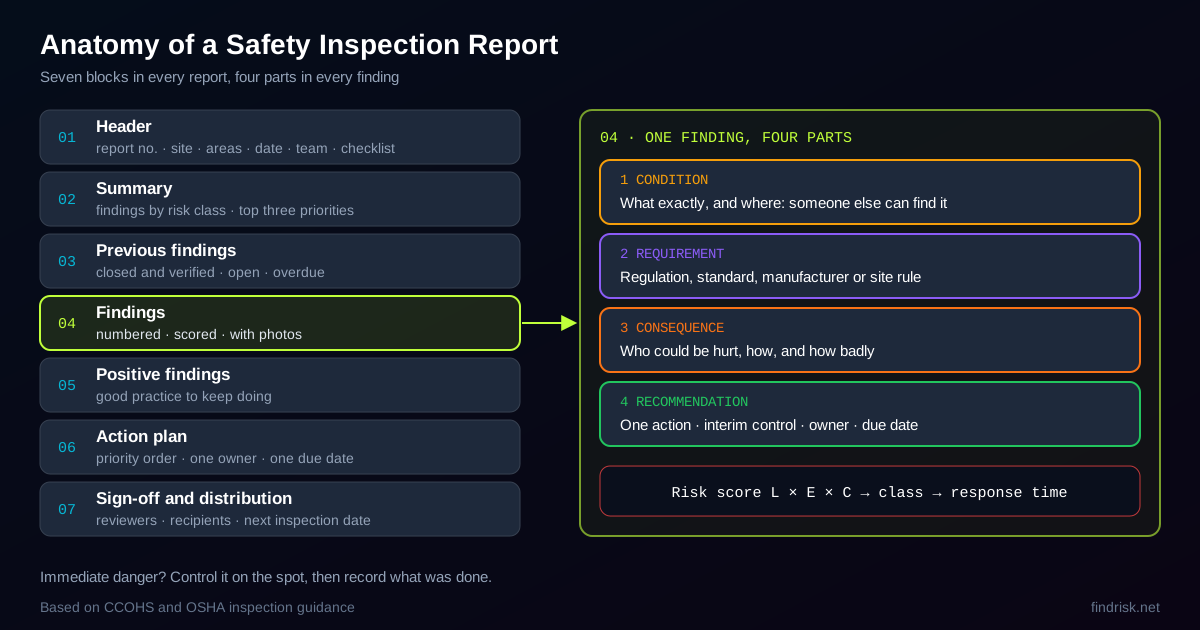
| Block | What goes in it | Why it is there |
|---|---|---|
| 1. Header | Report number, site, areas covered, date and time, inspection team, type (planned, follow-up, special), checklist used | Makes the report traceable and comparable month to month |
| 2. Summary | Number of findings by risk class, items controlled on the spot, top three priorities, repeat findings | CCOHS says management should be able to "understand and evaluate the problems, assign priorities, and quickly reach decisions" |
| 3. Previous findings | Each item from the last report: closed and verified, open, or overdue | CCOHS warns: "Do not simply repeat or copy previous inspection results." Check that earlier recommendations were implemented and work |
| 4. Findings | Numbered items with location, condition, requirement, consequence, risk score, recommendation, owner, due date and photo | The core of the report. CCOHS asks for numbered items and photos linked to the correct item |
| 5. Positive findings | Good practices you saw | Shows the area team what to keep doing and makes the report fair |
| 6. Action plan | Findings in priority order with owner, date and status | Matches OSHA's hazard control plan: priority order, a named person, a target date, tracking and verification |
| 7. Sign-off and distribution | Author, reviewers, issue date, recipients, next inspection date | CCOHS recommends each team member reviews the report before it is distributed |
One rule overrides the structure: do not save an immediate danger for the report. CCOHS puts it plainly: "Draw attention to the presence of any immediate danger - other items can await the final report." If equipment cannot be made safe on the spot, it should be shut down and locked out until it is repaired. The report then records what was done during the inspection, so nobody reopens the danger by mistake.
How to Write a Finding: Condition, Requirement, Consequence, Recommendation
A well-written finding answers four questions: what exactly did you see and where, what should it be, what could happen, and what should be done. We call this the four-part finding. It takes one more minute per item than "housekeeping poor," and it is the difference between a finding that gets fixed and one that gets copied into next month's report.
- Condition. The observable fact and its exact location. CCOHS sets the test: "A person who was not present should be able to find the same item based on the information provided." Use measurements, counts, equipment numbers and a photo reference. For behavior, describe the act, not the person: "an operator was grinding without safety glasses," not a name.
- Requirement. What it should be: the regulation, standard, manufacturer's instruction or site rule. If there is no written requirement, say "good practice" and explain why in one line. A cited requirement ends most arguments about whether a finding is valid.
- Consequence. The realistic outcome if nothing changes: who could be hurt and how. This is what you score, so write it down instead of keeping it in your head.
- Recommendation. One action per line, specific enough to assign. Prefer fixes that remove or engineer out the hazard over signs, training and PPE, as the hierarchy of controls sets out. If the permanent fix will take time, add an interim control. Then give it an owner and a due date.
Here is the same finding written badly and well:
| Weak finding | Four-part finding |
|---|---|
| "Machine unguarded" | "Guard missing on upper pulley #6 lathe in North Building" (the CCOHS example), plus the requirement, the consequence and the fix |
| "Housekeeping poor in assembly" | "Hydraulic oil puddle, about 1 m², on the main walkway beside press P3. Leak from the lower hose fitting; no drip tray. Walkway used by all assembly staff. Slip and fall risk. Absorbent and cones now; repair fitting and fit drip tray by Oct 21 (maintenance lead)." |
| "Fire extinguisher issue" | "Stores, east wall: 6 kg ABC extinguisher E-07 blocked by two pallets of sheet steel; it cannot be reached without moving them. Extinguishers must be readily accessible (29 CFR 1910.157(c)(1))." |
| "PPE not worn – retrain staff" | "Deburring station D2: operator grinding with a hand grinder without safety glasses; reports the glasses fog up. Supply anti-fog glasses for D2 and check whether a fixed screen can be fitted." |
Notice the last row. "Retrain staff" treats the worker as the problem. The four-part version asks why, finds a cause (fogging) and recommends something that removes it.
How to Prioritize Findings With a Risk Score
Prioritize findings by risk, not by the order you found them: estimate how likely harm is and how severe it could be, then fix the highest-scoring items first. OSHA's guidance says to "prioritize the hazards so that those presenting the greatest risk are addressed first." CCOHS uses a simple three-level scale: A (major, immediate action), B (serious, short-term action) and C (minor, long-term action).
A three-level label is quick, but two inspectors often label the same hazard differently. A scoring method makes the reasoning visible. Two common options:
- A likelihood × severity matrix. OSHA's walk-around fact sheet for safety officers shows an example adapted from ANSI/AIHA Z10, with five likelihood levels and four severity levels.
- Fine-Kinney. Risk = Likelihood × Exposure × Consequence, with fixed scale values and five risk classes. It adds exposure (how often people are near the hazard), which suits inspection findings well. Our Fine-Kinney method guide explains the scales.
The worked example below uses Fine-Kinney. The classes come from Kinney and Wiruth's 1976 report; the response times in the last column are our suggestion, not a rule. Kinney and Wiruth say their thresholds are based on experience and can be adjusted, so write your own response times into your inspection procedure and apply them every time.
| Score (R) | Class | Kinney's action | Suggested response in the report |
|---|---|---|---|
| > 400 | Very high | Consider discontinuing the operation | Stop the work or isolate the equipment now; tell the site manager before you leave the area |
| 200–400 | High | Immediate correction required | Interim control the same day; permanent fix within 7 days |
| 70–200 | Substantial | Correction needed | Permanent fix within 30 days; interim control if exposure continues |
| 20–70 | Possible | Attention indicated | Plan within 90 days or at the next scheduled maintenance |
| < 20 | Acceptable | Risk perhaps acceptable | Record; act if the fix is cheap and easy |
Two adjustments keep the score honest. First, OSHA notes that improbable but catastrophic exposures should not end up as low priority just because the likelihood is small; read the consequence column before you sort. Second, fix easy items quickly even when they score low. A pallet in front of an extinguisher takes thirty seconds to move.
Worked Example: A Filled Safety Inspection Report
The report below is a fictional example for a 60-person metal fabrication workshop. The team follows a wall-to-wall route, which OSHA describes as starting at receiving, following materials through the process and finishing at shipping, so no area is missed. Copy the structure; replace the content.
1. Header
| Field | Entry |
|---|---|
| Report no. | INS-2026-10 |
| Site | Fabrication workshop, 60 employees, one shift |
| Areas covered | Receiving and stores, machine shop, maintenance room, assembly, welding bay, loading bay |
| Date and time | October 14, 2026, 09:00–10:40 |
| Type | Planned monthly inspection |
| Team | Safety officer (author), production supervisor, worker safety representative |
| Checklist | Workshop monthly checklist, revision 3 |
| References | Previous report INS-2026-09, site risk assessment, site traffic plan |
2. Summary
Six findings: 1 High, 3 Substantial, 2 Possible. Four were controlled during the inspection: a damaged extension cord was removed from service, a pedestal grinder was tagged out of use, an oil spill was contained, and a blocked extinguisher was cleared. One finding (no. 2, loading-bay crossing) repeats an overdue item from the September report and is escalated to the plant manager. Three positive findings. Top priorities: findings 2, 3 and 4.
3. Status of previous findings (INS-2026-09)
| No. | Finding | Owner | Due | Status on Oct 14 |
|---|---|---|---|---|
| 09-01 | Band saw blade guard not adjusted to stock height | Maintenance lead | Sep 23 | Closed and verified: guard adjusted, operator briefed |
| 09-02 | Lids missing on two waste solvent containers, paint area | Production supervisor | Sep 18 | Closed and verified |
| 09-03 | Emergency exit sign not lit, stores | Facilities | Sep 30 | Closed and verified: lamp replaced and tested |
| 09-04 | Pedestrian crossing paint worn, loading bay | Maintenance lead | Oct 7 | Overdue: paint ordered, not applied. Raised again as finding 2 |
4. Findings (sorted by risk score, L × E × C)
| No. | Location and condition | Requirement | Consequence | Score | Recommendation | Owner, due |
|---|---|---|---|---|---|---|
| 1 | Assembly bench A4: extension cord feeding a hand drill has its outer sheath cut for about 2 cm; inner conductors visible. In use (photo 1) | 29 CFR 1910.334(a)(2)(ii): defective cords removed from service | Electric shock, possibly fatal | 3 × 6 × 15 = 270 High | Removed from service and tagged during the inspection (done). Replace the cord; add cords to the bench's pre-use check | Production supervisor, Oct 15 |
| 2 | Loading bay, crossing between dispatch office and door 2: crossing lines worn away for about 4 m; forklifts pass every few minutes. Repeat of 09-04 (photo 2) | Site traffic plan: marked pedestrian crossings on forklift routes | Pedestrian struck by a forklift, possibly fatal. A convex mirror and horn rule are in place, so likelihood is remote | 1 × 10 × 15 = 150 Substantial | Interim: barrier posts and a portable crossing sign, in place by 11:30 (done). Repaint the crossing. Escalated to the plant manager because overdue | Maintenance lead, Oct 21 (date set by plant manager) |
| 3 | Maintenance room, pedestal grinder G2: work rest gap about 10 mm, tongue guard gap about 15 mm. Used daily (photo 3) | 29 CFR 1910.215(a)(4): work rest gap max 1/8 inch (about 3 mm); 1910.215(b)(9): tongue gap max 1/4 inch (about 6 mm) | Workpiece jammed between rest and wheel; hand injury or wheel break | 3 × 6 × 7 = 126 Substantial | Tagged out of use during the inspection (done). Adjust rest and tongue with the wheel stopped; add a gap check to the weekly maintenance round | Maintenance lead, Oct 16 |
| 4 | Assembly, main walkway beside press P3: hydraulic oil puddle about 1 m²; leak at lower hose fitting; no drip tray (photo 4) | 29 CFR 1910.22(a): walking surfaces free of hazards such as leaks and spills | Slip and fall, lost-time injury | 6 × 6 × 3 = 108 Substantial | Interim: absorbent and cones placed (done). Repair the fitting and fit a drip tray | Maintenance lead, Oct 21 |
| 5 | Deburring station D2: operator grinding burrs with a hand grinder without safety glasses; glasses on the bench; operator says they fog up. Task done about weekly (photo 5) | Site PPE matrix: safety glasses at D2 | Eye injury from flying particles | 3 × 3 × 7 = 63 Possible | Discussed on the spot; glasses on (done). Supply anti-fog glasses for D2; assess a fixed screen at the station | Production supervisor, Oct 28 |
| 6 | Stores, east wall: 6 kg ABC extinguisher E-07 blocked by two pallets of sheet steel (photo 6) | 29 CFR 1910.157(c)(1): extinguishers readily accessible | Delayed first response to a fire | 1 × 6 × 7 = 42 Possible | Pallets moved during the inspection (done). Mark a keep-clear zone in front of every extinguisher in stores | Stores lead, Nov 13 |
5. Positive findings
- Welding bay: the new extraction arms were in use at both active stations, with the hoods placed close to the work.
- Forklift pre-use checks complete for every shift in the past four weeks.
- Stores aisles clear; rack load notices in place on every bay.
6. Action plan and sign-off
The findings table is the action plan: it is already in priority order, and each line has one owner and one date. Status is tracked as open, on hold or closed, as CCOHS suggests, and a finding is closed only after someone checks the fix on site.
| Item | Entry |
|---|---|
| Written by | Safety officer, Oct 14 |
| Reviewed by | Production supervisor and worker safety representative, Oct 15 |
| Issued | Oct 15 to the plant manager, maintenance lead, stores lead, production supervisor and the health and safety committee; one-page summary posted on the notice board |
| Follow-up check | Oct 22 for findings 2, 3 and 4 |
| Next inspection | November 11, 2026 |
Why it is written this way
- Sorted by score, so the reader starts with what matters most.
- On-the-spot actions are recorded, so nobody puts the grinder back into service without the fix.
- The repeat finding is escalated, not copied. Its new date is set by someone with authority over the maintenance budget.
- Behavior is described without names, and the recommendation fixes the cause (fogging glasses).
- Every finding has a requirement. Where no regulation applies, the site rule is cited.
Distribution, Follow-Up and Closing Findings
A safety inspection report is finished when its findings are closed and verified, not when it is sent. OSHA's walk-around guidance for managers says to prepare the abatement plan very soon after the inspection and warns that "failure to follow up can often stifle worker participation and enthusiasm, which can be hard to regain." We suggest issuing the report within two working days.
Who receives it. The person who can approve the money and labor for the fixes, every action owner, and the health and safety committee if you have one. CCOHS notes that the committee can review inspections, identify trends and monitor the progress of recommendations. Workers in the area should also see what happens: OSHA recommends sharing the plan and posting periodic updates.
Tracking. Keep one status per finding: open, on hold or closed. Review overdue items at a fixed meeting, not by email. The OSHA hazard prevention guidance asks you to "plan how you will track progress toward completion."
Verifying. A closed finding needs evidence: a photo of the fix, a measurement, or a check by the next inspector. OSHA also asks you to "verify the effectiveness of controls after they are installed or implemented." A guard that is fitted but removed every shift is not a closed finding. For findings that need root-cause work, move them into your corrective action process.
Trends. CCOHS advises: "Use older reports to identify trends." Three numbers tell you a lot each month: findings by risk class, repeat findings, and overdue actions. A rising repeat count means the reports are being read but not acted on, like the loading-bay crossing in our opening story.
Common Mistakes in Safety Inspection Reports
1. Vague findings
"Poor housekeeping" or "electrical issue" cannot be assigned, priced or verified. The owner has to repeat the inspection to find out what you meant, and most will not. Use the four-part finding.
2. No owner or due date
A finding without a named owner belongs to everyone, so it belongs to no one. OSHA's hazard control plan asks for a specific person and a target date for every control. One owner per line, even if several people do the work.
3. Copying last month's report
Re-pasting open items hides the fact that they are overdue. CCOHS warns against simply repeating previous results. Report the status of each earlier item separately, and escalate repeats.
4. Everything marked "high"
When every item is urgent, the reader picks the easy ones. A scoring method with fixed scales forces you to separate the forklift crossing from the missing bin lid.
5. Naming and blaming workers
Reports that name individuals turn inspections into policing, and workers stop talking to inspectors. CCOHS says: "Do not use information derived from inspections for disciplinary measures." Describe the act and look for the reason behind it.
6. Training and PPE as the default fix
"Retrain staff" and "remind workers to wear PPE" are the lowest levels of control. OSHA's guidance puts engineering solutions first, then safe work practices and administrative controls, and PPE last. Use them as interim controls, not as the whole answer.
7. Closing without checking
An action marked "done" by the owner is not verified. Close a finding only after a photo, a measurement or a site check confirms the fix works.
How FindRisk Supports Safety Inspection Reports
FindRisk is built for the inspector who has to write the report afterwards. On your phone (iOS and Android), you can generate an inspection checklist with AI for the area you are visiting, so the walk follows a structure from the start.
During the inspection, take a photo of each finding and mark the hazard directly on the image. FindRisk's AI analysis suggests possible hazards in the photo that you might have missed, and you can score each finding with the Fine-Kinney method on the spot.
When you finish, FindRisk produces a professional report in seconds, so you can issue it the same day instead of typing it up at your desk. You still decide the wording of each finding; the four-part formula above works just as well in the app.
Frequently Asked Questions
Who should write a safety inspection report?
The person who led the inspection usually writes it, and the other team members review it before it is issued. CCOHS notes that one designated person or the whole team can write it, and that each member should review it before distribution. Including a supervisor and a worker representative on the team makes the findings more accurate and the actions easier to agree.
Is a safety inspection report a legal requirement?
Usually the format is not prescribed, but a record is expected. OSHA advises employers to document inspections so they can verify that hazards were corrected, US construction rules require frequent and regular inspections by competent persons, and some standards require specific records, such as annual fire extinguisher maintenance. ISO 45001 also expects documented evidence of monitoring results. Check the rules for your country and sector.
How soon after an inspection should the report be issued?
As soon as possible, and we suggest within two working days. OSHA's walk-around guidance says to prepare the abatement plan very soon after the inspection, because slow follow-up discourages workers from taking part. Immediate dangers should not wait for the report at all: point them out and control them on the spot, then record what was done.
Should a safety inspection report name workers?
No. Describe the act and the location, not the person: "operator at station D2 grinding without safety glasses." CCOHS says inspection information should not be used for disciplinary measures. Naming people makes workers wary of inspectors, which costs you the information you need most. Look for the reason behind the act and fix that.
Can a safety inspection report include photos?
Yes, and it should. OSHA recommends taking photos or video of problem areas to support later discussion, and CCOHS suggests a photograph whenever a situation is hard to describe, linked to the correct item in the report. Number each photo and refer to it in the finding. A second photo of the fix is the simplest evidence for closing the finding.
How long should you keep safety inspection reports?
There is no single general rule; follow your records policy and any specific regulation that applies. For example, OSHA requires the annual maintenance record for portable fire extinguishers to be kept for one year after the last entry or the life of the shell, whichever is less. Keep enough history to compare reports, because CCOHS recommends using older reports to identify trends.
Conclusion
A safety inspection report earns its place only if someone acts on it. Give it seven blocks: header, summary, previous findings, findings, positive findings, action plan and sign-off. Write every finding in four parts: condition, requirement, consequence and recommendation. Then score it so the most serious items rise to the top.
The worked example shows the habits that make the difference: on-the-spot controls recorded, repeat findings escalated, behavior described without blame, one owner and one date per line, and nothing closed without a check on site. Start your next report from that template and compare how many findings are closed by the following inspection.
Download FindRisk to mark findings on photos, score them with Fine-Kinney and issue your safety inspection report before you leave the site.
Try FindRisk
Ready to modernize your safety workflow?
Conduct AI-powered risk assessments, generate reports instantly, and keep your team safe — anywhere, anytime.