
Hot Work Permit Checklist: Before, During and After the Job
A hot work permit checklist is the list of fire precautions that a designated person verifies before authorizing welding, cutting, grinding, brazing or any other work that produces flames, sparks or heat, then confirms during and after the job. It covers combustibles within 35 ft (about 11 m), fire extinguishing equipment, gas testing, the fire watch and its duration, and sign-off.
The stakes are real. According to the NFPA's analysis of 2017–2021 data, hot work started nearly 3,400 structure fires a year in the US, with an average of 19 civilian deaths, 120 injuries and $292 million in direct property damage each year. More than half (54%) were in non-home properties such as commercial buildings.
Most hot work permits in circulation are one-page forms with checkboxes and no explanation. That is how a permit turns into a signature exercise: the boxes get ticked from the office, the fire watch leaves when the welder leaves, and nobody looks at the far side of the wall.
This guide explains each check and where it comes from (OSHA 29 CFR 1910.252, the US Chemical Safety Board and NFPA 51B), sets out why fire watch durations differ between forms and which one to use, and walks through a filled permit for a real-looking job.
A Bracket, a Welder and a Pallet Rack
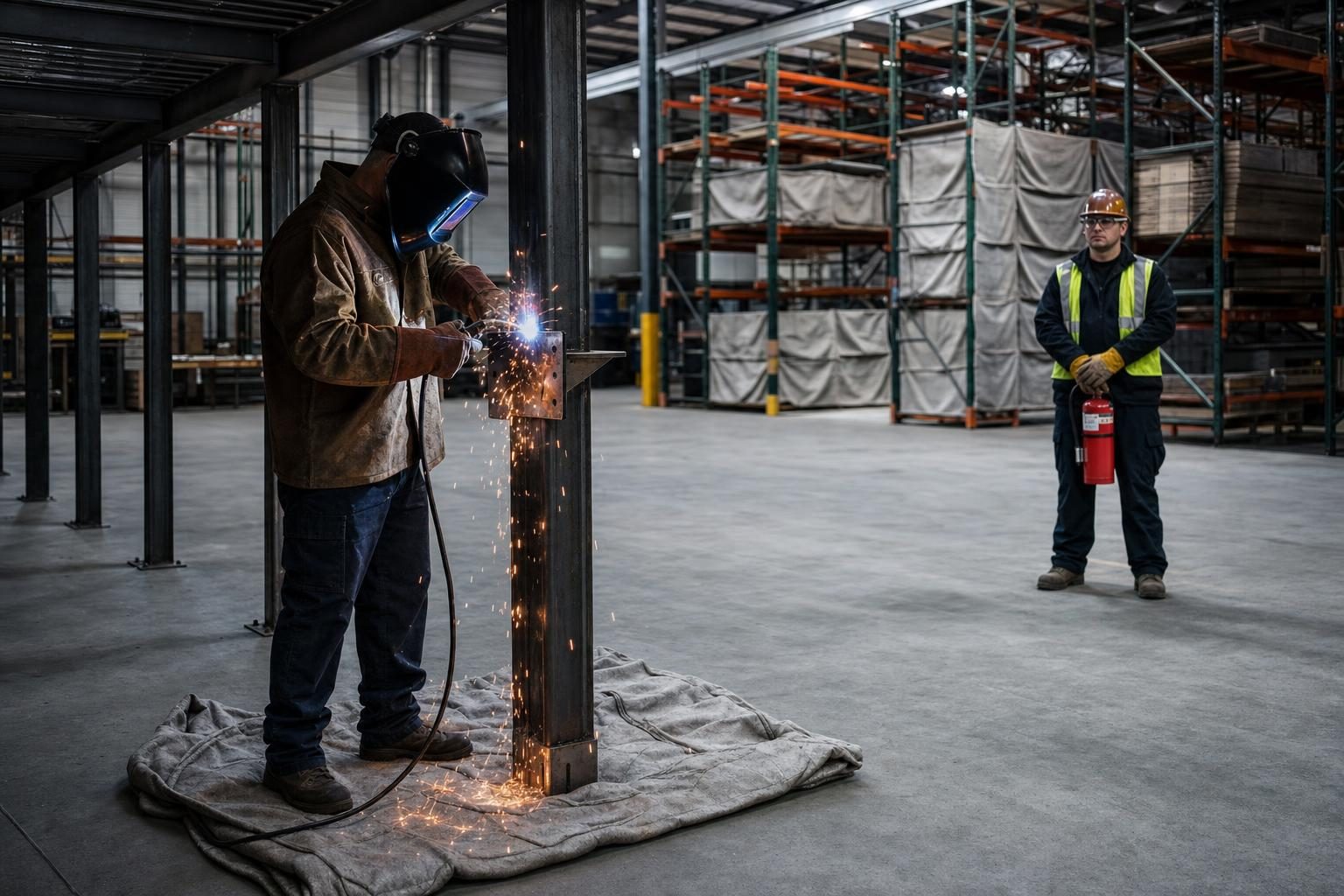
Here is a fictional scenario built for this guide. A warehouse maintenance team needs to weld a new steel bracket onto a mezzanine column. The column is 6 m from a run of pallet racking loaded with cardboard-boxed stock. There is a sprinkler system, a plastic-wrapped pallet at the foot of the column and an open cable penetration in the mezzanine floor.
The welder wants to start right after the morning break. The supervisor has a permit pad. The question is not "do we have a permit?" but "what does the permit need to prove before the first arc is struck?"
By the end of this guide, you will have seen this permit filled in line by line.
What Is a Hot Work Permit?
A hot work permit is a written authorization, issued by a designated person after inspecting the area, that allows a specific hot work task at a specific location for a limited time under stated precautions. It is one type of permit to work, focused on fire and explosion.
| Term | What it means |
|---|---|
| Hot work | Any task producing flames, sparks or heat that can ignite materials: welding, cutting, grinding, brazing, open-flame soldering, thawing pipe, torch-applied roofing |
| Permit Authorizing Individual (PAI) | The person who inspects the area and signs the permit (NFPA 51B term) |
| Fire watch | A trained person who watches for fires during the work and after it ends, with extinguishing equipment at hand |
| Fire monitoring | Periodic checks of the area after the fire watch ends |
| Designated area | A permanent location built for hot work (welding shop, booth) where a permit for each job is usually not needed |
In the US, OSHA's general industry standard says that before cutting or welding is permitted, the area must be inspected by the individual responsible for authorizing it, who designates the precautions, "preferably in the form of a written permit" (29 CFR 1910.252(a)(2)(iv)). The same standard requires management to designate that individual for areas not built for hot work (1910.252(a)(2)(xiii)).
The list of hot work tasks above comes from a hot work permit that references NFPA 51B, published by the State of Nevada's risk management office. Grinding is on it. Many sites forget that.
When Do You Need a Hot Work Permit?
You need a hot work permit whenever hot work is done outside a designated hot work area. Before you issue one, work through the decision in the order below. The first two steps are about avoiding the permit entirely.
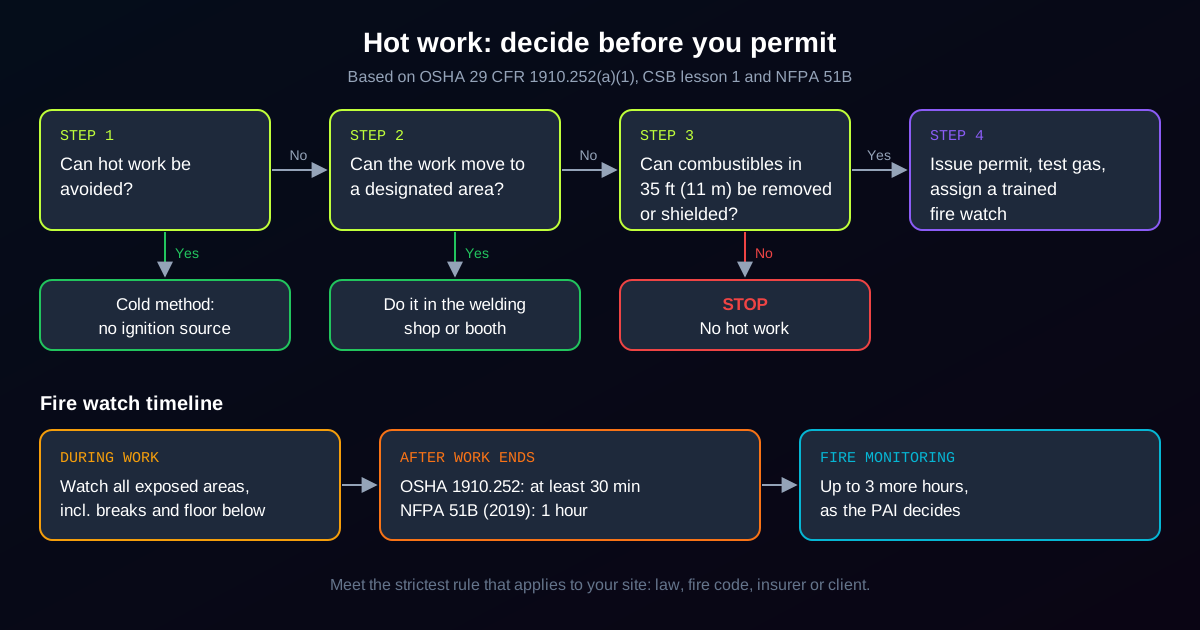
- Can you avoid hot work? Bolted connections, mechanical cutters, cold-cut saws or press-fit pipe fittings remove the ignition source. The CSB lists "use alternatives" as the first of its seven key lessons on hot work. This is the top of the hierarchy of controls.
- Can you move the work? OSHA's first rule is that if the object can be moved, take it to a designated safe location (1910.252(a)(1)). A bracket can be cut and drilled in the workshop and only tack-welded on site.
- Can you remove or shield the fire hazards? If the work cannot move, movable fire hazards nearby must be taken to a safe place, and fixed ones shielded with guards that confine heat, sparks and slag.
- If you cannot do either, stop. OSHA is blunt: if those requirements cannot be met, "welding and cutting shall not be performed" (1910.252(a)(1)(iii)).
OSHA also lists places where hot work is not permitted at all (1910.252(a)(2)(vi)):
- areas not authorized by management
- sprinklered buildings while the sprinkler protection is impaired
- explosive atmospheres, including inside uncleaned or improperly prepared tanks or equipment that held flammables, and areas with accumulated combustible dust
- near large quantities of exposed, readily ignitible materials such as bulk sulfur, baled paper or cotton
Hot Work Permit Checklist: Before Work
The pre-work checks are where most fires are prevented. Each item below has its source. Use it as the "required precautions" section of your permit.
Area and combustibles (within 35 ft / 11 m)
| # | Check | Source |
|---|---|---|
| 1 | Combustibles moved at least 35 ft (10.7 m) away, or covered with fire-resistant covers or shields where moving is impractical | OSHA 1910.252(a)(2)(vii) |
| 2 | Floor swept clean of combustible debris (paper, wood shavings, textile fibers) for 35 ft | OSHA 1910.252(a)(2)(v) |
| 3 | Combustible floors kept wet, covered with damp sand or protected by fire-resistant shields | OSHA 1910.252(a)(2)(v) |
| 4 | Openings and cracks in floors, walls, doorways and windows covered so sparks cannot reach combustibles beyond | OSHA 1910.252(a)(2)(i) |
| 5 | Combustibles on the far side of metal walls, ceilings or roofs moved away (heat conducts through metal) | OSHA 1910.252(a)(2)(iii)(A)(4) |
| 6 | Ducts and conveyors that could carry sparks to distant combustibles protected or shut down | Nevada / NFPA 51B permit |
Fire protection
| # | Check | Source |
|---|---|---|
| 7 | Sprinklers in service. Hot work is not permitted in a sprinklered building while protection is impaired | OSHA 1910.252(a)(2)(vi)(B) |
| 8 | Suitable extinguishing equipment ready for instant use (extinguisher, hose, sand) | OSHA 1910.252(a)(2)(ii) |
| 9 | Fire watch assigned if any fire watch trigger applies (see below) | OSHA 1910.252(a)(2)(iii)(A) |
Atmosphere and equipment
| # | Check | Source |
|---|---|---|
| 10 | Gas test with a calibrated combustible gas detector before work, even where flammables are not expected | CSB lesson 3 |
| 11 | Equipment and piping that held flammables drained and/or purged | CSB lesson 4 |
| 12 | Surrounding tanks and adjacent spaces tested too, not just the one being worked on | CSB lesson 4 |
| 13 | Hot work equipment (torch, hoses, regulators, cables) in good condition | Nevada / NFPA 51B permit |
People and paperwork
| # | Check | Source |
|---|---|---|
| 14 | Area inspected in person by the authorizing individual, precautions written on the permit | OSHA 1910.252(a)(2)(iv), CSB lesson 5 |
| 15 | Welders, cutters and supervisors trained | OSHA 1910.252(a)(2)(xiii)(C) |
| 16 | Contractors told about flammable materials and hazardous conditions on site | OSHA 1910.252(a)(2)(xiii)(D), CSB lesson 7 |
| 17 | Linked permits issued where needed: confined space entry, lockout/tagout | Nevada / NFPA 51B permit |
When is a fire watch required?
OSHA requires fire watchers whenever welding or cutting is done where more than a minor fire might develop, or where any of these conditions exist (1910.252(a)(2)(iii)(A)):
- combustible material closer than 35 ft (10.7 m) to the point of operation
- combustibles more than 35 ft away but easily ignited by sparks
- wall or floor openings within a 35 ft radius that expose combustibles in adjacent areas, including concealed spaces in walls or floors
- combustibles next to the opposite side of metal partitions, walls, ceilings or roofs that could be ignited by conduction or radiation
In practice, almost every hot work job outside a welding shop meets at least one of these.
Hot Work Permit Checklist: During Work
During the work, the job is to keep the conditions the permit was based on. Three checks matter most:
- The fire watch is present and only watching. Under OSHA, fire watchers must have extinguishing equipment readily available, be trained in its use, know how to sound the alarm and watch for fires in all exposed areas (1910.252(a)(2)(iii)(B)). The permit referencing NFPA 51B adds that the fire watch stays during break periods and may be needed in adjoining areas above and below.
- The atmosphere is still safe. The CSB calls for gas monitoring "prior to and during hot work activities" and, around tanks, continuous monitoring where necessary (CSB lessons 3 and 4).
- Nothing has changed. A forklift parks a pallet back in the cleared zone. A nearby team starts a solvent wipe-down. A sprinkler valve is closed for other work. Any of these means stopping and re-checking the permit. Coordination between permits is covered in our permit to work guide.
Hot Work Permit Checklist: After Work
Fires from hot work often start after the job is finished: a spark lodged in a gap, insulation smoldering behind a wall. After-work checks close that gap.
| # | Check | Source |
|---|---|---|
| 18 | Fire watch continues after hot work ends (duration below) | OSHA 1910.252(a)(2)(iii)(B); NFPA 51B |
| 19 | Area, adjoining areas and the far side of walls and floors inspected | Nevada / NFPA 51B permit |
| 20 | Fire monitoring after the fire watch, if the PAI decides it is needed | Nevada / NFPA 51B permit |
| 21 | Covers removed, equipment isolated, area returned | Nevada / NFPA 51B permit |
| 22 | Permit signed off with time finished and handed back | Site procedure |
How Long Should a Fire Watch Last?
The fire watch duration depends on which rule applies to you, and different forms copy different editions. That is why one university form says 30 minutes and the next says 60.
| Source | Fire watch after hot work | Notes |
|---|---|---|
| OSHA general industry, 29 CFR 1910.252(a)(2)(iii)(B) | At least 30 minutes | Legal minimum in US general industry |
| OSHA construction, 29 CFR 1926.352(e) | "A sufficient period of time after completion of the work to ensure that no possibility of fire exists" | No fixed minutes |
| NFPA 51B (2019 edition), as applied on the Nevada permit | 1 hour | Plus fire monitoring of the area for up to 3 more hours, as decided by the PAI |
Even the Nevada PDF shows the problem: its first page asks for a 1-hour fire watch, while an older checklist on its second page still says 30 minutes.
Rule of thumb for your procedure: meet the strictest requirement that applies to you (law, local fire code, insurer, client), and treat OSHA's 30 minutes as a floor, not a target. Extend the watch and add monitoring where heat can travel into hidden spaces: insulated panels, cavity walls, roofs, cable trays and areas with stored stock.
A Filled Hot Work Permit Example
Here is the permit for the warehouse scenario above. Names and numbers are illustrative.
| Field | Entry |
|---|---|
| Permit no. / date | HW-0417, valid today 09:30–16:00 only |
| Location | Mezzanine column C4, aisle 12, warehouse 2 |
| Task | MIG-weld one steel bracket to column; bracket pre-cut and pre-drilled in workshop |
| Alternatives considered | Bolted bracket rejected by structural engineer; cutting and drilling moved to workshop, on-site work limited to welding |
| Performed by | Contractor welder (inducted today, site hazards briefed) |
| PAI | Maintenance supervisor, inspected area at 09:10 |
| Combustibles within 35 ft | Plastic-wrapped pallet removed; racking bays 12-01 to 12-03 emptied of stock at levels 1–2; remaining rack covered with welding blankets |
| Openings | Cable penetration in mezzanine floor sealed with fire-resistant blanket; area below checked and cleared |
| Floor | Swept, no combustible debris |
| Sprinklers | In service, confirmed with facilities |
| Extinguishers | Two extinguishers at the work point, one below the mezzanine |
| Gas test | Not required for flammables (no flammable storage nearby); confirmed with detector at 09:15 anyway |
| Fire watch | Named person on the mezzanine, second person below during welding; both trained on extinguisher and alarm |
| Fire watch after work | 60 minutes (site rule follows NFPA 51B), plus 2 hours of monitoring rounds every 30 minutes because of stock in racking |
| Linked permits | None required |
| Sign-off | Work finished 11:40; fire watch released 12:40; final check 14:40 by PAI, no smoke or heat found; permit closed |
Two details make this permit work. First, the "alternatives considered" line shows that the job was reduced before it was permitted. Second, the fire watch includes the area below the mezzanine, because the open penetration was a path for sparks.
Common Mistakes With Hot Work Permits
1. Signing the permit without seeing the area
OSHA requires the authorizing individual to inspect the area before work is permitted. A permit signed from the office records intent, not conditions.
2. Forgetting that grinding is hot work
Grinders throw sparks well beyond the work point. Permits that reference NFPA 51B list grinding alongside welding and cutting. If your procedure says "welding permit," people will assume grinding is exempt.
3. Clearing only the visible side
Heat conducts through metal walls, ceilings and roofs, and OSHA names that case as a fire watch trigger. The far side of the wall and the floor below need the same check as the work point.
4. Testing only the vessel you are working on
A flammable atmosphere can sit next to the equipment you are working on. The CSB's fourth lesson is to test and, if necessary, continuously monitor surrounding tanks and adjacent spaces, not just the one being worked on. The CSB reports over 60 deaths since 1990 from hot work fires and explosions on tanks, including three workers killed at a corrugated packaging mill in Wisconsin in 2008 while welding above a tank containing hydrogen gas.
5. Letting the fire watch go when the welder goes
The fire watch has a separate clock that starts when hot work ends. Write the release time on the permit so it is visible when someone tries to close it early.
6. Leaving contractors to their own permit system
Contractors bring their own forms and habits. OSHA requires host management to advise contractors of flammable materials and hazardous conditions, and the CSB lists contractor supervision as a key lesson. The site's permit applies, issued by the site. See contractor safety management for the wider process.
How FindRisk Supports Hot Work Permit Checks
FindRisk can generate an inspection checklist with AI from a short description, for example "hot work permit checks for welding on a warehouse mezzanine," and you can edit it to match your site procedure. Walk the area with your phone, tick each item and attach photos as evidence.
If you find a hazard during the pre-work inspection, such as combustible stock inside 35 ft or an open floor penetration, mark it on the photo and let the AI analyze it. Score the finding with the Fine-Kinney method, then produce a professional report in seconds to attach to the permit file. FindRisk runs on iOS and Android.
Frequently Asked Questions
How long does a fire watch need to stay after hot work?
Under OSHA 29 CFR 1910.252, a fire watch must stay at least 30 minutes after welding or cutting ends. NFPA 51B (2019 edition) requires 1 hour, with up to 3 more hours of fire monitoring if the permit authorizing individual decides it is needed. Follow the strictest rule that applies to your site, including insurer and local fire code requirements.
Does grinding require a hot work permit?
Yes, when it is done outside a designated hot work area. Grinding produces sparks that can ignite combustibles at a distance, and hot work permits based on NFPA 51B list grinding alongside welding, cutting, brazing, soldering, thawing pipe and torch-applied roofing. Treat a grinder the same as a cutting torch when you check the 35 ft zone.
Who can sign a hot work permit?
A person designated by management to authorize hot work, who has inspected the area in person. OSHA calls this the individual responsible for authorizing cutting and welding operations; NFPA 51B calls it the permit authorizing individual (PAI). The CSB recommends qualified personnel who know the specific site hazards. The welder should not authorize their own work.
How long is a hot work permit valid?
Usually for one shift or one day at most, and only for the location and task written on it. The NFPA 51B-based permit published by the State of Nevada, for example, states it is good for one day only. If conditions change, such as stock moved back or sprinklers impaired, the permit should be suspended and the area re-checked.
Can the welder act as the fire watch?
It is not good practice. OSHA requires the fire watch to watch for fires in all exposed areas, including spaces where sparks may land out of sight. A welder looking through a darkened helmet lens at the weld pool cannot do that, and the fire watch must also stay on after the welder finishes. Assign a separate, trained person.
Is a hot work permit required by OSHA?
OSHA 1910.252 requires the area to be inspected by the authorizing individual and precautions designated "preferably in the form of a written permit." So the inspection and authorization are mandatory, and a written permit is the expected way to record them. Permits based on NFPA 51B are written forms signed by the permit authorizing individual and the person doing the work.
Conclusion
A hot work permit is only as good as the inspection behind it. Before work, clear or shield everything within 35 ft, check openings and the far side of walls, test the atmosphere and assign a trained fire watch. During work, keep those conditions. After work, keep the fire watch for at least the duration your strictest rule requires and check again before closing the permit.
Start by reviewing your current form against the 22 checks in this guide. Look at three things in particular: whether grinding is covered, which fire watch duration it states and whether it asks about adjoining areas. Then connect the permit to your fire risk assessment so hot work is treated as a known ignition source, not a surprise.
Download FindRisk to run your hot work pre-checks on your phone, mark hazards on photos and attach a clean report to every permit.
Try FindRisk
Ready to modernize your safety workflow?
Conduct AI-powered risk assessments, generate reports instantly, and keep your team safe — anywhere, anytime.