
Asbestos Management Plan: Register, Scoring and Filled Example
An asbestos management plan is the written arrangement for keeping people from breathing fibers from asbestos that is still in a building. It names who is responsible, holds the asbestos register and site plan, sets how each material is monitored, repaired or removed, and explains how anyone who might disturb it is told before work starts.
Asbestos is a legacy hazard that has not gone away. HSE's 2026 statistics put asbestos-related disease deaths in Great Britain at around 5,000 a year, including 2,146 mesothelioma deaths in 2024 (HSE, Asbestos-related disease statistics, November 2026). The World Health Organization estimates more than 200,000 deaths a year worldwide from occupational exposure, and states that all forms of asbestos cause cancer (WHO, 2026). These diseases take decades to appear, so today's deaths reflect past exposure. Today's exposure happens mostly to the people who drill, cut and lift the fabric of older buildings.
Most pages on this topic are either a regulator's blank template or a 60-page university plan. This guide explains the parts of the plan, compares what the UK, the US and Türkiye require, shows how HSE's two scoring tables work, and then fills in a register and plan for one older workshop, with every score worked out.
This guide is about managing asbestos that stays in place. It does not explain how to remove asbestos. Removal and repair are specialist work, and the plan's job is to get the right people to do them.
The Cable Job That Found the Ceiling Tiles
Picture a metal fabrication workshop with an office block, built in 1978. This is a fictional example built for this guide. An IT contractor arrives on a Friday afternoon to run network cable above the suspended ceiling in the office corridor. The office manager shows him the route and goes back to her desk. He lifts six ceiling tiles, snaps the corner off one that is stuck, and pushes the cable across the top of the others.
The maintenance technician walks past, sees the broken tile on the floor and remembers a survey report from years ago. The report is in a filing cabinet in the plant manager's office. It lists the corridor tiles as asbestos insulating board.
Nobody in this story was careless in the usual sense. The company had paid for a survey. What it did not have was the part that comes after the survey: a register someone keeps current, a rule that nobody works on the building fabric before checking it, a named person who briefs contractors, and a procedure for the moment a tile breaks. That is what an asbestos management plan is for.
What Is an Asbestos Management Plan?
An asbestos management plan is a site-specific document that sets out the procedures and arrangements for managing the risk from asbestos-containing materials (ACMs) in premises. In Great Britain it is a legal document under regulation 4 of the Control of Asbestos Regulations 2012. Elsewhere the same content appears under names such as asbestos operations and maintenance program.
The plan is built on the principle that asbestos in good condition, which nobody disturbs, is usually safer left where it is. HSE says of such materials that "it is usually safer to leave them in place and manage them" (HSE, asbestos management plan). The US Environmental Protection Agency describes its school rules as "founded on the principle of 'in-place' management" (EPA, Asbestos and School Buildings).
Four documents are often confused:
| Document | What it is | Who produces it |
|---|---|---|
| Asbestos survey report | A snapshot: where ACMs were found or presumed, with samples and a condition assessment | A competent surveyor |
| Asbestos register | The live list of every known and presumed ACM, its location, amount, condition and scores | The dutyholder, starting from the survey |
| Asbestos management plan | Roles, the register and site plan, monitoring schedule, control of work, communication, emergency procedure, action plan, review | The dutyholder |
| Plan of work / work plan | The method for one job that will disturb asbestos (repair, removal) | The contractor doing that job |
HSE's guidance lists what the plan should contain: who is responsible for managing asbestos, including deputies; the asbestos register with a site plan showing ACM locations and areas not inspected; the schedule for monitoring the condition of ACMs; how the register is shared with workers and contractors doing maintenance; control arrangements so that ACMs are not disturbed; and emergency procedures if they are.
Who Needs One: UK, US and Türkiye
Whether you must have a document with this name depends on the country. The duty to know where the asbestos is before anyone works on the building exists in all three.
| United Kingdom | United States | Türkiye | |
|---|---|---|---|
| Main text | Control of Asbestos Regulations 2012, regulation 4 | OSHA 29 CFR 1910.1001(j); EPA AHERA rules, 40 CFR Part 763 (schools) | Asbestle Çalışmalarda Sağlık ve Güvenlik Önlemleri Hakkında Yönetmelik (Official Gazette 25.01.2013, No. 28539) |
| Who holds the duty | The "dutyholder": whoever has a maintenance or repair obligation for non-domestic premises, or control of them | Building and facility owners; employers | The employer |
| Which buildings | Non-domestic premises; HSE also includes the common parts of multi-occupancy domestic premises. Assume asbestos if built or refurbished before 2000 | Buildings constructed no later than 1980 carry a presumption for certain materials | Any workplace where exposure to asbestos dust may occur |
| Is a written plan named? | Yes: a written plan, reviewed at regular intervals | Yes for schools (AHERA). For other workplaces OSHA sets identification, record and communication duties | No article on a plan for asbestos left in place; an iş planı (work plan) is required before work with asbestos |
| Exposure limit | Not covered in this guide | 0.1 fiber/cm³ as an 8-hour TWA; 1.0 f/cc over 30 minutes | 0.1 fiber/cm³ as an 8-hour TWA |
United Kingdom. Regulation 4 requires the dutyholder to make a suitable and sufficient assessment of whether asbestos is or is liable to be present, to consider its condition, to record the conclusions, and to prepare a written plan. The plan must include measures for monitoring the condition of asbestos, for maintaining it or safely removing it, and for giving information about its location and condition to every person liable to disturb it and to the emergency services. Everyone else must cooperate with the dutyholder. HSE's guidance adds that you must presume materials contain asbestos unless there is strong evidence that they do not, and that the plan is reviewed every 12 months or sooner (HSE, duty to manage).
United States. OSHA 1910.1001 paragraph (j) requires building and facility owners to determine the presence, location and quantity of asbestos-containing material (more than 1% asbestos) and presumed asbestos-containing material. In buildings constructed no later than 1980, thermal system insulation and sprayed-on or troweled-on surfacing materials are treated as asbestos-containing, and so is asphalt and vinyl flooring installed no later than 1980, unless the presumption is rebutted. Owners keep the records for the duration of ownership and pass them to the next owner. They inform employers whose employees do housekeeping in those areas, and those employees are trained at least once a year. For schools, EPA's AHERA rules require a management plan for each school, surveillance at least once every 6 months and reinspection at least once every 3 years (40 CFR 763.85, 763.92, 763.93).
Türkiye. The Turkish regulation is written for work with asbestos. It bans the extraction, processing, sale and import of all asbestos types (Article 5), requires a risk assessment where there is a risk of exposure (Article 6), and sets the 0.1 fiber/cm³ limit (Article 11). Article 7 is the one that matters for building managers: before removal, demolition, repair or maintenance work, the employer must examine the building to identify materials that may contain asbestos, and where there is a suspicion of asbestos the regulation applies. The work itself is done by a trained asbestos removal worker under the supervision of an asbestos removal specialist (Article 8), after a work plan is sent to the provincial Çalışma ve İş Kurumu directorate (Article 9). We found no article that requires a register or a management plan for asbestos that simply stays in the building. That is our reading of the text; confirm it for your own case. The Ministry of Labor's 2019 practice guide (in Turkish) does describe an inventory followed by risk analysis and reproduces the same scoring tables HSE uses, so a plan built the way this guide describes fits Turkish practice too.
Step 1: Find Out Where the Asbestos Is
The plan starts with an honest answer to one question: where is asbestos, or where could it be? HSE's rule of thumb is short: "If the building was built or refurbished before 2000, assume that there is asbestos in it" (HSE). The cut-off year differs by country. OSHA's presumption uses 1980. The Turkish ministry guide notes that asbestos was used in Türkiye until 2010.
In industrial buildings HSE lists, among others: sprayed coatings on ceilings, walls, beams and columns; lagging on boilers and pipes; asbestos insulating board (AIB) in ceiling tiles, partition walls and fire doors; asbestos cement roofs, panels, gutters and water tanks; vinyl floor tiles; textured coatings; and rope seals and gaskets (HSE, where can you find asbestos).
There are two types of survey, and they answer different questions:
| Management survey | Refurbishment or demolition survey | |
|---|---|---|
| Purpose | Lets the dutyholder produce the register and the plan for normal occupation and routine maintenance | Finds all ACMs in the area of planned work, including those hidden in the building fabric |
| Method | Inspection of accessible areas, some sampling | Destructive inspection; the area must be vacated |
| When | Once, then kept current through re-inspection | Before any refurbishment or demolition work in that area |
A management survey is not a license to refurbish. If the cable job in our scenario had been a planned rewiring project, the corridor ceiling would have needed a refurbishment survey first. HSE strongly recommends using accredited surveying organizations; in Great Britain the accreditation body is UKAS.
Two rules protect you from the gaps in any survey. First, an area the surveyor could not reach is presumed to contain asbestos until it is inspected. Second, record materials that look like asbestos but tested negative, so that nobody stops a job over them later.
Step 2: Build the Asbestos Register
The asbestos register is the live record of every known and presumed ACM. The survey report is its starting point, but the register is yours to maintain. HSE says it must contain:
- All known and presumed ACMs in your buildings
- The type of ACM
- How much there is and its condition, with the dates of the original and the last inspection
- The potential of each ACM to release fibers (a material assessment) and the likelihood of disturbance (a priority assessment)
- Where asbestos is presumed because the surveyor could not get access
Add a site plan with every entry marked on it. A contractor reads a drawing faster than a table. Update the register at least once a year and whenever something changes the risk from an ACM: damage, repair, removal, a change in how a room is used (HSE, register).
Step 3: Score Each Material
Scoring turns a list of materials into an order of action. HSE describes two assessments, each with a simple additive algorithm. You are free to use another method, but these two are the most widely recognized, and the Turkish ministry guide reproduces both.
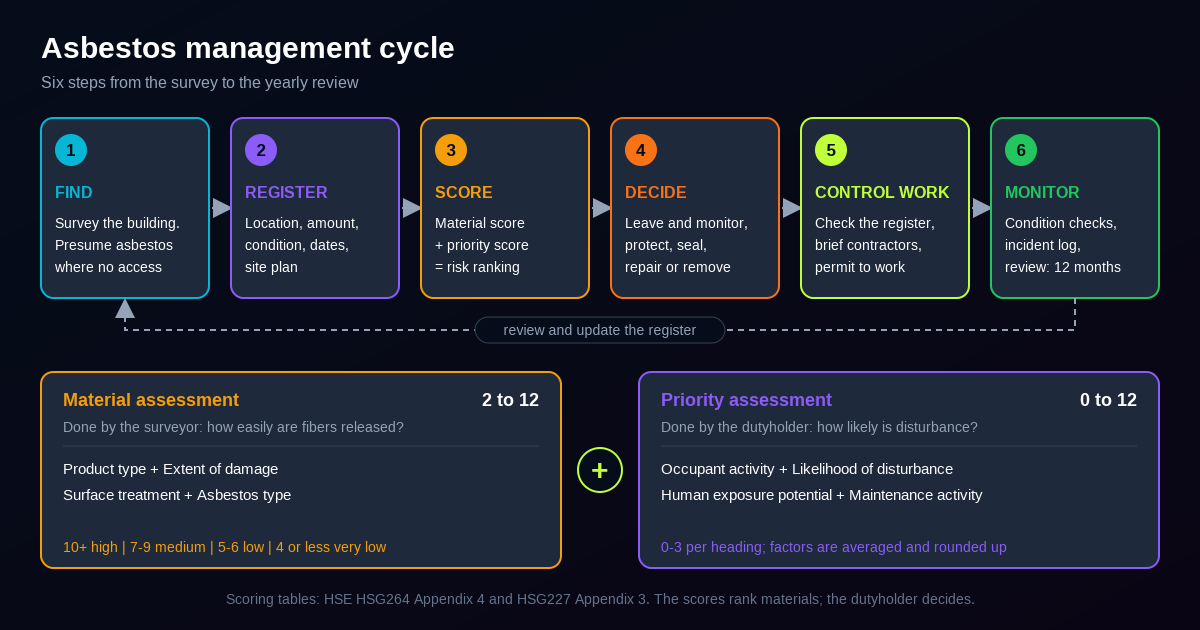
The material assessment: how easily will it release fibers?
The material assessment comes from HSE's survey guide HSG264 (Appendix 4) and is normally done by the surveyor. Four parameters are scored and added:
| Parameter | 0 | 1 | 2 | 3 |
|---|---|---|---|---|
| Product type | — | Reinforced composites: vinyl floor tiles, asbestos cement, mastics, roofing felt | AIB, millboard, textiles, gaskets, ropes, paper | Pipe and boiler lagging, sprayed asbestos, loose asbestos |
| Extent of damage | Good condition, no visible damage | Low: a few scratches, broken edges | Medium: significant breakage or several small damaged areas showing loose fibers | High: delamination, visible debris |
| Surface treatment | Composites: reinforced plastics, resins, vinyl tiles | Enclosed sprays and lagging; painted or encapsulated AIB; asbestos cement sheets | Unsealed AIB; encapsulated lagging and sprays | Unsealed lagging and sprays |
| Asbestos type | — | Chrysotile | Amphibole other than crocidolite | Crocidolite |
The total runs from 2 to 12. HSG264 rates 10 or more as high potential to release fibers, 7 to 9 as medium, 5 to 6 as low and 4 or less as very low. A presumed material is scored as crocidolite (3) unless there is strong evidence otherwise.
The priority assessment: how likely is someone to disturb it?
A high material score does not automatically mean first in line. Lagging in a sealed duct is less urgent than a damaged board next to a doorway. The priority assessment in HSG227 (Appendix 3) is the dutyholder's job, because only you know how the building is used. It has four headings, each scored 0 to 3:
| Heading | Factors | 0 | 3 |
|---|---|---|---|
| Normal occupant activity | Main type of activity in the area | Rare disturbance (little-used store room) | High disturbance (AIB fire door in constant use) |
| Likelihood of disturbance | Location, accessibility, extent | Outdoors; usually inaccessible; small amounts | Confined space; routinely disturbed; more than 50 m² or 50 m of pipe |
| Human exposure potential | Number of occupants, frequency of use, time in use | None; infrequent; under 1 hour | More than 10; daily; over 6 hours |
| Maintenance activity | Type and frequency of maintenance | Minor disturbance; unlikely to be disturbed | Removing a number of tiles; more than once a month |
Where a heading has several factors, score each and average them, rounding up. The priority score (0 to 12) is added to the material score to give an overall risk assessment score for each ACM. HSE is frank about the limits: the algorithms "are best guesses and will often require you to make your own additional judgements."
A Filled Register and Plan for One Workshop
The workshop from the scenario has 18 shop-floor workers, 12 office staff and one maintenance technician. Everything below is our own illustration: the building, the materials, the quantities, the scores we assign with HSE's tables and the actions we choose.
The register with material scores
| # | Location | Material | Amount | Condition | Product | Damage | Surface | Type | Material score |
|---|---|---|---|---|---|---|---|---|---|
| A | Boiler room | Pipe lagging, cloth-wrapped and painted (amosite) | 8 m | One elbow split, fibers visible | 3 | 2 | 2 | 2 | 9 (medium) |
| B | Office corridor | AIB ceiling tiles, painted (amosite) | 40 m² | Good | 2 | 0 | 1 | 2 | 5 (low) |
| C | Workshop roof | Profiled asbestos cement sheets (chrysotile) | 600 m² | Weathered, a few chipped edges | 1 | 1 | 1 | 1 | 4 (very low) |
| D | Canteen floor | Vinyl floor tiles (chrysotile) | 45 m² | Good | 1 | 0 | 0 | 1 | 2 (very low) |
| E | Service riser behind fixed panel | Not accessed: presumed ACM | Unknown | Unknown | — | — | — | — | Not scored |
The priority scores
| # | Occupant activity | Likelihood of disturbance (location, access, extent) | Human exposure (occupants, frequency, time) | Maintenance (type, frequency) | Priority score |
|---|---|---|---|---|---|
| A | 0 (plant room, rarely entered) | 2, 2, 1 → 1.67 → 2 | 1, 2, 0 → 1 | 2, 2 → 2 | 5 |
| B | 1 (office activity) | 2, 1, 2 → 1.67 → 2 | 3, 3, 0 → 2 | 2, 2 → 2 | 7 |
| C | 0 (nothing reaches the roof) | 1, 0, 3 → 1.33 → 2 | 3, 3, 3 → 3 | 1, 1 → 1 | 6 |
| D | 1 (canteen use) | 2, 1, 2 → 1.67 → 2 | 3, 3, 1 → 2.33 → 3 | 0, 3 → 1.5 → 2 | 8 |
How we read the tables for entry A: the boiler room is a room of under 100 m² (2), the lagged pipe runs at working height beside a valve and is easily disturbed (2), and the run is under 10 m (1). One technician (1) enters weekly (2) for less than an hour (0). Valve servicing is a medium disturbance (2) and happens more than once a year (2).
The ranking and what it tells you
| # | Material | Material score | Priority score | Total | Rank |
|---|---|---|---|---|---|
| A | Boiler room lagging | 9 | 5 | 14 | 1 |
| B | Corridor AIB tiles | 5 | 7 | 12 | 2 |
| C | Asbestos cement roof | 4 | 6 | 10 | 3 |
| D | Canteen vinyl tiles | 2 | 8 | 10 | 3 |
| E | Riser (presumed) | — | — | Unknown | Inspect first |
Three points come out of this small example.
The damaged lagging is first, as expected. It is the only entry with visible damage, and the technician works next to it every week.
The canteen floor tiles end up level with the roof and close to the ceiling tiles, although they have the lowest potential to release fibers of anything in the building. The reason is that 18 people sit in the canteen every day, which lifts the human exposure heading. This is the anomaly HSG227 warns about: scores cluster, and the number alone does not decide. Intact vinyl tiles that nobody sands or lifts stay a monitoring item.
The riser is not on the ranking at all, and it may be the biggest unknown. A presumed material in an area maintenance staff will one day need to open belongs at the top of the "find out" list.
The action plan
| # | Decision | Action | Who | When |
|---|---|---|---|---|
| A | Repair now, remove at next shutdown | Lock the boiler room; entry by permit only. A specialist asbestos contractor repairs and seals the split elbow. Removal of the 8 m run is planned for the summer boiler shutdown, because valve servicing will keep disturbing it | Appointed person; specialist contractor | Lock today; repair within 2 weeks; removal next shutdown |
| B | Manage in place | No tile is lifted by staff or general contractors. Any work above the ceiling needs a permit and, if tiles must come out, a specialist contractor. Replace the broken tile area through a specialist contractor | Appointed person | Rule in force now |
| C | Manage in place | No roof access without a permit. Condition checked from below and from the ground | Maintenance technician | Annual check |
| D | Manage in place | Cleaning method agreed with the cleaning contractor: no sanding, no dry abrasive stripping. Tiles are not lifted | Office manager; cleaning contractor | Brief now; annual check |
| E | Find out | Panel labeled "do not open, presumed asbestos". Surveyor inspects when the panel can be opened under controlled conditions | Appointed person | Within 3 months |
For entry D, the US rule is a useful benchmark even outside the US: OSHA 1910.1001(k)(7) prohibits sanding asbestos-containing floor material and requires stripping to be done with low-abrasion pads at under 300 rpm and wet methods.
The plan around the register
The rest of the workshop's plan fits on four pages and follows the headings of HSE's template:
| Section | What the workshop wrote |
|---|---|
| Roles | Dutyholder: the company (owner-occupier). Appointed person: plant manager. Deputy: maintenance technician |
| Register and site plan | Five entries above, marked on the floor plan; kept at reception and in the maintenance office; the survey report is attached |
| Condition monitoring | A: monthly until repaired, then every 6 months. B: every 6 months. C and D: every 12 months. Each check is dated, photographed and signed |
| Control of work | Nobody drills, cuts, lifts or fixes to the building fabric without the appointed person checking the register and issuing a permit. Contractors sign the register briefing at induction |
| Communication | Staff briefing once a year; contractors at every induction; register and site plan given to the fire service |
| Training | Asbestos awareness for the maintenance technician, the office manager and supervisors. Awareness training does not qualify anyone to work on asbestos |
| Incident procedure | See the next section |
| Review | Every 12 months, and after any incident, building work, change of use or change of responsible person |
The inspection intervals are our choices for this example. HSG227 says the period between checks depends on the material, its location and the activity around it, and would not be expected to be more than 12 months in most cases.
Steps 4 to 6: Decide, Control the Work, Monitor
Choosing between leaving, protecting and removing
For each ACM the choice is between managing it in place and taking it out. HSG227 lists three measures that are needed in every case where ACMs remain: communicate, monitor the condition, and put a safe system of work in place. On top of those come the options for the material itself:
| Option | When it fits | Watch out for |
|---|---|---|
| Leave and monitor | Good condition, sealed, unlikely to be disturbed | Monitoring must really happen and be recorded |
| Label or color code | Material left in place where labels will be seen by the people who work on the building | HSE's template says labeling is not mandatory and should not be relied on as a standalone control |
| Protect or enclose | Reasonable condition but exposed to knocks, such as boards near vehicle routes | The enclosure goes on the register and is itself inspected |
| Seal or encapsulate | Surface needs binding or covering | The work disturbs the material: trained people only |
| Repair | Minor, local damage | Same |
| Remove | Damaged beyond repair, or likely to be disturbed by normal use, maintenance or planned refurbishment | Specialist contractor, plan of work, clearance evidence kept with the register |
HSE's template gives three firm pointers for the action plan. Materials with a high potential to release fibers, for example material scores above 10, are prioritized for immediate action. Materials in good condition but with a high potential for disturbance should be protected or removed. Materials likely to be disturbed by major planned refurbishment must be removed unless the work can be designed to avoid them.
This is the hierarchy of controls applied with care. Elimination is still the top of the hierarchy, but removal itself disturbs the material, so it is chosen when the material cannot be kept safe where it is.
Controlling work on the building
Most exposure today comes from maintenance and small building jobs. The plan therefore has to reach the electrician, the plumber and the IT contractor before they pick up a drill.
- Make the register a gate. No work on walls, ceilings, floors, ducts, roofs or plant insulation starts until someone with authority has checked the register for that location. A permit to work is the simplest way to enforce this.
- Tell people before they start. HSE states that you must tell workers about your asbestos management plan before they start work on the fabric of your building. Build it into contractor induction, and ask for the contractor's own risk assessment and method statement to show how they will avoid the ACMs on the register.
- Treat changes as triggers. A new machine foundation, a new cable route or a change in room use can move a "leave in place" material into someone's way. Route these through your management of change process.
- Order the right survey. Planned refurbishment or demolition needs a refurbishment or demolition survey of the affected area before the design is fixed.
What to do when a material is damaged
HSE requires the plan to contain emergency procedures but leaves the detail to you. The workshop in our example wrote this one. It is our illustration, not a quoted procedure:
- Stop work at once. Do not sweep, vacuum or bag anything.
- Get everyone out of the area and close it off. Switch off local ventilation if that can be done from outside the area.
- Call the appointed person or the deputy. Contact numbers are on the permit.
- Anyone with dust or debris on clothing stays at the edge of the area and waits for instructions from the appointed person, who calls the specialist contractor.
- The specialist contractor assesses, cleans and repairs. The area reopens only when the contractor confirms it is safe in writing.
- Record the event in the incident log with names of those present, update the register, and review why the control failed.
HSE's own instruction to workers is brief: stop work if you think you have found asbestos. The template adds an accidental damage and incident log and suggests testing the plan against realistic scenarios, such as a burst pipe or the installation of a new fire alarm.
Monitoring and review
Every condition check answers the same questions: is the surface intact, is the sealant or enclosure sound, is there debris below, has anything changed nearby? Photographs taken from the same spot each time make deterioration visible. Review the whole plan at least every 12 months, and sooner when work has affected an ACM, when a responsible person changes, after any accidental disturbance, and after scheduled condition checks find a change.
Common Mistakes in Asbestos Management
1. Treating the survey report as the plan
A survey says what was there on the day. Without named roles, a monitoring schedule and a way of reaching contractors, it sits in a cabinet, as in the scenario. The survey is the input to the plan.
2. Using a management survey for refurbishment work
A management survey covers accessible areas for normal occupation. It does not look inside walls or above fixed ceilings. Starting refurbishment on that basis sends workers into materials nobody inspected.
3. Forgetting the areas nobody accessed
"No access" in a survey report means "presumed asbestos". These entries often drop off the register because there is nothing to score. They are the places where the next surprise will be.
4. Letting the score make the decision
The algorithms rank; they do not decide. In the worked example, intact floor tiles score the same as a 600 m² roof. Read each score with its reasons, and write down your reasoning when you depart from the ranking.
5. Relying on labels
A label helps the person who sees it and understands it. It does nothing for the contractor working from the other side of the wall. Labels support the register check and the briefing; they do not replace them.
6. Briefing contractors after they have started
The briefing has to happen at the planning stage and again at the gate. Once the ceiling tile is lifted, the information is late.
7. Never reviewing
Rooms change use, staff leave, tiles get damaged and replaced. A register with a last inspection date three years old tells a contractor very little. Regulation 4 requires review at regular intervals, HSE's guidance sets that at 12 months at most, and it is good practice everywhere.
How FindRisk Supports Asbestos Management
FindRisk does not replace an asbestos survey, laboratory analysis or a specialist contractor. Where it helps is in the routine work the plan creates.
You can build the condition check as an inspection checklist, with AI drafting the questions from a short description, and run it on a phone at the interval your plan sets. Photos taken during the check can be marked up on the spot, so a split in a lagging wrap or a chipped board edge is recorded with its location. A report is produced in seconds and can be filed with the register as evidence that the check was done.
When asbestos sits alongside other hazards in a wider workplace risk assessment, FindRisk's Fine-Kinney scoring lets you rank it with the rest and track actions to completion. FindRisk runs on iOS and Android.
Frequently Asked Questions
Is an asbestos management plan a legal requirement?
In Great Britain, yes: regulation 4 of the Control of Asbestos Regulations 2012 requires the dutyholder for non-domestic premises to prepare a written plan and keep it under review. In the US, EPA's AHERA rules require a management plan for schools, and OSHA 1910.1001(j) requires building owners to identify, record and communicate asbestos. The Turkish regulation requires identification before maintenance or demolition and a work plan for asbestos work.
What is the difference between an asbestos register and an asbestos management plan?
The register is the list of known and presumed asbestos-containing materials with their location, amount, condition and scores. The management plan is the wider document that contains the register and adds who is responsible, how materials are monitored, how work on the building is controlled, how people are informed, what happens after accidental damage and when everything is reviewed.
How often should an asbestos management plan be reviewed?
HSE's guidance says to review the plan, including the register and site plans, at least every 12 months, and sooner if work affects a material, responsible staff change or a material is accidentally disturbed. Condition checks of individual materials may be more frequent; HSG227 says the interval would not be expected to exceed 12 months in most cases. EPA's school rules require surveillance every 6 months.
Does asbestos have to be removed when it is found?
No. Material in good condition that is sealed and unlikely to be disturbed can usually be left in place and monitored; HSE notes this is often safer than removal, which disturbs it. Removal is the choice when the material is damaged beyond repair, cannot be protected from disturbance, or lies in the way of planned refurbishment or demolition.
Who can write an asbestos management plan?
The dutyholder is responsible for the plan and may write it with help from a competent adviser. In practice the building owner or the person responsible for maintenance appoints someone with the authority, training and resources to run it. Surveyors supply the survey and material scores, but the priority assessment needs the dutyholder's knowledge of how the building is used. US school plans must be developed by an accredited management planner.
Do buildings built after 2000 need an asbestos survey?
HSE's guidance for Great Britain is to assume asbestos is present if a building was built or refurbished before 2000. A newer building with reliable construction records is unlikely to need a survey there. The year differs by country: OSHA's presumption applies to buildings constructed no later than 1980, and the Turkish ministry guide notes asbestos was used in Türkiye until 2010. Check the rule where your building stands.
Can our own maintenance staff work on asbestos materials?
Only within the limits your country's rules set, and only with task-specific training. Asbestos awareness training tells people how to avoid disturbing asbestos; it does not qualify them to work on it. HSE's template separates tasks that trained, non-licensed workers can do from those that need a licensed contractor. In Türkiye, work under the regulation is done by a certified asbestos removal worker under an asbestos removal specialist.
Conclusion
An asbestos management plan answers four questions for every older building: where is the asbestos, what condition is it in, who might disturb it, and what stops them doing so by accident. The survey answers the first two on one day. The register, the scores, the permit check, the contractor briefing and the annual review keep the answers true after that.
Start small. List what you know and what you must presume, score each entry, decide on an action for each and name one person who owns the register. Then make sure no contractor can start work on the building fabric without passing that person.
If you want the condition checks and their photo records in one place, download FindRisk and build your first asbestos condition checklist. Leave sampling, repair and removal to the specialists your plan names.
Try FindRisk
Ready to modernize your safety workflow?
Conduct AI-powered risk assessments, generate reports instantly, and keep your team safe — anywhere, anytime.