

ALARP Principle: What It Means, How to Apply It, and Common Misunderstandings
The Question Every Risk Assessment Must Answer
Every risk assessment, at its core, must answer one question: is this risk acceptable?
But "acceptable" is not a fixed standard. A risk that is acceptable in one context — sky diving, motor racing — is not acceptable in another. And in the workplace, "acceptable" has a legal definition that many safety professionals do not fully understand.
In the UK and many other jurisdictions, the legal standard for risk control in the workplace is not "eliminate all risk" — it is ALARP: As Low As Reasonably Practicable.
ALARP acknowledges that zero risk is not achievable, and that society does not benefit from demanding an infinite level of resource expenditure to eliminate residual risk. What it requires is that every reasonably practicable measure that can reduce the risk has been implemented — and that the cost of any further reduction is grossly disproportionate to the safety benefit it would achieve.
This is a precisely specified legal standard. Misunderstanding it creates real risk — of over-investment in low-priority controls, and more dangerously, of under-investment in areas where ALARP has not been demonstrated.
What Does ALARP Mean?
ALARP stands for As Low As Reasonably Practicable. It is the criterion used to determine whether a risk has been reduced sufficiently — or whether additional control measures are required.
The definition of "reasonably practicable" comes from UK case law. In Edwards v National Coal Board [1949], the Court of Appeal established that "reasonably practicable" means:
A computation must be made in which the quantum of risk is placed on one scale and the sacrifice involved in the measures necessary for averting the risk (whether in money, time, or trouble) is placed on the other, and that, if it is shown that there is a gross disproportion between them — the risk being insignificant in relation to the sacrifice — the defendants discharge the onus on them.
In plain English: a risk is ALARP when the cost (money, time, effort, disruption) of reducing it further is grossly disproportionate to the safety benefit of doing so. If a further risk reduction can be made at a cost that is proportionate to the benefit, it must be made.
Key principle: The duty holder (employer) must implement a control measure unless they can demonstrate that the cost is grossly disproportionate to the benefit. The burden of proof is on the duty holder to demonstrate ALARP — not on the regulator to prove it has not been achieved.
ALARP vs ALARA vs SFAIRP
These three acronyms are frequently confused:
| Acronym | Meaning | Primary Use |
|---|---|---|
| ALARP | As Low As Reasonably Practicable | UK OHS law (HSWA 1974), EU, Australia, and many other jurisdictions |
| ALARA | As Low As Reasonably Achievable | Radiation protection (ICRP standards, nuclear industry) |
| SFAIRP | So Far As Is Reasonably Practicable | Alternative expression of ALARP; used in UK legislation and some OHS management systems |
ALARP and SFAIRP mean the same thing — "so far as is reasonably practicable" and "as low as reasonably practicable" are equivalent expressions. ALARA is used specifically in radiation protection and has a slightly different nuance: it emphasizes continuous improvement toward the lowest achievable level, without requiring the gross disproportion test.
In general industry safety, ALARP is the relevant standard.
The ALARP Triangle: Three Risk Regions
The ALARP principle is typically visualized as a triangle divided into three risk regions:
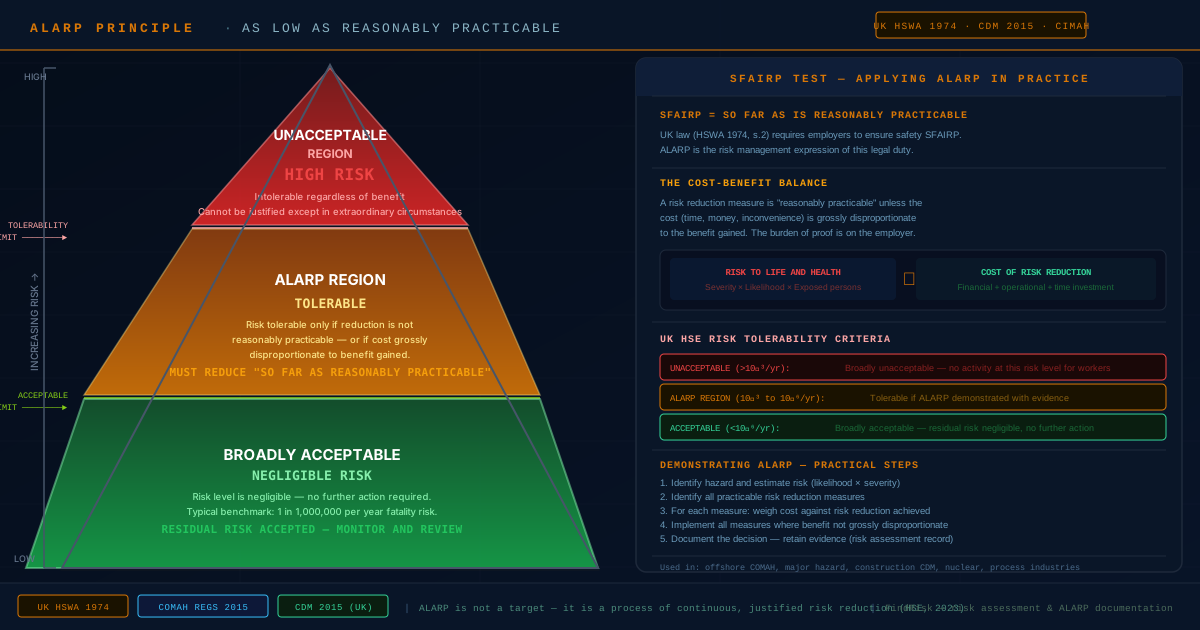
Region 1: Unacceptable (Upper Zone) Risk is so high that it cannot be justified — work must stop until the risk is reduced to below the upper boundary. This region is defined by regulatory standards or established tolerability limits.
Region 2: ALARP (Middle Zone — "Tolerable Region") Risk is in the range where it might be acceptable, provided it has been reduced as far as reasonably practicable. This is where the cost-benefit analysis is applied. If there are cost-proportionate measures that would further reduce the risk, they must be implemented. If the only remaining reductions would be grossly disproportionate to the benefit, the risk has been demonstrated ALARP.
Region 3: Broadly Acceptable (Lower Zone) Risk is so low that no further control is required — it is broadly comparable to everyday life risks (driving to work, crossing the road). Controls may still exist but are not required by the ALARP standard.
How to Demonstrate ALARP
Demonstrating ALARP requires documented evidence that all reasonably practicable control measures have been identified and implemented. The process:
Step 1: Identify the Hazard and Estimate the Risk Level
Use a recognized risk assessment methodology:
- For quantitative ALARP demonstration: Quantitative Risk Assessment (QRA) to establish a numerical risk level (e.g., individual fatality risk per year)
- For semi-quantitative ALARP: Fine-Kinney method or risk matrix to establish a risk band
- For qualitative ALARP: structured qualitative assessment with documented reasoning
Step 2: Apply the Hierarchy of Controls
For each identified hazard, systematically work through the hierarchy:
| Control Level | Question | ALARP Application |
|---|---|---|
| Elimination | Can the hazard be removed entirely? | If elimination is technically feasible and not grossly costly, it must be implemented |
| Substitution | Can a less hazardous alternative be used? | If substitution is feasible and proportionate, it must be implemented |
| Engineering controls | Can physical safeguards reduce the risk? | Each credible engineering control must be evaluated for cost-benefit |
| Administrative controls | Can procedures, training, or supervision reduce the risk? | Generally low-cost; normally required unless they provide no meaningful risk reduction |
| PPE | Can personal protection reduce the residual risk? | Required where technically feasible; not a substitute for higher controls |
Step 3: Apply the Cost-Benefit Test
For each potential control measure that has NOT been implemented, document:
- The risk reduction the measure would achieve (in quantitative or qualitative terms)
- The cost of implementing the measure (financial cost, operational disruption, time)
- The assessment of whether the cost is grossly disproportionate to the benefit
The HSE's guidance on ALARP suggests a disproportion factor of at least 10:1 — a control that costs £100,000 may not be required if the risk reduction value is £10,000, but a control that costs £10,000 where the risk reduction value is £10,000 would normally be required.
Step 4: Document the ALARP Case
The ALARP case is the documented record of the risk assessment, the controls considered, the controls implemented, and the rationale for any controls not implemented. It should be:
- Specific to the hazard and the location
- Based on best available information (industry data, manufacturer specifications, incident history)
- Proportionate to the severity of the risk (a complex written ALARP case for a high-consequence scenario; a brief recorded assessment for a low-consequence scenario)
- Dated and reviewed when conditions change
Step 5: Review and Update
ALARP demonstration is not a once-and-done exercise. The assessment must be reviewed:
- When the nature of the hazard changes
- When better control technology becomes available
- When an incident or near miss occurs
- When regulatory guidance changes
- At defined periodic intervals (typically annually for high-risk scenarios)
ALARP in Different Industry Contexts
| Industry | Risk Tolerability Limits | Common ALARP Methods |
|---|---|---|
| Oil and gas | HSE's Tolerability of Risk framework (UK): 10⁻³/year intolerable, 10⁻⁶/year broadly acceptable | QRA with ALARP case; Layer of Protection Analysis (LOPA) |
| Nuclear | 1 in 10,000 per year (10⁻⁴) for workers (intolerable above); ALARA applies throughout tolerable range | Probabilistic Risk Assessment; ALARA/ALARP combined |
| Construction | Qualitative risk matrix; Fatal Accident Rate (FAR) benchmarks | Qualitative ALARP using hierarchy of controls documentation |
| General industry | ISO 45001 requirements; jurisdiction-specific regulations | Semi-quantitative (Fine-Kinney) or qualitative ALARP case |
| Railways | ALARP within defined risk tolerability limits (10⁻⁴ to 10⁻⁶ for passengers) | Formal Safety Assessment; Cost Per Life Saved analysis |
Common Misunderstandings About ALARP
Misunderstanding 1: "ALARP means we only have to do what is cheap"
ALARP does not set a cost ceiling — it sets a disproportion test. A measure that costs $500,000 must be implemented if the safety benefit warrants it. The "gross disproportion" threshold is not low.
Misunderstanding 2: "Residual risk is automatically ALARP if we've done the risk assessment"
A risk assessment identifies hazards. An ALARP case demonstrates that all proportionate controls have been applied to those hazards. The two are not the same.
Misunderstanding 3: "ALARP doesn't apply in our jurisdiction because we're not UK-regulated"
ALARP as a legal standard originated in UK law, but the principle is embedded in OHS regulation worldwide. ISO 45001 requires that risks be reduced to the extent practicable. OSHA's General Duty Clause requires that recognized hazards be abated using feasible means. The cost-benefit analysis at the heart of ALARP is applied implicitly in every OHS regulatory system.
Misunderstanding 4: "PPE is ALARP because it's the most cost-effective control"
PPE is at the bottom of the hierarchy of controls for a reason — it provides the least reliable protection and must be worn correctly every time to be effective. PPE may be part of an ALARP case, but PPE-only controls are rarely ALARP when engineering or administrative controls are technically feasible.
ALARP and ISO 45001
ISO 45001 does not use the word "ALARP," but the concept is embedded in its requirements:
| ISO 45001 Clause | Requirement | ALARP Connection |
|---|---|---|
| Clause 6.1.2 | Identify hazards and assess risks | ALARP begins with risk assessment |
| Clause 6.1.4 | Determine the actions to address risks | Actions must reduce risk "as far as practicable" |
| Clause 8.1 | Operational planning and control | Controls must be implemented to manage risks |
| Clause 10.3 | Continual improvement | ALARP is not static — better controls must be implemented as they become available |
Frequently Asked Questions
Is there a specific risk level that defines the ALARP boundary?
In quantitative risk assessment contexts (major hazard industries), the UK HSE defines specific tolerability limits: an individual fatality risk above 1 in 1,000 per year (10⁻³) is broadly unacceptable; below 1 in 1,000,000 per year (10⁻⁶) is broadly acceptable. Between these levels, the risk is tolerable provided ALARP is demonstrated. These specific limits apply primarily to major hazard facilities. For general industry, qualitative and semi-quantitative methods are used to place risk within one of the three ALARP regions.
Does ALARP require a formal cost-benefit analysis document?
For high-risk scenarios, yes — a documented ALARP case with explicit cost-benefit reasoning is expected by regulators and required for demonstrating compliance with major hazard legislation (COMAH, OSHA PSM). For lower-risk scenarios, the ALARP case may be less formal — but it should still be documented. A risk assessment that notes "risk has been assessed and controls are in place" without documenting what controls were considered and why some were not implemented does not demonstrate ALARP.
How does ALARP relate to the precautionary principle?
The precautionary principle (applied in environmental law and some OHS contexts) suggests that where there is uncertainty about a risk, the burden of proof is on demonstrating safety rather than proving harm. ALARP is more specific — it applies to quantified or assessable risks and requires cost-benefit analysis. In practice, for novel or uncertain risks, the precautionary principle may require more stringent controls than the ALARP cost-benefit test alone would suggest.
Conclusion
ALARP is not a paperwork concept. It is a legal standard, a risk management philosophy, and a practical decision-making tool that answers the fundamental question every safety professional must be able to answer: "Have we done enough?"
The organizations that demonstrate ALARP most effectively are those that approach it not as a compliance exercise but as a genuine inquiry — systematically identifying every credible control measure for each significant hazard, honestly assessing the cost and benefit of each, implementing those that are proportionate, and documenting the reasoning for those that are not.
The alternative — claiming ALARP without the analysis — is not just a compliance failure. It is a failure of the duty of care that the organization owes to the people who work for it.
Download FindRisk to support your ALARP demonstrations — with AI-assisted hazard identification, Fine-Kinney risk scoring, hierarchy-of-controls structured assessments, and documented evidence of control selection rationale.
Try FindRisk
Ready to modernize your safety workflow?
Conduct AI-powered risk assessments, generate reports instantly, and keep your team safe — anywhere, anytime.