
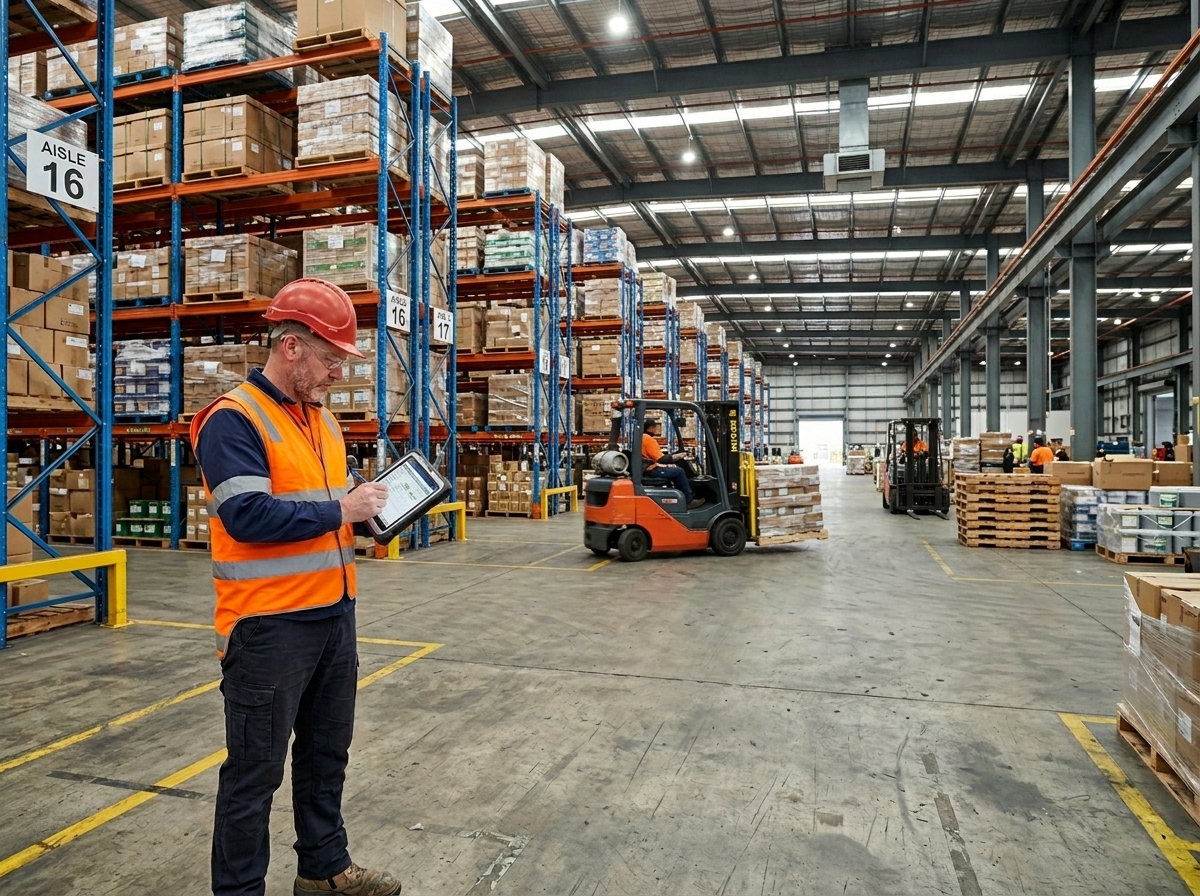
Warehouse and Logistics Safety: Complete 45-Point Inspection Checklist
When the Racking Collapsed
In 2015, a warehouse employee in Poland was retrieving a pallet from a racking system when an incorrectly stored oversized load on the level above caused a cascading collapse. The entire racking bay — 12 metres of steel racking — fell. Two workers were killed.
Investigation found that the racking had been damaged in a previous forklift collision and the damage had been reported. The report had been filed. No inspection of the racking damage had been commissioned. No repair or temporary restriction of the affected bay had been put in place.
Warehouses and logistics facilities are among the most hazard-dense environments in general industry. The combination of forklifts and pedestrians, high-density racking, manual handling, and rapid pace of operations creates a hazard profile that is consistently underestimated — and consistently under-inspected.
According to OSHA, powered industrial truck (forklift) accidents account for approximately 85 fatalities and 34,900 serious injuries in the US alone each year. Racking failures cause several hundred additional serious injuries annually. The majority are preventable.
Warehouse Safety Hazard Profile
| Hazard Category | Primary Risks | Common Causes |
|---|---|---|
| Powered industrial trucks (forklifts) | Struck by, runover, tip-over | Speeding, pedestrian proximity, unstable loads |
| Racking and shelving | Collapse, falling objects | Forklift damage, overloading, poor installation |
| Manual handling | Musculoskeletal injury | Heavy loads, repetitive motion, awkward posture |
| Falling objects | Struck by, fatality | Unstable loads, unsecured items, racking failure |
| Slips, trips, and falls | Fractures, sprains | Wet floors, damaged flooring, poor housekeeping |
| Fire | Burns, smoke inhalation, building loss | Poor storage, electrical faults, inadequate suppression |
| Loading dock hazards | Vehicle movement, falls, struck by | Unsecured trailers, dock leveler failure |
45-Point Warehouse Safety Inspection Checklist
Section 1: Powered Industrial Trucks and Vehicles (Points 1–12)
| # | Inspection Item | Guidance |
|---|---|---|
| 1 | All forklift operators hold current certification for the specific vehicle type they operate | Verify certification cards; check expiry dates |
| 2 | Pre-shift vehicle inspection is completed and documented for all forklifts | Review inspection log; look for blank entries or identical records across days |
| 3 | Damaged or defective forklifts are tagged out of service and not operated | Check for visible damage on vehicles in service |
| 4 | Forklift speed limits are posted and enforced throughout the facility | Observe vehicle speeds during inspection |
| 5 | Pedestrian and vehicle routes are clearly separated by physical barriers, not only painted lines | Check that barriers are in place and undamaged |
| 6 | Pedestrian walkways are clearly marked and free of obstructions | Yellow floor markings visible; not blocked by pallets or equipment |
| 7 | Mirrors are installed at all blind corners and intersections | Mirrors clean, angled correctly, and undamaged |
| 8 | Forklifts are not operated with loads blocking the operator's view | Observe operational practice |
| 9 | Trucks and trailers at loading docks are chocked and/or using dock lock systems | Verify chocks in place at all occupied dock positions |
| 10 | Forklift charging areas are ventilated, free of ignition sources (lead-acid batteries), and not used for storage | Battery room inspection |
| 11 | Overhead clearances are marked and respected — no loads raised beyond safe height in aisles | Check ceiling-mounted hazard markings |
| 12 | High-visibility vests are worn by all pedestrians in forklift operating zones | Observe compliance; check vest condition |
Section 2: Racking and Shelving Systems (Points 13–20)
| # | Inspection Item | Guidance |
|---|---|---|
| 13 | Racking has been formally inspected by a competent person within the past 12 months | Inspection certificate from SEMA-approved inspector or equivalent |
| 14 | Load ratings are posted on all racking bays | Beam load, bay load, and floor load ratings visible |
| 15 | Loads do not exceed posted bay load ratings | Check pallet weights against ratings |
| 16 | No racking damage visible — uprights, beams, and base plates inspected | Bent uprights are critical findings — load capacity reduced by up to 50% with minor damage |
| 17 | Racking damage is tagged and reported; damaged bays are not loaded until inspected | Check for "Do Not Use" tags on damaged sections |
| 18 | Anti-collapse mesh or barriers are installed at aisle ends where racking is accessible from both sides | Prevents loads falling into adjacent aisles |
| 19 | Row spacers or column guards are installed to protect racking uprights from forklift impact | Check for impact guards at aisle-facing uprights |
| 20 | No ad-hoc storage (non-palletized items, irregular loads) on racking bays not designed for them | Check for oversized loads or items stored on racking designed for standard pallets only |
Section 3: Manual Handling and Ergonomics (Points 21–26)
| # | Inspection Item | Guidance |
|---|---|---|
| 21 | Manual handling risk assessments are current for all tasks involving loads above the threshold (typically 16–25 kg) | Review risk assessment register |
| 22 | Mechanical handling aids (pallet jacks, pump trucks, conveyor systems) are available and used | Observe actual practice — are aids being used or bypassed? |
| 23 | Order picking workstation heights are appropriate for the workers using them | Adjustable or task-matched height |
| 24 | Repetitive tasks are assessed for frequency, force, and posture | Tasks performed at rate above 900 operations/shift |
| 25 | Team lifting procedures are in place and practiced for loads requiring two or more persons | Check for written procedure and observed compliance |
| 26 | Floor surfaces in manual handling areas are level, free of damage, and appropriate for loads | No cracked or uneven flooring in high-traffic areas |
Section 4: Fire Safety (Points 27–31)
| # | Inspection Item | Guidance |
|---|---|---|
| 27 | Sprinkler systems are functional, not obstructed, and maintained within required interval | Check clearance above sprinkler heads (typically 0.45–0.5 metre minimum) |
| 28 | Fire extinguishers are present at required locations, accessible, inspected within 12 months | Check that extinguisher type is appropriate for the fire risk in that area |
| 29 | Electrical panels are accessible and covers are in place; no combustible material stored in proximity | 0.9 metre clear access required |
| 30 | Commodity storage is compatible with the sprinkler system design (storage height, class) | Oversized pallets or high-piled commodity may exceed sprinkler design parameters |
| 31 | Smoking and hot work controls are enforced in high-commodity storage areas | Observe compliance; check for unauthorized hot work |
Section 5: Loading Dock Safety (Points 32–36)
| # | Inspection Item | Guidance |
|---|---|---|
| 32 | Dock levelers are functional and have been serviced within required interval | Check for hydraulic leaks, damaged lip, and proper operation |
| 33 | Dock doors seal correctly when closed — no significant gaps that allow vehicle exhaust into the building | Visual inspection |
| 34 | Dock edge protection is in place (dock safety gates or chains) when dock doors are open and no vehicle is docked | Falls from dock edge are one of the most common warehouse fatalities |
| 35 | Vehicle communication procedure is in place — drivers must wait for dock signal before entering or leaving | Check procedure is posted and observed |
| 36 | Dock area lighting is adequate for safe vehicle and pedestrian movement at night | Minimum 108 lux recommended for vehicle movement areas |
Section 6: General Housekeeping and Emergency Preparedness (Points 37–45)
| # | Inspection Item | Guidance |
|---|---|---|
| 37 | Aisles are clear of pallets, debris, and spilled product | Spot-check all main aisles during inspection |
| 38 | Spills are cleaned up promptly and the cause investigated | Check for unresolved spills and for lack of spill response equipment |
| 39 | Stretch wrap and banding waste is managed — not accumulated on the floor | Cut or loose strapping is a serious slip and trip hazard |
| 40 | Emergency exit routes are clear, marked, and illuminated | Verify each emergency exit is accessible and signs are illuminated |
| 41 | Emergency assembly point is clearly marked and known to all workers | Worker interviews |
| 42 | First aid kits are stocked and within expiry | Check contents of all first aid kits |
| 43 | Lighting is adequate throughout the facility — no areas where low lighting creates a safety risk | Check storage areas, dock areas, and access routes |
| 44 | Waste and recycling areas are managed — no overflow of combustible waste materials | Cardboard compactor or baler areas particularly important |
| 45 | Temperature is managed in storage areas where heat stress is a risk | Provide water and rest areas; monitor for heat illness symptoms |
How FindRisk Supports Warehouse Safety Inspections
AI-assisted checklist generation: Describe the warehouse type (cold storage, ambient, hazardous materials, automated), the current operations (picking, receiving, dispatch), and any specific equipment in use — and FindRisk generates a contextually relevant inspection checklist that supplements the standard 45-point framework with site-specific hazards.
Racking damage photo documentation: Photograph and annotate racking damage directly in the app. The photo, with drawn annotations showing the specific damage location, is automatically embedded in the inspection report — providing the evidence needed to assign and track racking repair corrective actions.
Forklift compliance tracking: Document forklift pre-shift inspection compliance rates across your fleet over time. Identify which vehicles have consistently poor inspection compliance — a leading indicator of fleet maintenance issues.
Corrective action assignment: Every finding is immediately assigned to a named owner with a deadline — from the inspection floor, before the inspector leaves the area.
Frequently Asked Questions
How often should warehouse racking be formally inspected?
The Storage Equipment Manufacturers' Association (SEMA) and EN 15635 (European standard for racking inspection) recommend a formal racking inspection by a competent inspector at least annually. In high-throughput facilities with frequent forklift movement adjacent to racking, quarterly formal inspections are advisable. Additionally, daily informal visual checks by trained warehouse staff are required — any damage identified should be tagged immediately and formally assessed before the bay is used again.
What qualifications are required for forklift operators?
In the US, OSHA 1910.178 requires that forklift operators be trained and evaluated before they operate a powered industrial truck. Certification is specific to vehicle type — operators certified on counterbalance forklifts are not automatically certified for reach trucks, order pickers, or pallet jacks above defined weight thresholds. Refresher training is required every three years or when an operator is observed operating unsafely, is involved in an incident, or is assigned a different type of truck. Certification must be employer-issued — industry-standard cards from third-party trainers confirm training was received but do not substitute for employer evaluation.
What is the minimum aisle width required for forklift operations?
OSHA does not specify a minimum aisle width for forklifts directly, but requires that aisles be "sufficiently wide" for safe two-way travel or one-way travel as appropriate. In practice, OSHA inspectors reference the forklift manufacturer's specifications. Counterbalance forklifts typically require 3.5–4.0 metre aisles for two-way travel with pallet loads. Very narrow aisle (VNA) trucks require aisles designed for their specific width.
Conclusion
Warehouse and logistics safety is not a background concern — it is a daily operational discipline in one of the most hazard-intensive general industry environments. Forklifts operating near pedestrians, racking systems carrying multi-tonne loads, and intensive manual handling operations create a combination of risks that requires structured, regular inspection to manage.
The 45-point checklist in this guide provides the minimum scope. Site-specific hazards — cold storage, hazardous materials, automated systems, mezzanine levels — add additional inspection requirements beyond this baseline.
What makes the difference between a warehouse with a good safety record and one with a poor one is almost never the hazards — they are the same hazards. It is the discipline and consistency of the inspection program that makes them visible, and the follow-through on corrective actions that makes them controlled.
Download FindRisk to conduct AI-assisted warehouse safety inspections — with photo documentation, automatic corrective action assignment, and professional reports generated on-site.
Try FindRisk
Ready to modernize your safety workflow?
Conduct AI-powered risk assessments, generate reports instantly, and keep your team safe — anywhere, anytime.