
Toolbox Talk Guide: How to Run Effective Safety Briefings (With 10 Ready Topics)
The Five-Minute Conversation That Saves Lives
In 2014, a construction company in Australia introduced a mandatory five-minute toolbox talk at the start of every shift — covering the specific hazards for that day's work. Within 12 months, their recordable incident rate dropped by 44%.
The content was not sophisticated. The talks were led by site supervisors, not safety specialists. The topics were practical and specific: the hazards of the day's tasks, the controls in place, the one or two things that could go wrong and how to prevent them.
What made the difference was not the information — workers already knew most of it. What made the difference was the daily, structured habit of stopping, talking, and thinking about safety together before work began.
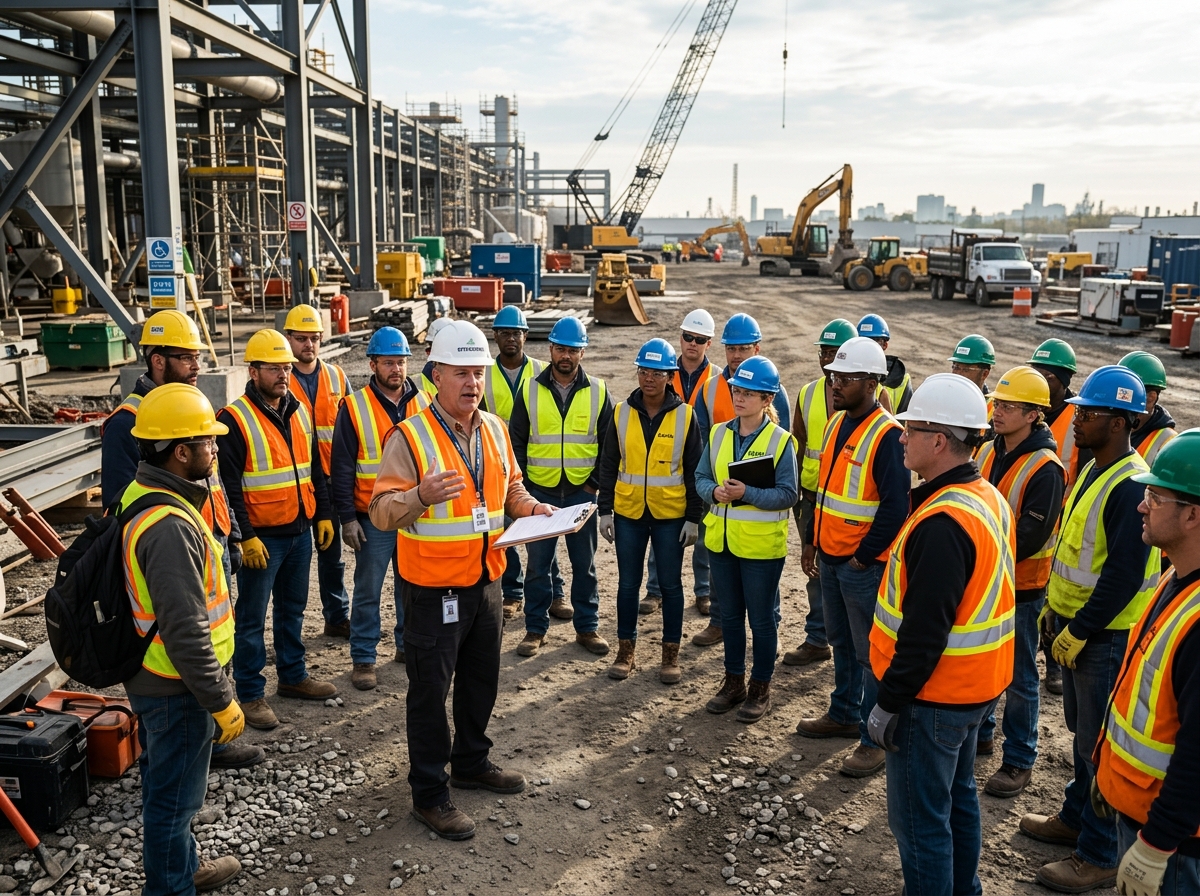
A toolbox talk is not a lecture. It is not a compliance tick-box. It is a brief, focused conversation that connects the general principles of workplace safety to the specific task, the specific location, and the specific hazards workers will encounter in the next few hours.
Done well, it is one of the highest-ROI safety interventions available to any organization.
What Is a Toolbox Talk?
A toolbox talk (also called a tailgate meeting, safety briefing, pre-task safety meeting, or safety stand-down in different industries) is a short, informal safety discussion held with a work crew, typically at the start of a shift or before beginning a specific task.
Toolbox talks are:
- Short — 5 to 15 minutes, not longer
- Specific — focused on a single topic relevant to today's work
- Interactive — not a presentation but a conversation
- Regular — daily or weekly, not a one-off event
Toolbox talks are distinct from formal safety training (which is longer, more structured, and covers theoretical knowledge) and formal safety meetings (which cover management-level safety performance and system issues). They are the daily safety communication mechanism — the link between the safety management system and the work that is actually happening.
What Makes a Toolbox Talk Effective?
Research on safety communication consistently identifies the same factors that separate toolbox talks that change behavior from those that are ignored:
| Effective | Ineffective |
|---|---|
| Topic is directly relevant to today's tasks | Topic is generic or disconnected from current work |
| Led by the immediate supervisor (not a safety officer) | Led only by safety specialists workers don't see daily |
| Workers are invited to contribute and ask questions | Workers are talked at — no interaction |
| Specific — names the hazard, the task, the location | Vague — "be careful out there" |
| Brief — 5 to 10 minutes | Long — exceeds 15 minutes |
| Held at the work location, not in an office | Held in a site office or conference room |
| Attendance recorded with signatures | No record — attendance not verified |
The most common failure mode of toolbox talks is reading from a prepared script with no connection to the day's actual work. Workers disengage immediately — they have heard the generic content before. The supervisor who says "today we're working on [specific task] near [specific hazard] and here's what we're going to watch for" captures attention in a way that a safety leaflet never will.
How to Structure an Effective Toolbox Talk
A toolbox talk does not need a complex structure. The following framework works consistently across industries and topics:
1. Open with a Hook (1–2 minutes)
Start with something that captures attention:
- A brief incident or near-miss story (real or generalized) related to the topic
- A statistic about the hazard type
- A question that invites workers to engage immediately
Example: "Last week, a site in Queensland had a near-miss with a falling object because a worker didn't notice an unsecured tool tray three floors above. Today we're working in the same situation. Let me tell you what we're doing to make sure that doesn't happen here."
2. Identify the Specific Hazard (2–3 minutes)
Be precise about the hazard — not the general category, but the specific risk in today's context:
- What is the hazard? (not "working at height" — "the exposed edge at grid line E, third floor, where the scaffold is incomplete")
- What makes it hazardous? (what could happen if the control fails)
- Who is at risk? (entrants, workers below, adjacent trades)
3. Explain the Controls (2–3 minutes)
Describe what is being done to control the hazard and what each worker is responsible for:
- What physical controls are in place? (barriers, guardrails, LOTO)
- What procedures must be followed?
- What PPE is required and how must it be worn?
- What does each person need to do before, during, and after the task?
4. Ask for Input (1–2 minutes)
Invite workers to identify hazards the supervisor hasn't mentioned:
- "Has anyone worked in this area before? Anything I've missed?"
- "What else could go wrong today that we haven't talked about?"
This is where the most valuable information often emerges. Workers who perform the task daily frequently identify hazards that supervisors and safety officers miss.
5. Confirm Understanding and Record Attendance (1 minute)
Ask a quick check question to confirm understanding. Record attendance — names and signatures — on a toolbox talk form.
10 Ready-to-Use Toolbox Talk Topics
Each topic below includes a brief outline for a 5–10 minute talk. Adapt to your specific site conditions.
Topic 1: Working at Height — Fall Prevention
Hook: Falls from height remain the leading cause of construction fatalities globally. Last year, more than 35% of all construction deaths in the US involved falls.
Key points:
- Today's height work: [describe specific location and task]
- Fall protection required at heights above [site threshold — typically 1.8–2m]
- Inspect harness and lanyard before use — what to check
- Anchor points: only use designated, rated anchor points
- When in doubt, stop and ask — never improvise a fall arrest system
Discussion prompt: "Is everyone clear on where the anchor points are on today's work area? Has anyone noticed a condition that concerns them?"
Topic 2: Struck-By Hazards — Dropped Objects and Moving Equipment
Hook: Dropped objects are the second most common cause of construction fatalities. A 1 kg wrench dropped from 10 metres strikes with the force of a car impact at speed.
Key points:
- Today's dropped object risks: [specific elevated work, tool-heavy tasks]
- Tethering tools: which tools must be tethered today
- Exclusion zones: boundaries below elevated work
- Vehicles and pedestrian separation: today's traffic control plan
- Hard hat and high-visibility vest: mandatory at all times in the exclusion zone
Discussion prompt: "Who is responsible for establishing and maintaining the exclusion zone this morning?"
Topic 3: Chemical Handling — Reading the Safety Data Sheet
Hook: Two workers were hospitalized last month at a facility in our industry after mixing cleaning chemicals that produced chlorine gas. Neither had read the Safety Data Sheet for the products involved.
Key points:
- Today's chemicals in use: [specific products]
- Where the SDS is located for each chemical
- The three things you must know before handling any chemical: hazards, PPE required, and what to do if there's a spill or exposure
- Incompatible chemicals: never mix [specific examples for today's work]
- Emergency: eyes — flush 15 minutes; call [site emergency number]
Discussion prompt: "Does everyone know where to find the SDS for the chemicals we're using today?"
Topic 4: Manual Handling — Back Injury Prevention
Hook: Back injuries are the most common work-related injury in our industry. They are also the most preventable — and the most likely to cause long-term disability.
Key points:
- Today's manual handling tasks: [specific loads, distances, frequencies]
- Safe lifting technique: position, grip, lift with legs, keep load close
- When to use mechanical aids: if the load exceeds [site threshold], use a trolley / forklift / hoist
- Team lifting: when two people are needed and how to coordinate
- Body position for pushing and pulling: keep back straight, use body weight
Discussion prompt: "Are all the mechanical aids we need for today's loads available and in working order?"
Topic 5: Electrical Safety — Avoiding Contact with Overhead Lines
Hook: In 2022, a contractor operating an elevated work platform in Western Australia made contact with an overhead power line. The operator was electrocuted. The line had been identified in the site survey. The exclusion zone had not been enforced.
Key points:
- Overhead lines on today's work area: [location, voltage, height]
- Exclusion zone dimensions: [distance required — typically 3–6 metres depending on voltage]
- Equipment that cannot enter the exclusion zone: [cranes, EWPs, trucks with raised tipper]
- Banksman requirement: a dedicated spotter when working near exclusion zone
- If contact is made: stay on the machine until the supply is isolated; if you must jump, land with feet together and shuffle away
Discussion prompt: "Has everyone identified today's overhead line locations relative to their work area?"
Topic 6: Hot Work — Fire Prevention
Hook: The most common cause of industrial fires during maintenance is hot work — welding, cutting, or grinding — conducted without adequate controls. Almost all of them are preventable.
Key points:
- Hot work permit: is it issued? Does everyone know where it is?
- Pre-work fire risk assessment: removal of combustibles within [radius — typically 10–15m]
- Atmospheric testing: has the area been tested for flammable vapors before starting?
- Fire watch: who is assigned? What are their responsibilities during and after work?
- Fire extinguisher: type and location
- No hot work near [specific flammable materials on site today]
Discussion prompt: "Who is the fire watch today, and do they know their responsibilities after the work stops?"
Topic 7: Slips, Trips, and Falls — Housekeeping
Hook: Slips, trips, and falls account for approximately 30% of all workplace injuries globally. The vast majority involve conditions that were present and visible before the incident occurred.
Key points:
- Today's housekeeping priorities: [specific high-traffic areas, wet surfaces, cable hazards]
- Walkway maintenance: who is responsible for keeping access routes clear during today's work?
- Wet surfaces: what creates them today (rain, process washdown, concrete work) and how they will be managed
- Lighting: if working in low-light areas today, [specific arrangements]
- Footwear: appropriate footwear for today's conditions
Discussion prompt: "Is there any area on site right now that you would trip or slip if you weren't watching carefully?"
Topic 8: Personal Protective Equipment — Correct Fit and Use
Hook: PPE that doesn't fit correctly provides no protection. A safety harness with a loose dorsal connection, a respirator that doesn't seal, or safety glasses worn below the nose — all provide zero protection against the hazard they are designed to address.
Key points:
- PPE required for today's work: [specific list]
- Correct fit check: walk through the inspection and fit procedure for each item
- When PPE must be replaced: damage inspection criteria for each item
- PPE is the last line of defense: remind workers of the controls that come before PPE and why PPE alone is not enough
- Reporting defective PPE: who to report to; replacement is available
Discussion prompt: "Is anyone unsure about how to correctly fit and inspect their PPE for today's work?"
Topic 9: Near Miss Reporting — Why It Matters
Hook: For every workplace fatality, there are statistically 300 near misses involving the same hazard. The near miss is the warning sign. Organizations that capture and act on near misses prevent the serious incident that follows them.
Key points:
- Definition: a near miss is any event that had the potential to cause harm, but didn't
- Why people don't report: fear of blame, thinking it wasn't serious enough, not knowing how
- How to report a near miss: [site-specific reporting system — app, paper form, verbal to supervisor]
- What happens when you report: investigation, corrective action, feedback to the reporter
- Near miss reporting is a sign of a healthy safety culture — not an admission of failure
Discussion prompt: "Has anyone seen a near miss in the last week that wasn't reported? What stopped you from reporting it?"
Topic 10: Heat Stress — Working Safely in Hot Conditions
Hook: Heat stroke kills. A core body temperature above 40°C causes brain damage within minutes. Outdoor workers in summer are at serious risk — and heat illness progresses faster than most workers realize.
Key points:
- Today's forecast: [temperature, humidity, UV index]
- Early warning signs of heat illness: excessive sweating or cessation of sweating, dizziness, confusion, nausea
- Prevention: shade, cool water available at [location], rest breaks every [frequency], lightweight clothing
- Acclimatization: new workers are most vulnerable in the first 5–7 days
- If a colleague shows signs of heat illness: remove them from heat, cool them with water, call for medical help — do not leave them alone
Discussion prompt: "Is everyone clear on where the water and shade are today? Who will monitor the team for heat stress signs?"
Record-Keeping for Toolbox Talks
Toolbox talks must be documented. For ISO 45001 compliance and legal defensibility, the record must include:
- Date, time, and location
- Topic discussed
- Name of the person who led the talk
- Names and signatures of all attendees
- Any actions raised during the discussion (hazards identified, follow-ups required)
Records should be retained for a minimum of 12 months — longer for incidents that occur in the period following a toolbox talk.
How FindRisk Supports Toolbox Talks
Pre-talk hazard assessment: Use FindRisk to conduct a quick AI-assisted pre-task assessment before the toolbox talk. The AI generates a hazard list specific to the day's tasks — giving the supervisor specific, relevant content for the briefing rather than relying on generic topic cards.
Attendance recording: Record toolbox talk attendance in FindRisk with a mobile form — names, date, topic, and any actions. The record is time-stamped and saved automatically.
Action tracking: If the toolbox talk identifies a hazard that requires corrective action, assign it immediately in FindRisk with an owner and deadline. The supervisor doesn't need to remember to follow up — the system tracks it.
Frequently Asked Questions
How often should toolbox talks be held?
At minimum weekly — daily for high-hazard work environments (construction sites, industrial turnarounds, confined space programs). The most effective programs hold a brief (5-minute) pre-task talk at the start of every shift and a longer (10–15 minute) topic-based talk once per week. The daily talk focuses on the specific hazards of that day's work; the weekly talk covers a broader safety topic.
Who should lead toolbox talks?
The immediate supervisor of the work crew — not the safety officer. Toolbox talks are most effective when led by the person the workers work with every day and who is directly responsible for their safety. Safety officers can provide topics, content, and coaching, but the delivery should come from the supervisor. Workers respond differently to a safety message from their direct supervisor than from a specialist who visits occasionally.
What if workers are reluctant to participate?
Reluctance is usually a symptom of either irrelevant content (workers have heard it before and it doesn't connect to their work) or a culture where participation feels risky (workers fear being seen as complainers or troublemakers). Address content by making talks specifically relevant to today's tasks. Address culture by ensuring that contributions are welcomed, acted on, and credited — not ignored or dismissed.
Are toolbox talks required by law?
Toolbox talks are not explicitly required by name in most OHS legislation, but they satisfy legal requirements for worker consultation and communication (ISO 45001 Clause 5.4, OSHA's Hazard Communication Standard, and equivalent legislation in most jurisdictions). For high-risk work categories — confined space, work at height, hot work — pre-task briefings are effectively required as part of the permit-to-work authorization process.
Conclusion
The toolbox talk is the most accessible and most frequently underused safety tool available to front-line supervisors. Five minutes at the start of each shift — focused, specific, interactive — does more to reduce the incident rate than any amount of policy documentation.
The organizations that do this well are not necessarily the ones with the largest safety departments or the most sophisticated management systems. They are the ones where supervisors take five minutes every morning to stop, talk about what could go wrong today, and make sure every person on the crew knows what to do about it.
Download FindRisk to generate AI-assisted pre-task hazard content for your toolbox talks, record attendance digitally, and track any safety actions raised during the briefing — all from a single mobile app.
Try FindRisk
Ready to modernize your safety workflow?
Conduct AI-powered risk assessments, generate reports instantly, and keep your team safe — anywhere, anytime.