
Behavior-Based Safety Observation: Card, Steps and Example
A behavior-based safety (BBS) observation is a short, planned observation of people doing real work, in which a trained observer records specific safe and at-risk behaviors on a card, talks with the worker about what they saw, and feeds the anonymous data into an analysis of why at-risk behaviors happen. The goal is to fix the causes of behavior, not to catch people out.
Most safety professionals have seen both versions of BBS. In the good version, workers and supervisors talk openly about how the job is really done, and the data shows which conditions push people into shortcuts. In the bad version, observation cards become a quota, supervisors fill them in at the end of the shift, and workers learn that "safety observation" means someone is looking for a name to blame.
This guide shows how to build the first version. You will get the evidence behind BBS, the conditions the UK Health and Safety Executive (HSE) sets before starting, a six-step process, a sample observation card, a worked example that turns four weeks of card data into a system fix, and a table for responding to errors and violations differently.
A Card Program Nobody Believes In
Picture a packaging plant (a fictional example) that launched a safety observation program two years ago. Every supervisor must hand in ten cards a month. The cards have twenty-five checkboxes, from "PPE worn" to "good attitude." The safety committee reports that 97% of observed behaviors are safe.
The numbers look excellent, but nobody trusts them. Operators say the cards are filled in from memory in the office. When an observer does come to the line, people put their glasses on and slow down until they leave. Last quarter, an operator cut their hand clearing a jam on the sealer, and the incident report blamed "failure to follow procedure." The same jam is cleared by hand, with the machine running, many times a shift.
The plant does not need more cards. It needs fewer, sharper behaviors, honest observation, conversations instead of corrections, and someone who asks why everyone clears the jam that way. The rest of this guide shows how.
What Is a Behavior-Based Safety Observation?
A behavior-based safety observation is the data-collection step of a behavior-based safety program. HSE describes behavioural safety approaches as programs that define safe and unsafe behavior, observe workplace behavior (by managers or peers, with or without targets) and give feedback that reinforces safe behavior and re-educates unsafe behavior.
The method comes from applied behavior analysis. One of the first controlled workplace studies was published by Komaki, Barwick and Scott in the Journal of Applied Psychology in 1978 (DOI 10.1037/0021-9010.63.4.434). In two departments of a food manufacturing plant, the researchers defined the desired safety practices, observed them for 25 weeks, explained and displayed the target behaviors, and gave frequent feedback. The share of observed incidents performed safely rose from 70% and 78% to 96% and 99%. When the program was withdrawn, performance fell back to about baseline (71% and 72%), which pointed to the feedback as the active ingredient.
Two lessons from that study still matter. The behaviors were specific and observable, and the reward was feedback, not prizes or punishment.
A BBS observation is often confused with other safety activities. They answer different questions:
| Activity | What it looks at | Typical output | Main question |
|---|---|---|---|
| BBS observation | People doing a task right now | Count of safe and at-risk behaviors, a conversation | How is the work really done, and why? |
| Safety inspection | Conditions, equipment, housekeeping | List of defects and actions | Is the workplace in a safe state? |
| Near-miss report | An event that almost caused harm | Report, investigation | What nearly happened, and what failed? |
| Risk assessment | Hazards of an activity | Risk ratings and controls | What could go wrong, and is it controlled? |
A good program uses all four. Observation data often explains why the same defects keep showing up in inspections.
Before You Start: Is BBS the Right Tool?
BBS is the right tool only after the basic engineering and management controls are in place. HSE's behavioural safety resource page recommends that, before a site starts a behavioral program, it has identified all its hazards, applied the hierarchy of control, provided adequate staffing and procedures, trained operators thoroughly, learned from past incidents and reviewed its risk controls.
Use this readiness check before launching:
- The task risk assessments are current, and the hierarchy of controls has been applied to the main hazards.
- Known equipment and layout problems have owners and dates, or workers will rightly ask why you are watching them instead of fixing the machine.
- Managers are willing to be observed and to act on what observations reveal about their own decisions (staffing, targets, maintenance).
- There is a clear, written rule that observation cards are never used for discipline.
- Someone will analyze the data and close the actions.
HSE also lists the main pitfalls. Behavioral programs need sustained effort and often fail without real commitment. Off-the-shelf programs may not fit the local culture. They can focus on easy, intuitive issues and overlook low-probability, high-consequence risks. They can shift responsibility onto individuals and ignore management behavior. A failed program can leave the workplace worse off than before.
The limit is sharpest for major hazards. HSE describes behavioral safety as useful for occupational safety but of limited benefit for controlling major hazards, and its resource page notes that hard hats and high-visibility jackets offer little protection in a major fire or explosion. On a chemical or process site, BBS can support personal safety, but it must never take resources from process safety barriers.
How to Run a BBS Observation Program in 6 Steps
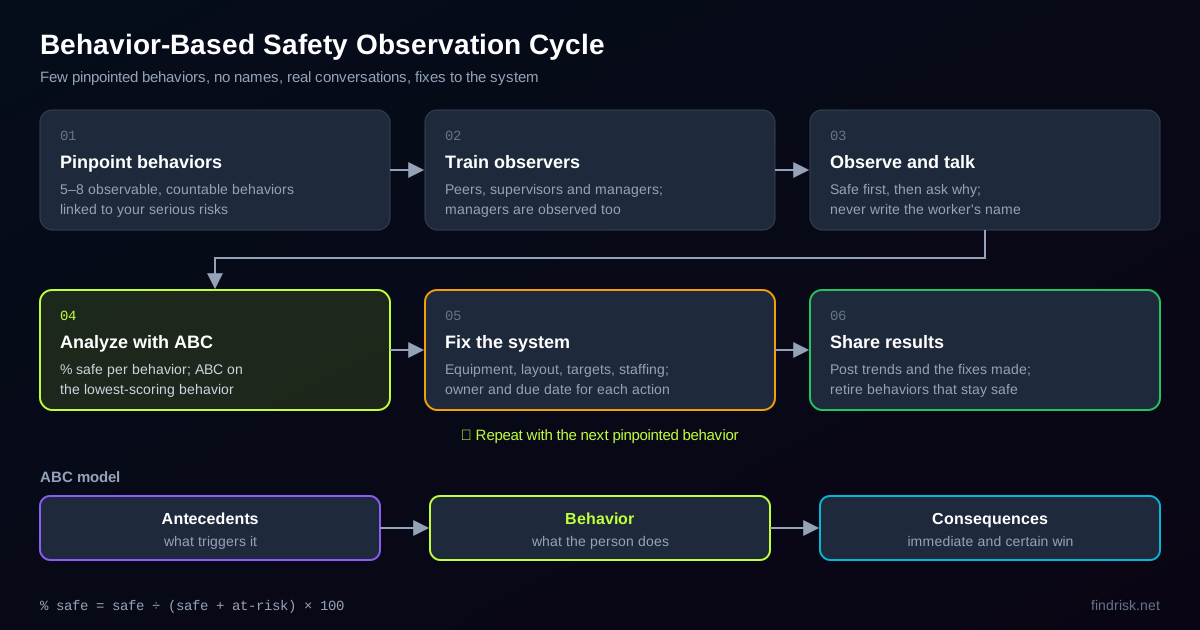
A BBS observation program runs as a cycle: pinpoint the behaviors, train observers, observe and talk, analyze the data, fix the causes and feed results back to the workforce.
1. Pinpoint critical behaviors
Choose 5 to 8 behaviors that matter for your serious risks. Take them from your risk assessments, incident and near-miss records and the experience of the people who do the work. A good behavior is observable and countable: two observers watching the same moment would record the same result.
| Vague (avoid) | Pinpointed (use) |
|---|---|
| Works safely | Presses the stop button before reaching into the sealer |
| Good PPE use | Wears safety glasses while at the cutting station |
| Lifts properly | Holds the carton close to the body and turns with the feet, not the waist |
| Good housekeeping | Walkway beside the line is free of film offcuts |
2. Train observers
Observers need three skills: recognizing each behavior against its definition, recording without guessing, and holding a short, respectful conversation. Peers, supervisors and managers can all observe. Peer observation often gets a more honest view of the job, while manager observation adds visibility. Many sites use both. Train managers first and have them observed too, so the program is not seen as something done only to the front line.
3. Observe and talk
Tell the work team before the observation starts. Watch for a few minutes, record what you see, then talk. Start with what was done safely, then ask about any at-risk behavior: "I saw the sealer cleared without stopping it. What makes that the normal way?" The answer to that question is the most valuable data on the card. Never write the worker's name.
4. Analyze with the ABC model
Group the cards by behavior and calculate the percentage safe for each one: safe observations divided by all observations of that behavior, times 100. Take the behavior with the lowest score and analyze it with the ABC model (antecedents, behavior, consequences), shown in the worked example below.
5. Fix the system, not only the person
Turn each finding into an action with an owner and a date, and track it the way you track any corrective action. Most fixes should change the antecedents and consequences: equipment, layout, tools, staffing, targets and supervision. Retraining alone is rarely enough.
6. Share results and repeat
Post the percentage-safe trend for each behavior on the shop floor, along with the actions taken because of the cards. Workers keep giving honest answers only when they see them lead to change. When a behavior stays above your target for several months, retire it from the card and add the next one.
Sample Behavior-Based Safety Observation Card
The card below is a sample for the fictional packaging line used in this guide. Replace the behaviors with your own pinpointed list.
Area / line: Packaging line 2 Date / shift: ______ Task observed: ______ Observer role: ☐ Peer ☐ Supervisor ☐ Manager Worker name: not recorded
| # | Behavior (pinpointed) | Safe | At-risk | Not seen |
|---|---|---|---|---|
| 1 | Presses the stop button before reaching into the sealer | ☐ | ☐ | ☐ |
| 2 | Uses the jam tool, not fingers, to clear film from the cutter | ☐ | ☐ | ☐ |
| 3 | Wears safety glasses at the cutting station | ☐ | ☐ | ☐ |
| 4 | Carton held close; turns with the feet when stacking | ☐ | ☐ | ☐ |
| 5 | Crosses the forklift aisle only at the marked crossing | ☐ | ☐ | ☐ |
| 6 | Walkway beside the line kept free of film offcuts | ☐ | ☐ | ☐ |
Conversation notes: What did the worker say makes the at-risk behavior easier or necessary? ______ Conditions noticed (equipment, layout, tools, time pressure): ______ Immediate stop needed? ☐ Yes (stop the work, make it safe, report) ☐ No
Three design choices make this card work. It has six behaviors, not twenty-five, so the observer can actually watch them. It has a "not seen" column, so observers don't tick boxes for things they didn't observe. And most of the space goes to the conversation and the conditions, because that is where the causes are.
Worked Example: From Observation Data to a System Fix
This example is fictional. Over four weeks, peer and supervisor observers on packaging line 2 completed cards using the sample above. The table shows the totals for five of the behaviors.
| Behavior | Safe | At-risk | Percent safe |
|---|---|---|---|
| Safety glasses at cutting station | 118 | 6 | 95% |
| Walkway kept clear | 88 | 12 | 88% |
| Marked aisle crossing used | 96 | 14 | 87% |
| Carton close, turn with feet | 74 | 22 | 77% |
| Stop button before reaching into sealer | 41 | 39 | 51% |
| All five behaviors | 417 | 93 | 82% |
The overall 82% hides the real story. Safety glasses are not the problem. Reaching into a running sealer, a hand-injury risk, is at-risk about half the time. That is where the analysis goes.
ABC analysis: reaching into the running sealer
The ABC model asks what comes before the behavior (antecedents) and what follows it (consequences). Consequences that are immediate and certain usually drive behavior more strongly than ones that are delayed and unlikely.
| Antecedents (what triggers it) | Behavior | Consequences (what follows) |
|---|---|---|
| Film jams in the sealer several times a shift since a change of film supplier | Operator reaches into the sealer with the machine running to pull out jammed film | Line keeps running: immediate, certain, positive for the operator |
| Stop button is on the far side of the machine | No restart sequence: immediate, certain, positive | |
| Restart after a stop takes about four minutes and drops the line below its hourly target | Supervisor praises output on the board: soon, likely, positive | |
| No jam tool at the station | Hand injury: delayed, unlikely on any single occasion, negative |
Read across the table and the behavior makes sense from the operator's point of view. Every immediate consequence rewards reaching in, and the only negative one is uncertain. Telling people to "follow procedure" changes none of these. The conversation notes on the cards said the same thing in plain words: "If I stop it every time, we miss the target, and nobody says anything when we reach in."
Actions
| # | Action | Hierarchy level | Owner | Due |
|---|---|---|---|---|
| 1 | Fit an interlocked guard on the sealer opening so the machine stops when it opens | Engineering | Maintenance manager | 6 weeks |
| 2 | Work with the film supplier to fix the jamming (film tension and roll specification) | Elimination of the trigger | Purchasing + production | 4 weeks |
| 3 | Add a second stop button on the operator side; shorten the restart sequence | Engineering | Maintenance | 6 weeks |
| 4 | Remove jam-clearing stops from the hourly target calculation | Administrative (consequence) | Production manager | 1 week |
| 5 | Place a jam tool at the station; brief all shifts on the new method in a toolbox talk | Administrative | Shift supervisors | 1 week |
Only one of the five actions is about the worker, and it comes after the system changes. Six weeks after the guard and the second stop button are fitted, the observers check the same behavior again. If the percentage safe has risen and stayed up, the behavior can later leave the card. If not, the next ABC analysis starts with the cards' conversation notes.
How to Respond to At-Risk Behavior: Errors vs Violations
The right response to an at-risk behavior depends on why it happened. HSE's guidance on managing human failures separates errors, which are unintended, from violations, which are deliberate departures from a rule. Most violations, HSE notes, are well-meant and rarely malicious: people break a rule to get the job done.
| What you observe | Type of human failure | What HSE says about it | Response that works |
|---|---|---|---|
| A familiar step done wrongly, such as the wrong button | Slip | Happens in familiar tasks; cannot be eliminated by training | Improve the design: layout, labels, interlocks, error-tolerant equipment |
| A step forgotten, such as glasses left on the bench after a break | Lapse | Same as slips | Reminders built into the task, checklists, design changes |
| The worker believed the wrong method was right | Mistake | Usually lack of knowledge or a new situation | Training based on good procedures; coaching |
| The worker knowingly took a shortcut | Violation | Caused by poor task or equipment design, peer pressure, unworkable rules or incomplete understanding | Find the root cause; design the violation out; make rules practical and explain why they exist; involve the workforce in writing them |
Two points follow. First, a BBS conversation is the best tool you have for telling these apart, because the worker can tell you whether they knew, forgot or chose. Second, even a violation is usually a symptom. In the worked example, reaching into the sealer was a violation, and the root cause was the target and the machine design.
Observation is not an excuse to walk past danger. If an observer sees someone at immediate risk, they stop the work first and make it safe. That is a stop-work intervention, recorded separately, not a BBS data point.
Turning Observations Into Leading Indicators
Observation data is one of the few leading indicators that measures the work itself. OSHA defines leading indicators as proactive and preventive measures that can show how effective safety activities are and reveal potential problems in a safety program. HSE also lists providing some leading indicators among the advantages of behavioral approaches.
Useful observation indicators:
- Percent safe by behavior, trended monthly. Use the behavior-level number, not only the overall average, which hides the worst behaviors.
- Observation quality, such as the share of cards with conversation notes or conditions recorded. Cards without notes are often written from memory.
- Actions raised and closed from observation data, and the average time to close them.
- Participation, such as the number of different people who observed this month, including managers.
Avoid indicators that reward the wrong thing. A target for the number of cards produces cards written in the office. A target for 100% safe tells observers to stop recording at-risk behavior. Prizes tied to injury-free periods can discourage reporting. In the United States, OSHA's recordkeeping rule (29 CFR 1904.35) states that a reporting procedure is not reasonable if it would deter or discourage a reasonable employee from accurately reporting an injury or illness, and it prohibits discrimination against employees who report.
For a full framework, combine observation data with your other measures as described in our guide to leading and lagging safety indicators.
Common BBS Observation Mistakes
1. Too many behaviors on the card
A card with twenty-five boxes cannot be completed honestly in a few minutes. Observers start ticking from memory and the data becomes noise. Keep the card to the few behaviors that matter for serious risks.
2. Names on the cards
Once a name appears on a card, the card becomes evidence. Workers change their behavior while watched and stop explaining why they work the way they do. The conversation, which is the most valuable part, disappears.
3. Using the data for discipline
Observation data and disciplinary processes must be completely separate. HSE lists a process that is seen as fair, which depends on trust, among the conditions for a program to succeed. A single disciplinary case based on a card can end honest observation for years.
4. Card quotas
A target of ten cards per supervisor per month measures paperwork, not safety. Set expectations for observation quality and for actions closed instead.
5. Ignoring management behavior
HSE warns that behavioral programs can shift responsibility onto individuals and fail to address management behavior. Targets, staffing, maintenance budgets and production pressure are behaviors too. In the worked example, the hourly target was a bigger cause than any operator.
6. Treating BBS as a substitute for engineering
If the cause is a missing guard, the answer is a guard. HSE states that behavioral approaches must also address engineering and systems. A strong observation program makes the case for engineering fixes; it doesn't replace them.
7. Never closing the loop
When workers see no change after months of cards, they stop participating. Publish what was fixed because of observations, even small things.
How FindRisk Supports Safety Observations
Observation conversations often reveal conditions: a stop button out of reach, a missing jam tool, a blocked walkway. With FindRisk, the observer can photograph the condition on the spot, mark the hazard directly on the photo and let the AI analyze it, so the condition is recorded with evidence and without naming anyone. Those photos make the follow-up discussion with maintenance or management much more concrete.
FindRisk can also generate an AI inspection checklist for the area, so the conditions that observations keep uncovering become part of routine inspections, and score the findings with a Fine-Kinney risk assessment. The results turn into a professional report in seconds, on iOS and Android.
Frequently Asked Questions
What is the difference between a safety observation and a safety inspection?
A safety observation looks at people doing a task and records specific safe and at-risk behaviors, usually followed by a conversation with the worker. A safety inspection looks at the state of the workplace: equipment, guarding, housekeeping and conditions. Both are needed. Observation data often explains why the same defects keep appearing in inspections, and inspection findings often explain why people take shortcuts.
How many safety observations should be done per month?
There is no standard number. Enough observations are needed to see a reliable trend for each pinpointed behavior, and each one must be done properly, with real watching and a conversation. Setting a quota for cards tends to produce cards written from memory. A better expectation is regular observation by trained people on every shift, with the focus on quality and on actions closed.
Should safety observations be anonymous?
Yes, the worker being observed should not be named on the card. The purpose is to understand how and why work is done, not to evaluate individuals. Naming workers turns the card into evidence, changes behavior while being watched and ends the honest conversation that reveals causes. The observer's role (peer, supervisor, manager) can be recorded so participation can be tracked.
What is the ABC model in behavior-based safety?
The ABC model analyzes a behavior through its antecedents (what comes before and triggers it), the behavior itself, and its consequences (what follows it). Consequences that are immediate and certain usually shape behavior more strongly than delayed and unlikely ones. That is why an at-risk shortcut that saves time every day often persists even though an injury is possible: the reward is certain, the harm is not.
Does behavior-based safety work?
It can, when it is used for the right problems. In a 1978 study by Komaki, Barwick and Scott, safe performance in two departments of a food plant rose from 70% and 78% to 96% and 99% with clear behavior definitions and frequent feedback. HSE notes that behavioral programs can change behavior and engage employees, but they often fail without real commitment and have limited benefit for major hazards.
What are the main criticisms of behavior-based safety?
The main criticisms are that it can blame workers for conditions that management controls, focus on easy issues such as PPE while missing low-probability, high-consequence risks, and draw resources away from engineering and process safety. HSE lists these pitfalls and warns that a failed program can leave a workplace worse off. Programs that analyze causes and fix systems avoid most of these problems.
Who should do safety observations: peers or supervisors?
Both can. HSE describes observation by managers or peers. Peer observers often see the job as it is really done and get more honest answers, while supervisor and manager observations add visibility and show commitment. Many sites use peers for most observations and have managers observe regularly too, including being observed themselves.
Conclusion
A behavior-based safety observation program works when it stays small, specific and honest: a few pinpointed behaviors, no names, real conversations and data that leads to changes in equipment, layout, targets and supervision. The evidence behind BBS, from Komaki's 1978 study onwards, points to feedback and clear definitions, not quotas and blame.
Start only after the basic controls are in place, keep management behavior in scope, and treat every at-risk behavior as a question about the system before it is a question about the person. Then use the percentage-safe trend as a leading indicator alongside your inspections, near-miss reports and safety culture assessment.
Download FindRisk to capture the conditions your observations uncover with photos, turn them into inspection checklists and produce a professional report in seconds.
Try FindRisk
Ready to modernize your safety workflow?
Conduct AI-powered risk assessments, generate reports instantly, and keep your team safe — anywhere, anytime.