
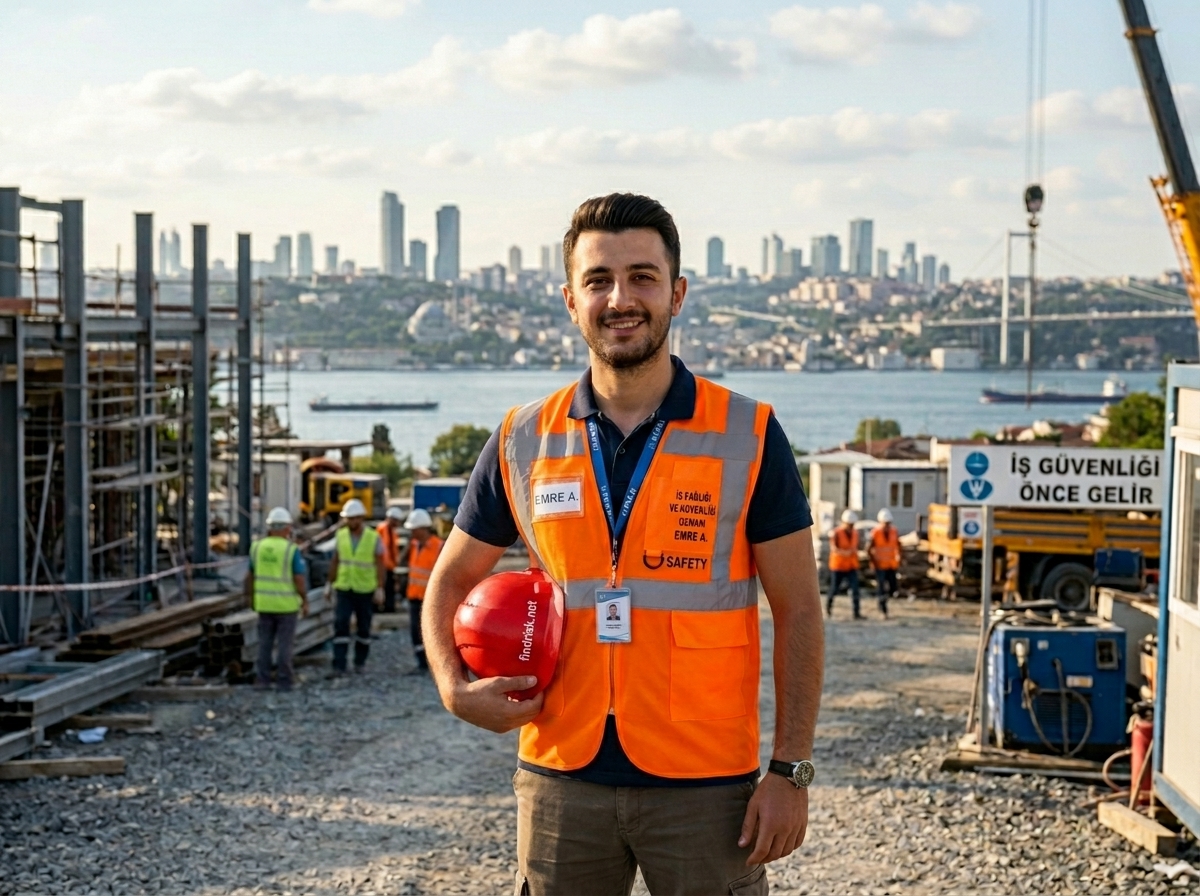
OHS Professional Career Guide: Certifications, Roles, and Career Pathways
The Job That Didn't Exist When Most Practitioners Started
A Health and Safety Director at a major UK construction group was asked by a graduate student how she had planned her career in occupational health and safety. She paused. "I didn't plan it," she said. "Twenty years ago, the career didn't really exist in the way it does now. I started as a site manager, saw too many injuries, and gradually moved into safety. The profession built itself around people like me."
That story is typical of a generation. But the generation entering OHS practice now enters a recognized profession with defined entry routes, established qualifications, professional bodies, salary frameworks, and career ladders — from safety officer to Group EHS Director.
The profession has changed in another way too. An OHS professional today is expected to be a risk assessment practitioner, a management system specialist, a data analyst, a behavior change agent, and a regulatory compliance expert — often simultaneously. The technical demands have increased substantially.
This guide maps the landscape: how to enter the profession, which qualifications matter and why, how careers typically progress, and what differentiates practitioners who advance from those who plateau.
Entry Routes into OHS
There is no single entry route into occupational health and safety. The profession draws from multiple backgrounds:
| Entry Route | Typical Background | Common First Role |
|---|---|---|
| Graduate entry | BSc/MSc in OHS, environmental health, or engineering | Graduate safety officer, OHS coordinator |
| Operational transition | Site supervisor, maintenance manager, nurse, engineer | Safety officer in known industry sector |
| Adjacent profession | Environmental compliance, quality management, HR | EHS coordinator, integrated MS role |
| Apprenticeship / vocational | Safety technician programs | Safety technician, compliance support |
| International qualification route | NEBOSH IGC → higher diploma → membership | Entry at various levels depending on experience |
The majority of OHS practitioners do not enter through a dedicated OHS degree. Most transition from operational roles in their industry — manufacturing, construction, healthcare, oil and gas — bringing sector knowledge that is genuinely valuable. A safety professional who has worked as a maintenance engineer understands machinery risk in ways that cannot be learned from a textbook.
Professional Qualifications: The Landscape
NEBOSH (National Examination Board in Occupational Safety and Health)
NEBOSH is the dominant international qualification brand in OHS, recognized in over 130 countries. Key qualifications:
| Qualification | Level | Typical Audience |
|---|---|---|
| NEBOSH International General Certificate (IGC) | Entry/Foundation | Safety representatives, supervisors, those new to OHS |
| NEBOSH National General Certificate | Entry/Foundation | UK-focused practitioners |
| NEBOSH International Diploma | Professional/Advanced | Practitioners pursuing chartered status or specialist roles |
| NEBOSH Construction Certificate | Sector-specific | Construction industry practitioners |
| NEBOSH Process Safety Certificate | Sector-specific | Oil, gas, chemical industry practitioners |
NEBOSH IGC is the most widely held OHS qualification globally — it is the standard entry requirement for many safety officer roles internationally and is recognized by IOSH as the entry qualification for Technical membership.
NEBOSH Diploma is the primary route to CMIOSH (Chartered Member of IOSH) status when combined with relevant experience. It is the UK/international equivalent of an undergraduate OHS degree.
IOSH (Institution of Occupational Safety and Health)
IOSH is the world's largest professional body for OHS practitioners, with over 50,000 members across more than 130 countries. Membership grades reflect qualification and experience:
| Grade | Requirements |
|---|---|
| Affiliate (AIOSH) | Studying for or recently completed NEBOSH IGC or equivalent |
| Technical Member (TechIOSH) | NEBOSH IGC or equivalent + relevant experience |
| Chartered Member (CMIOSH) | NEBOSH Diploma or equivalent degree + experience + competency assessment |
| Chartered Fellow (CFIOSH) | CMIOSH + sustained senior-level contribution to the profession |
CMIOSH is the standard benchmark for a professionally recognized OHS practitioner in the UK and internationally. Many senior OHS roles explicitly require chartered status.
BCSP (Board of Certified Safety Professionals) — US/North America
| Certification | Level | Requirements |
|---|---|---|
| ASP (Associate Safety Professional) | Entry/Developing | Bachelor's degree + 1 year experience or alternative |
| CSP (Certified Safety Professional) | Professional | ASP + bachelor's degree + 4 years professional safety experience |
| SMS (Safety Management Specialist) | Specialist | Experience-based alternative pathway |
CSP is the primary professional safety credential in the United States, widely required for senior safety roles in North American organizations.
ABIH (American Board of Industrial Hygiene)
| Certification | Focus |
|---|---|
| CIH (Certified Industrial Hygienist) | Occupational health — chemical, biological, physical hazard recognition, evaluation, control |
The CIH is the gold-standard credential for occupational hygiene practice in the US and internationally. Entry-level practitioners often pursue the Industrial Hygienist in Training (IHIT) designation through ABIH while accumulating the experience required for full CIH certification.
(Note: The OHST credential is administered by the Board for Global EHS Credentialing (BGC), not ABIH — a separate body covering broader EHS competency.)
ISO 45001 Lead Auditor
ISO 45001 Lead Auditor certification (delivered by accredited bodies through CQI/IRCA and PECB) qualifies practitioners to conduct third-party certification audits of OHS management systems. Widely required for consultancy and certification body roles.
Career Progression: Typical Pathways
The Generalist OHS Career Ladder
| Level | Typical Role | Key Responsibilities | Qualification Expectation |
|---|---|---|---|
| Entry | Safety Officer / OHS Coordinator | Inspections, inductions, incident reporting, admin | NEBOSH IGC or equivalent |
| Mid | Safety Advisor / EHS Advisor | Risk assessments, management system maintenance, audits, training delivery | NEBOSH Diploma or degree + TechIOSH/CMIOSH pursuing |
| Senior | Senior Safety Advisor / OHS Manager | Program management, regulatory compliance, team leadership, incident investigation | CMIOSH or equivalent |
| Head | Group OHS Manager / EHS Manager | Strategy, multi-site oversight, budget, executive reporting | CMIOSH + significant experience |
| Director | EHS Director / VP EHS | Board-level reporting, M&A due diligence, cultural leadership, investor ESG | CFIOSH / CSP + 15+ years |
Specialist Pathways
Some practitioners move into specialist roles rather than the generalist management ladder:
Process Safety Engineer/Specialist — HAZOP leadership, SIL assessment, major hazard regulatory compliance. Typically requires an engineering degree and NEBOSH Process Safety Certificate or equivalent.
Occupational Hygienist — Chemical, biological, and physical hazard exposure assessment. Requires CIH or equivalent and specialist measurement/analytical training.
Ergonomist — Workstation and manual handling risk assessment, MSD prevention programs. Requires CPE (Certified Professional Ergonomist) or equivalent.
OHS Consultant — Independent or firm-based advisory, typically requiring CMIOSH/CSP and strong sector expertise.
ISO 45001 Auditor — Third-party certification audits. Requires ISO 45001 Lead Auditor certification.
What Differentiates Practitioners Who Advance
Research on OHS career progression consistently identifies several factors that separate practitioners who reach senior and director levels from those who plateau:
Genuine understanding of business context. The OHS practitioners who reach director level are those who frame safety in terms of business risk, operational continuity, and organizational value — not only in terms of legal compliance. "We need to do this because the law requires it" is a less compelling argument than "here is the operational and financial case."
Incident investigation depth. Senior practitioners are distinguished by their ability to conduct rigorous root cause analysis — identifying systemic causes rather than stopping at human error. This requires structured methodology (5 Whys, fault tree analysis, ICAM) and the organizational standing to investigate without interference.
Management system expertise. ISO 45001 implementation and maintenance is a core competency at mid and senior levels. Practitioners who can lead a gap analysis, design a management system, and prepare for certification audit have a significant advantage.
Data and metrics capability. Organizations increasingly expect OHS practitioners to work with leading and lagging indicators, trend data, and benchmarking. Practitioners who can build a safety dashboard and present data credibly to leadership advance faster than those who cannot.
Sector depth combined with cross-sector exposure. Deep expertise in a single sector (oil and gas, construction, healthcare) is valuable — but practitioners who combine sector depth with exposure to different industries and regulatory frameworks are more competitive for senior roles.
Salary Benchmarks by Region and Level (2026–2027)
Salary ranges vary significantly by country, sector, and organization size. The following are indicative ranges for full-time employed practitioners based on 2026–2027 market data:
| Level | UK (£) | US (USD) | Australia (AUD) | UAE (AED/month) |
|---|---|---|---|---|
| Safety Officer / Entry | £30,000–£43,000 | $55,000–$75,000 | A$65,000–A$88,000 | AED 9,000–16,000 |
| Safety Advisor / Mid | £43,000–£62,000 | $75,000–$108,000 | A$88,000–A$125,000 | AED 16,000–26,000 |
| OHS Manager / Senior | £62,000–£85,000 | $108,000–$148,000 | A$125,000–A$168,000 | AED 26,000–40,000 |
| EHS Director | £90,000–£150,000+ | $148,000–$225,000+ | A$175,000–A$245,000+ | AED 48,000–78,000 |
Sector premiums: High-hazard sectors (oil and gas, mining, nuclear, offshore) command a 25–40% premium over equivalent roles in lower-hazard sectors. The energy transition and ESG reporting requirements have driven particularly strong demand — and wage growth — for EHS professionals in 2025–2027.
Contract/consultancy rates are typically 35–55% above employed equivalents at comparable experience levels. Remote and hybrid roles are now common at advisor level and above in non-field-based positions.
In-demand specialisms in 2026–2027: Process safety engineers, ISO 45001 lead auditors, ESG/sustainability-linked OHS reporting specialists, and AI-assisted risk assessment practitioners command above-market rates in most geographies.
Continuing Professional Development (CPD)
All major professional bodies require CPD for membership maintenance:
- IOSH: Members must record ongoing CPD activities demonstrating competence development — typically a minimum of 30 hours per year is recommended. IOSH uses a competency-based CPD framework rather than a strict points system; records are submitted annually via the member portal.
- BCSP: 30 recertification points per 5-year cycle for CSP holders, earned through safety-related training, presentations, publications, and professional activities.
- ABIH: 60 CM (Continuing Maintenance) points per 6-year recertification cycle for CIH holders.
CPD activities include: attending professional conferences (IOSH Annual, NSC Congress), completing specialist short courses, publishing articles or delivering presentations, participating in professional body working groups, and formal postgraduate study.
How FindRisk Supports OHS Professional Practice
Field-ready assessment tools: FindRisk provides AI-assisted risk assessment, inspection checklists, and Fine-Kinney scoring that OHS professionals can deploy immediately from a mobile device — without dependency on office-based systems or connectivity.
Documentation for competence demonstration: The inspection reports, risk assessments, and corrective action records generated in FindRisk provide the documented evidence base that practitioners need for professional portfolio submissions and CPD records.
Methodology reference: FindRisk's blog library covers the methodologies that appear in NEBOSH Diploma and CSP examinations — HAZOP, JSA, ALARP, Fine-Kinney, ISO 45001 — in applied, practitioner-focused form.
Frequently Asked Questions
Which qualification should I start with?
For most people entering OHS from a non-safety background, the NEBOSH International General Certificate is the right starting point. It is internationally recognized, requires no prior OHS qualification, and is the standard entry requirement for safety officer roles. It provides sufficient foundation to begin working in OHS while pursuing the NEBOSH Diploma or equivalent degree for career advancement.
Is a university degree required to progress in OHS?
Not universally — but a degree-level qualification is increasingly expected for senior and director roles. The NEBOSH Diploma is accepted as degree-equivalent by IOSH for Chartered membership. A dedicated OHS/EHS degree provides the academic foundation for chartered status and is valued by larger organizations. However, significant operational experience combined with NEBOSH qualifications and CMIOSH status is competitive with an OHS degree alone at most levels.
How long does it take to reach a senior OHS manager level?
Typically 8–12 years from entry level, assuming progressive role development and qualification achievement. Practitioners who advance faster typically combine qualification achievement with genuine operational exposure — managing incidents, leading audits, implementing management systems — rather than remaining in administrative safety roles.
What is the difference between an OHS advisor and an OHS manager?
The distinction is primarily about scope of responsibility and organizational level. An OHS advisor typically provides technical expertise and supports line management in implementing safety programs. An OHS manager has ownership of the safety program, manages a team (directly or functionally), reports to senior management, and is accountable for safety performance outcomes. In smaller organizations, the same person may hold both roles.
Conclusion
Occupational health and safety is a mature profession with established qualification frameworks, professional bodies, and recognized career pathways — but one that still rewards operational credibility and genuine technical depth over credential accumulation alone.
The practitioners who reach the highest levels of the profession are those who combine formal qualifications with real field experience, who understand business as well as hazard, and who can demonstrate measurable impact on the organizations they work within.
Whether you are entering OHS for the first time or planning the next step in an established career, the qualification frameworks are clear and the pathways are well-defined. The work itself — protecting people from harm — remains one of the most directly impactful roles in any organization.
Download FindRisk to support your OHS professional practice — AI-assisted risk assessment, structured inspection documentation, and corrective action tracking from any field location.
Try FindRisk
Ready to modernize your safety workflow?
Conduct AI-powered risk assessments, generate reports instantly, and keep your team safe — anywhere, anytime.