

Dynamic Risk Assessment: 5 Steps, Pocket Card and Examples
A dynamic risk assessment is the on-the-spot judgement a trained worker or crew makes at the work location when conditions differ from the plan or change during the task. You stop, look at what has changed, assess who could be hurt, apply the controls you can, and decide to proceed, proceed with changes, or stop and escalate. It supplements the written risk assessment; it never replaces it.
Every written risk assessment is a prediction. It describes the job as someone expected it to be on the day they wrote it. Then the crew arrives and the ground is wet, a pipe has been rerouted, a contractor is working overhead or a colleague has called in sick. The gap between the plan and the site is where people get hurt, and the dynamic risk assessment is the habit that closes it.
This guide gives you a 5-step method, a pocket card you can print, six stop rules that say when an on-the-spot assessment is not enough, four worked industrial scenarios, and a short log for feeding what you found back into the written assessment.
The Plan Said One Thing, the Site Said Another
This is a fictional example built for this guide. A maintenance fitter is sent to replace a bearing on a cooling water pump. The job card, the risk assessment and the isolation list were written last year: lock off the motor isolator, close the suction and discharge valves, drain the casing.
At the pump, the fitter notices a new bypass line with its own valve, installed during a shutdown last month. It is not on the isolation list. With the two listed valves closed, the casing could still be fed from the bypass.
Nothing in the paperwork is wrong for the pump as it used to be. It is wrong for the pump as it is today. What the fitter does in the next two minutes is a dynamic risk assessment. We come back to this fitter in the worked examples.
What Is a Dynamic Risk Assessment?
A dynamic risk assessment (DRA) is a continuous process of spotting hazards, judging the risk and acting on it while the work is happening, for situations the written assessment could not fully foresee. The UK Health and Safety Executive describes it, in its lone working guide INDG73, as the situation "where workers themselves make operational decisions based on risks which cannot necessarily be foreseen," and adds: "This is not a substitute for a comprehensive risk assessment."
Emergency services use it routinely, because their workplace changes by the minute. Victoria's emergency services in Australia define it in Joint Standard Operating Procedure J08.02 (version 6.0, 2024) as "the continuous process of identification, assessment and control of risk in the rapidly changing circumstances of an operational incident or training scenario." Ireland's Health Service Executive uses a similar definition in its risk assessment guideline and notes that this type of assessment is undocumented.
Two different things share the name
Search for the term and you will find a second meaning. In process safety, "dynamic risk assessment" also describes risk models that update continuously from sensor, maintenance and incident data. An EU-OSHA discussion paper (2021) traces that meaning to the process industries and describes it as risk assessment that has "digitalised and modernised" to deal with fast-changing risks.
| On-the-spot dynamic risk assessment | Data-driven ("continuous") dynamic risk assessment | |
|---|---|---|
| Who does it | The worker, crew or incident commander at the work location | Safety engineers and software, from a control room or office |
| When | At the start of the task and whenever conditions change | Continuously, as new data arrive |
| Input | Observation, experience, the written plan | Sensor readings, maintenance records, near misses, permits |
| Output | Proceed, proceed with changes, or stop and escalate | Updated risk level, alerts, decisions on permits |
| Typical users | Emergency services, maintenance, construction, lone workers | Chemical, oil and gas and other process industries |
This guide is about the first meaning: the judgement made by people at the work location.
Dynamic Risk Assessment vs Written Risk Assessment, JSA and Other Checks
A dynamic risk assessment differs from the other tools by timing and trigger: it happens during the work, and it is triggered by change. The others are planned in advance or done once at the start.
| Tool | When | Who | Scope | Usual record |
|---|---|---|---|---|
| Written risk assessment | Before work starts; reviewed periodically and when things change | Employer, with competent people and workers | All significant hazards of the activity | Formal document |
| Job safety analysis (JSA/JHA) | Before a specific task | Supervisor and crew | One task, step by step | JSA form |
| Permit to work | Before high-risk, non-routine work | Permit issuer and performing authority | One job, one place, one time window | Signed permit |
| Toolbox talk | Start of the shift or job | Supervisor to crew | A briefing on one topic or job | Attendance sheet |
| Last-minute risk assessment (LMRA), "Take 5", point-of-work check | Immediately before starting | Worker or crew | Here and now, short fixed questions | Short card, often kept |
| Dynamic risk assessment | Throughout the task, whenever something changes | Worker, crew or incident commander | Conditions the plan did not foresee | Usually none at the time; a log afterwards |
The LMRA and the dynamic risk assessment overlap. Think of the LMRA as the first dynamic check, done before the first tool touches the job. The dynamic assessment keeps running after that.
Is a Dynamic Risk Assessment a Legal Requirement?
None of the laws we checked require a separate document called a dynamic risk assessment. What they require is a written assessment that stays valid, and that duty is what makes on-the-spot assessment necessary.
| Jurisdiction | What applies |
|---|---|
| UK | The Management of Health and Safety at Work Regulations 1999, regulation 3 require a "suitable and sufficient assessment" and its review when "there is reason to suspect that it is no longer valid" or there has been a significant change. Employers with five or more employees must record the significant findings. HSE's INDG73 says that where a worker may have to make a dynamic risk assessment, they must be trained to make it, consider the range of possible controls and get support for their decisions. |
| EU | The Framework Directive 89/391/EEC requires a risk assessment (Article 9) and asks employers to adjust measures to changing circumstances (Article 6(1)), as the EU-OSHA paper notes. |
| US | The concept is closest to OSHA's "competent person" in construction: someone "capable of identifying existing and predictable hazards" with authority to take prompt corrective measures (29 CFR 1926.32(f)). |
| Australia (Victoria emergency services) | JSOP J08.02 requires all responders to carry out a DRA when there are unforeseen hazards, and says that where proper documented planning is possible, it must happen in addition to the DRA. |
| Türkiye | Neither Law No. 6331 nor the Risk Assessment Regulation uses the term. Workers must immediately report serious and imminent danger, and gaps in protective measures, to the employer or the worker representative (Article 19), may leave the dangerous area when such danger cannot be prevented (Article 13), and the written assessment must be renewed after changes in equipment or method, accidents and near misses (Regulation Article 12). |
The pattern is the same everywhere: the employer owns a written assessment, and the people doing the work are trained, allowed and supported to act when reality departs from it.
How to Do a Dynamic Risk Assessment: 5 Steps
A dynamic risk assessment for industrial work can be done in five steps: stop, look for change, assess, control, decide. We adapted them from the six-step emergency service procedure in JSOP J08.02 (evaluate, select a system of work, assess, decide whether the risk is proportional to the benefit, modify, proceed) and shortened them for maintenance, construction and production work, where the benefit side of the equation is rarely worth a serious injury.
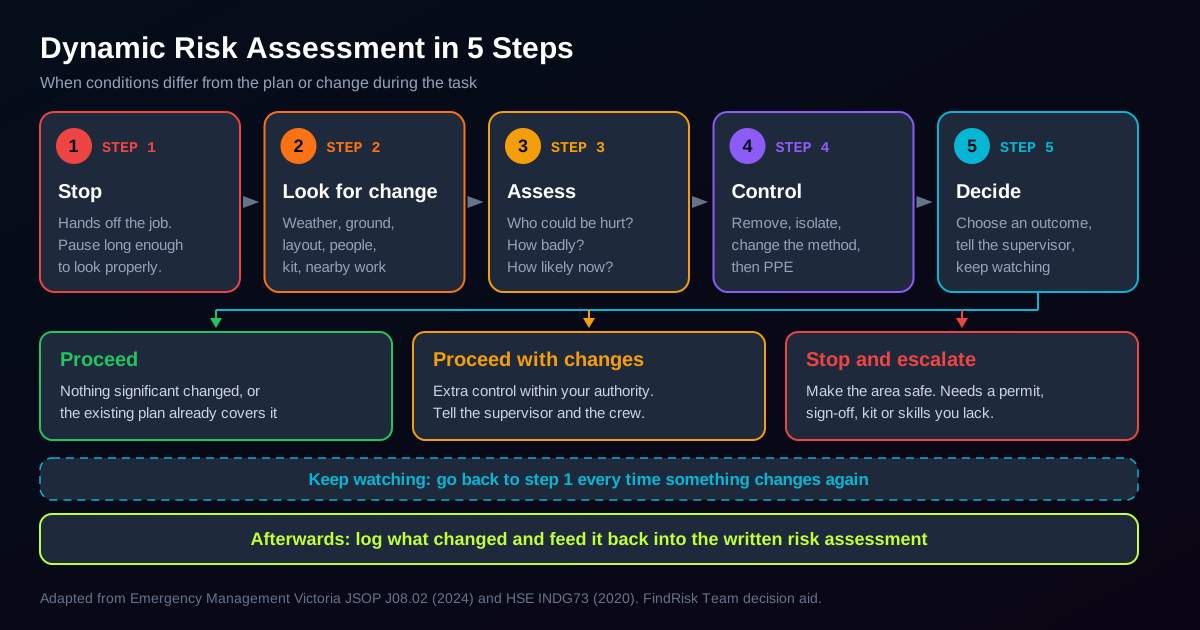
Step 1: Stop
Take your hands off the job. A dynamic risk assessment cannot happen while you are already lifting, cutting or climbing. In practice this is a pause of seconds to a few minutes, long enough to look around properly.
Step 2: Look for what has changed
Compare what you see with what the plan, the permit and the briefing assumed. Typical changes: the weather, the ground, the layout, nearby work, the people (fewer, new, tired), the equipment or materials, and time pressure. If you do not know what the plan assumed, that is already a finding.
Step 3: Assess the new risk
For each change, ask who could be hurt, including people nearby and the public, how badly, and how likely it is now. You do not need a score. You need an honest answer to one question: could this kill or seriously injure someone?
Step 4: Control what you can
Work down the hierarchy of controls: remove the new hazard, isolate it or keep people away from it, change the method, then add PPE. Use only controls you are trained, equipped and authorized to apply. Moving a barrier is fine; changing an isolation point is not.
Step 5: Decide, tell someone, keep watching
Choose one of three outcomes:
- Proceed: nothing significant has changed, or the change is fully controlled by the existing plan.
- Proceed with changes: you applied an extra control within your authority. Tell your supervisor and the crew.
- Stop and escalate: the change needs a decision, a permit, equipment or skills you do not have. Make the area safe and call the supervisor.
Then keep watching. Return to step 1 every time something changes again.
Dynamic Risk Assessment Pocket Card
The pocket card below is a FindRisk Team template. Print it on a card, translate it for your crews, and adjust the questions to your work. Any "no" or "not sure" sends you to the right-hand column.
| Ask yourself | If "no" or "not sure" |
|---|---|
| 1. Is this the job, place and crew the plan was written for? | Stop. Check with your supervisor before starting. |
| 2. Do I know what has changed since the plan, permit or briefing? | Walk the area again. Ask the last person who worked here. |
| 3. Do I know who could be hurt, including people nearby? | Set up barriers or a lookout before going on. |
| 4. Is the worst realistic outcome less than a serious injury? | Stop and escalate unless you can remove or isolate the hazard now. |
| 5. Are the planned controls in place and working right now? | Restore them first. Do not work around a missing guard, barrier or isolation. |
| 6. Can I control the change with what I am trained and equipped to do? | Stop and escalate. Do not improvise. |
| 7. Can I do this without a new permit or someone else's sign-off? | Stop. The permit issuer or supervisor decides. |
| 8. If something goes wrong, can we raise the alarm and get help? | Fix communication and rescue before starting. |
Decision: proceed / proceed with changes and tell the supervisor / stop and escalate.
When a Dynamic Risk Assessment Is Not Enough
A dynamic risk assessment lets a trained person adjust the work within the limits of the plan. It cannot authorize work the plan never covered. These six stop rules are FindRisk Team guidance; adapt them to your own procedures.
- There is no written assessment, method statement or permit for the task. On-the-spot judgement is not a substitute for planning. Victoria's JSOP allows DRA as the only risk process only where the situation is genuinely dynamic; if there is time to plan, planning must happen too.
- The change touches something signed off by someone else. Energy isolation, permit conditions, confined space entry, lifting plans and excavation support belong to the person who authorized them.
- The fix needs equipment, people or skills you do not have. A control you cannot apply properly is not a control.
- The worst outcome is fatal or life-changing and you cannot remove or isolate the hazard now. Do not rely on care and attention for high-consequence risks.
- Proceeding would mean breaking a rule, procedure or law. A dynamic assessment never overrides a written prohibition.
- Several things have changed at once, or you are unsure. Uncertainty is a finding. Stop and get a second opinion.
Worked Examples: 4 Dynamic Risk Assessment Scenarios
The four scenarios below are fictional, written by FindRisk Team to show the method in industrial settings. Each ends with what goes back into the written assessment, because that is what stops the same surprise from happening again.
1. Maintenance: an isolation point missing from the list
- What changed: the cooling water pump from our opening scenario has a new bypass line that is not on the isolation list.
- Assessment: with the bypass open, the casing could be pressurized while the fitter has it open. Hot or pressurized water could cause burns or impact injuries.
- Control within authority: none. Adding an isolation point is not the fitter's call.
- Decision: stop and escalate. The fitter makes the area safe, leaves the casing closed and calls the supervisor, who has the isolation list updated by the authorized person before work resumes.
- Back into the written assessment: update the isolation list and the job's risk assessment. Ask why a change to the plant did not trigger a review of the isolation list; that is a management of change gap.
2. Warehouse: forklifts diverted through a pedestrian route
- What changed: a damaged racking upright has been cordoned off, closing one aisle. Forklift drivers have started using the marked pedestrian walkway as a shortcut.
- Assessment: pedestrians and forklifts now share a route the traffic plan kept separate. A struck-by injury could be serious.
- Control within authority: the shift leader closes the walkway to pedestrians with temporary barriers, sends foot traffic the long way round and posts a banksman at the crossing point.
- Decision: proceed with changes and inform the warehouse manager.
- Back into the written assessment: a temporary traffic plan for blocked aisles, and a faster repair route for damaged racking.
3. Roofing: wind picks up during material handling
- What changed: during a flat-roof insulation job, the wind strengthens and loose insulation boards start to lift near the edge.
- Assessment: boards could blow off the roof onto the public footpath below, and a worker holding a board near the edge could be pulled off balance.
- Control within authority: stop handling boards, weigh down or strap the stack, move work away from the edge.
- Decision: stop material handling and escalate. The supervisor decides when work resumes and whether the area below needs closing.
- Back into the written assessment: if the method statement had no weather stop condition, add one, with who measures it and how.
4. Electrical: water around a temporary distribution board
- What changed: after overnight rain, an electrician arriving for a routine test finds water pooling under a temporary distribution board and a supply cable crushed by a vehicle.
- Assessment: risk of electric shock to anyone touching the board or standing in the water.
- Control within authority: do not touch the board. Cordon off the area and keep people out.
- Decision: stop and escalate. Isolation from upstream is done by the authorized person under the site's lockout/tagout procedure before anyone approaches.
- Back into the written assessment: board location above standing water, cable protection on vehicle routes, a check after heavy rain.
In three of the four cases, the right answer was to stop. That is normal. A dynamic risk assessment that always ends in "proceed" is a ritual, not an assessment.
How to Record a Dynamic Risk Assessment Afterwards
You usually do not write anything down during a dynamic risk assessment; that would defeat its purpose. Ireland's Health Service Executive calls this kind of assessment "undocumented." But what you found should not stay in your head, because the written assessment is now known to be out of date for that situation.
A short log, filled in after the job or at the end of the shift, is enough. Use these seven fields:
| Field | Example (scenario 2) |
|---|---|
| Date, time, location | 14 March, 10:40, aisle 7 |
| Task and plan reference | Pallet put-away, warehouse traffic risk assessment |
| What changed | Aisle 6 closed for racking damage, forklifts using walkway |
| Hazard and who was at risk | Pedestrians struck by forklifts |
| Decision | Proceed with changes |
| Controls applied or escalation | Walkway closed, banksman at crossing, manager informed |
| Follow-up and owner | Temporary traffic plan for closed aisles; warehouse manager |
Then close the loop:
- Review the written assessment. In the UK, regulation 3(3) requires a review when there is reason to suspect the assessment is no longer valid. In Türkiye, Article 12 of the Risk Assessment Regulation requires renewal after changes in equipment or production methods, and after accidents and near misses.
- Report near misses. If the change nearly hurt someone, it is also a near miss. Log it through your near miss reporting process.
- Look for patterns. Supervisors should review DRA logs every week or two. The same change appearing again and again means the written assessment is wrong, not that crews are good at improvising.
Common Mistakes With Dynamic Risk Assessments
1. Using "dynamic" to skip planning
"We'll assess it on the day" is not a risk assessment. HSE is explicit that a dynamic risk assessment is not a substitute for a comprehensive one. Plan everything that can be planned.
2. Expecting it without training
HSE says workers who may have to make a dynamic risk assessment must be trained to make it. A worker who has never been shown what to look for, or what they are allowed to change, will either freeze or improvise.
3. No support when someone stops the job
If a stop decision gets overruled by schedule pressure, crews learn not to stop. HSE's INDG73 says workers must get support for their decisions. Managers should thank people for stopping, especially when the stop turns out to be unnecessary.
4. Turning it into another long form
A two-page "dynamic risk assessment form" signed before every job becomes a tick box, and people stop looking. Keep the in-the-moment part mental and short, and log afterwards.
5. Changing controls that belong to someone else
Moving an isolation point, extending a permit or skipping a gas test on the basis of an on-the-spot judgement removes the protection those systems exist to provide. And if what the crew found never reaches the written assessment, the next crew meets the same surprise.
How FindRisk Supports Dynamic Risk Assessments
FindRisk can build a dynamic risk assessment checklist with AI from a short description such as "pump maintenance in a cooling water plant". You can start from the pocket card above, edit the questions to match your site, and run it on your phone at the work location in a minute or two.
When something has changed, take a photo, mark the hazard on it and use the AI analysis as a second pair of eyes. That photo becomes part of your log entry, which is far more useful to the person updating the written assessment than "water near the board".
When the change means the written assessment needs updating, score the new hazard with the built-in Fine-Kinney risk assessment and produce a professional report in seconds to share with the supervisor. FindRisk runs on iOS and Android.
Frequently Asked Questions
Is a dynamic risk assessment a legal requirement?
Not as a separate document under the UK, EU or Turkish rules we checked. The law requires a suitable written risk assessment that is reviewed when it may no longer be valid, and that is what makes on-the-spot assessment necessary. HSE adds that where workers may need to make dynamic risk assessments, they must be trained, consider possible controls and get support for their decisions.
Do you need to write down a dynamic risk assessment?
Not while doing it. The assessment happens in the moment, and Ireland's Health Service Executive describes it as undocumented. You should, however, log what changed and what you decided after the job, in a few lines. That log is how the written risk assessment gets reviewed and how near misses get reported.
Who carries out a dynamic risk assessment?
The person or crew doing the work, because they see the change first. In emergency services it is every responder, with the incident commander making the bigger calls. Workers need training to do it and a clear limit on what they may change themselves. Anything that touches a permit, an isolation or someone else's sign-off goes to the supervisor.
What is an example of a dynamic risk assessment?
A shift leader sees forklifts using a pedestrian walkway because an aisle is closed for racking damage. They stop, assess the struck-by risk, close the walkway to pedestrians, post a banksman, inform the manager and log the change so a temporary traffic plan can be written. The whole assessment takes minutes and changes how the work continues.
What is the difference between a dynamic risk assessment and a last-minute risk assessment?
A last-minute risk assessment (LMRA), also called a Take 5 or point-of-work check, is a short fixed set of questions answered immediately before starting a task. A dynamic risk assessment continues throughout the task and is triggered by change. In practice, the LMRA is the first dynamic check, and the dynamic assessment keeps running after it.
Can a dynamic risk assessment replace a written risk assessment?
No. HSE states that it is not a substitute for a comprehensive risk assessment. Even emergency services, who use it routinely, require documented planning in addition wherever planning is possible. A dynamic risk assessment adjusts work within the limits of the plan; it cannot authorize work that was never planned.
How often should you do a dynamic risk assessment?
At the start of every task and every time something changes during it: weather, layout, people, equipment, materials or nearby work. There is no fixed interval. On a stable job, it may be one quick check. During an emergency or on a busy construction site, it may be continuous.
Conclusion
A dynamic risk assessment is the bridge between the plan and the site. The written assessment predicts the job; the dynamic assessment checks that prediction against reality and adjusts or stops the work when the two disagree. It works only when the written assessment exists, the workers are trained, and their decisions are backed, especially the decision to stop.
Use the five steps, carry the pocket card, respect the stop rules, and log what changed so the next version of the written assessment is better than the last.
Download FindRisk to turn the pocket card into a checklist on your phone, mark hazards on photos as conditions change, and share the update with your team the same day.
Try FindRisk
Ready to modernize your safety workflow?
Conduct AI-powered risk assessments, generate reports instantly, and keep your team safe — anywhere, anytime.