
Confined Space Entry: Safety Requirements, Permit Process, and Checklist
The Rescuer Who Became a Victim
On 7 June 2011, two workers entered a manhole at a wastewater treatment plant in California to inspect a pump. Within seconds of entry, both workers collapsed — overcome by hydrogen sulfide gas that had accumulated in the space.
A third worker, witnessing the collapse, entered the manhole without respiratory protection to attempt a rescue. He also collapsed.
All three workers died. The space had not been atmospheric tested before entry. No rescue equipment was staged at the entry point. There was no confined space entry permit.
This triple fatality follows a pattern documented repeatedly in confined space incident investigations. According to OSHA, approximately 60% of confined space fatalities are rescuers — people who entered an immediately dangerous atmosphere without protection to save a colleague.
Confined space incidents are uniquely deadly because the rescuer's instinct to help becomes the mechanism by which the fatality count multiplies. This is why the confined space entry standard demands rescue planning before work begins — not after someone collapses.
What Is a Confined Space?
According to OSHA 1910.146, a confined space has three defining characteristics:
- Large enough for a worker to bodily enter and perform work
- Has limited or restricted means for entry or exit
- Is not designed for continuous worker occupancy
Common examples: tanks, vessels, silos, storage bins, hoppers, vaults, pits, manholes, tunnels, sewers, underground utility vaults, pipelines, and ship compartments.
Permit-Required vs Non-Permit Confined Spaces
| Type | Definition | Entry Requirements |
|---|---|---|
| Permit-Required Confined Space | A confined space that contains or has potential to contain a serious safety or health hazard | Written entry permit required before entry |
| Non-Permit Confined Space | A confined space that does not contain — and with respect to atmospheric hazards, does not have potential to contain — a hazard capable of causing death or serious physical harm | No permit required, but precautions still apply |
A confined space is permit-required if it:
- Contains or has the potential to contain a hazardous atmosphere
- Contains material that could engulf an entrant
- Has an internal configuration that could trap or asphyxiate a worker (converging walls, sloping floors leading to a smaller section)
- Contains any other recognized serious safety or health hazard
Key principle: A space is classified based on its potential — not its current condition. A tank that contained a hazardous substance last month may still have residual contamination. A space that has been clean for years may accumulate hazardous atmospheres under the right conditions.
The 4 Atmospheric Hazards in Confined Spaces
Atmospheric hazards are the leading cause of confined space fatalities. They are invisible, odorless in some cases, and can incapacitate a worker in seconds.
| Hazard Type | Definition | Threshold | Common Sources |
|---|---|---|---|
| Oxygen deficiency | Oxygen below safe breathing level | < 19.5% O₂ | Oxidation (rust), biological decomposition, displacement by inert gases |
| Oxygen enrichment | Oxygen above safe level — increases fire and explosion risk | > 23.5% O₂ | Oxygen leaks from welding equipment, oxygen-enriched atmospheres |
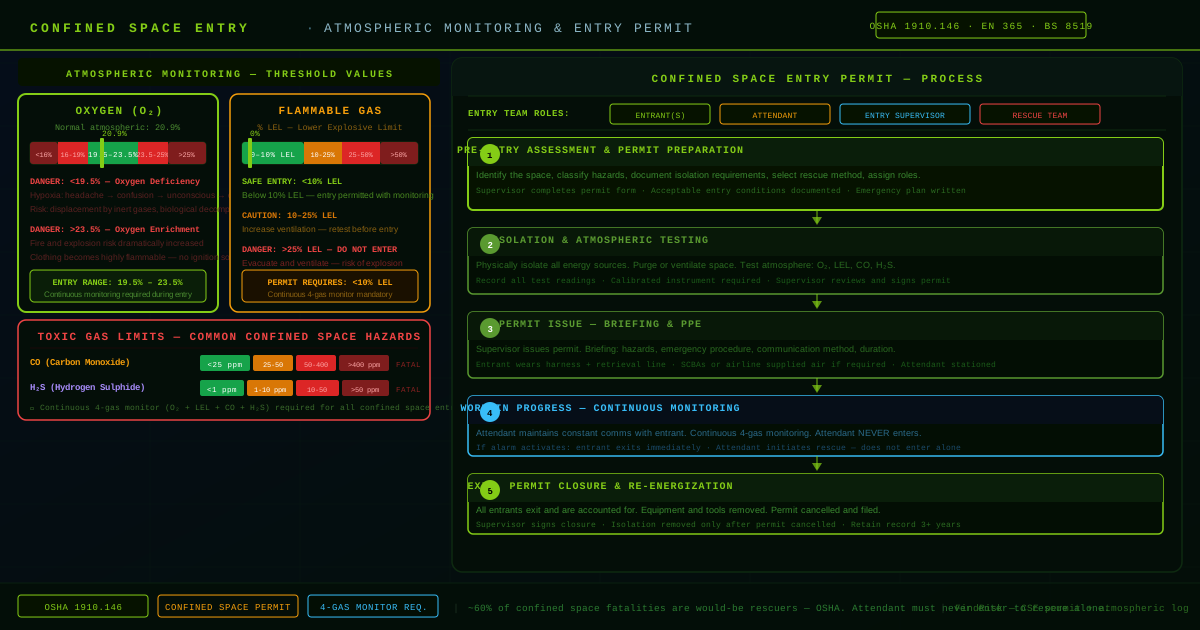
| Flammable atmosphere | Concentration of flammable gas or vapor | > 10% of Lower Explosive Limit (LEL) | Petroleum products, solvents, methane from decomposition |
| Toxic atmosphere | Toxic substance above permissible exposure limit | Substance-specific (e.g., H₂S > 10 ppm TWA) | Hydrogen sulfide (sewers), carbon monoxide (combustion), ammonia (refrigeration) |
Why Atmospheric Testing Sequence Matters
Test in this order:
- Oxygen first — if O₂ is insufficient or excessive, subsequent tests may be inaccurate
- Flammability second — if LEL is above 10%, entry is prohibited regardless of other results
- Toxicity third — specific toxic substances based on space history and contents
Testing must be conducted:
- Before any entry
- At multiple levels within the space (hazardous atmospheres stratify — test at head, torso, and foot level)
- Continuously during entry using a personal gas monitor worn by the entrant
- Any time conditions change (unusual odors, visible gases, changes in equipment operation)
The Confined Space Entry Permit
For permit-required confined spaces, a written entry permit must be issued before any worker enters. The permit is not simply a form — it is the documented verification that all required preconditions have been met.
Required Elements of a Confined Space Permit
| Element | Content |
|---|---|
| Space identification | Name, location, and description of the space |
| Purpose of entry | Specific task to be performed inside |
| Date and authorized duration | Valid from / valid until — permits must be time-limited |
| Authorized entrants | Names of all workers authorized to enter |
| Entry supervisor | Named person responsible for overseeing the entry |
| Attendant(s) | Named person(s) stationed outside the space during entry |
| Hazards identified | All potential hazards for this space and this entry |
| Isolation measures | Valves closed, lines blinded, equipment locked out |
| Atmospheric test results | O₂ %, LEL %, specific toxic substances — with time of test and tester name |
| Acceptable entry conditions | The specific atmospheric and physical conditions required for safe entry |
| Communication procedure | How entrant and attendant will communicate |
| Rescue procedure | Specific rescue plan, rescue equipment staged |
| Equipment required | Testing equipment, communication, retrieval system, lighting |
| Authorizing signature | Entry supervisor confirms all conditions met |
The permit is valid only for the specific space, specific task, specific personnel, and specific duration listed. Any change — personnel, task scope, atmospheric condition change — requires a new permit.
Roles and Responsibilities in Confined Space Entry
Entry Supervisor
The entry supervisor is responsible for:
- Verifying that acceptable entry conditions exist before authorizing entry
- Verifying that all entries are authorized and documented
- Terminating entry if conditions change
- Removing unauthorized personnel
- Ensuring rescue services are available before entry begins
The entry supervisor may also serve as an attendant for small entries, but cannot enter the space while serving as supervisor.
Attendant
The attendant remains outside the permit space throughout entry and:
- Maintains continuous communication with entrants
- Tracks the identity and number of entrants inside the space
- Monitors conditions inside and outside the space
- Orders evacuation if required
- Summons rescue services
- Prevents unauthorized entry
- Does NOT enter the space under any circumstances — not even to perform a rescue
The attendant's most critical function is their most counterintuitive one: when a colleague collapses inside a confined space, the attendant must call for rescue — not enter. This is the rule that saves the attendant's life and prevents the fatality count from multiplying.
Authorized Entrant
The entrant is responsible for:
- Wearing a retrieval system (harness and lifeline) when this can be done without increasing overall risk
- Wearing a personal gas monitor with alarm
- Communicating with the attendant throughout the entry
- Alerting the attendant to any hazardous condition
- Exiting immediately if ordered by the attendant or entry supervisor, or if the personal gas monitor alarms
Pre-Entry Confined Space Checklist
Before any entry permit can be issued, the following conditions must be verified:
Isolation:
- All energy sources isolated and locked out (electrical, mechanical, hydraulic)
- All lines containing hazardous substances blinded or disconnected
- Space purged and ventilated before testing
- All valves into the space closed and locked, or blinded
Atmospheric Testing:
- Calibrated gas monitor used for testing (calibration date current)
- Space tested at multiple elevations before entry
- O₂ between 19.5% and 23.5%
- LEL below 10%
- Toxic substances below permissible exposure limits
- Test results recorded on permit with time and tester name
Ventilation:
- Mechanical ventilation in place and operating
- Ventilation airflow verified (not just that the fan is running)
- Discharge from ventilation does not create hazards elsewhere
Communication:
- Communication method established (verbal, visual, signal, radio)
- Attendant positioned where continuous communication is possible
- Emergency contacts identified
Rescue:
- Rescue equipment in place at entry point before entry begins (retrieval system, harness, lifeline, SCBA if non-entry rescue not possible)
- Rescue plan documented and communicated
- Rescue personnel trained and available
- External rescue service (fire department) notified if required by facility procedure
Personnel:
- All entrants named on permit
- Attendant named and briefed
- Entry supervisor identified and on site
- All entrants wearing personal gas monitors
Rescue Planning: Non-Entry vs Entry Rescue
Rescue is one of the most critical — and most underplanned — elements of confined space management.
Non-Entry Rescue (Preferred)
Non-entry rescue is the retrieval of an entrant without anyone entering the space. It requires:
- A full body harness worn by the entrant
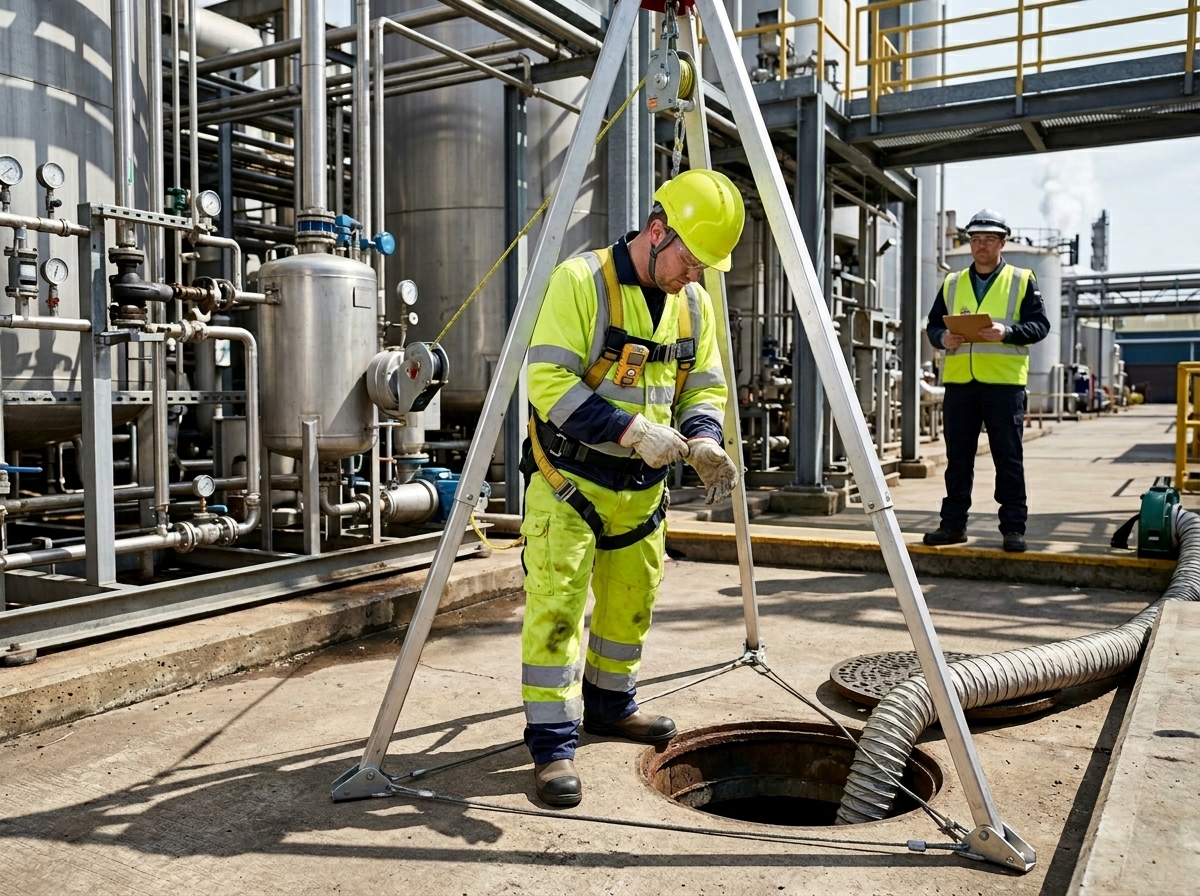
- A retrieval line attached to a mechanical advantage system (tripod or similar) at the entry point
- The attendant can retrieve the entrant mechanically, without entering
Non-entry rescue must be pre-planned and the equipment staged before entry begins. A retrieval system that is stored in a cabinet 50 metres from the entry point is not available for rescue.
Entry Rescue (Last Resort)
Entry rescue — sending trained rescue personnel into the space — is required when:
- Non-entry rescue is not feasible (the entrant's position or injury prevents retrieval)
- The space geometry prevents non-entry rescue
Entry rescue requires:
- Rescue personnel trained in confined space rescue
- Full respiratory protection (SCBA)
- Continuous communication
- Medical support staged
The critical rule: Rescue must be pre-planned before any entry. A rescue that is planned after someone collapses is not a rescue plan — it is improvisation in a fatal environment.
Confined Space Entry and ISO 45001
| ISO 45001 Clause | Requirement | How Confined Space Program Satisfies It |
|---|---|---|
| Clause 6.1 | Identify hazards and assess risks | Confined space classification and atmospheric hazard assessment |
| Clause 8.1 | Operational planning and control | Entry permit system controls the confined space entry operation |
| Clause 8.2 | Emergency preparedness | Rescue plan and rescue equipment staged before entry |
| Clause 7.2 | Competence | Training requirements for entrants, attendants, and supervisors |
| Clause 9.1 | Monitoring and measurement | Atmospheric monitoring during entry; permit records |
How FindRisk Supports Confined Space Safety
Pre-entry hazard assessment: Use FindRisk's AI-assisted assessment to generate a confined space-specific hazard checklist based on the space type, contents history, and entry task. The AI identifies hazard categories — including atmospheric, engulfment, entrapment, and energy isolation — that a generic checklist might miss.
Entry permit documentation: Document all pre-entry verification steps, atmospheric test results, and isolation confirmations using FindRisk's mobile form. Photographic evidence of gas monitor readings, lockout applications, and rescue equipment staging is captured and included in the automatically generated permit record.
Corrective action tracking: If pre-entry checks identify deficiencies that prevent entry, FindRisk tracks those corrective actions to close-out — ensuring the space is genuinely safe before the next entry is authorized.
Frequently Asked Questions
What gas monitor is required for confined space entry?
A multi-gas monitor capable of measuring oxygen percentage, LEL, and relevant toxic gases (at minimum H₂S and CO for most confined spaces) is required. The monitor must be calibrated before each use per the manufacturer's specification. Personal gas monitors worn by entrants must provide audible and visual alarms at defined alert thresholds. Bump testing (verification that sensors respond to known gas concentrations) should be performed before each entry session.
Can a worker enter a confined space without a permit if it's a "quick look"?
No. If the space is classified as permit-required, a permit is required for any entry — including a brief visual inspection. The classifications exist because the hazards don't negotiate with the duration of the entry. A worker who enters for 30 seconds without atmospheric testing is exposed to the same risk as one who enters for 30 minutes.
What happens if the gas monitor alarms during entry?
The entrant must immediately evacuate the space. The attendant must order immediate evacuation and account for all entrants at the entry point. The entry supervisor must cancel the permit and ensure the cause of the alarm is identified and addressed before any re-entry is authorized. Re-entry requires a new atmospheric test and a new permit — there is no "reset" of the original permit after an alarm.
Who can train workers in confined space entry?
Training should be provided by a qualified person with knowledge of confined space hazards, entry procedures, atmospheric testing, and rescue requirements. Training must be task-specific and cover the types of confined spaces the worker will actually encounter. Generic online training without site-specific elements does not satisfy OSHA competency requirements.
How often should confined space procedures be reviewed?
At minimum annually, and whenever: an incident or near miss occurs during confined space work; a new type of confined space is identified on site; changes to equipment, processes, or materials affect the hazard profile of existing spaces; new workers are assigned to confined space work.
Conclusion
Confined space incidents are preventable. Every fatality in a confined space — whether from atmospheric hazards, engulfment, or botched rescue — can be traced to a failure of the entry process: a hazard not identified, a test not conducted, an attendant who entered to help, or a rescue plan that existed only in theory.
The entry permit system is not administrative burden. It is the mechanism by which a potentially lethal environment is made safe enough to enter — and by which a safe rescue is possible if something goes wrong anyway.
According to OSHA, an estimated 90% of confined space fatalities could be prevented with proper adherence to permit-required confined space procedures. The cost of the procedure — the time for atmospheric testing, the staging of rescue equipment, the pre-entry briefing — is measured in hours. The cost of skipping it is measured in lives.
Download FindRisk to manage confined space entries with AI-assisted pre-entry hazard assessment, mobile permit documentation, atmospheric test recording, and automatic corrective action tracking.
Try FindRisk
Ready to modernize your safety workflow?
Conduct AI-powered risk assessments, generate reports instantly, and keep your team safe — anywhere, anytime.