
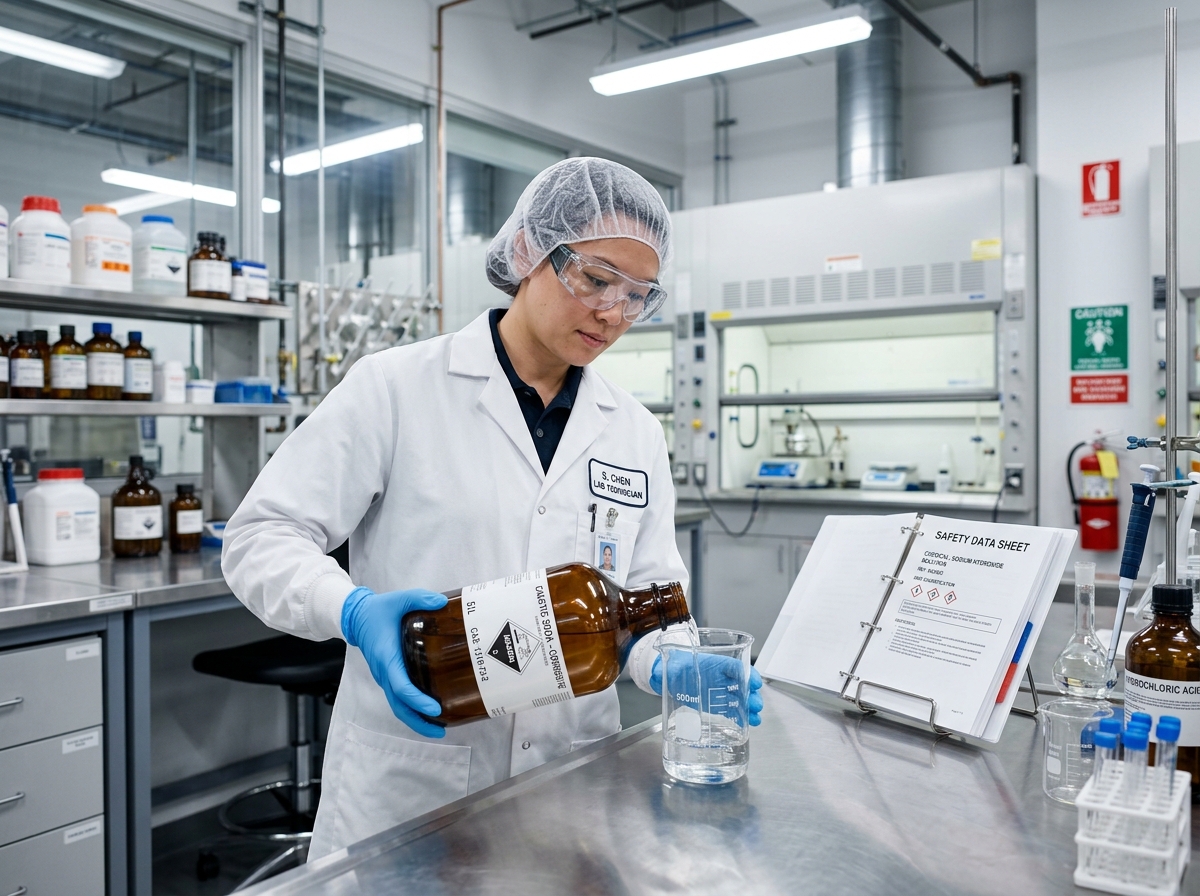
Chemical Safety in the Workplace: GHS, SDS, COSHH, and Exposure Control
The Solvent That Accumulated for Years
At a small furniture manufacturing workshop in France, workers had used a petroleum-based cleaning solvent for over a decade. The ventilation was poor. No one had measured airborne concentrations. The chemical had a low odor threshold — workers could smell it, but smell does not indicate safe levels.
When a health assessment was commissioned after three workers developed neurological symptoms, solvent vapor concentrations in the main work area were found to be 8–12 times the occupational exposure limit. The workers had been chronically overexposed for years.
No one had conducted a COSHH (or equivalent) assessment. The SDS was filed but unread. The chemical had been in use so long that its hazard had become invisible.
According to the World Health Organization, occupational exposure to chemicals is responsible for approximately 340,000 deaths annually — more than all physical workplace accidents combined in most countries. The majority of chemical exposures are chronic and cumulative, producing health effects that appear years after the exposure began.
The Globally Harmonized System (GHS)
The GHS is the international standard for classifying and labeling chemicals. Developed under United Nations coordination, it is implemented through:
- OSHA's Hazard Communication Standard (HazCom 2012) in the US
- CLP Regulation (EC 1272/2008) in the EU
- Corresponding national legislation in most other countries
The GHS standardizes:
- Hazard classification: Chemicals are classified by hazard type and severity category
- Labels: Required elements including pictograms, signal words, hazard statements, and precautionary statements
- Safety Data Sheets (SDS): 16-section format for chemical hazard communication
GHS Pictograms and What They Mean
| Pictogram | Hazard Category |
|---|---|
| Flame | Flammable liquids, solids, and gases |
| Exploding bomb | Explosives, self-reactive substances |
| Flame over circle | Oxidizers |
| Corrosion | Corrosive to skin/eyes, metals |
| Skull and crossbones | Acute toxicity (severe) |
| Exclamation mark | Skin/eye irritation, respiratory sensitization, acute toxicity (less severe) |
| Health hazard | Carcinogen, reproductive toxin, specific target organ toxin |
| Environment | Hazardous to aquatic environment |
| Gas cylinder | Gases under pressure |
Safety Data Sheets (SDS): The 16 Sections
An SDS is the primary technical document communicating chemical hazard information. Under GHS, SDSs have a standardized 16-section structure:
| Section | Content |
|---|---|
| 1. Identification | Product name, supplier, recommended use, emergency contacts |
| 2. Hazard identification | GHS classification, label elements, hazard statements |
| 3. Composition/ingredients | Chemical name(s), CAS numbers, concentration ranges |
| 4. First-aid measures | Response for inhalation, skin contact, eye contact, ingestion |
| 5. Fire-fighting measures | Suitable extinguishing media, special hazards |
| 6. Accidental release measures | Spill containment, cleanup procedures |
| 7. Handling and storage | Safe handling precautions, storage conditions |
| 8. Exposure controls/PPE | Occupational Exposure Limits (OELs), ventilation requirements, PPE |
| 9. Physical and chemical properties | Flashpoint, boiling point, vapor pressure, density |
| 10. Stability and reactivity | Conditions to avoid, incompatible materials, hazardous decomposition |
| 11. Toxicological information | Routes of exposure, acute and chronic effects, carcinogenicity |
| 12. Ecological information | Environmental hazards, persistence, bioaccumulation |
| 13. Disposal considerations | Waste disposal methods |
| 14. Transport information | UN number, hazard class, packing group |
| 15. Regulatory information | Country-specific regulatory status |
| 16. Other information | Date of preparation, revision history |
Section 8 is critical for workplace chemical risk assessment — it contains the occupational exposure limits and specifies the controls required to stay within them.
Occupational Exposure Limits (OELs)
Occupational exposure limits are the concentrations of a substance in workplace air at which most workers can be exposed without adverse health effects. Three key values:
| Limit | Definition | Example (n-Hexane) |
|---|---|---|
| TWA (Time-Weighted Average) | Average concentration over a typical 8-hour shift | 50 ppm (OSHA) |
| STEL (Short-Term Exposure Limit) | Maximum concentration for 15-minute exposures (max 4 per shift) | 510 mg/m³ (EU) |
| Ceiling value | Concentration that must not be exceeded at any time | Substance-specific |
Important: OELs are regulatory limits, not safety thresholds. Being below the OEL does not guarantee safety — particularly for carcinogens and sensitizers where any exposure may carry risk.
Different countries set different OELs for the same substance. Always use the limit applicable to your jurisdiction.
COSHH Assessment (UK) and Equivalent Requirements
The Control of Substances Hazardous to Health (COSHH) Regulations 2002 (UK) require employers to:
- Identify substances hazardous to health used or created in work processes
- Assess the risks to health
- Implement control measures
- Maintain and monitor controls
- Provide health surveillance where appropriate
- Provide information, instruction, and training
- Plan for emergencies
Equivalent requirements exist in most jurisdictions: OSHA Hazard Communication (US), EU REACH and CLP (Europe), and national OHS legislation elsewhere.
The assessment structure is consistent: identify the substance, understand its hazards (from SDS), assess the exposure (how, how much, how often, who), implement controls following the hierarchy, and verify that controls are effective.
The Hierarchy of Controls for Chemical Hazards
The hierarchy of controls applies directly to chemical hazards:
1. Elimination Remove the hazardous substance entirely. Substitute a non-hazardous or less hazardous alternative. This is the most effective control — if you don't use the chemical, there is no exposure.
Example: Switching from a solvent-based adhesive to a water-based adhesive eliminates organic solvent exposure entirely.
2. Substitution Replace with a less hazardous substance. A carcinogen replaced by a non-carcinogen; a highly volatile solvent replaced by a low-volatility alternative.
Example: Replacing trichloroethylene (Group 1 carcinogen) with n-propyl bromide — itself a potential reproductive hazard, demonstrating that substitution requires assessment of the substitute.
3. Engineering Controls Physical modifications that reduce exposure:
- Local exhaust ventilation (LEV): Extract vapors at source before they reach the worker's breathing zone
- Enclosed or isolated processes: Prevent worker contact with the substance
- Wet methods: Keep dusts wetted to prevent inhalation
- Automation: Remove the worker from exposure
4. Administrative Controls Procedures that reduce exposure duration or frequency:
- Work rotation to limit individual exposure time
- Safe work procedures that minimize unnecessary exposure
- Restricting access to high-exposure areas
- Hygiene facilities and procedures
5. PPE Last line of defense — protects the worker from exposure that engineering and administrative controls have not eliminated:
- Respiratory protection: Filter type must match the specific chemical hazard (organic vapor, dust, acid gas)
- Gloves: Material must be appropriate for the chemical — not all gloves protect against all chemicals
- Eye protection: Goggles vs. safety glasses depending on splash vs. dust risk
- Coveralls/aprons: For skin absorption hazards
Common Chemical Exposure Routes and Their Implications
| Route | How It Occurs | Control Priority |
|---|---|---|
| Inhalation | Breathing vapors, mists, dusts, fumes | Ventilation, respiratory protection |
| Dermal absorption | Chemical penetrates skin without a wound | Gloves, coveralls, skin barrier creams |
| Ingestion | Hand-to-mouth transfer | Hygiene practices, no eating/drinking in chemical areas |
| Eye contact | Splashes, mists, vapors | Eye protection, eyewash stations |
Inhalation is the primary route for most volatile chemicals. Dermal absorption is frequently underestimated — many chemicals (including some solvents and pesticides) penetrate intact skin at significant rates.
Chemical Inventory and Assessment Process
A systematic chemical safety program requires:
Step 1: Chemical Inventory Catalog all chemicals present in the workplace — purchased chemicals, process chemicals, and cleaning/maintenance products. Include substances generated in work processes (welding fumes, wood dust, diesel exhaust).
Step 2: Hazard Classification For each substance, determine the hazard classification from the SDS. Prioritize:
- Carcinogens, mutagens, reproductive toxins (CMRs) — highest priority
- Respiratory sensitizers
- Acutely toxic substances
- Skin/eye corrosives
Step 3: Exposure Assessment Estimate or measure actual exposure levels:
- Who is exposed?
- By what route (inhalation, dermal, ingestion)?
- How often and for how long?
- At what concentration (measured or estimated)?
Step 4: Control Implementation Select controls from the hierarchy based on the exposure assessment and the OEL.
Step 5: Monitoring and Review Periodically verify that controls are effective:
- Occupational hygiene monitoring (air sampling) where exposure is uncertain
- Biological monitoring (blood or urine analysis) for appropriate substances
- Health surveillance where OELs are at risk of being exceeded
How FindRisk Supports Chemical Safety Assessments
Chemical hazard identification: Before entering a chemical handling area, use FindRisk's AI assessment to generate a contextually relevant hazard list — including chemical exposure routes, PPE requirements, and first-response procedures specific to the substances present.
Inspection documentation: Document chemical storage, SDS availability, LEV functionality, and PPE compliance during inspections. Photo documentation of chemical labels and storage conditions provides time-stamped evidence.
Corrective action tracking: Chemical safety deficiencies — missing SDS, inadequate ventilation, incorrect PPE — are assigned with owner and deadline immediately in FindRisk. Closure is tracked to completion.
Frequently Asked Questions
Are workers legally entitled to access SDS for chemicals they work with?
Yes — in virtually every jurisdiction. OSHA's Hazard Communication Standard requires that SDSs be readily accessible to workers in their work area during their shift. The EU REACH regulation similarly requires that workers be provided with chemical safety information. Workers cannot be told that SDS information is proprietary and withheld — the chemical identity and hazard information on Section 2 and 3 of the SDS must be disclosed.
How often should a COSHH (or equivalent chemical risk) assessment be reviewed?
COSHH assessments should be reviewed when: the substance is changed (different supplier, different concentration), the process or exposure conditions change, new health information about the substance becomes available, monitoring results suggest controls are insufficient, or at defined periodic intervals (typically annually for high-risk substances). A COSHH assessment for a chemical that hasn't changed in five years may still be current — but should be formally reviewed and confirmed as current.
What does skin notation on an OEL mean?
A skin notation (indicated as "Skin" or "H313/H315" in the GHS framework) indicates that dermal absorption is a significant route of exposure for that substance. When a chemical has a skin notation, controlling airborne exposure alone is insufficient — dermal protection must also be provided. The OEL for the substance applies to inhalation exposure; dermal exposure is additional and requires separate control.
What PPE is required when handling corrosive chemicals?
Corrosive chemicals (GHS pictogram: corrosion) require protection of all likely contact areas. Minimum PPE typically includes: chemical splash goggles (not safety glasses), chemical-resistant gloves (material selected for the specific acid or base), face shield for high-splash risk, chemical-resistant apron or coveralls, and chemical-resistant footwear. Respiratory protection may be required if the substance is also volatile. Consult the SDS (Section 8) for substance-specific requirements.
Conclusion
Chemical safety is not managed by filing SDS binders. It is managed by understanding what chemicals are present, what harm they can cause, how workers are actually exposed, and whether the controls in place are sufficient to keep exposure below levels that cause harm.
The gap between documented chemical safety and actual chemical safety is often large — because chemicals, unlike falling objects or moving vehicles, produce harm invisibly and cumulatively. By the time health effects appear, exposures have been occurring for months or years.
A systematic program — inventory, assessment, control, monitoring, and review — addresses this visibility problem. It brings chemical hazards into the same managed framework as physical hazards.
Download FindRisk to support your chemical safety inspections — with AI-assisted hazard identification, photo documentation of controls and storage conditions, and immediate corrective action tracking from the field.
Try FindRisk
Ready to modernize your safety workflow?
Conduct AI-powered risk assessments, generate reports instantly, and keep your team safe — anywhere, anytime.